I have the best job in the world. As the foreign-affairs columnist for The New York Times, I get to be a tourist with an attitude. I get to go wherever I want, whenever I want and write about whatever I want. It’s a great job. There’s only one downside. I have to have attitudes twice a week, every Tuesday and Friday, on The Times’ editorial page. So the big challenge when I started this job in January 1995 was: What attitudes?
I’m the fifth foreign-affairs columnist in the history of The New York Times. The first was Anne O’Hare McCormick. She got her start — according to her highly politically incorrect obit in The Times — in 1937, accompanying her husband on buying trips to Europe. She started writing for the newspaper and they liked her stuff so much they gave her a column — the first column in The New York Times, actually, and the first foreign-affairs column, which was called “In Europe,” because as far as The New York Times was concerned, in 1937, “In Europe” was foreign affairs. The title only changed to “Foreign Affairs” in 1954 with the advent of the Cold War as America stood astride the world as a superpower.
The super-story, the framework for Anne O’Hare McCormick’s attitude, was the crumbling of Versailles Europe and World War II. Her three successors — C.L. Sulzberger, Flora Lewis ’41 and Leslie Gelb — had the Cold War as the framework and super-story for their attitudes. Well, when I started in January 1995, the Cold War had just ended and no one was quite sure, least of all myself, what would be the framework and super-story for my attitudes. My book, The Lexus and the Olive Tree, was really my own personal answer to that question.
The core thesis of the book is that globalization is not a trend or a fad. My view is that globalization — this integration of markets, finance and technology — is shrinking the world from a size “large” to a size “medium,” and from a size “medium” to a size “small,” and enabling each of us to reach around the world farther, faster, deeper and cheaper than ever before. Globalization is actually the international system that replaced the Cold War system. And like the Cold War system, it has its own rules, logic, pressures and incentives that will and do affect everyone’s company, everyone’s country and everyone’s community, either directly or indirectly.
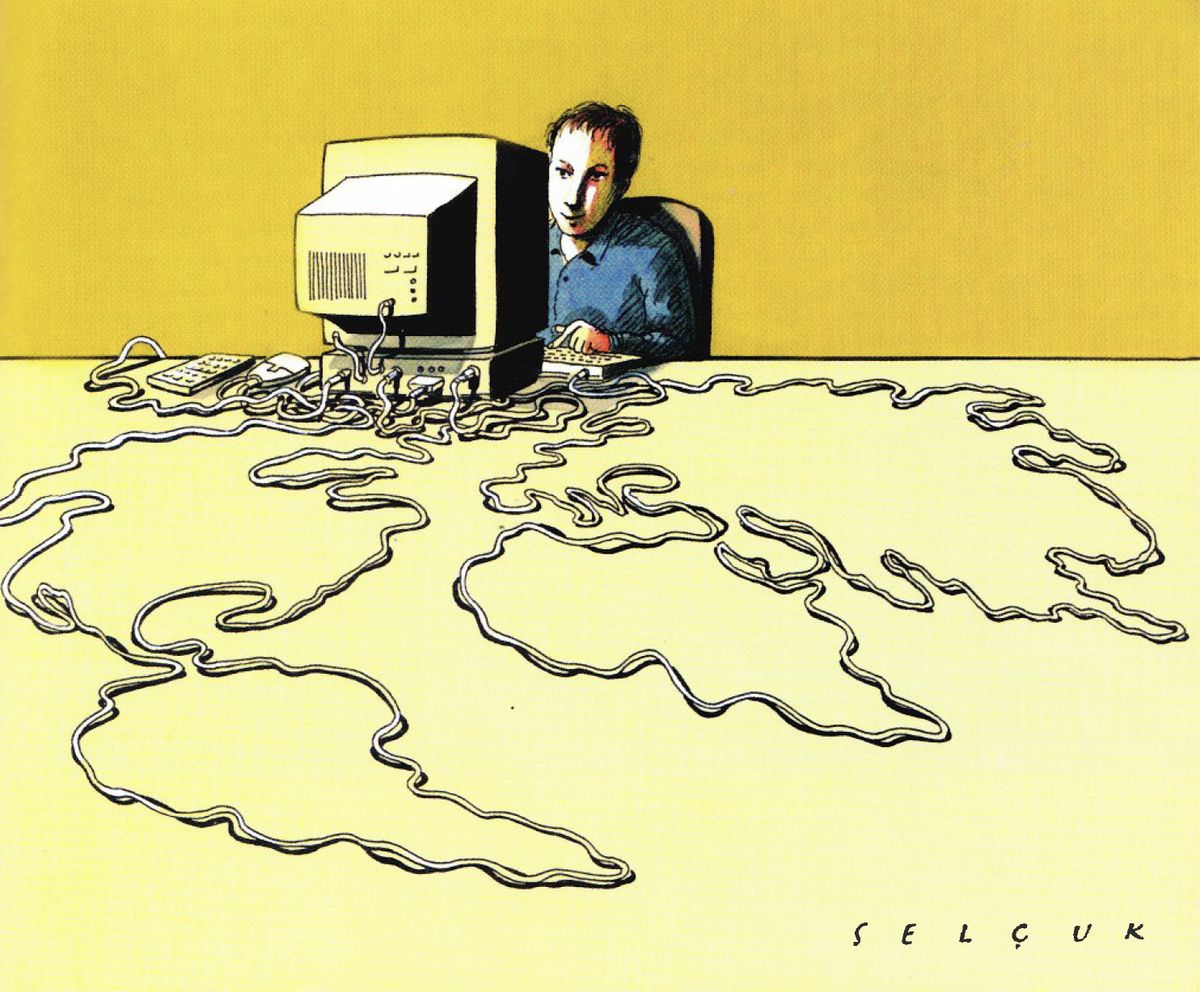
The best way to understand the implications of this globalization system is to compare it to the Cold War system, which was characterized by one overarching feature: division. The world was a divided place where all threats and opportunities as a country or company tended to flow from who you were divided from, and it was symbolized by a single word, the Wall. Globalization is also characterized by one overarching feature: integration. In this new system, all threats and opportunities tend to flow from who you’re connected to, and it is symbolized by a single word, the Web. So over the past 15 years or so, we’ve gone from a world of division and walls to a world of integration and webs. In the Cold War, we reached for the hot line that connected the White House and the Kremlin — a symbol that we were all divided, but that, thank God, at least two people were in charge, the United States and the Soviet Union. In globalization, we reach for the Internet — a symbol that we’re all connected and nobody’s in charge.
If the Cold War had been a sport, it would undoubtedly have been sumo wrestling: two big fat guys in a ring with lots of ritual grunting and stomping around but not a lot of contact until the very end when one fat guy finally pushed the other fat guy out of the ring. If globalization were a sport, it would be the 100-meter dash over and over and over and over and over. If you lose by a tenth of a second, it’s like you lost by a week, and the only thing that winning ensures is that you get to race again the next morning. In the Cold War, the first question we asked was: How big is your missile? In globalization, the first question we ask is: How fast is your modem? In the Cold War, the second question we asked was: Who are you divided from? In globalization, the second question we ask is: Who are you connected to? So the internal logic of these systems is very different.
What truly distinguishes these two systems is how power is structured within them. The Cold War system was about states balancing states, confronting states and aligning with states. But globalization is built on three balances. The first is the balance of power between states and states. The next is the balance between states and the supermarkets, the 25 largest global stock, bond and currency markets in the world — from Tokyo to Shanghai to Frankfurt to Paris to London to Wall Street — that today have become increasingly autonomous geopolitical actors, in some ways the equal of, and in some cases superior to, states. The United States can destroy you by dropping bombs; the supermarkets can destroy you by downgrading your bonds. Take your choice.
Thirdly, and most unique in this globalization system, we now have super-empowered people. When you start to blow away the walls and wire the world into networks, we as individuals can increasingly act on the world stage directly, unmediated by a state. Jody Williams, who won the Nobel Peace Prize in 1997 for organizing a global ban on land mines, was asked how she did it. Her brief answer: e-mail. She was a super-empowered, nice lady.
On the flip side, there are super-empowered angry men and women. Osama bin Laden, the Saudi millionaire who blew up two American embassies in Africa two years ago, was a super-empowered, angry man. And he had his own network, too, a kind of jihad online, JOL, which he used to take on the United States of America. Do you know what the United States did to Osama bin Laden? It fired 77 cruise missiles at him one day four years ago — 77 cruise missiles at a million dollars each fired at a person. That was, I believe, the first recorded battle between a superpower and a super-empowered, angry man.
Ramzi Yousef was the Pakistani gentleman who wanted to blow up the World Trade Center. I always wondered, what did Ramzi Yousef want? Did he want a Palestinian state in Brooklyn? Did he want an Islamic republic in New Jersey? I reread the court case from a book, and what he wanted was to blow up the two tallest buildings in America. Period. Globalization as Americanization had gotten in his face and it had empowered him as an individual to do something about it. Like Osama bin Laden, Ramzi Yousef was a super-empowered, angry man.
What is scary about the system we’re living in today is not that Osama bin Laden or Ramzi Yousef can or ever will be superpowers; it is how many people today can be Ramzi Yousef or Osama bin Laden. And what makes this system so complex to understand and to manage today is the fact that we now have states and states, states and supermarkets and states and super-empowered people all wildly gyrating against one another every day on the front pages of our papers.
I have an intuition that we will look back on the Clinton years as a kind of fool’s paradise between the end of the Cold War system and before the globalization system, with all its complexities, reached full force. And you have to look at the Clinton years as a coincidence, from the American point of view, as a number of highly fortunate and stabilizing forces that came together. Those forces are called Boris Yeltsin, Helmut Kohl, Alan Greenspan and a lengthily expansive American economy, which was hugely important for stabilizing the global economy and the global system. Whether the next eight years will produce the same combination of wise, geopolitical actors and a stable American economy is, I believe, central to the success of the globalization system.
At the same time, if we don’t have that combination of forces but still get the speed of change that we seem to be heading for, there could be problems. I worry about the fact that when Bill Clinton was elected, there were 50 pages on the Web. Today there are 2 billion, 3 billion, nobody knows. When Bill Clinton was elected, few people had e-mail and most people thought the Internet was something used to catch fish on the Nile. In the eight years of Clinton’s administration, almost everyone has e-mail and people consider Internet access an entitlement. Now scale out that pace of change another eight years, and I think we’re heading for the most complex period in American history since 1776-1789.
The Internet will, over time, increasingly shape how we communicate, how we educate and how we do business. It won’t dominate, but it’s going to be a huge factor in all of those things. Unlike a newspaper or book publisher, it has no editor, no censor, no teacher, no guard, no supervisor. This means that the center of our lives will be a technology that we will increasingly interact with nakedly, and we will all meet one another so much more directly through it, both locally and globally.
And what that means to me is the paradox of globalization, the paradox of the Internet: the faster the modems become, the more the walls fall, the more we meet each other directly and the more things get speeded up, the more we need to stress fundamentals. Reading, writing, arithmetic. Church, synagogue, temple, mosque. Rule of law and good governance.
The secret of the sauce for success in globalization, whether it’s economic success as a company or building a successful and thriving country, is all about the fundamentals. It’s all about the stuff you cannot download. It’s all about the stuff you have to upload the old-fashioned way, under the olive tree.



