In case you were wondering, Nell Irvin Painter M.A. ’67 is funny in real life, too; she’s also one of the most important thinkers and artists working today. Her forms of study challenge not just hard-boiled preconceptions about American life and history, but teach us how we might still collectively move toward insight in the present.
Painter studied anthropology at UC Berkeley before in 1966 attending UCLA, then renowned for its African history program, which perhaps has guided her work away from more normalized forms of American exceptionalism. She led a full career as one of America’s most prominent historians before retiring from Princeton University as the Edwards Professor of American History. She then went back to school to study art, a journey detailed in her memoir Old in Art School: A Memoir of Starting Over, a finalist for the National Book Critics Circle Award in 2018. Her most recent book (one of eight) is I Just Keep Talking: A Life in Essays, which collects a host of Painter’s prints since she turned to drawing and painting, alongside her essays on history, autobiography, whiteness and visual art. It was longlisted for the PEN/Diamonstein-Spielvogel Award for the Art of the Essay.
I ask her about recognition — or, rather, when she feels the popular world started to see her. She laughs. “A few months ago,” she says, “when universities started wanting to profile me.”
Painter’s work is holistic, suffused with a historical attention to specificity and individuality and her own fair-minded gaze upon the detritus of the past and how it emerges in the present. It’s also hilarious. Reading Old in Art School as well as the essays collected in I just Keep Talking, there were moments when I just had to share passages with friends in a text, along with the cackling emoji and the question, “Did she really say that??” or “Did you know about this??”

Elias Rodriques, who has written about Painter’s work for The Nation, tells me he really did not know that Sojourner Truth never said the line most closely identified with her: “And ar’nt’ I a woman?” It’s one that “bears repeating on a regular basis, particularly as feminists seek to make their movement more broadly representative,” Painter writes. For her, it’s always worth distinguishing the figure from the person. During our time together, she reminds me, more than once, that “white people do not own individuality.”
Rodriques, for his part, is also astounded by events told in Painter’s oral autobiography of the Black radical activist Hosea Hudson. “Can you believe they just fought off the cops? And lived?” he says.
The answer to that is no, I couldn’t; it’s too easy to look at the present and underimagine the past. I’d forgotten the extent of the formerly possible. But Painter has a knack for reminding us that the peculiarities of what has been — of which there are many — cannot always be assumed from our vantage point in the present. “What do you mean ‘the archive’?” she volunteers ahead of any questions about recent turns in Black studies. “There are many archives.”
Deep Thinking — and Many Questions
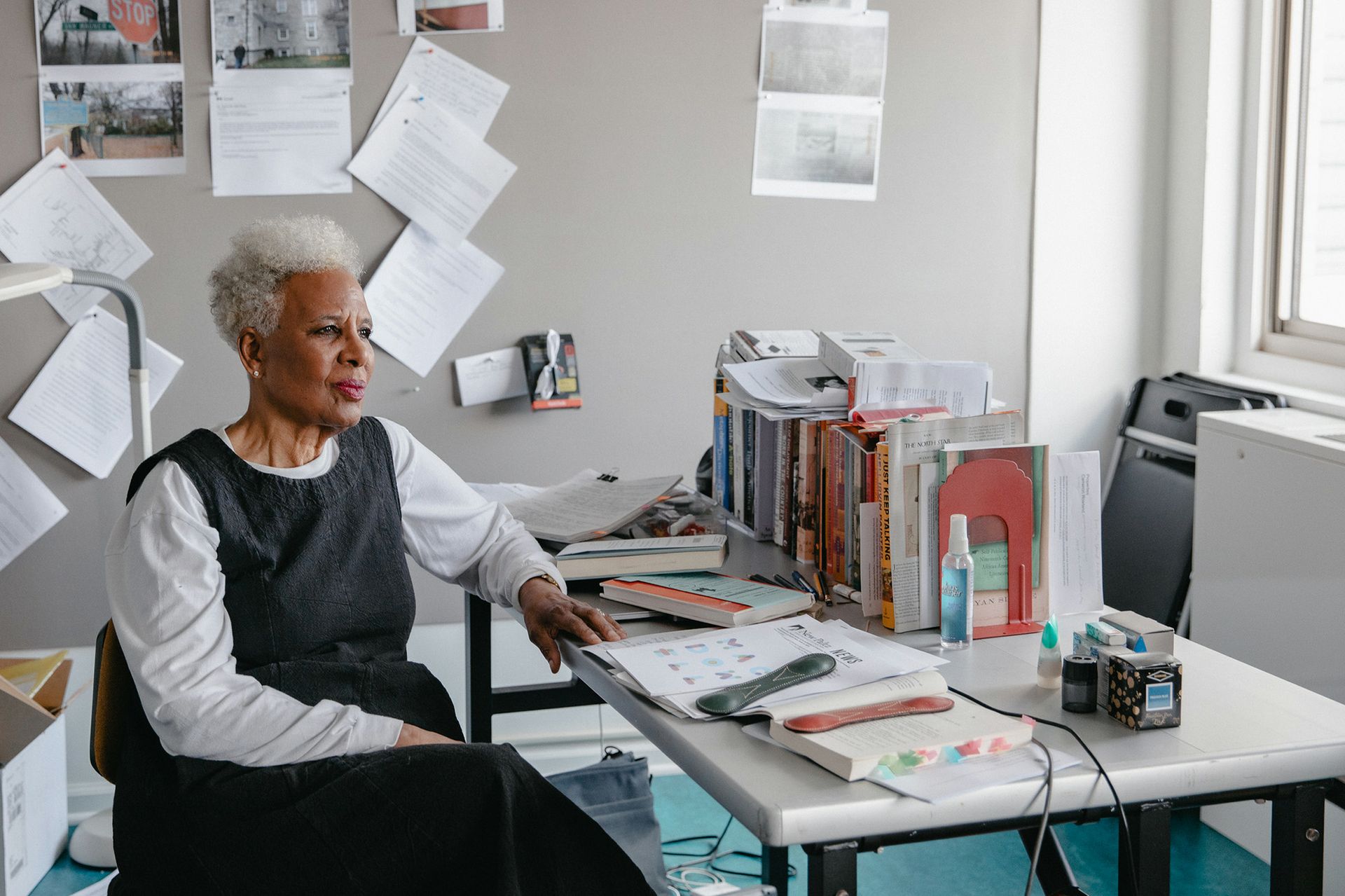
Painter’s studio is actually two condos rolled into one in East Orange, New Jersey, with her life and labors divided by a single door whose entry point states ever so plainly, on a paper note, “Nell Painter Studio.” In the back room, there is an open space and kitchen where her husband, Glenn, a mathematician, also works; between the two rooms, a door seals off Painter’s workspace. “He had siblings,” Painter says of her husband, closing the door. “But I can’t focus with so much distraction.”

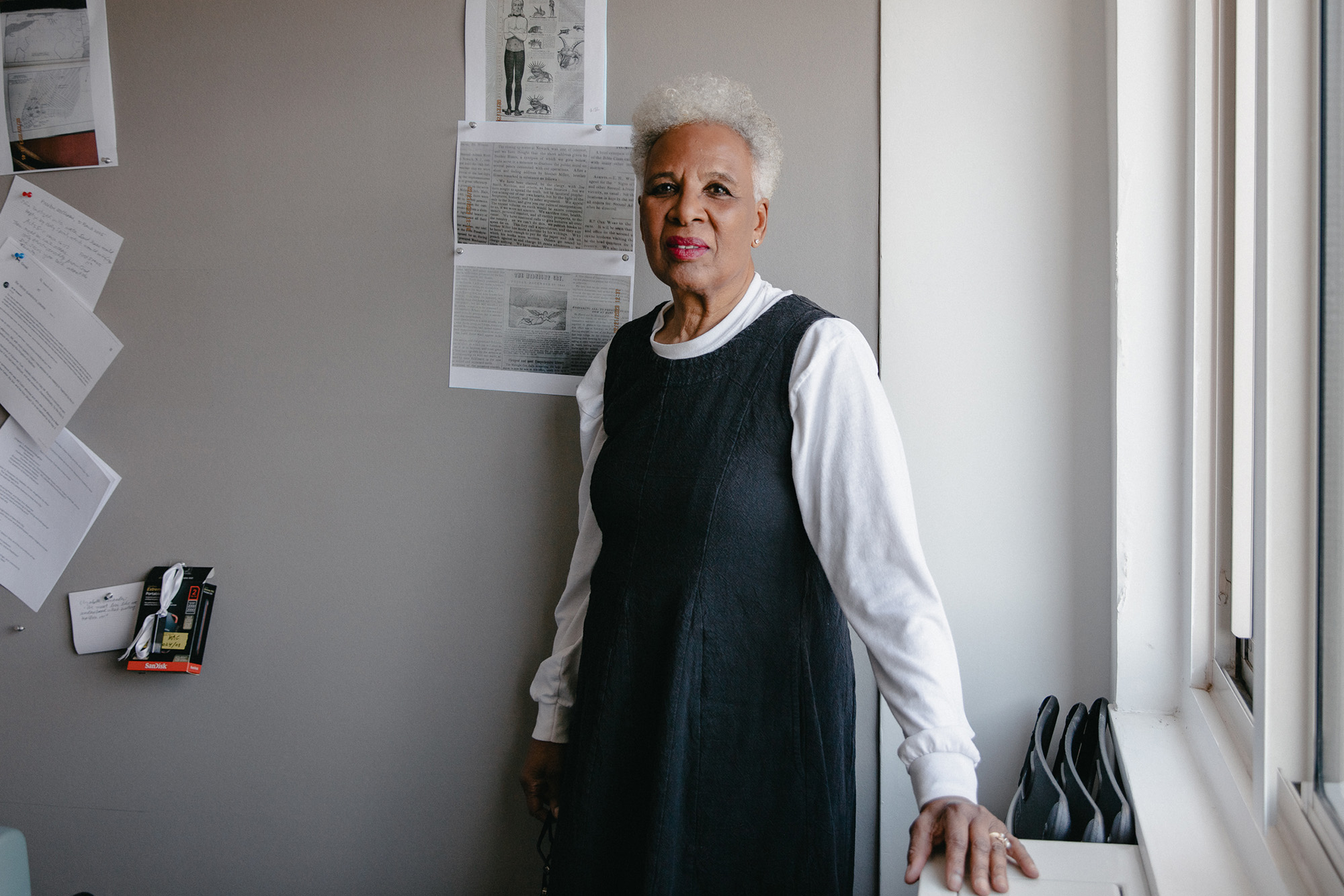
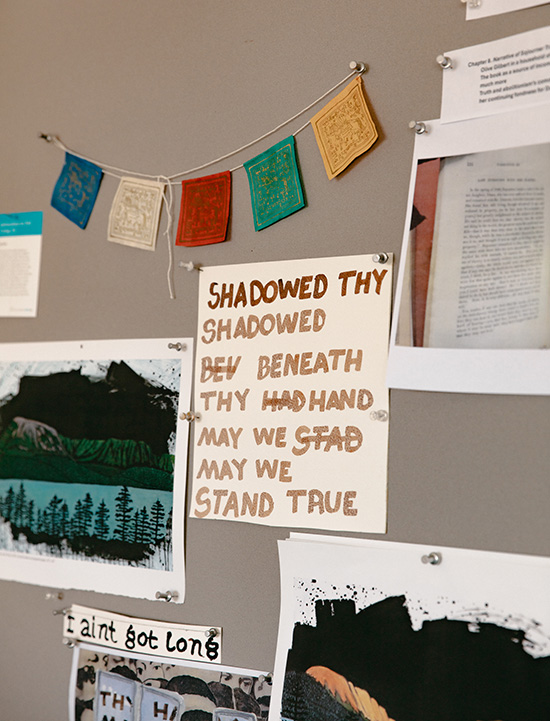
The space itself is that of a serious thinker whose patience and curiosity have not dwindled a bit with experience. There are two desks: one for the work Painter is doing on a new book about Sojourner Truth, and one at which she will soon be speaking to a book club via Zoom about Old in Art School. An array of her art prints, some of which are featured in I Just Keep Talking, are aligned in neat rows along white walls; among them are chapter outlines for her forthcoming book Sojourner Truth Was a New Yorker and She Didn’t Say That, which Painter is currently researching. There are maps, drawings and photos of the Hudson Valley territory, a chapter on the Sojourner Truth monument, a history of Truth’s mother and her teacher, a chapter on Truth’s early travels and learning, and another titled “Sojourner Truth, Knitter.” And, everywhere, questions.
“Did you know about the cult?” she says, most excited about the surprising and understudied “truth” in Truth’s life: that she was involved in a millenarian cult in the 1830s. It’s hard not to think here of another preeminent scholar, Sylvia Wynter, and the importance she placed on Christopher Columbus’ millenarianism.
Truth (both the quality and the person) may be worthy subjects for examination, but then again, so is Nell Painter. Her most popular book, 2010’s A History of White People, reviewed in The New York Times, was published more than 40 years after she first began writing. At around the same time, Painter decided to go back to art school at Rutgers’ Mason Gross School of the Arts in New Jersey. In Old in Art School, which chronicles that time, a friend jokes at a dinner party that her newfound popularity is because she’d finally started writing about the right people. It’s a clear indictment of what we all sort of know: that it’s difficult to make it as a writer or intellectual who cares about Black people’s lives and history without providing white people an easily digestible sense of their own importance. Sojourner Truth is interesting to Painter in part because there’s so much more to say about her besides the CliffsNotes attributed to her.
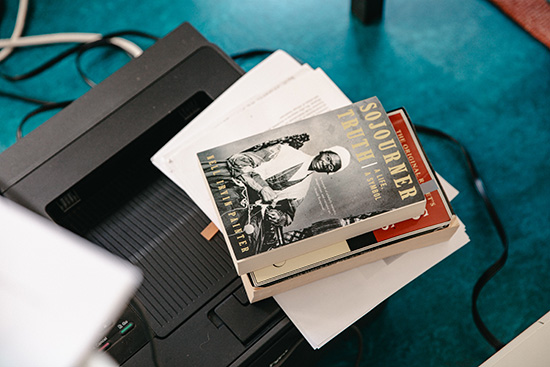
Painter’s first book on Truth, Sojourner Truth: A Life, A Symbol, was released in 1997, the same year as Saidiya Hartman’s Scenes of Subjection. Hartman’s book argued, among other things, for a critical turn in how we think about the history of slavery: from a series of violent spectacles, to a quotidian set of practices which are not so easy to discern, even in enjoyment. Painter’s first biographical essay in I Just Keep Talking, “Difference, Slavery, and Memory: Sojourner Truth in Feminist Abolitionism,” takes as its fulcrum the many forms in which Truth has been seen against the image of how we’ve wanted to see her, of the “discursive approaches that have preserved Truth’s place in cultural history.” Painter’s writing has an intensive clarity and levelheadedness, with little regard for sentiment or projected heroism. You can see this in her mind at work, playing out through those notes along her studio walls: “Was Sojourner Truth unique in 1851? What made her remarkable, and how intentionally created was her persona? Why was Truth remembered when other Black women reformers have mostly been forgotten?” And, “Could 19th-century Black women feminist abolitionists be ‘woman’?”
Painter has a gift for creating a seamless transition between the infinitesimally specific and the broad, sweeping questions of language and authenticity, between feminism in the 19th century and now, between the changing roles of Black people in public life and the questions of African influence. She guides me along the edges of her studio, between the archival images that situate Truth’s life and the photos Painter herself has taken during her travels. She’s excited in a way that makes you excited, too. You can feel her thinking. There’s something persuasive in the way she rekindles the dwindling art of serious consideration.
“This book is about who Sojourner Truth was,” she says, “as an individual.”
A “Somebody” Now
Against the light from large windows covering one wall, Painter’s short gray hair and brown skin glow the way you would imagine a portrait of her in a flattering documentary might. She wears a soft black-and-white sweater that matches her short socks. She’s comfortable not only in her own skin, but with necessary silence when trying to think or remember.
This is all less an observation and more a question about clothing and comportment, both of which Painter devotes a great deal of time and attention to in her work and life. The difference in comportment and dress between Sojourner Truth and other women of her era, after all — that “she was using bourgeois self-fashioning, but also leaning toward Quakers and women who stood up and talked in public” (not to mention her contrast with men like Frederick Douglass, still the most photographed person of the time), would come to matter a great deal in how Truth was read, Painter says.
Likewise, Painter writes in a comically serious manner about the changes in her own dress and comportment that have accompanied her shift from the world of history to the world of art. For anyone who knows, self-fashioning has been such a prominent and unavoidable fact of Black social life, especially for women, that nary a second passes without at least a fleeting consideration. There’s even an odd — I’m being polite — review of Painter’s memoir in The Nation that calls her style “overly colloquial.” This is all another way of saying that I wanted to ask her about clothes, and in another sense, the kinds of scripts — those positions we have to conform to in order to speak or be heard — available to Black people both then and now.
“People have started dealing with me as somebody now, but for the longest time I was nobody.”
We laugh about what it means to dress like, or unlike, an artist or professional, and the potential punishments that follow. I dressed better coming to speak to her than I would have any other day, imagining (correctly, it turns out) that Painter agrees more with my own mother and Kiese’s on this point than, say, even the most tranquil pioneers of the hip-hop generation: We need not always be formal, but there is a not-so-subtle importance to the proper form of dress for any occasion.
We go on to talk about how much geography and class matter in such issues, too. Painter recalls a moment at the American Historical Association (AHA) with her friends of 50-odd years, but pauses before giving a full description. “Even old people are not as old as I am,” she says, laughing (and during the pause I think, And the young people don’t seem as healthy). At the AHA, Painter and friends had been talking about the Association of Black Women Historians, of which Painter is a lifelong member, having joined a year after its founding. Someone had commented— from the stage, no less — that they liked how Painter dressed: “Like someone who went out into the world.” She’d enjoyed the compliment then, even though now, having been retired from that world for 20 years, she says she has no idea what people do anymore with professional dress.
Painter has traversed many worlds and continues to do so. Only recently has she come to think of herself as a public figure. She had always done well in the academic world, getting promoted to associate professor in three years, then full professor, and publishing many books, but she felt as though these things didn’t matter in terms of public recognition. “People have started dealing with me as somebody now, but for the longest time I was nobody,” she says. This is due in some part to the fact that she was “a bright young person before you were allowed to be a bright young person who was Black and female and dark-skinned.”
Among my favorite essays in I Just Keep Talking is one titled “Hill, Thomas, and the Use of Racial Stereotype,” in which Painter reappraises Clarence Thomas’ practice of racial stereotyping against his sister, Emma Mae Martin, before the more well-known castigation of Anita Hill. Painter writes of how denigration of the former as a mammy, welfare cheat and oversexed Jezebel figure preorganized the senatorial inability to see race and gender outside those well-worn signifiers used to describe Black women, specifically. At best, Anita Hill was positioned as a traitor to the race. Painter reminds us of what Lisa Jones had to say about Emma Mae Martin in The Village Voice — that she was on government assistance “only temporarily” and was otherwise a mother of four who typically worked more than one job to support her family.
This brings to mind the more fundamental question I want to ask Painter, about the way Black redemption so often comes in the form of labor, a retort that says, essentially, twice as hard and twice as long, instead of say, querying the abolition of work or the family, and the ways in which the state both makes welfare a necessity, and denigrates those who require it. I confide in Painter that this is a big problem in my own work and, I think, one that looms large with much contemporary work by and about Black people: the rush to either ignore or venerate. “Is there any way,” I ask her, “that we might redeem — if that’s the right word — or that we might think about Emma Mae Martin as a person worth consideration, whether or not she works?” In other words, can she only be good or worth talking about if she works hard?
Painter doesn’t hesitate. “Well,” she says, “it’s only a problem in a right-wing frame.”
It is an impossible loss that most all American discourse takes place in a right-wing frame, no matter who the president is; but the amplification of right-wing extremism is getting harder to ignore even for those who want to. What Painter writes about Donald Trump against the shock and awe of his first election holds true. This is not a new America, but one recognizable with any serious attention to history, though now with an important difference: “This time, the white men in charge will not simply happen to be white; they will be governing as white, as taking America back, back before multiculturalism.” This claim seems to me even more true in Trump’s second term than in the first.
I kept thinking, too, of Painter’s conversation earlier this year at the Brooklyn Public Library with the historian Sarah Lewis on the latter’s 2024 book The Unseen Truth, about how images from the fight for independence in the Caucasus troubled the fictions of race after the Civil War. It was a kind of marvel to watch their longstanding collaboration unfold, the playfulness and rigor, the regard they have for each other. Toward the end, one of the audience members asked, “How does your book fit into current political issues such as the Israeli-Palestinian war?” Painter, as moderator, protected Lewis. She said that this was a great question, but one that she did not want Lewis to answer. It would cause a great deal of fighting, she said, but it was a great question nonetheless, so she wanted to read it. It was hard not to think of other near-contemporaries of Painter in this frame, of James Baldwin’s or June Jordan’s relationship to global political struggles.
A Place to Be “Just a Woman”
Like Maya Angelou and Julian Mayfield, Painter and her family lived in Ghana for a few years in the early 1960s, just before W.E.B. Du Bois died there in 1963. In a biographical essay titled “Hers: A Sense of Place,” Painter describes this part of her life as one of the best things that ever happened to her. This was a place where she could become “just a woman,” whereas in the United States, she was “always — outside a tight circle of family and close friends — a Black woman.” This was never the same as “just a woman, without a racial qualifier.” Painter sometimes felt more at home in Ghana than in Oakland, California, where she grew up after her parents moved from Houston. For Painter, Ghana is where the overwhelming qualifications of race opened more into the politics of class and economic development, a place where “those who profited and those who suffered were all equally Black” and Painter “couldn’t figure out the racial angle.” Painter, of course, recognized a unique privilege of being in Ghana but not associated with the U.S. Embassy, especially at that time, which was that people with suspicious views of the U.S. and its motives treated her as kindred rather than as another imperial scourge.
Painter speaks clearly and with great precision across historical junctures and geographic nuances in I Just Keep Talking, from essays on Harriet Jacobs to the concept of history or nation, on Freud and Linda Brent, Malcolm X and Martin R. Delany, on “Seeing Police Brutality Then and Now.” But the book is also suffused with her prints, and her work in the visual register is no less impressive. For anyone struggling to speak to or translate thought from the page into painting or drawing, I would recommend Painter’s Old in Art School. She struggles with the utility of her vast historical repertoire as it comes to making art evacuated from history or representation, the way her fellow students did, and in this sense, she could not be an artist’s artist. Eventually, she settles into her own unique blend of history, language and visuality. She thinks carefully about self-representation and the representation of language in art. I ask her whether she is now more plagued with these questions on the page or on the canvas.
“My first thought,” she says, “is that it’s easier to deal with in words than image, because you have so many more words, and you get to situate those words in the context of other words.” She thinks for a second before continuing. “And because we have this discussion in words rather than images, I think words are how you get to the nuances.”
There is an insistence on how rare and difficult honest self-portraits are, especially with regard to the racism, sexism and colorism both within and outside of the art world. I Just Keep Talking opens, in fact, with the print of an abstract painting from 2011 called Self-Portrait Normal. A brown face is contrasted with overlapping layers of blues, greens and yellows, flowers emerging from the would-be breast pocket of a blouse. The eyes are greyed out and lack irises; the figure is hairless, but for the fine blue print marked sideways across the front of the skull. You have to squint to see it, and even then, it’s not entirely legible. This painting is part of a series, Self-Portrait Triptych, in which Painter responds to a question she got from Stephen Colbert on The Colbert Report in 2010. (Someone had asked if she was white, because she’d written The History of White People.) The other paintings in the triptych are the same image transposed in contrasting black or white. Together, they almost recall the title of the 2003 landmark text Black, White, and in Color from one of Painter’s greatest contemporaries, the scholar Hortense Spillers.
Painter is someone who is difficult not to consider as “a specific individual embedded in a specific context,” which are among her first words of excitement when I ask her about her next book on Sojourner Truth. As she begins the Zoom call with the book club, she’s all laughs, introducing me and describing the situation — that she’s being profiled for her alma mater.
“Guess,” she asks the Zoom room, “when I graduated from there.”
No one gets it right, and Painter uses the opportunity to get to know some of the participants. She asks first about their lives and the book club’s history, the people who both make and inhabit the space she’s entering. Before long, the normally fear-stricken or reverential way that authors are regarded in such spaces gives way to a candor that feels refreshing, even though the participants are miles apart.
Thadious Davis, who has written the most important book on another of Painter’s contemporaries, 2021’s Understanding Alice Walker, recalls fondly the time when she and Painter were colleagues at the University of North Carolina at Chapel Hill in the ’80s. Davis was working on a book about Nella Larsen, and Painter was writing her first on Sojourner Truth.
“She was always the more optimistic one,” Davis tells me.
In this, too, you can feel in Painter’s presence, an ambition sharpened rather than dulled by the America that popular culture claimed not to recognize in 2016, one that Painter knew all too well from the study of history. There’s an ink-and-graphite drawing that Painter made in 2020 while working at an artist’s residency, the Bogliasco Foundation in Liguria, Italy, titled American Whiteness Since Trump. It conveys an immediate comfort in combining text with image: Across the top of the drawing, a series of six huge question marks hover over “Nov 2016,” with the less legible “12” over a “9” sequestered to the left corner. The words “What Whiteness Means in the Trump Era” sits atop a portrait of Painter, the word “Trump” resting on her head; the portrait is accompanied by “NB. authentic personal hair in Newark.” And to the right, more text is pulled from Painter’s writing on the problem more directly; the positioning of these prints in I Just Keep Talking alongside Painter’s essays helps reinforce the otherwise diffracted patterns of thinking and remembering.
Speaking to Painter, and engaging with her work, brings to mind the sweeping losses of bell hooks, Greg Tate, Nikki Giovanni and so many other groundbreaking Black thinkers over the last few years. Painter attributes a great deal of her ability to reinvent herself later in life to her mother, a staggering genius whom she also saw become more herself late in life; she opens Old in Art School thankful that she herself did not die young, a fact for which we might all give a little praise.
Archives are great, but it’s another kind of transcendence to take our best scholars and artists seriously while they live and breathe. And there seems to be no end in sight for Nell Painter, who has already outlived so many, so long as we leave her to it.
Read more from UCLA Magazine’s Fall 2025 issue.