Eleven years ago, Margarita Aguilar arrived in Southern California with a 5-year-old in tow, no money, no contacts and no place to live. She found a job as a cleaning woman, working Monday through Saturday, some days starting at 2 a.m. and continuing until after 5 in the evening. She was paid $80 a week, and her bosses often threatened to fire her if she didn’t also work Sundays. While she worked, Aguilar had to pay someone to care for her daughter, Maritza. But sometimes no one came to pick up the child from school, and Aguilar would get a chilling telephone call warning that the police would be notified if her daughter was left again.
After several months, Aguilar took a job sewing clothing in the garment district, where she met her husband. Things have improved some; now she is able to stay home to care for their children while he works. The family of six lives in a one-room apartment on the second floor of a small building next to the Harbor Freeway.
Margarita Aguilar’s story is not unusual in Los Angeles. But for many families like hers struggling to make it in the inner city, there is at least one place where they and their children can turn for help: Hope Street Family Center.
Established in 1992 as a pilot program funded by a grant from the federal Administration for Children and Families to UCLA and California Hospital Medical Center, Hope Street is a comprehensive resource center serving the downtown Los Angeles area. More than 70 percent of this community is Latino; many are recent immigrants; most work in the garment, manufacturing and service industries; and Spanish is the dominant language. The area has the lowest literacy level in the city; just 23 percent of the population has a high school diploma, and more than half have little more than a rudimentary education. Forty-two percent of households in the area make less than $15,000 a year, and to meet Hope Street eligibility, a family of three will earn below the federal poverty level of $14,150.
The hurdles faced by the working poor go beyond the economic: Poverty also impacts children’s health, early development and later school readiness, thwarting the most basic desires of parents to attain a better education for their sons and daughters.
Enter Hope Street. Dealing with early-childhood education issues is one of the center’s primary charges, explains Vickie Kropenske, Hope Street’s director. Housed on the grounds of California Hospital Medical Center — a community hospital operated by Catholic Healthcare West Southern California — Hope Street falls under the umbrella of UCLA’s interdisciplinary Center for Healthier Children, Families and Communities.
Early intervention — the earlier, the better — is key, says Neal Halfon, professor of pediatrics and public health and director of the Center for Healthier Children, Families and Communities. Research on early brain development shows that infancy and the early-childhood years are critical to a child’s development.
“The explosion in brain-development research is really highlighting what’s at stake early in a child’s life,” says Halfon. “No more than 1 to 2 percent of kids are actually born with some kind of neurologically based developmental problem, but by second or third grade, we have between 12 and 18 percent of children going into special education. So something is happening between birth and when they start school during which kids are falling off the map.” If problems are identified earlier as they first begin to manifest, he says, they can be addressed more effectively “because the brain is more plastic when the child is younger.”
At Hope Street, the foundation of this approach is Early Head Start, a program for children from birth to age 3 that focuses on development and early intervention to catch and prevent problems that could adversely affect a child later in life. Early Head Start targets families primarily through a family-services coordinator, or “home visitor,” who goes to the home for 90 minutes each week to monitor the child’s development, encourage interaction between the parents and children and help families address broader issues that affect children’s health. The home visits are structured around a specific lesson plan, developed by the home visitor and parents with support from the center’s multidisciplinary, clinical staff, and tailored to each family’s individualized needs.
“You become almost a family member,” says Araceli Campos, who has been going to Aguilar’s home for almost a year, since Aguilar’s youngest, Jessica, 2, was enrolled. “I come often enough to keep the momentum up, to support the family, to help them become more self-sufficient. And I learn from them, too.”
Aguilar has noticed the difference. “Jessica’s more aware and open,” she says. “She understands things better. I’m very grateful to see my daughter develop better from the program. I also learned to help my children in their education, how to help them progress, how to be a better parent.”
For Maria Olea, a woman with three children and a shy smile, the program has been amazing, especially for her 3-year-old, Ana. When Ana started Early Head Start last November, she would hardly speak. “We were concerned she might have a hearing problem, because she wasn’t speaking,” says Luz Cubias, the Olea family’s home visitor. “We brought her books, we’d talk to her a lot, read to her, try to do activities that would emphasize language. Now she pretty much names everything and is using more two- or three-word phrases.”
“A lot of the language needs of our children can be environmentally remedied. Many of our parents believe that once their children get to school age, that’s where the real education starts,” explains social-services coordinator Sherrie Segovia ’77, who supervises the home visitors. “But drawing on the brain research that’s come out, we teach parents that their kids come with the opportunity to learn from the beginning, and it’s a matter of stimulating them from day one.”
That has made all the difference for Olea. “I read to them, I talk to my children now,” she says with pride. “I’m doing activities. I am more involved. My husband and I play with the children, and he speaks with Ana and talks with her about what she did that day in class.”
To supplement the home visits, families come to the Hope Street facility, which occupies the bottom two floors of a building adjacent to the hospital. Monthly parent meetings take place in this spacious, clean and inviting center. There also is time for parents and children to play in the classrooms, which are also the setting for Even Start, a family-literacy project funded by the California Department of Education.
The language-enriched focus of Even Start — structured around a “creative curriculum” in which children learn while they play — complements Early Head Start’s goals and continues to stimulate and develop those who have graduated from the program.
Language development, though a primary concern, is not the only need of these children. “A lot of the families are in very cramped quarters, so many of the kids are lagging in their gross-motor skills,” says outreach coordinator Annabel Sherk, who has been with Hope Street since its inception. “For cognition development, often our children can benefit from a more enriching environment than is available in their homes.”
Coming to the colorful, bright, roomy classrooms boasting smiley yellow suns painted on the walls, pint-sized furniture, playhouses and shelves brimming with books and toys, the children get the right stimulation to jump-start their developing minds and bodies. Says Martha Sapien, a mother of four: “Edgar, at 4, knows his ABCs and how to count. Eileen, who’s 9 months, learned to crawl here. She enjoys being with the books and knows how to turn pages. She babbles when she sees the pictures. My children are all happy to be here.”
Parents, too, are joyous at the improvements they see in their children. For some, it is a 180-degree turn from their initial perceptions of the program. “In the beginning, some parents were wary of us,” says Lillian Ulloa, an infant-development teacher. “But now, parents see results. They know we’re here to benefit them.”
In a sense, Hope Street is as much a learning experience for the parents as for the children. Says Alma Clara, the mother of an 11-month-old: “We are learning different ways to raise the children, the process of their development and the reasons for doing certain things with them.”
And while the children are learning in Even Start, the parents are themselves learning English phrases, grammar and sentence construction in an on-site class, as well as parenting and computer skills.
For many of the mothers, previously isolated at home taking care of their children, this is something of a dream come true that has provided them with a sense of empowerment and friendship.
“Before, we were more shy,” says Clara. “Now we’re more open. We share. We communicate more. We talk about and compare our children, but not in a competitive way. Before, I was just at home, not involved in anything. Now I don’t feel so lonely.”
Says M. Lynn Yonekura, director of perinatal services and executive director of family-support services at California Hospital: “Helping children develop means that we also have to help the families develop — to help the parents achieve everything they want to achieve for themselves so they can transmit that to their children.”
For those families in which both parents work full time, Hope Street offers subsidized child care through its Child Development Center, located two blocks away. The center is also structured around the creative curriculum, so development is constantly stimulated.
There also are enrichment programs for older, school-age siblings through the Hope Street Youth Center, which offers after-school academic and recreational programs. In a community where 89 percent of students read below grade level, and the average student is more than three years behind, a mentoring program called HOSTS — staffed by volunteers from downtown offices, the hospital and, this fall, UCLA — has been able to increase reading levels by an average of one grade for each six months of involvement in the program. A Los Angeles Unified School District continuation, or alternative, high school rounds out the programs offered on-site by Hope Street.
“Really, the kids see this place as their hangout,” acknowledges Segovia, the social-services coordinator. “They play and converse and interact in a way that’s constructive and positive. The youth center offers a safe haven for young children and serves as an alternative to the streets.”
Hope Street is one of five community centers in low-income areas partnered with UCLA under a new initiative called CERC (Community Education Resource Center), which is part of Chancellor Albert Carnesale’s effort to renew, redefine and reinvigorate the university’s public-service mission and outreach to the community. (The other CERC sites are The 100 Black Men organization in Inglewood; Projecto Pastoral at Dolores Mission in East Los Angeles; the Elizabeth Learning Center in Cudahy; and the Watts Labor Community Action Committee.) At Hope Street, UCLA has identified pilot activities that include increasing and varying after-school activities, enhancing tutoring and literacy programs and designing a comprehensive arts and culture program.
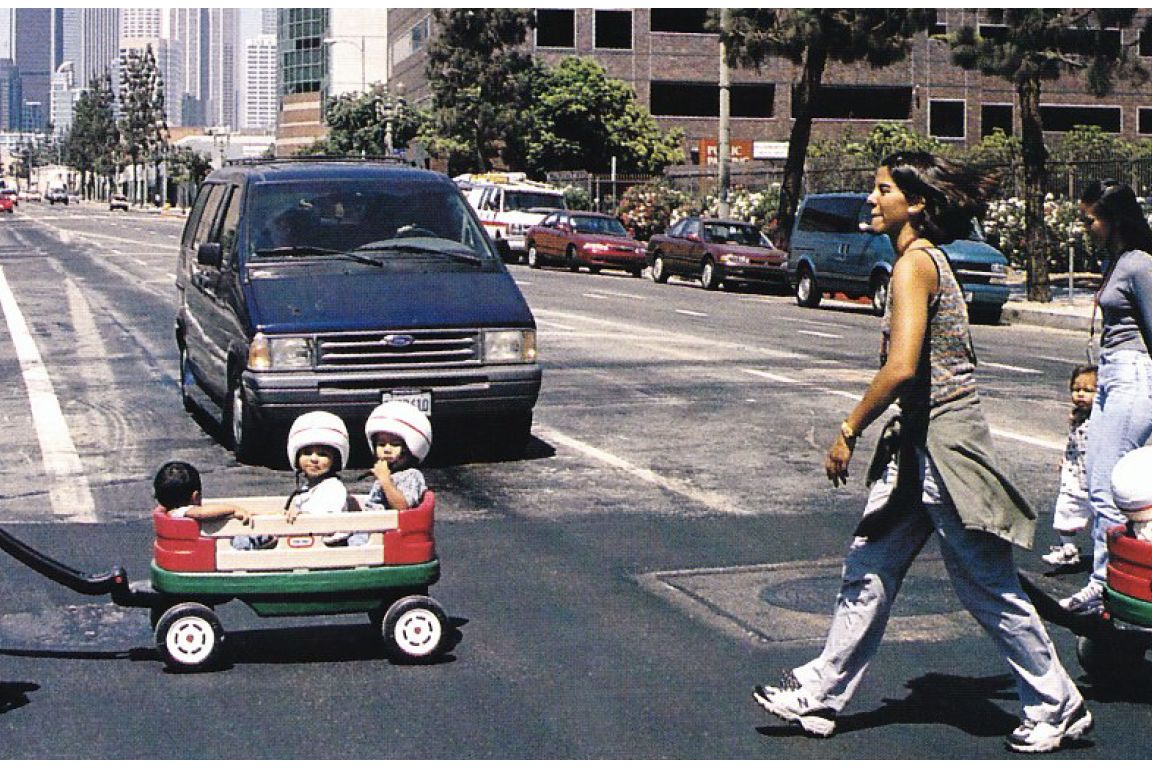
It is a warm, late-July afternoon and 12 mothers, more than 25 children and several Hope Street staffers are waiting patiently on Figueroa Street for the DASH Downtown shuttle to take them to the California Science Center at Exposition Park. It’s field-trip day at Hope Street, a monthly outing for those in Even Start, and after the museum the group will be off to a local public library.
“Typically our field trips involve free events and using public transportation,” explains Segovia. “The idea, then, is that this is something families can do independently of the program.”
Clearly self-sufficiency is one of the primary goals of Hope Street. From the moment families are accepted to the center, they make clear-cut goals to work toward that are identified in a family-partnership agreement, a contract of sorts, with the home visitor.
“It is like that old saying about teaching a man to fish and you feed him for a lifetime,” says Segovia. “We’re always teaching people how to fish. We want families to be able to find their own ways of developing and strengthening themselves.”
In fact, self-sufficiency is exactly what Hope Street has attained. Originally, UCLA wrote the grants funding Hope Street and subcontracted California Hospital staff to implement the program; that shifted in 1998, and the hospital now writes the grants and subcontracts for UCLA staff, including Halfon, who is faculty adviser to Hope Street, and Kropenske.
“Philosophically, it’s fitting that the university helps to obtain resources for the community and then, once those have been established, comes back and continues to assist in an evaluative, development role while allowing the program to take root and develop in the community with community leadership and community direction,” says Kropenske.
Community building — another of Hope Street’s missions — then becomes possible once families become self-sufficient and, thus, able to get involved in, contribute to and help shape their communities.
One way is through a policy council comprised of elected parent and community representatives that helps to make decisions, approve budgets and policies, hire staff and plan programs. The Hope Street Youth Center, for example, came about because the council noted a need for more services for school-age kids. “So that’s really how our youth center was developed, because parents really asked for that as a service,” explains Kropenske, a public-health nurse who, in her 17 years at UCLA, has developed several innovative service programs that include the Neonatal Intensive Care Unit follow-up clinic at UCLA and Olive View hospitals and the Suspected Child Abuse and Neglect home-visitation program. “The ownership of this project really belongs to the community.”
(Of Kropenske, Halfon says, “She is a modern-day Jane Addams and Hope Street is the Hull House for the 21st century.”) “Parents have gotten involved. They’ve set goals together. They’ve envisioned the difference that can happen in this community,” says Cecilia Samartin ’83, mental-health coordinator at Hope Street. “Once they began investing themselves in this way, in this center, that began to expand their community involvement. Parents have been involved in community gardens and clean-up efforts throughout the community, and housing efforts and crime-prevention efforts.”
Another way Hope Street fosters community building is through a state-funded child-care network, which provides assistance to community members interested in running day-care centers from their homes. By providing support, training, workshops, toys, books and other materials, Hope Street helps entrepreneurial-minded community members start their own businesses, while also giving Hope Street working parents an alternative source of subsidized day care to the Child Development Center, which has a wait list of up to a year.
“We’re affording these women the ability to stay in the community, to build businesses, to develop professionally and really to take a leadership role,” says Sherk, who coordinates the service.
The success of the Hope Street Center is borne out by some hard statistics. For example, the rate of employment among participating families has leaped from 45 percent to more than 90 percent, says Melinda Beswick, president of California Hospital Medical Center.
“Hope Street,” she says, “is the lynchpin of many of the community-benefit programs that we host at this hospital. Access to services, be it early-childhood education, housing or job training, is fragmented and difficult to negotiate for any family, but Hope Street provides a focal point that enables people to take advantage of what’s available and get ahead.”
A week before the start of the Democratic National Convention, Kropenske is slightly frazzled after another hectic day dealing with the logistics of holding a convention-related event at Hope Street.
What started out as a small reception for convention delegates hosted by Sallie Mae, the federal educational loan provider, to highlight literacy, has escalated into an all-day affair beginning with a press conference featuring Sen. Ted Kennedy (D-Mass.) and actor/director Rob Reiner, two of Hope Street’s biggest supporters, and celebrities reading books to the children.
“We try to serve as a model, so we have a lot of visitors from other parts of the city, state and nation who may be interested in replicating this program,” explains Kropenske. She is used to people observing Hope Street, which has caught the eye of many key policy-makers. “I see us expanding in terms of providing technical assistance, including staff development, to other communities and agencies that would like to start a center like Hope Street.”
With the passage in 1998 of Proposition 10, the California state measure that levies a 50-cent-per-pack tax on cigarettes to provide funding for health, education and support services for preschool children, many counties are looking to the Hope Street Family Center as an important model for delivering these early-childhood services.
The notion, too, of home visiting for children, is gaining currency, says Halfon, and Hope Street provides two successful models: Early Head Start and a nurse visitation program for first-time pregnant teens.
“UCLA and many universities around the country have invested enormous resources in creating innovative model programs to better provide health and human services,” says Halfon, who has been asked by the Proposition 10 commission, headed up by Rob Reiner, for ideas on how to “franchise” Hope Street, and by the federal government to develop a series of reports on this notion of platforms for early-childhood services.
However, he says, translating a pilot program to policy has been enormously difficult. That crucial issue is something that Halfon and a new campuswide Institute for Children, Families and Communities will be working to resolve.
Not only does Hope Street serve as a model for other communities, it also benefits UCLA faculty and students as a place to engage in research, service learning and fieldwork, another way the CERC initiative is eager to connect UCLA with the center.
Both Kropenske and Halfon envision the partnership as a way for the university and the center to learn from one another. “We could be developed as a field-placement site for a variety of departments. This center is a good setting for helping students see the connection between the academic and the practical application of what occurs within a natural setting,” observes Kropenske.
“We teach classes here. I have my public-health students go and do a couple of sessions at Hope Street, and they want to go back and do internships,” says Halfon. “It piques their imagination about what’s possible.” This, then, recapitulates the university’s missions in a new light, one in which research, teaching and service are replaced by knowledge production, knowledge transmission and knowledge application, the same ideas driving the Institute for Children, Families and Communities.
“This is allowing us to be out on the street where things are happening, rather than working only in a laboratory setting,” explains Halfon. “It also allows us to develop collaborative learning experiences with our community partners.” The lessons learned through such programs as Hope Street, he continues, are transmitted to public-policy makers and to the public at large, greatly broadening the scope of societal benefits.
“For a university to remain vital, it has to be innovative. It will die on the vine if it keeps on doing the same old thing. Even great ideas can get stale if not acted upon,” suggests Halfon.
Getting stale is certainly not part of Halfon’s vision for the future.
“If you look around the country,” he says, “there’s probably nothing in this arena as innovative as the Hope Street Center.”



