The hallway outside of the Little Theater is buzzing with pent-up anxiety. Perry Daniel rubs the newly shorn head of Matt Benton for luck. Others bite their nails and shift from foot to foot. These are students from the Master of Fine Arts (M.F.A.) in Acting at the UCLA School of Theater, Film and Television. The clock is ticking before their auditions for the university’s upcoming production of Goldoni’s The Housekeeper.
As the door to the theater is flung open, questioning looks are given to the first-year M.F.A. students who’ve just completed their auditions before the play’s director, Professor Michael Hackett, chairman of the UCLA Department of Theater. “Break a leg,” a grinning first-year student offers. For the third-year M.F.A. students in the hallway, their turn has come. Nine third-year M.F.A. students are set to audition. Lucky for them, there are nine roles to be filled. All the nerves that were present in the hallway seem to fade away as the actors take the stage. The only question that remains: Who will be cast in which role?
When assessing the production slate for 2010, the plays selected by the theater department were chosen carefully. “We try to do material that audiences won’t get to see most places and that has a diversity of repertoire,” says Mel Shapiro, head of UCLA’s M.F.A. Acting Program. “It also has to challenge our students in terms of their growth and development, while sharpening their skills and techniques.”
Set in the 18th century, Goldoni’s play fits the bill with its blend of romantic triangles, mischief and crafty female wiles that make Desperate Housewives look tame. “Great playwrights are both completely of their age and transcend their age,” says Hackett of the play’s 21st-century relevance. “That’s true with Goldoni.”
A theme running throughout the play is that of power, and power plays aplenty will do battle onstage when the production opens. Says Hackett, “There are issues related to power and control between parents and children, masters and servants, men and women.”
In The Housekeeper, women definitely don’t take a backseat to men in the power arena. Indeed, the play’s main character, a housekeeper named Valentina, wields mighty power despite her seemingly menial household position. It’s no surprise that Daniel, who introduces herself as “the difficult one,” is cast in the role.
Despite Valentina’s conniving, the audience will find themselves pulling for her. “You like almost every main character,” says Hackett of The Housekeeper. “At the same time, you’re aware of their weaknesses.”
Before the curtain rises and Valentina’s predicament can unfold, however, there’s much to be done to bring Goldoni’s vision, and that of the director, players and production staff, to life. And the people in charge of bringing all the pieces of the puzzle together?
They can be found backstage.
Setting the Stage
When a visitor sits in the Little Theater during auditions, the thing that springs out about the space is that it’s entirely black, save for a small platform stage that can be moved into different configurations. Additionally, risers have taken the place of traditional seating, bringing the audience closer to the stage.
“Due to the economy, the space was scrutinized and then transformed into a repertory set for multiple productions,” says scenic designer Alexandra Dunn, a third-year M.F.A. student. The challenge it presents for scenic design, she explains, is that “the space is dictated.”
For The Housekeeper, the goal was to have a simple set with a claustrophobic feeling that works with space-eating period costumes. Another place where the costumes had to be taken into consideration was a hutch that’s integral to the plot. “Three people have to fit in it,” says Dunn. “This required taking the back off and building a platform for the actors to stand on so their period costumes wouldn’t be squished.”
Beyond the hutch, there’s minimal furniture on the set — a couple of chairs and a small writing table. Once Dunn learns the direction of the show’s lighting, the furniture will be refinished and reupholstered. For now, Hackett can be heard reminding the actors, “Let’s not hurt the table,” as they get into character and bang a wobbling piece that has yet to make its debut.
Let There Be Light
With a completely black set, one would think Donny Jackson, lighting designer for The Housekeeper and a first-year M.F.A. student, would see only obstacles before him — but he doesn’t. “The space is the jumping-off point,” he concedes. “But there’s a statement that has to be made in the play through symbols that keeps me interested as a designer.”
The simplicity of the set makes the lighting for The Housekeeper extremely important because “the lighting represents the emotion of a scene,” says Jackson. When Jackson and Hackett discussed lighting design, they found themselves influenced by the works of Mark Rothko, an abstract artist who emerged during the 1940s. Rothko’s works had a concentration on color, shape, balance, depth, composition and scale.
Inspired by Rothko, Jackson has been honing ideas about what will work for the production. Light boxes with shapes? The need for a backdrop? Though the answers to these questions are still being weighed, Jackson is clear about one thing in particular when it comes to lighting. “It’s important not to upstage the actors,” says Jackson. “But even more important than making the actors look good is making the characters look good.”
Sounding Off
The repertory approach the theater department chose for 2010 had an impact of its own on Veronica “Roni” Lancaster, the sound designer for The Housekeeper and a second-year M.F.A. focusing on sound design. She’s also the sound designer for Fire Island, the play directly following The Housekeeper in the Little Theater. “I have to find a sound system that satisfies both shows,” she says. Hackett gave a directive that helped. “He wants the sound to be about what’s happening in these people’s minds, instead of in the space or location.”
When Lancaster began researching music for the play, she was clear on one point. “It’s not going to be 18th-century music. My research has been all over the place with a wide variety of genres and eras — music from the ’60s and ’70s, slower smooth jazz, higher up-tempo pieces.”
Despite all this research, taking in a night of rehearsals made her switch gears when it came to finding the sound of The Housekeeper. “I came into the play thinking I was going to be doing more ambiance and mood-setting, then realized — the actors don’t really need my help,” says Lancaster. “They’ve been working together for three years; they’re a well-oiled machine. I don’t want to hinder them or add anything unnecessary.”
How the sound design will come together with the other production elements won’t be set until the week of tech rehearsal, says Lancaster. For now, she sees a clear path in terms of sound. “It’s all about showcasing the actors and their performances and less about the spectacle of theater.”
All Dressed Up
“Corsets, petticoats, bum pads,” costume designer Michelle Neumann, a third-year M.F.A. student, lists the elements found in The Housekeeper’s costumes. “Wearing them changes the way you walk, hold yourself, sit and take up your space.” Thus the reason Hackett early on laid down an edict for cast members to wear period-specific garments to all rehearsals.
The period enhancements take viewers into the 18th-century world in which The Housekeeper is set. The audience will be thrown some curveballs, however, with modern-day elements that creep into the mix. Neumann and Hackett went over the concept for the wardrobe and decided to set it in the early 19th century versus the 18th century. “There’s a rock-star quality to the men’s costumes, which have a modern twist,” she says. “The women are more period, but with modern hairstyles, shoes and jewelry.”
She put their ideas on paper via drawings. Her next step, blind pulling from stock wardrobe. The Housekeeper’s male characters first came to life on dress forms with clothes Neumann had pulled for inspiration; the women’s costumes were inspired by historical fashions from the mid-19th century. “We were shooting for straight, simplistic and beautiful with very toned-down silhouettes,” Neumann says of the style they were aiming for versus the ruffles and frills normally seen in the period.
Pulling together the play’s wardrobe proved easier than Neumann expected. “I’ve been so fortunate in budget,” she says. Building the women’s intricate dresses are two staff members and two students. They’ve encountered hiccups along the way; for instance, making the women’s restrictive costumes work for pregnant cast member Abby Galstad, who plays Dorotea. “We want her to be as comfortable as possible, so we’re not corseting her,” says Neumann. “Instead, boning is being built into the dress, rather than on her.”
Hair proved to be another challenge. The aforementioned newly shorn Benton was cast in the role of Lothario Baldissera, a role requiring long, luxurious locks. The look for Valentina, played by Daniel, called for R&B singer Rihanna-inspired short hair. A debate began about whether Daniel should cut her hair. So that Daniel could keep her tresses and Benton could enhance upon his, professional wig stylist Michelle Blum was brought in for her expertise. “Right after the production, the actors go into showcase where they audition for talent agents,” says Neumann. “It’s important for them to look their best.”
Taking Cues
Though most of the students on The Housekeeper have previously worked together, Tim Jones, the production’s stage manager, is new to the mix. “It’s nice to jump right in,” says Jones, a transfer student and fourth-year theater undergrad focused on design and production.
Jump right in he did. The schedule for The Housekeeper has been fast-paced from the start. In November, the second- and third-year M.F.A. students came together for a workshop led by Teatr Zar, a Polish theater company known for fusing music, movement and imagery into their performances. Next up, actors read through the Scottish translation of Goldoni’s script for edits to make it more “speakable” and easier for American audiences to understand.
Auditions coincided with finals week of the last quarter of 2009. Rehearsals couldn’t officially begin until Jan. 4, giving the production five weeks to pull everything together. For Jones, who says, “I deal better in chaos,” the accelerated schedule suits him just fine. He’s since been joined by assistant stage manager Janet Leon. “Janet is on book in case actors call for a line or line notes need to be taken,” he says of what they’re currently working on. “I work with blocking lines and director’s notes.”
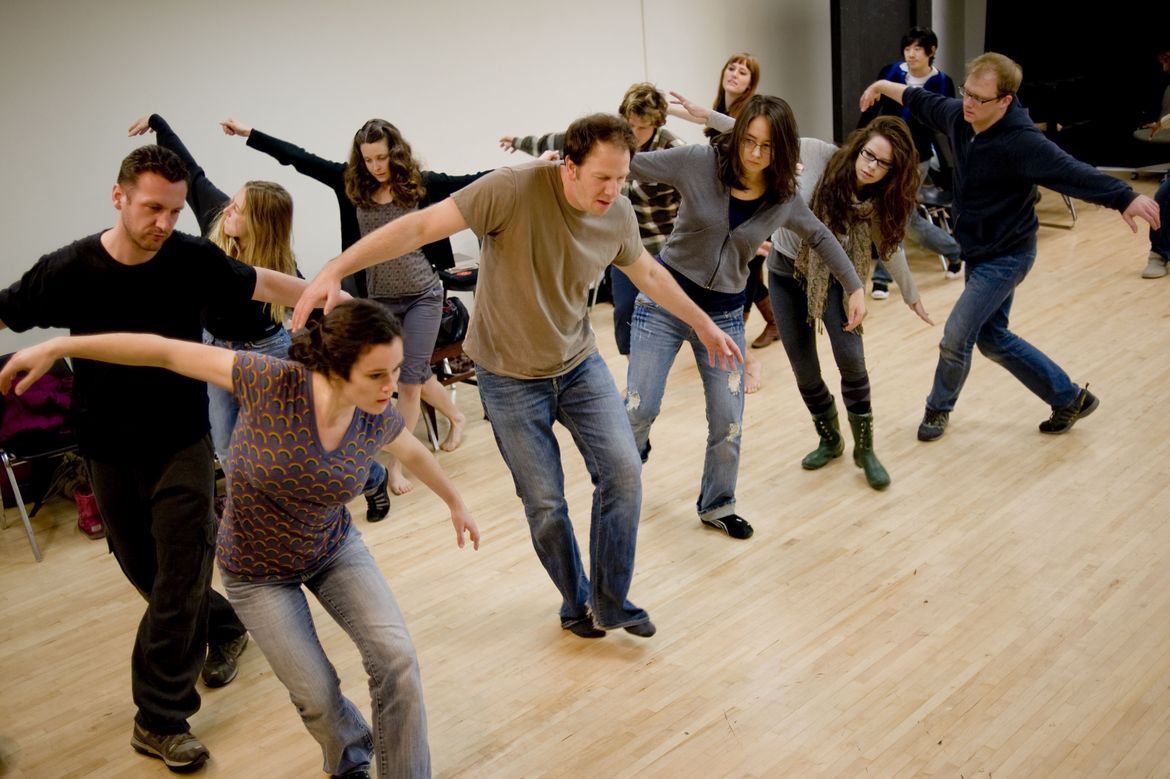
At the moment, Hackett is considering the flow of a particular scene. “Every step has to be considered,” he tells the actors. “Think about the use of space at the same time you’re thinking about inflection, reaction and eye contact.” In reworking the blocking, Hackett lines the actors up in what he refers to as a “Goldonian line.” “Before we get to tech week, we work out any kinks in blocking,” explains Jones. “It’s easier and clearer for everyone’s head if we’re all on the same page.”
During the five weeks of rehearsal, the cast is set to get through four or five pages of text and blocking within two days. From there, Jones will work with the various elements and go through cues. Says Jones of the pace, “I like it.”
The Curtain Rises and Falls
The conclusion of The Housekeeper is about both endings and beginnings. Valentina asks, “But between the theater and the home, there is a great gulf fixed. Our situations, dreamt up by our author and placed under the glare of lights, how could they bear any relation to any real persons or actual happenings?”
They’re Goldoni’s words, but our Bruin thespians’ reality. And especially poignant for the production staff and cast of The Housekeeper, because for many, this will be their final bow before bidding adieu to UCLA and heading out to take on the world.