Editor’s note: This is an article from the September 1997 issue of UCLA Magazine.
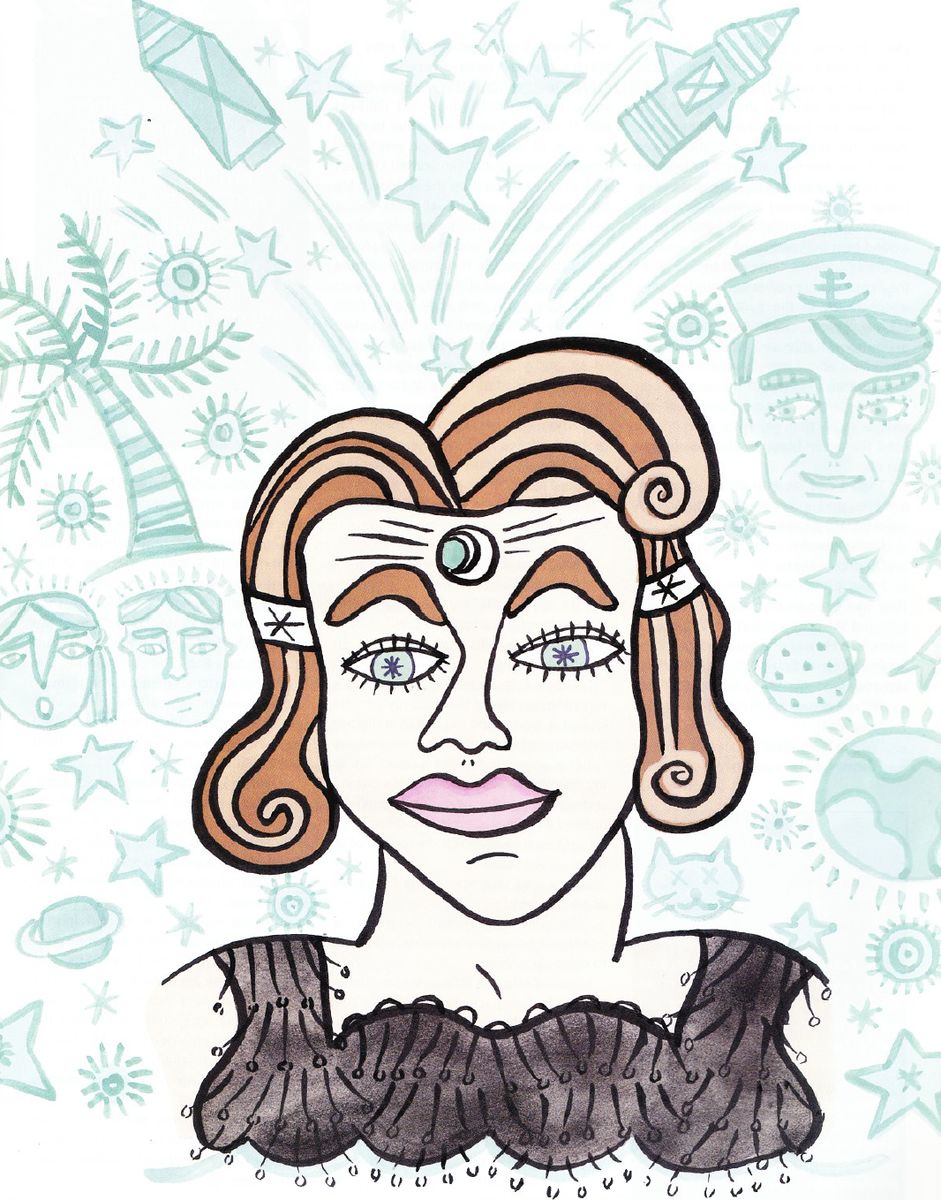
Mother couldn’t cope with reality, but she sure knew how to dance. My mother had a twist dress. It was black and had rows and rows of silk fringe all the way from her bosom to her knees. She and my brother, Johnny, would do the twist in our Connecticut kitchen on weekday afternoons. They would talk about Chubby Checker with great authority. I was 8, and he was 12. He had a paper route and a job shoveling snow in the winter, and he saved up for a record player that could run at three different speeds 33, 45 and 78 rpms. When no one was around, I snuck into his room and played my grandfather’s Cab Calloway 78s. I didn’t know how to twist. Everyone said it was just like crushing out a cigarette. It was that easy. But I didn’t smoke, so I didn’t think I would ever be able to learn.
In the spring of 1962 my mother had a nervous breakdown. It happened the night after she took us to the drive-in to see Frank Sinatra in A Hole in the Head. Mother didn’t like the movie. The next day she was supposed to take me and my brother to the beach, but instead she went crazy. We loaded into the car and when she backed out of the driveway, she accidentally ran over her Siamese cat. Then she zoomed up Ledge Lane running down every other mailbox. We — and the car — ended up in a pond near Belltown Road.
An ambulance came and took us all to the hospital. My mother and brother were unconscious, so the paramedics had to ask me all the questions. I lay on the emergency room table and stared up at the huge light above me. It was as big as the sun. I pretended I was at the beach. I pretended that we’d never run over my mother’s cat, that we were safe on the sand, the ocean breathing long sighs into our ears.
Then there was light shining directly in my eyes and a voice shouting, “Andrea, wake up. Are you awake?”
I wasn’t awake.
“Andrea, wake up.”
I saw a man with large brown arms. They had a tangle of black hairs, and as I followed the arms up and up, I found the man’s face. He was dressed in white and he reminded me of Bob Hope. He looked like someone who was going to play golf later.
“Where is your father?” he asked.
“Virginia.”
“Where in Virginia?”
“The navy.” That’s all I knew. Somewhere in Virginia. Somewhere in the navy. My father was always somewhere else.
My mother spent three months at a state mental institution called Fairfield Hills. It took an hour for my father to drive us there, so we only went on weekends. The place looked a lot like Scarlett O’Hara’s Tara, only it had bars on the windows. My brother and I weren’t allowed inside because we were kids, so we would wait on the grass outside and make up stories about the people in the criminally insane wing of the hospital. Finally our parents would come out, and they would fight while my brother and I ate the chicken sandwiches we’d packed in aluminum foil. I’d sit and watch them, imagining my mother was Scarlett O’Hara and my father was Rhett Butler.
“When am I getting out of here?” My mother refused to eat the sandwich, refused the forsythias I had picked from the backyard for her. They were wilted anyway.
“When you’re better.” My father swallowed hard.
“I’m better.”
“No you’re not.”
“I’m not taking any pills.”
“It’s not the pills,” my father sighed. “It’s the reason why you took the pills.”
“I took the pills because you’re an asshole.”
“Please, Evie. Please.” My father had a way of saying please that hurt my ears. He looked at Johnny and me, as if to apologize for our mother’s language. I wanted my father to stand up to her. I wanted him to say, “Frankly, my dear, I don’t give a damn,” and walk away. But he didn’t. Instead, he opened the picnic basket and offered her some Oreo cookies, which she took all of them and stood up.
“Fuck you,” she spit at my father. He bowed his head.
She walked away, and her nurse or guard I wasn’t sure which had to run to catch up with her.
“Your mother’s a little upset,” my father told us. And we packed up our picnic basket and went home.
When my mother was let out of the mental hospital, my father decided it would be nice to take the family to Key West, Florida. He thought it would be a good rest for Mother, hanging out by the Key Ambassador Motel pool, while he spent the day on a battleship teaching young sailors the ins and outs of chemical warfare.
On the night before we left for Florida, my mother took me to the side of the garage and told me what they did to her in the mental hospital. She told me they changed the clocks around and teased the patients. She told me they made her scrub the bathroom floor. The staff told her she was being dramatic when she complained. She made me promise not to let them put her away ever again. Then she popped three little pills and squeezed me hard against her plump bosom.
Two days after we arrived in Key West, the Cubans pointed their missiles at the U.S. My father came home to the motel early and said we needed to buy canned foods. We were going to spend the night in a fallout shelter. My brother and I were very excited.
“It’s the end of the world!” Johnny yelled to my mother. “We’re all gonna die!”
But she didn’t hear him. She was floating in the blue water of the pool, and her ears were submerged. She was wearing that black twist dress and the fringe floated all around her. She looked like a poisonous jellyfish.
“The bombs are coming!” my brother screamed louder.
Finally my mother did look up. She lowered her sunglasses and smiled at us. “That’s nice,” she said as she twisted slowly in the water.