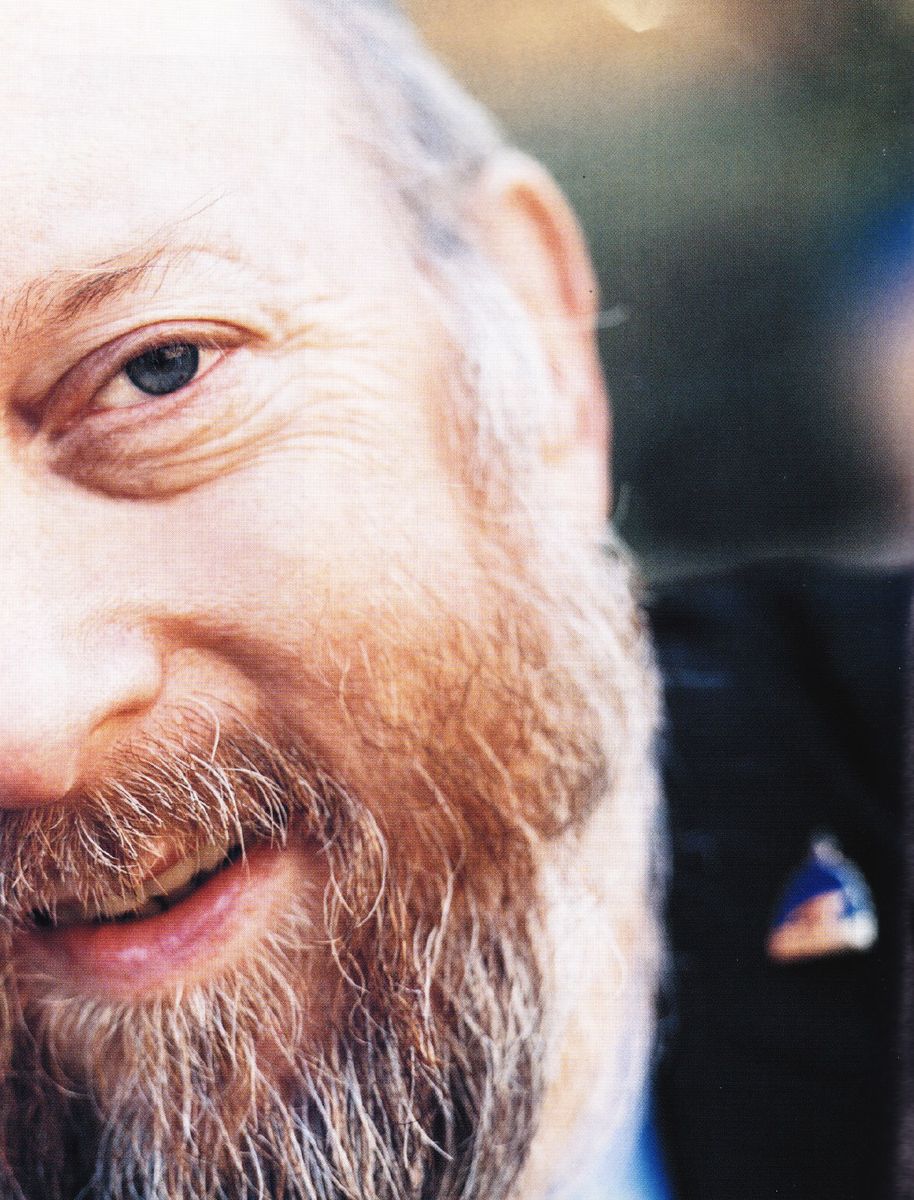
If you’re looking for heroes to honor among the legions of renowned scientists, scholars, dedicated teachers and prominent alumni affiliated with UCLA, you might easily pass over Howard Welinsky ’72.
This affable but low-key, unassuming film-distribution executive — who prefers working in rolled-up shirtsleeves and lunching at his favorite family-owned diner to wearing Armani suits to Hollywood power lunches — looks like your everyday, ordinary face-in-the crowd. You might spot the ever-present UCLA lapel pin on his sports coat and shrug him off as just another Bruin fan.
But you would be wrong.
Among those with his particular calling, Howard Welinsky is the undisputed master of political advocacy. Over a lifetime spent carefully cultivating relationships with elected officeholders and influential Democratic Party officials, Howard Welinsky has become UCLA’s most powerful crusader in the ferocious joust for state funds that takes place off the floor of the Legislature — at cocktail-party receptions, fund-raisers, party committee meetings, anywhere where one can grab and hold on to the ear of a legislator.
Take it from one who has seen him in action: “Howard is one of UCLA’s most important human assets,” says former State House Speaker Antonio Villaraigosa ’77, now a Los Angeles mayoral candidate, who has been lobbied many times by Welinsky on UCLA’s and UC’s behalf. “He’s as passionate about the university as he is about politics. He has committed himself to working on behalf of the university wherever he can.”
“Wherever” might be the hallways of the State Capitol, where you can spot him chatting up House Speaker Bob Hertzberg (D-Sherman Oaks) or State Senate President Pro Tem John Burton (D-San Francisco). Or in a hotel room where Welinsky, relaxing on a long weekend at Lake Tahoe, got an urgent request from university officials to talk to former State Sen. Bill Lockyer, now California attorney general, about a specific issue. “Fortunately, he called me back in two hours,” says Welinsky, who interrupted his weekend plans to wait in his room for Lockyer’s return call.
It’s all part of the life of UCLA’s most valued volunteer advocate. Among state politicos, Welinsky is a name that is inseparable from two causes: UCLA and Israel.
Sure, Howard Welinsky has his day job in Burbank, where he puts in grinding 14-hour days poring over movie box-office figures as senior vice president of administration for Warner Bros. Pictures Distributing. But 24/7, he remains vigilant and connected via phone, fax and e-mail to staffers at UCLA Government and Community Relations and at the UC Office of the President, State Governmental Relations. He gets up-to-the-minute bulletins on legislative action off the Internet — ever protective of the interests of UCLA and the University of California.
For all the thousands of dollars he makes in political contributions to support politicians who share his commitment to the mission of public higher education and to Israel, for all the hours he devotes to building goodwill with lawmakers, Howard Welinsky is a UCLA alumnus hero with titanium-hard loyalty who has time and time again parlayed his considerable political clout to win make-or-break votes for UCLA and UC during white-knuckle moments when the clock is ticking down and millions of dollars hang in the balance for researchers and educators.
Unlike lobbyists who are paid to push the agenda of special interests, he carries the message for higher education, for what it can achieve for California and its citizens, straight from his heart.
And that makes his message especially appealing.
“Howard comes to elected officials with an incredibly strong reputation and unassailable credibility,” says Keith Parker, assistant vice chancellor for Government and Community Relations. “In the University of California, he’s regarded as one of its most important advocates. Clearly, he is UCLA’s most important advocate. He truly bleeds blue and gold. His commitment is such that he is always willing and able to leverage his political contacts on behalf of the university. And he has the very best political connections of anyone we know.”
Says State Sen. Sheila Kuehl ’62 (D-Santa Monica): “Legislators who know him are genuinely impressed by his quiet intellect and his ability to understand what we need to know. We don’t have time for the ‘How are yous?’ Howard is effective because he understands that. He’s always polite and soft-spoken, but he gets to the point. He knows how to make the most of a 20-minute meeting with a legislator.”
His message to legislators is upfront and simple, but not always so soft-spoken. Once, when a lawmaker he had supported began, as Welinsky recalls, “behaving very badly toward UC,” the advocate got the offending official on the line: “When you feel a tendency to vote against UC, pretend it’s a dagger through my heart,” he told the officeholder bluntly. “You don’t want to hurt me, do you? Then don’t hurt UC because if you do, it’s going to hurt me personally.”
Welinsky does not toss off such threats lightly. But he knows what’s at stake for the university.
“Is it wrong that other people who don’t or can’t afford to make campaign contributions don’t have as much access to legislators? It’s the reality of the game. It’s all about helping the university be as great as it can be and get the resources it deserves,” he says. “That state money means more than just an education for students. UC does something the other segments of California public higher education do not, and that’s research. Research has a tremendous impact on the economy, the creation of new businesses and new jobs. Not to mention finding cures for life-threatening diseases and social ills. It’s a huge, monster research engine.
“You have to make the case that if UC and UCLA do not get those resources and cannot pay the best professors competitive salaries, then that professor and all he or she can produce is lost to us permanently. They’re gone. I make this case over and over and over again.”
Welinsky also knows that if he doesn’t reach legislators with the message, others representing special interests will. “Only a small portion of the state budget is discretionary,” he explained. “And UC’s portion comes out of that discretionary budget. By statute, approximately 40 percent of the state’s general-fund budget goes to K–12 education and the community colleges. When you ask, ‘So what does that discretionary money pay for?,’ it’s higher education, prisons and the pay-raise increments that state employees receive — that’s what UC is up against. The reality of the game is that UC has been literally competing for state funds with prisons for many years. Prisons have unions that make big campaign contributions. State-employee unions are fighting for bigger raises. Our voices have to be heard. Legislators need to hear from university administrators who can speak to the specifics of what is needed, but they also need to feel the passion of alumni who can vote, who can write checks and do all of the things the university as an institution cannot do for itself.”
The scope of what he can accomplish became clear last spring when Welinsky, browsing through legislative Web sites, picked up bad news. Earlier in January, Gov. Gray Davis had given a major boost to UC by building into his budget proposal a 12.1-percent, $328-million state general-fund increase. The Senate’s budget subcommittee had approved the same level of funding. But the Assembly subcommittee had slashed $180 million off of its version, funds that were slated for Davis’ future California Institutes for Science and Innovation and the teaching hospitals. The effect would be crippling, especially on Davis’ plan to fund three institutes that would explore new technologies that would give California a scientific edge and propel it economically into the 21st century.
“We had major, major cuts that we were fighting hard to have restored,” recalls Stephen Arditti ’64, J.D. ’67, UC assistant vice president and director of State Governmental Relations. The timing was critical. The budget conference committee was trying to wind up its work on a compromise version by the weekend.
Welinsky knew he had only four or five days before it would be all over. After urgent calls and faxes to and from university officials to get up to speed on the losses UC would sustain, the advocate knew what had to be done: One of his closest friends happened to be throwing a fund-raiser for Speaker Hertzberg in San Diego the very next day. Welinsky knew he had to be there.
“I knew I was going to get two shots at Hertzberg,” Welinsky said. First, there was a reception for 200 people, followed by a more intimate dinner for 75 to 80 movers and shakers.
Equipped with hastily faxed one-page fact sheets and summaries to bolster his argument, Welinsky drove to San Diego, walked into the reception and immediately spotted an ally: an alum wearing a Cal tie. Taking the stranger aside, Welinsky briefed him on their desperate mission. “With the two of us, it would be easier to focus Hertzberg’s attention on the issue,” Welinsky strategized, and block out intruders trying to wiggle into their conversation.
“Fortunately, I have a long relationship with the speaker,” Welinsky says, smiling. Working his way to Hertzberg, telling him how he had driven down to San Diego at the invitation of his best buddy, the host of the fund-raiser, Welinsky felt he had the speaker’s attention.
“We made the speech. What was really important was to get him focused, to get the facts out quickly in front of him. Sure, there were many competing issues here, but to his credit, Hertzberg realized something had to be done.”
If the governor could put the money in UC’s budget, and the Senate could do it, the Assembly could as well, Welinsky urged. “If John Burton can do it, you can,” he told the legislator.
“I used a multitude of arguments, but bottom line, he understood it was the right thing to do,” Welinsky says.
Message delivered, Welinsky then worked the room, honing in on other Assembly members with UC campuses in their districts, including Majority Leader Kevin Shelley (D-San Francisco) and Fred Keeley (D-Boulder Creek). “I got them focused on it. Kevin Shelley (with whom Welinsky had been to Israel on a goodwill visit) took my piece of paper.”
Moving on to dinner, Welinsky found even more reason to be optimistic when Hertzberg came by his table to let him know they were working on the issue. When it came time for the traditional farewell photo session with the speaker, who favors bear-hugging his supporters and friends, Welinsky recalls taking the initiative and hugging Hertzberg from behind, mugging for the camera. “This picture is going to cost me $180 million!” Hertzberg remarked jovially.
Five days later, at midnight Sunday, Arditti left Welinsky the phone message he had been waiting for: the $180 million had been restored in increments — $25 million one day, $35 million the next, and so on — until it was all in place. “Never in my life has something so tangible, so remarkable happened in such a short period of time,” Welinsky says, shaking his head.
Months later, on Dec. 7, the image of Gov. Davis beamed in from a Sacramento press conference onto a giant screen in Ackerman Grand Ballroom, announcing to an expectant audience that UCLA and UC Santa Barbara scientists would receive $100 million from the state to launch the California NanoSystems Institute, selected against heavy competition as one of Davis’ three California Institutes for Science and Innovation. The other selected projects were the California Institute for Telecommunications and Information Technology, a collaboration between UC San Diego and UC Irvine, and the California Institute for Bioengineering, Biomedical Research, led by UC San Francisco with UC Berkeley and UC Santa Cruz.
Welinsky knew there were no guarantees that his advocacy efforts would pay off. “Each time you do this, you feel you’re being tested,” he explained. “You’re sweating each time it happens. It doesn’t happen overnight or automatically. It’s hard work, repeated phone calls, the thank-yous afterward.” And then there’s typically the long wait. “Sometimes you don’t see the results for months.”
There have been other close calls.
In 1999, local water and sewer districts were pushing hard for a bill that would empower them to increase by hundreds of millions of dollars the capital-facility assessments paid by local school districts, higher education institutions and other public agencies. Current laws restricted the amounts these districts could assess public agencies.
“This was a huge problem for us,” Arditti recalls. “The bill had already passed the Senate and was in the Assembly appropriations committee. So once again, we went to Howard.”
Howard called then-House Speaker Villaraigosa to request a meeting in Sacramento on behalf of UC and other representatives of the public-educational system.
“As usual, when Howard comes by, he’s got my ear. I have a lot of respect for him,” Villaraigosa says. “I believe then and now that we shouldn’t be robbing Peter to pay Paul. We shouldn’t be charging the university to make up for shortfalls in other public services. When he was able to convince me that this legislation would cost the university hundreds of millions of dollars, I was not willing to allow that to happen.”
When the meeting ended, there was a common sigh of relief as Villaraigosa assured them the bill would not leave the committee in a form that was unacceptable to them. He assigned a staffer to work on a compromise. But when no common ground could be found, the bill languished for months in committee without ever getting a hearing.
When supporters made one last-gasp effort to resuscitate it in the final days of the session, Welinsky again ran interference. “It was like a bad horror movie with a monster that keeps resurrecting,” recalls Welinsky, who again called on legislators.
“It finally died in committee, and there’s no doubt in my mind that Howard made the difference,” Arditti says.
A lifelong resident of Culver City, Welinsky found his calling to political advocacy early. By age 7, he was walking the precincts with his mother, a city-planning commissioner, campaigning for a school-board candidate. When he was a high school senior, he was appointed the youth chair for Richard Pachtman’s race for city council; through Pachtman ’45, Welinsky became deeply involved in Culver City politics.
“At the time, I was studying political science at UCLA, which was where I knew ever since grammar school that I would be going.” Culver City became his real-life political-science laboratory, “where I could observe what I learned.” He saw how city councils voted when faced with a high-profile issue that had the public clamoring in their chambers; he watched as they quietly handled other issues that nobody seemed to care about.
At UCLA, Welinsky was participating politically on another level: joining anti–Vietnam War demonstrations and the UCLA Young Democrats, where he met Terry Friedman ’71, Burt Margolin and Rick Tuttle M.A. ’64, Ph.D. ’75, all bound for political careers.
By the mid-’70s, Welinsky was elevated to the State Democratic Party, where he served on the rules and platform committees. He has attended every Democratic state convention since 1975.
“Politics has always been a part of my life,” says Welinsky, who also serves on The UCLA Foundation Board of Governors and the California Postsecondary Education Commission, to which he was appointed by Villaraigosa. “It’s not that I felt so much drawn to it. What draws you to go eat at lunchtime? It’s what I talk about at the dinner table and with my friends. In fact, it’s hard for me to develop a personal relationship with someone who has no interest in politics. Warner Bros. is my profession, but politics is my passion.”
Each time UCLA and UC officials have asked him for help, Welinsky has answered their call, officials say gratefully.
On his 50th birthday, friends threw him and Tuttle, now Los Angeles City Controller, with birthdays a few days apart, a surprise party at the James West Alumni Center where many of their friends contributed to a scholarship to be offered in their names. The first award will be given out this year to a political-science major.
“It makes me feel really good,” says Welinsky, who does not shy from the label “lobbyist.”
“There’s nothing you can do to make a saint out of a lobbyist for the tobacco industry,” he reasons, “because you know ultimately, the end result is not in the best interest of society. But when your goal is to help UCLA and UC, it’s the reverse. There’s nothing you can do that’s terribly bad because the university impacts so many lives in so many positive ways.
“Legislators understand I’m not doing this to enrich myself or the company from which I earn a living,” Welinsky says. “What I do is designed to enrich society as a whole. It enriches legislators’ constituents who are students and the beneficiaries of UC and UCLA research. So it’s worthwhile doing.”
Get Involved
Volunteer advocacy is at the core of UCLA’s Government Relations Program. Working closely with the UCLA Alumni Association, the UCLA Government Relations Program is committed to incorporating volunteer advocates into every phase of Government Relations programming, including planning, implementation and the review of program activities. Among the key advocacy programs are:
Bruin Caucus
Bruin Caucus members, currently more than 1,400, are asked to contact elected officeholders and other government officials to advance the mission of UC and UCLA, often in support of state and federal funding of UC programs. Bruin Caucus seeks to inform and educate a broad base of supporters through periodic mailings and a quarterly newsletter.
District Office Outreach
Volunteers meet in a legislator’s district office or at UCLA-affiliated sites in the district to discuss issues of mutual interest to the legislator and the university. Volunteers are assigned according to their relationship to an individual legislator (i.e., a constituent, contributor, acquaintance, etc.).
Legislator to Campus Visits
Volunteers assist UCLA staff in hosting legislator visits to UCLA to familiarize federal, state and local officeholders with the research, instructional and public-service activities being conducted on campus. The visits routinely include a meeting with the legislator and UCLA administrators, faculty and volunteers, who are alumni, friends, constituents or supporters of the legislator.



