Editor’s note: This is an article from the December 1998 issue of UCLA Magazine.
The young mother is frantic as she pushes through the doors of the emergency room on a chilly, gray morning, cradling a tiny baby in her arms. She looks to be in her early 20s, but a hardscrabble life of poverty on the streets of this capital city has added many more years to her features. She has little comprehension of what is wrong with her child, just that he is desperately sick.
Indeed he is.
The infant, a black-haired, brown-eyed boy just a few weeks old, is conscious but listless, an emaciated, sad skeleton swaddled in loose skin, his rib cage clearly visible, a sharp outline under the shell of his body. He struggles for air, his breaths coming in short, rapid bursts.
He was born with pulmonary atresia — the vessels to ferry the blood from his heart to his lungs had not formed — and the small duct present at his birth that had been keeping him alive by allowing some blood exchange is closing. His blood-oxygen levels, which in a normal individual would be at or near 100, have dropped into the 30s; his tiny body is starving for oxygen, giving his skin and lips a mottled bluish cast.
Had this been UCLA Medical Center or any other large hospital in the United States, the baby would stand a good chance of surviving.
“We could have saved him,” Dr. Juan Carlos Alejos says sadly. “If we had had the right medicine, we could have stabilized him enough to get him to surgery to fix the problem.”
“We could have saved his life.”
But this isn’t a hospital in the U.S.; this is more than 4,000 miles from Los Angeles, in the heart of Lima, Peru.
In this country of 25 million people, the Instituto de Salud del Niño is the sole specialized children’s hospital. For the poorest of this very poor country — nearly half of all children suffer from chronic malnutrition, almost two-thirds of the population must rely on the government for even minimal health-care services and the rate of infant mortality is the second highest in Latin America — it may be the only medical center that offers even remote hope for gravely ill children. Worse, for many families, just getting to the front door can be a deadly journey over treacherous roads that snake along the face of sheer cliffs from villages high in the Andes or deep within the Amazon Basin. In one week in September, 54 people were killed and 35 injured when overcrowded, broken-down trucks and buses skidded off crumbling mountain roads.
And the end of the road doesn’t guarantee success. Even in this large hospital, the right medicine, in this case the drug prostaglandin, simply isn’t available. And if it were, the high cost — several hundred dollars for a single vial — puts it out of reach for all but the wealthiest families.
“The expense would not be a consideration in an emergency in the States,” says Dr. Josephine B. Isabel-Jones, a cardiologist and assistant dean of student affairs in UCLA’s School of Medicine. “Prostaglandin is readily available; we would administer the drug, save the baby’s life and worry later about how to pay for it. But in this instance, we simply didn’t have it.”
And so, the baby died.
“It was so hard, so frustrating for us,” says Alejos, “to see this little baby die because of the lack of resources.”
That is why Alejos, a UCLA pediatric cardiologist with a ready smile and easy manner, has for four years traveled to Peru, organizing and assembling volunteer medical teams to bring with him. These trips are something of a personal mission for Alejos, a way to honor the memory of his Peruvian father, a pediatrician, by giving something back to the country of his forbearers. The goal, Alejos says, goes beyond healing sick children. The real aim is to work side-by-side with the South American doctors and nurses in order to train them in techniques that are routine in this country but rare in Peru for correcting complex congenital heart defects.
On this last trip, for two weeks in September and October, Alejos is accompanied by nine doctors, surgeons and nurses: Isabel-Jones; UCLA cardiologist Alvaro Galindo; UCLA heart surgeons Ali M. Sadeghi and Riad Meada; anesthesiologist Howard Chait from St. John’s Hospital in Santa Monica; UCLA critical-care nurses Chris Eisenring M.S.N. ’97 and Julie Chait; pediatrician Mike Schessel from New York; and cardiologist Sophie Stravinidis from Montreal, Canada. Before they left for Peru on an eight-hour nonstop flight from L.A., Alejos collected two tons of donated equipment and supplies — much of it surplus from UCLA Medical Center — which was shipped ahead. In addition, the team carried with them 28 large duffle bags crammed with medicines, tubing, bandages and other specialized gear.
The vista beyond the dirt-streaked windows of the 70-year-old hospital’s operating room is a dreary sprawl of gray cinder-block buildings, church domes, boulevards choked with pushcart vendors, cars, diesel exhaust and the ceaseless clatter of people on the move. Seven floors below on the Avenida Brasil, mothers in kaleidoscopic Indian dress clutch their children tight as they dodge among the rattling buses, trucks and taxis, past the street peddlers hawking inflatable toys, fried bananas, comic books, toilet paper and warm bottles of Orange Crush and Inca Cola on their way to the hospital’s front door.
Outside, paramilitary guards stop everyone entering the building to search through bags. Weapons are ever-present on the streets of a country that for years was subjected to remorseless, arbitrary attacks by Maoist Sendero Luminoso — “Shining Path” — guerrillas. More than 18,000 people were killed between 1980 and 1990, an estimated 200,000 driven from their homes in provincial areas. Hundreds of small clinics and hospitals in outlying areas closed, putting increased pressure on an already attenuated health-care system. Today, armed guards are stationed in front of virtually every public building.
Though terrorism has been suppressed in recent years, the sharp rat-tat-tat-tat of gunfire can still be heard sporadically in the city. One day, just a few miles from where the doctors were operating, soldiers opened fire with automatic weapons when anti-government demonstrators broke through the gates of the Presidential Palace.
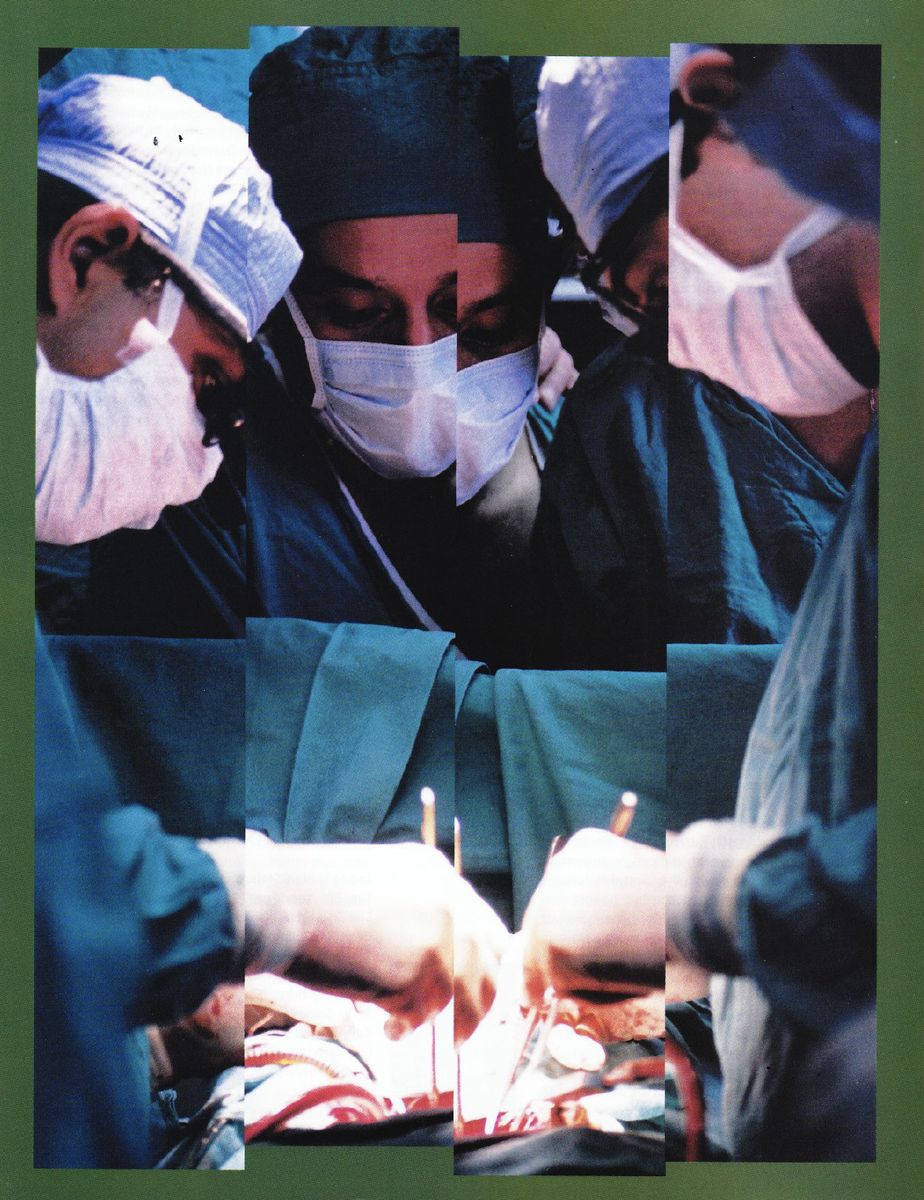
Through it all, for five long days, often starting before 8 in the morning and sometimes lasting past midnight, the team performed surgery on infants and teenagers, selected from among 75 candidates presented by the hospital. All suffered various forms of cyanotic heart disease, congenital defects that restrict the flow of blood from the heart to the lungs. Existence for them is a misery. Such children often are bedridden, unable to walk or play without quickly becoming exhausted; their lips and fingernails take on a bluish hue, like the baby in the E.R. Without treatment, they are doomed to a slow, inexorable death.
In all, the UCLA team performed 12 intricate operations to close holes between chambers of the children’s hearts, replace defective valves, refashion malformed vessels and to shunt the flow of blood directly to the lungs, bypassing abnormal areas of the heart. In between, they performed more than a dozen diagnostic procedures and less invasive interventions such as cardiac catheterizations in which thin tubes are snaked through vessels into the heart to make less complicated repairs without surgery.
As they work in the O.R., the efficiency and relative calm of surgery contrasts sharply with the tumult on the streets below and within the jammed, noisy corridors of the hospital, where parents and children arrive early in the morning, jostling for a place in line for clinics or the pharmacy. In the small waiting area outside the operating rooms, an Andean woman in a brimmed hat sits on a bench nursing a baby under her shawl. Anxious parents line the stairway, pace the cracked linoleum floor and crowd around the locked door to the surgery, pressing their faces against the mirrored glass in the hope of catching a glimpse of their child or a nurse who can deliver some news.
Anxiety among parents of sick children is universal but, in this setting, their desperation somehow feels more urgent. Perhaps it is because for many, the visit of these medicos Americanos is their last hope.
“They don’t have the resources here to fight for every life,” says Alejos. “They have to say ‘no’ to the most difficult cases.”
So it is not unusual for a mother, hope and desperation mixed in her eyes, to approach an American-looking stranger and press into his hand photographs and notes pleading for succor on behalf of her son and daughter — Mi niño es muy enfermo. Necessita ayuda, por favor!
For many, it is all they can do. In the short amount of time they have in Lima, the doctors cannot possibly address every case. “We have to say no to so many of them,” Alejos laments.
Working in unfamiliar surroundings, with unfamiliar equipment (some of it more than 20 years old) and struggling to communicate in an unfamiliar language, improvisation becomes the key to survival. When a 13-year-old girl goes into full cardiac arrest on the operating table, surgeons Sadeghi and Meada are stunned to learn that the O.R. is not equipped with internal paddles — slender prongs that would fit inside the open chest cavity — for the defibrillator machine to jump-start her stopped heart. Given no other choice, the two fashion their own internal paddles, wrapping two pairs of forceps in saline-soaked gauze, placing them against the child’s still, exposed heart and touching them with the broad, flat paddles of the defibrillator. The result is a loud ZAP! and a brief funnel of sparks. The girl returns to life.
Sometimes it is the doctors themselves who suffer the consequences of mechanical failures. In the middle of one operation, anesthesiologist Howard Chait reaches to adjust the setting on a monitor, lets out a sudden loud groan and staggers backward after receiving a strong jolt of electricity from a short circuit. Later in the O.R., someone smells something burning; it turns out to be an electrical cord in a wall socket. A nurse reaches down, pulls the cord from the wall, waves it in the air for a few moments to let it cool and then plugs it back into the same outlet. The American doctors just shake their heads and return to work.
The fact is, things have improved since Alejos’ first visit in 1995, when a gowned and masked hospital mechanic, tools in hand, had to attend each surgery in case the aging heart bypass machine broke down. There is newer equipment now, much of it donated from abroad. Yet, one doctor observes that much of what he sees looks like it should be on display in a medical museum.
But the focus here is not on updating outmoded equipment, but on refining technical skill. And for the Peruvian doctors, having the UCLA medical team in their hospital is a godsend.
“We are 20 years behind the times in our surgical techniques,” says Rafael Guerrero, a cardiothoracic surgeon. “It is impossible to learn everything that we need to know in just a few days, but the most important thing is for the nurses and doctors in this hospital to learn as a team so that everyone — the surgeons, the cardiologists, the anesthesiologists and nurses — know what is being done and why.”
One of the most serious problems facing doctors in Peru who want to gain more surgical experience is monetary. Because the medical system is so financially strapped, families of patients must on their own purchase the necessary supplies for surgery — everything from bedsheets to anesthesia — at a cost that easily can exceed a year’s wages. This is true even in a public hospital such as the Instituto del Niño, which is operated by the Ministry of Health. Only 10 percent of the population has the wherewithal to readily afford such treatment. As a consequence, critically needed care often is delayed months or years while families raise the necessary funds.
“There aren’t enough patients whose families have the financial resources, so we are unable to do the operations that are necessary to increase our skills,” Guerrero adds. “When there is no money, we have to swim against the tide. It is exhausting.”
That situation has eased a bit in recent years. A nonprofit organization founded in 1996 by the eldest daughter of Peruvian President Alberto Fujimori, the Fundacion Peruana Cardioinfantil — Peruvian Foundation for Infant Cardiology — is working to provide necessary resources to pay for the medical treatment of children whose families cannot afford care. Still, the need is well beyond the current resources of the foundation. Thus far, the foundation has paid for about 280 operations, but each year in Peru, an estimated 9,000 children are newly diagnosed with heart disease.
“Let’s not kid ourselves,” Alejos says. “The dozen or so children we operate on in the short time we are here isn’t going to change anything. But my goal is to continue building on this effort so these doctors can learn how to perform these procedures without our help. We know that what we are doing is not going to fix the world, and we are not going to save every child. But we can make a small dent. We have to do the best that we can.”
And that seems to be recompense enough for the medicos who volunteer to join Alejos on his treks of mercy — that and smiles and tears on the faces of the mothers whose children they have just saved.
“It has been one of the most rewarding, wonderful experiences of my life,” says Sadeghi. “It makes me feel privileged to do what I do. To save the life of a child who otherwise might not have had a chance to live, and to see the joy and gratitude in the eyes of the mothers and fathers goes beyond anything I have experienced.”



