Occasionally, it is possible to glimpse a rough outline of what the world might look like in the 21st century. So it was when an assembly of cyber-gurus gathered at UCLA in October to mark the 35th anniversary of the birth of the Internet.
A lot has changed since 1969, when, without any fanfare, a refrigerator-size computer lodged in a small office in Boelter Hall sent out the first-ever cyberspace message. “Lo,” it read, a historically attention-seeking word that was in fact an accident. The computer had crashed before the intended term, “login,” was fully transmitted.
“Login” has since become the hallmark for the Internet, that amalgam of high-tech communications technologies that makes up the global information infrastructure. A multidimensional medium, at once personal and public, the Internet enables billions to log in to a vast array of resources, from finance, technology, media, politics and the government to more traditional institutions that are often struggling to adapt to the fast-changing realities of the marketplace.
And yet the Internet has barely begun to transform global communications. Its potential reach is so huge that, at the very least, it is expected to one day connect all humans on Earth. “We’ve watched it grow, we’ve seen what it’s become and we’re seeing where it’s going,” says UCLA Professor of Computer Science Leonard Kleinrock, who directed the transmission of the Internet’s first message 35 years ago, a decade after he developed “packet switching,” the technology at the heart of Internet communication.
“There are two things that give the Internet its power,” says Kleinrock. “One is the concept of people sharing ideas and participating in each other’s work. The other is the culture that allows that to happen. The beginnings of the Internet are clearly stamped with a feeling of openness — open research, open architecture, open access, trusting members of the community, no overbearing control.” But that same culture, cautions Kleinrock, is also “a formula for the dark side of the Internet. That’s where spam, pedophilia, pornography and identity theft come from.”
The Internet’s infrastructure is expanding in several ways, Kleinrock told the roughly 200 delegates at the recent birthday bash. The first, “nomadic computing,” or “nomadicity,” refers to the ability to use computers anywhere wirelessly, even from atop Mount Everest. Another direction is the “invisibility” of the human-computer interface. “For most users, cyberspace exists behind the computer screen,” says Kleinrock. “We want to take cyberspace outside and deploy it in our physical world — on our desks, shoes, eyeglasses, vehicles, refrigerators, possibly even in our bodies.”
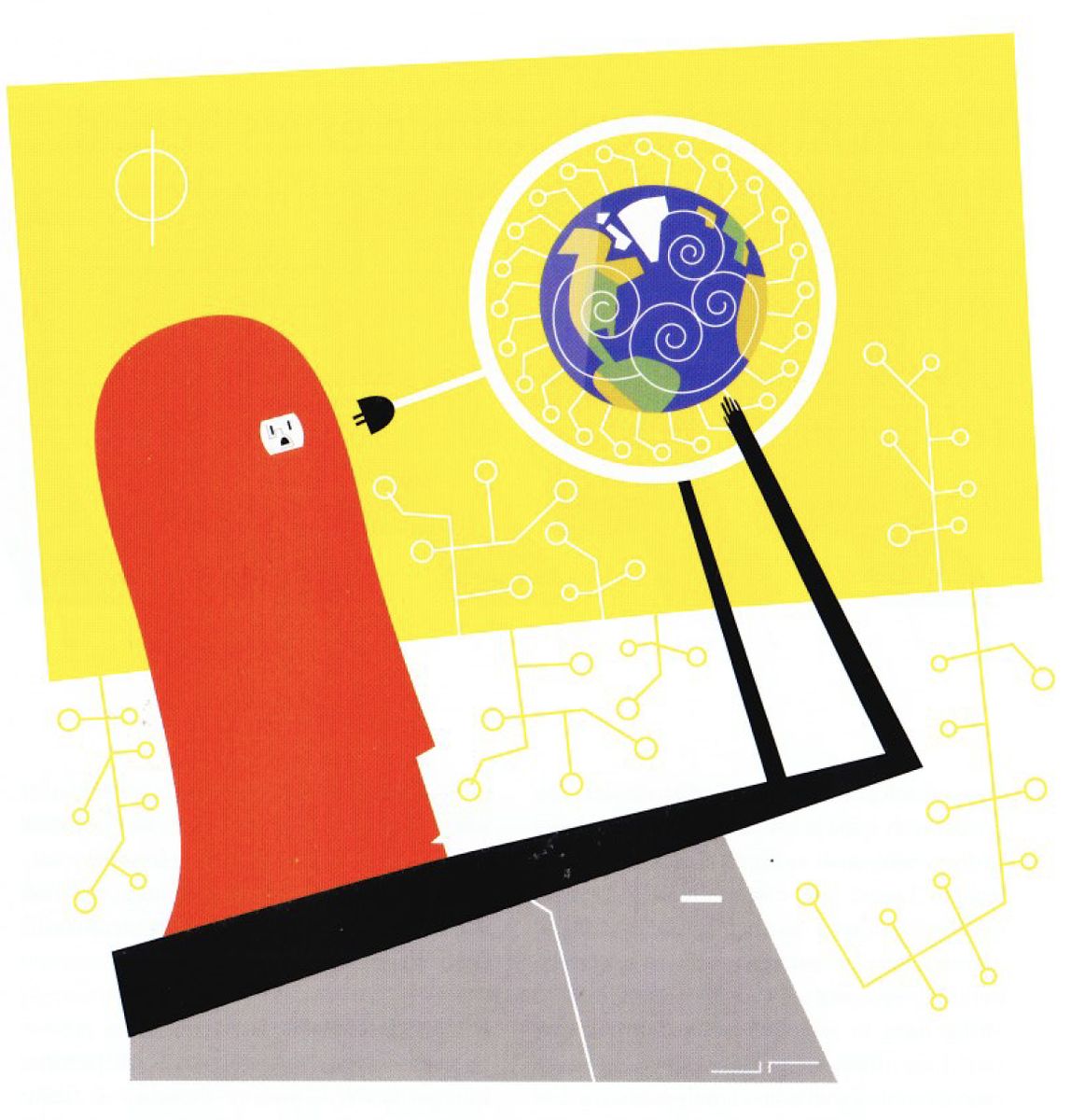
That’s a widely shared vision among tech gurus — the kind of self-fulfilling prophecy underpinning much of the Internet’s success. “We’ve created something that will ultimately connect every living synapse on this planet,” predicts John Perry Barlow, a former Wyoming rancher and Grateful Dead lyricist, and co-founder of the Electronic Frontier Foundation. “We still have a long ways to go down that road, but the Internet is a system that will ultimately be totally inclusive — a nervous system for the collective unconscious of the human race.”
Efforts are already underway to infuse our environment with such a high level of technology that just about everything around us becomes “smart” and easily accessible. As Kleinrock puts it: “If I walk into a room, the room will know I’ve walked in. I’d be able to talk to the room and get a voice answer, or maybe a hologram or information display of some sort will pop up.”
All this intimate and pervasive interaction with our surroundings will eventually create a world of mass customization. Already, young consumers tend to love their mobile phones more than their newspapers (and their video games more than television), so the day isn’t far off when businesses, armed with a storehouse of information on consumer preferences, will target customers directly in real-time, in homes, offices and shopping malls. Imagine a morning, for example, when you’re stepping into the shower and your local bakery calls to tell you that your favorite French rolls, hot out of the oven, can be at your door within minutes.
As with any other technology, it’s impossible to predict how the Internet will actually serve consumers in the future, given that e-mail, instant messaging and the World Wide Web were themselves complete surprises. Which is why, as Kleinrock concedes, “it’s much easier to predict infrastructure.” Many such predictions are based on the almost surreal ability of computers to do more and more computing in ever-smaller spaces over increasing bandwidths, using ever-lower power, thereby validating Intel co-founder Gordon Moore’s 1965 prediction, known as Moore’s Law, that the computer power available on a single chip doubles every 18 to 24 months.
So if the core of the Internet is rife with increased capacity, where do the big challenges lie? At the network’s edges, says Vinton Cerf M.S. ’70, Ph.D. ’72, one of the Internet’s pioneering architects who is senior vice president of technology strategy for the telecommunications giant MCI. At a time when cable companies and their fiber-optics rivals are vying to control the flow of information to U.S. households, the hottest tech issue is broadband. In some parts of the world, such as South Korea and Japan, “where homes are essentially high-density dwellings, there is an increase in broadband access because it’s easier to outfit an apartment building with high-speed fiber than it is to string fiber to separate family homes,” says Cerf. In contrast, because the United States has relatively more individual family homes, delivering wireless broadband connection is a daunting exercise.
Partly, that’s due to the way the telecommunications and media markets are allocated, and partly it has to do with what Cerf describes as “our hesitation to share spectrum usage by allowing more than one party to be radiating [data] on ultra-wideband at the same time.” Such concurrent use means that competitors will potentially interfere with each other’s signals.
But that’s just what ultra-wideband technologies are intended to do, says Cerf, adding that applications that were once separate are becoming more and more commonly transportable in a shared, packet-switched Internet environment, creating, for example, Internet-enabled mobile phones. They might not carry voice as efficiently as data, which is why there is a voice channel for the mobile phone and a separate channel for data, he says, but eventually, voice, video, text and any other form of data will be combined and carried in Internet packets. Revolutionary? The scenario was predicted in a 1979 study. “It’s taken 25 years to realize it,” says Cerf.
Another foreseeable trend is that a greater number of devices in automobiles will become Internet-enabled, making them more finely tuned to their surroundings and thereby greatly reducing the potential for accidents. “I don’t want to argue that everything in the universe will be connected to the Internet, but the Internet is becoming an increasingly ubiquitous communications system,” says Cerf.
More and more communications networks are using packet-switching technology, making it inevitable that the Internet will augment and, in some cases, replace older technologies such as the telephone and television without phasing them out. “They can then be used to carry Internet traffic, just as it is possible to transmit Internet data over satellite-linked video channels,” says Cerf. “There is a confluence in both directions: The historical communications system becomes a bearer of Internet traffic and the Internet becomes a bearer of the content those historical systems exclusively carried.”
Ultra-wideband, a key element of the digital future, is a technology that allows many users to share a very broad amount of a given transmission spectrum. This, by the way, is precisely the philosophy of the Internet and of packet switching. “Instead of dedicating channels, which is what you have in circuit switching and the telephone system, in packet switching you aggregate as much demand as you can and then switch packets of information one after another,” Cerf says. The result: Usage capacity is never wasted. And that’s important in a communications era ruled by the “convergence” of diverse applications.
Take the “smart phone,” which Henry Samueli ’75, M.S. ’76, Ph.D. ’80, chairman of Broadcom Corporation and a UCLA professor of electrical engineering, praised at the symposium as “the best invention since the wheel.” It offers messaging, e-mail, Internet access, calendar, camera and music — all in a single device. This is the kind of technology that allowed The Telegraph newspaper in Britain to send mobile alerts to 5,000 people during the last World Cup soccer competition — a beep rang every time a goal was scored. Not just newspapers but every business that understands the power of the digital age is connecting its processes and linking its marketing strategies to mobile phones.
The Internet is addictive, no doubt, and that’s not necessarily a bad thing. But such a compelling technology also makes people vulnerable to social evils like spam and, in the case of children, pedophilia, raising the question of whether the Internet should be allowed to prosper without a controling authority, whether it be a global body such as the United Nations or a sovereign state.
“Technologists need to find preemptive solutions to a whole sphere of problems that, for lack of a better word, can be summed up as problems of trust,” says Bran Ferren, CEO of Applied Minds, a product-development company. “If problems develop to a point where our politicians think they need to fix them, then we’re in very serious trouble.”
So it’s fair to ask where the Internet is really taking us, and if there are other important areas of our lives that it can — or should — improve. In one form or another, the question is regularly echoed in the media, and so it was no surprise that UCLA Adjunct Professor of Computer Science Alan Kay raised it, plunging the symposium into something of a hush.
At a time when much of the world does not have enough drinking water and access to affordable medicine, Kay asked what people should make of the computer industry’s “SUV mentality” of manufacturing increasingly powerful computers that, to a large extent, are not tools of education in a sorely uneducated world but tools of entertainment. “The trick,” Kay suggested, “is to use the Internet as much more than an instrument of pop culture.”
Renaissance Europe is an excellent guide to the kind of investment today’s tech elite should be making in the Internet, Kay suggested. “The people who built cathedrals in Europe knew they would die before the cathedrals would be completed,” he said. “They left a legacy — a sort of gift for the future generations.” The obvious moral: In envisioning the Internet’s future, think of the world’s children in the decades to come.
Bridging the world’s yawning digital divide is another area of concern. According to the United Nations Development Program’s 2001 Human Development Report, Internet users as a percentage of the population doubled in the United States and quadrupled in countries belonging to the Organization for Economic Cooperation and Development over a two-year period ending in 2000. In contrast, the Arab states, Africa and South Asia showed relative increases of just 0.4 percent, 0.3 percent and 3.6 percent, respectively.
Yet in another sense, high technology is reducing the digital divide. Massive cell-phone usage in China, for example, is helping the Chinese to leapfrog their nation’s relatively few wired telephone lines. In India, inventive entrepreneurs provide satellite-linked community PCs to power-starved villages. The machines, known as “Internet rickshaws,” are mounted on tricycles and powered by a simple pedal-driven device. “In countries where you can’t trust the infrastructure, you’ve got to build your own,” says Ethan Zuckerman, a research fellow at Harvard Law School’s Berkman Center for Internet & Society. “What we’re seeing in the developing world is really creative engineers who are returning [from the West] and building infrastructure in their home countries.”
Some of the most exciting developments, according to Barlow, are happening in Asia, where the Internet’s potential market is enormous and the success of many Asian companies is only partly related to cheaper labor. “Because of the information economy, Asian companies can mobilize a gazillion cottage industries, turning them into an Asian version of General Motors,” he says.
Asia’s cultural heritage might also be an advantage for the region, Barlow contends. “In traditional, non-monotheistic societies, leadership comes from the collective — from below rather than the top,” he says. “In the West, human endeavor is hierarchical, and this worked well during the Industrial Age, when authority ruled. That’s not a good model for the Information Age.”
Of all the Internet’s many ironies, perhaps the most underreported is the digital divide in this very country. “My heart goes out to all these young kids whose main concern is not technology or weblogs but abuse and poverty, crime and hunger,” says Kleinrock. “How much time can they spend thinking about computers? It’s a social issue the Internet won’t solve, although it can help solve it through more education and by leveling the playing field.”