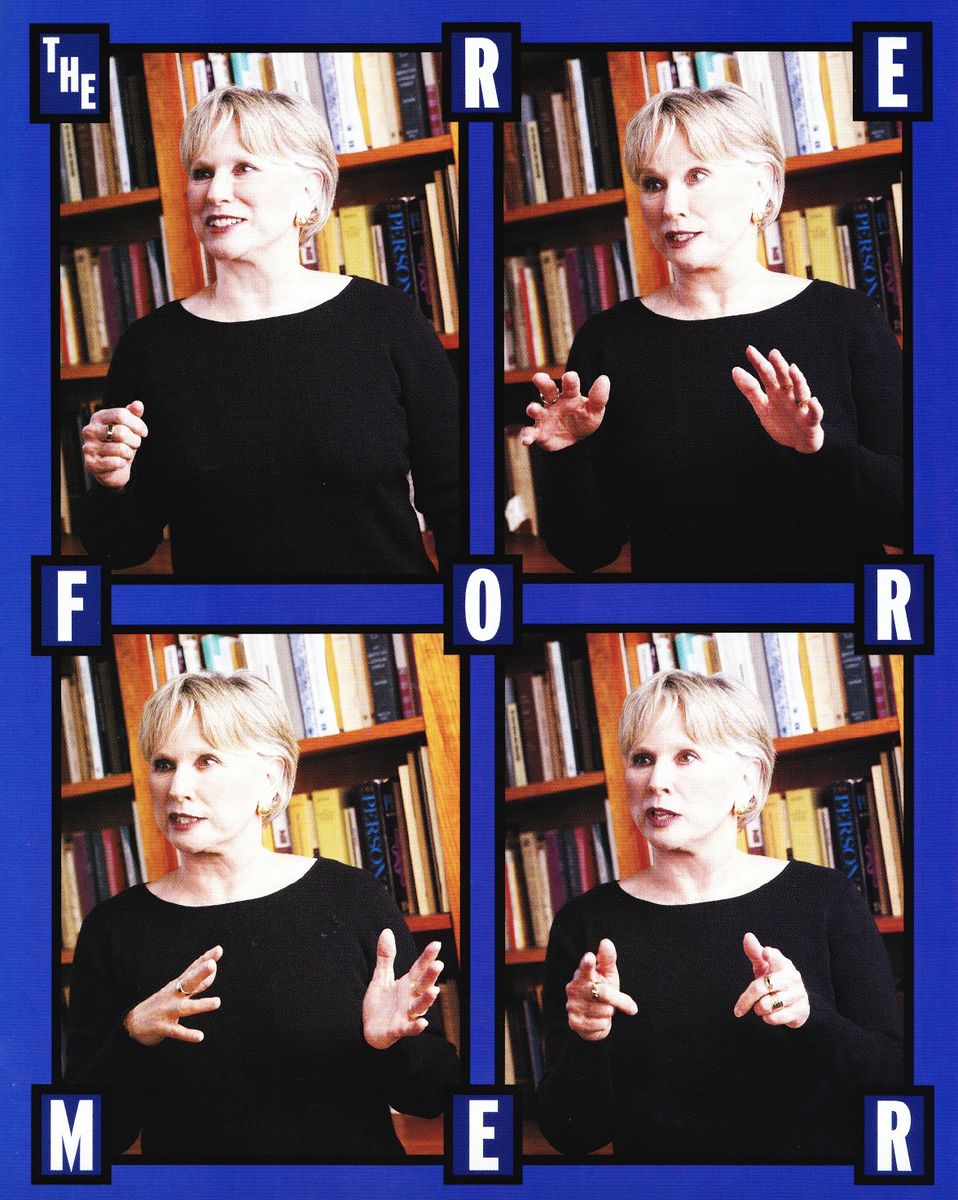
Everyone talks about fixing the schools. But is anyone actually doing anything about it?
Jeannie Oakes recalls being in a meeting with some 30 administrators and researchers from around the country, everyone talking on and on about the problems of urban schools, but no one getting to the heart of the issue.
After a while, Oakes couldn’t take the nattering any longer. “Finally I said, ‘You know, maybe we have exactly the schools we want ... schools that are set up to enable just a few students to do well while others are prepared for places in society that bring them less privilege and material rewards. Maybe one of the functions of our schools today is to justify the unequal structure we have for jobs and income and social status in this country.’”
Not words one might expect to endear her to the educational establishment, perhaps, but Oakes Ph.D. ’80 readily admits that she often walks a fine line, one that tends to diverge on matters of education reform from that of traditionalists.
“I guess they think I’m a little over the edge,” she says. “But I try to say things in a way that doesn’t make other people feel like they are being foolish or stupid. I do it more to prod them along, to get them to think about what’s really going on and to say ‘Whoa! Wait a minute! Maybe we should consider that.’”
What Oakes, UCLA’s Presidential Professor of Education in the Graduate School of Education & Information Studies, wants them to consider is the premise that a one-size-fits-all approach to education can’t work in our stratified society. Rather than reforming around the edges by, for example, simply cutting class size (which itself creates a host of new problems when there aren’t enough qualified teachers for the additional classes that are created), Oakes argues for a “democratic social movement” of parents, students, community organizers and civic leaders to shape educational priorities, rather than leaving them in the hands of the system. Only then, she says, can fundamental changes be made that open the gates of education to all children, no matter what their racial, cultural or socioeconomic backgrounds.
That her words may cause disquiet among some at the higher echelons of education policymaking doesn’t muffle Oakes’ voice. Indeed, her voice resonates, loud and clear. It is heard in Sacramento, where she travels frequently, recently testifying before state legislative committees on K–12 education and university outreach and meeting with lawmakers to talk about the problems immigrant children face in the state’s schools. It is heard beyond the state’s borders when she appears as an expert witness in desegregation cases, gives lectures or serves on committees such as the National Academy of Sciences’ panel to review advanced coursework in high school science and mathematics — a panel she was invited to join, she says, to ensure that the group “doesn’t forget about equity issues.”
Oakes’ solid research, and that of her UCLA colleagues with whom she closely collaborates, is the foundation of her unassailable credibility. And it is her research as applied to the cause of positive social change for which she is perhaps most highly regarded. Her goal: “To undo the destructive connections our culture makes between race, class and intelligence.”
“I greatly admire the way that Jeannie has integrated the highest-quality research with a commitment to social justice,” says Kevin G. Welner J.D. ’88, Ph.D. ’97, assistant professor of education at the University of Colorado at Boulder and co-director of that school’s Education in the Public Interest Center. “She stands as a living demonstration of how these two objectives can, and should, go hand in hand. In doing so, she offers us all a superb model of a morally grounded scholar.”
Through her dogged efforts, Oakes has collected the hard data to back up her claims of educational inequality. Her pioneering and controversial book Keeping Track: How Schools Structure Inequality catapulted her into the national spotlight and spurred a nationwide reform campaign. In it, she revealed that low-income students and students of color are most often the ones identified as “low-ability” or “slow” learners, due primarily to cultural or racial differences that are mistaken for low intelligence. The book, first published in 1985, was recently named one of the 60 most important books of the century by the Museum of Education at the University of South Carolina.
That groundbreaking work was done 16 years ago, but there’s no dearth of related issues today to occupy Oakes’ attention. Education reform continues to be a hot-button topic — take note of the emphasis it received in the last presidential campaign. Closer to home, news stories out of Los Angeles recently screamed yet again about how the standardized test scores of K–12 students consistently lag behind national averages, and how African-American and Latino students fall on the very lowest rungs of achievement.
And while L.A. Unified administrators prided themselves on bumping up the test scores a few notches this year, Oakes was not as sanguine. “We have an enormous responsibility to gather information about the conditions under which children are asked to learn,” she says. “What if for the past four years a child has not had a certified teacher? What if there aren’t enough desks or no science labs? To judge students based on a test score without taking the big picture into consideration is just unfair.”
After an early-morning jog, Oakes jumps into her aging BMW and pulls out of the driveway of her home in Mandeville Canyon, where she lives with her husband and frequent collaborator, Martin Lipton, a communications analyst for the education school’s Institute for Democracy, Education & Access (IDEA). She is heading to her campus office in Moore Hall, which brims with photographs of her four young grandchildren, shelves crammed with books and videos — such as I’ve Got the Light of Freedom, Outsmarting IQ and Stand and Deliver — and a wealth of framed certificates and commendations.
In addition to research and teaching, Oakes heads two new initiatives aimed, respectively, at improving Los Angeles schools and enhancing student diversity within the University of California — IDEA and UC ACCORD (All Campus Consortium on Research for Diversity). These initiatives, as Oakes sees them, go to the heart of UCLA’s mission as a major urban university — focusing the institution’s formidable resources on significant social issues.
In this case, the issue is improving the quality of education that is delivered to underrepresented minority students to make them competitive candidates for admission to the UC.
“Access to college is a key indicator of the health and equity in our system,” Oakes says. “The children who have the least resources outside of school — the least social capital, economic resources and political power — also receive the least from their schools. Access to learning opportunities, to high-quality teaching and to college preparation is vital. Seeing the patterns of access tells us who is getting good K–12 education.”
IDEA is a locally focused effort. Parents, students, educators and community activists work together on outreach projects to promote college access throughout Los Angeles. ACCORD, on the other hand, is statewide, an initiative launched at the request of the UC chancellors to bring together researchers from UC and other institutions to look at issues of access to the University of California.
“Our goal is to make sure that every child in California, no matter their background, has a reasonable chance to join the competition to come to UCLA or Berkeley, the most competitive universities in the state,” Oakes says. “Everybody should have a reasonable chance.”
In the recent Futures project at Santa Monica High School, for example, Oakes and her IDEA team placed 25 Latino and African-American students — none of whom had previously been high-achieving — into college-bound and Advanced Placement classes. At the same time, the students acted as “critical researchers” to observe how they negotiated their way through this unfamiliar, intimidating terrain.
Parents, too, were involved in the process, learning to become advocates for their children.
“For low-income students and families, the school system is a mystery,” Oakes says. “We want poor parents to have the same knowledge and political savvy that upper-middle-class parents already possess.”
The students were also provided many of the things middle-class students generally take for granted — tutoring, access to computers and visits to college campuses. At the end of four years, 80 percent of the students were accepted to a four-year college or university — including one young man who traded his role as a gang leader for that of vice president of the student body.
Last year, Oakes and her colleagues started a similar project helping 400 students in the city of Inglewood find their way to college, starting in the sixth grade.
Oakes’ knowledge of educational inequity comes from first-hand experience. Following a conservative, middle-class upbringing in La Mesa, and college at San Diego State University and Cal State Los Angeles, she taught in Glendora, Calif., where she was assigned to teach three different levels of an English class, including one in which the students, from the very first day, identified themselves as “the dumb class.”
It was clear to Oakes — and equally evident to her students — that they were being tracked according to their perceived abilities. When Oakes questioned the practice of tracking, her efforts served primarily to get her into trouble. It was then, she recalls, that she realized that teachers, even if they have good ideas, “aren’t given the time of day.”
After seven years of teaching, Oakes returned to grad school. She earned her Ph.D. in education from UCLA in 1980 and worked for the Rand Corporation as an education researcher. She joined the UCLA faculty after the publication of Keeping Track.
In her latest book, Becoming Good American Schools: The Struggle for Civic Virtue in Education Reform, Oakes reports on the efforts of educators in 16 schools around the country to eliminate inequalities. The book was coauthored with her husband, UCLA colleague Karen Hunter Quartz Ph.D. ’94 and Steve Ryan Ph.D. ’99 of the University of Louisville.
One close-to-home effort she is most proud of is the revamping of UCLA’s teacher-education program in 1992, shortly after the insurrection that followed the acquittal of four Los Angeles police officers in the beating of African-American motorist Rodney King.
On the day the unrest flared, Oakes was meeting with colleagues in a Wilshire Boulevard high-rise. “We could see the fires starting around the city,” she recalls. “After our meeting, as we crawled through the traffic in our expensive cars back to our nice houses, I thought about the families who lived in the neighborhoods that were burning. I realized then that it was important to pay closer attention to what’s happening in Los Angeles.”
Impelled by that crisis, Oakes and her colleagues took a hard look at the university’s teacher-education program, which had a reputation for graduating well-prepared teachers who would immediately be snatched up by the city’s best middle-class and suburban schools. Today, the program, known as Center X — “where research and practice intersect for urban school professionals” — focuses on turning out “social-justice educators” who are trained to hit the ground running in some of the city’s toughest inner-city schools.
“We’ve graduated teachers who do amazing things with children,” Oakes says. “You can go into some of the most devastated schools in this city, walk into a classroom and see wonderful interactions between children and teachers. They do it without the resources that they need, without the support they need, and they often have to break the rules,” she says. “It’s our job — those of us who teach teachers, who work with the schools — to fix these problems so that people who are well-prepared and committed can do the jobs they want to do.”
For Oakes, fixing problems means working directly within inner-city communities, meeting with grassroots organizers to formulate strategies and convening with downtown administrators. And it means lunching at the Getty Center with civic and business leaders, and attending parties with Hollywood glitterati who profess an interest in school reform and who might be counted on to contribute to the ongoing work.
That ability to straddle many worlds has proven invaluable.
“Because Jeannie is not afraid to let her values shape her decisions about what she studies, her work resonates with those of us who share a vision of schools as places that can transform individual lives and communities,” says Anne Wheelock, a Massachusetts policy analyst, researcher and student advocate. “I can’t think of anyone else who has been as willing to share what she knows and to learn from people who are directly engaged in making change for the most vulnerable students.”
In the end, Oakes says, it comes down to helping people act on their own behalf to create a just world.
“On the one hand, I think I am perceived as a very severe critic of education. But on the other, I see that so many people in the system really do want it to be better. If you can show educators a new way of thinking about something, they are brilliant at figuring out strategies to translate those ideas into action.
“My job is about pushing people, casting issues in a different light. It’s about the constant struggle of ordinary people to make schools better than the larger society in which they exist.
“It’s like Sisyphus pushing the rock up the hill. It’s a huge task,” Oakes says. “But it is the task.”



