If there was an epiphany in the career of UCLA chemist Jim Heath, a moment of pure revelation, it struck in September 1984, on his first day as a graduate student in the laboratory of a Rice University chemist and future Nobel laureate named Rick Smalley. As an undergraduate, Heath had studied chemistry at Baylor but had gone that route mostly because a research job in a chem lab would put spending money in his pocket. It was not, at that time, what one might term a divine calling.
Then he went on to Rice and to Smalley’s lab, showing up on Day One to find himself confronted by a machine technically called a “laser-supersonic cluster beam apparatus” and which Heath describes more simply as “this huge, two-story contraption that had all sorts of lasers around it and no one to run it.” Smalley, who designed the device (which was capable of vaporizing materials to study their constituent atoms or molecules), instructed Heath in the fine points of its operation and together they began to collect data. Late in the evening, Smalley went home to bed and Heath stayed behind, mesmerized by the machine and its capabilities. “At three in the morning,” he recalls, “I had to call Smalley, wake him up and ask him how to turn the machine off. I knew,” he says with a laugh, “I had found the right place to be.”
It was almost exactly one year later that the laser-supersonic cluster beam apparatus, with Heath at the controls, began creating the 60-carbon atom molecule known as C60 or, more popularly, buckyballs (after R. Buckminster Fuller, the American architect whose geodesic dome designs have a structure similar to that atom). The creation and discovery, which opened an entirely new branch of chemistry, led to the Nobel Prize in 1996 for Smalley and the other two senior collaborators, Bob Curl of Rice and Harry Kroto of the University of Sussex in England. It also sealed Heath’s reputation as a graduate student and scientist of great promise. Such recognition might have induced him to devote his life to the study of this remarkable family of carbon molecules. But that wasn’t Heath’s style.
Heath is the quintessential experimentalist: His colleagues describe him as fearless and intuitive, possessing an almost uncanny ability to get an experiment to work. Kroto says Heath has “green fingers,” the experimental equivalent of a gardener’s green thumb. He will attack an interesting problem with the confidence that he will do what has to be done to make it work, learn what he has to learn to solve the problem.
“He has a killer instinct,” says Pat Collier, his postdoctoral fellow at UCLA. “He just knows what’s really cool out there and how to get it.” As a result, his latest work — the creation of a futuristic computer architecture based on molecular switches and quantum wires so thin they are only several atoms across — appeared last July on the front page of The New York Times under the headline: “Tiniest Circuits Hold Prospect of Explosive Computer Speeds.”
And Heath is now a principal investigator in an $8-million endeavor, funded jointly by the Defense Advanced Research Project Agency and Hewlett-Packard Corporation, to turn these tiny circuits into a workable computer. This would be step one in a technology that holds the potential to create computers not only tiny, inexpensive and ubiquitous — “an integral part of every man-made object,” as the Times put it — but 100-billion times more efficient than the PC on your desktop. (The smaller the wires and switches, the less electrical current they require to turn on and off, translating into a computer that can potentially perform a vast number of operations per second while consuming very little power.) Heath is also working to create what he calls the manufacturing technology of the future: a “bottom-up” manufacturing method of chemically assembling his molecular computers and other electronic devices, all so small that millions could fit on the head of a pin.
The notion falls into the realm of nanotechnology, a discipline existing at the intersection of science fiction and science fact that is so exciting and promising that Business Week recently anointed it one of its 21 great ideas for the 21st century. (Literally, nano, from the Greek nanos, or dwarf, means 1-billionth part of, as in a nanosecond.) Indeed, in January, President Clinton announced his proposal to launch a $225-million, multi-agency National Nanotechnology Initiative, promising potential breakthroughs in everything from materials and manufacturing to medicine, agriculture, computation, the environment and national security. As Heath puts it, in his soft-spoken, laid-back Texas drawl: “A manufacturing technology at this scale is inevitable. If we don’t do it, somebody is going to. And probably lots of people.”
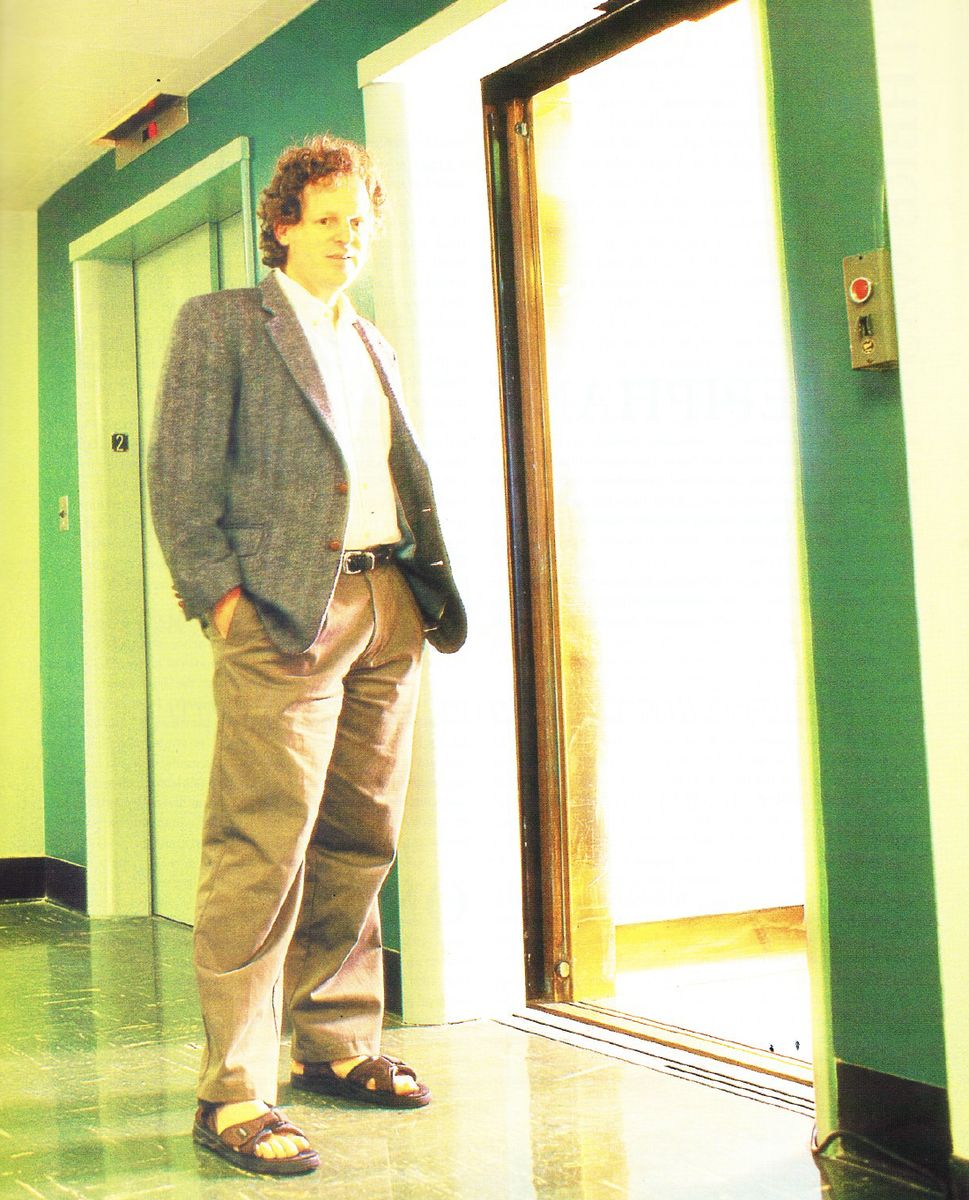
On what passes in Westwood for a cold Friday afternoon in January, Heath is sitting in his office, legs crossed, hair in characteristic disarray, drinking a warm beer from the bottle and describing a spectacular career that could easily have derailed along the way. His first love, for instance, has always been music. (Kroto describes Heath as a “fantastic musician.”) He started on the trumpet in grade school and moved on to the guitar, saxophone and violin. “When I was at Rice,” he says, “I was in a band and we played clubs a lot. Everything from jazz, which is my thing, to rock to reggae to ska.”
After earning his Ph.D. at Rice with Smalley, Heath went on to a postdoc at UC Berkeley under Rich Saykally. The two chemists developed a kind of mutual admiration society. Heath calls Saykally “probably the world’s best spectroscopist,” while Saykally calls Heath “the most brilliant experimentalist” he’s ever worked with. Heath, Saykally also says, is the only postdoc who ever punched him — an enlightening tidbit if ever there was one. The gist of the story is that Saykally found Heath’s intensity and total absorption while doing an experiment oddly amusing, and Heath one day took exception to Saykally’s delight at walking up unnoticed behind him and trying to scare him witless. “He chased me around the lab,” Saykally says, “and punched me as hard as he could in the chest.”
At Berkeley, however, Heath learned the downside of publicly admitting to visionary tendencies, at least when looking for a faculty job. “That year, I was the hot guy on the interview market until people actually heard what I wanted to do, and then nobody wanted to hire me,” Heath says. He was a physical chemist proposing to study nanoscience, to synthesize clusters of metal atoms and study their properties, which required skills far beyond any that came through on his résumé. Saykally describes Heath’s research proposals as “a little too futuristic for most chemistry departments” and so Heath’s efforts racked up a disheartening 0-for-12 record: 12 interviews, 12 rejections. Heath was so depressed by the state of affairs and the specter of working as an industrial chemist — “some guy comes into your lab and hands you some yellow stuff and says, ‘Here, what is it? I’ll be back later’” — that Saykally had to convince him not to quit science. “I was ready to go to med school, law school, do anything,” says Heath. “I didn’t want to do this.”
After another year at Berkeley, however, he did another round of interviews and this time reined in his ambitions, at least publicly. He said he wanted to do physical chemistry, which was what he had made his name at, and was promptly hired by IBM. Heath then took advantage of a screw-up with his laboratory to establish himself in nanotechnology. The IBM episode, says Saykally, was “a beautiful story.”
“IBM promised Jim hundreds of thousands of dollars’ worth of lasers and fancy equipment to do gas phase work, presumably on clusters,” Saykally says. “But they had problems getting his lab renovated and getting some aspects of the lab approved by the safety people. So he had all this equipment sitting out in the hall, and he was getting angry and frustrated and talking about opening an ice cream store in Waco. But IBM emphasizes big, important problems in industry and Jim learned that the big, important problem of the time was how to make silicon and germanium nanostructures and nanowires. And Jim just got out a bunch of beakers, read the literature and figured out how to solve the big problem of the day, all the time while waiting for his physical chemistry lab to come through. And he did it ahead of all the top people in the field. Just like that. He never did uncrate his lasers.”
The denouement to the story was twofold: Not only did it get Heath an offer at UCLA, where he arrived in early 1994, but it convinced him that computers and other electronic devices could be synthesized chemically — from the bottom up — rather than by etching the necessary circuits out of slabs of silicon, which is how chips are made today.
“Today, you take a material and you whittle away almost all of it using lithography,” explains Heath. “It’s like sculpting. You come with a chisel and you take away all the stuff you don’t want. I started thinking about how to build a computer by bringing small amounts of stuff together, molecules at a time. And I realized there’s no reason why it can’t work.”
Now, says Heath, “we work in nano,” giving it a kind of cowboy-like allure. And he has generated a host of research projects based on this infinitesimal scale of chemistry. He is working, for instance, on the study of quantum dots, which Heath calls artificial atoms or nanoparticles — tiny chunks of perhaps a thousand atoms of a single element. Heath and his colleagues have made artificial solids out of these artificial atoms, and they have learned to precisely control the properties of these solids, turning them effortlessly from insulators to semiconductors to superconductors. There are all kinds of “gee-whiz things” one could do with such artificial solids, says Heath, his favorite being the synthesis of sensors that would react to, say, a single photon of light by changing from an insulator to a semiconductor or even a superconductor. He seems most enamored, however, with the pure science promise of the work: “You can really go to your favorite solid-state theory and from first principles design a solid that tests the theory. And so we can design solids that we can flip between metals and insulators and other exotic phases, even superconductors. This is a very, very powerful technology and it’s an area that we invented and have taken pretty far.”
It’s the molecular-sized computer, however, that has captured the attention of the world, or at least The New York Times and other hot media (of Heath, Vanity Fair rhapsodized in its end-of-the-millennium 1999 Hall of Fame: “Like William Blake, he spies the world in a grain of sand”). The idea emerged after Heath was recruited by UCLA chemist Stan Williams to help Hewlett-Packard launch a basic research division. While at HP, Heath and Williams met Phil Keukes, an HP physicist, who introduced them to Teramac, an HP computer capable of astounding performance while being as riddled with defective circuits as Swiss cheese is with holes. This made Teramac exceedingly relevant to Heath’s dreams of synthesizing computers from the bottom up. “If you’re going to design a computer by chemical synthesis,” says Heath, “you’re inevitably going to have plenty of defects. It’s going to be far from perfect. But Teramac had a quarter-of-a-million defects in it and it still did a trillion operations per second. And these were hardware defects, not software bugs. If a Pentium even has one, it’s trash. And so the very fact that this worked suggested that we ought to take some time and learn about this machine.”
Heath, Keukes and Williams, along with HP’s Gregory Snider, spent the next two years studying Teramac and writing a paper for the prestigious journal Science on a computer architecture that would be resistant to defects and that could be synthesized using the techniques of nanotechnology. The essence of their plan was to grow an ordered crystal of redundant wires and switches, locate the defects and then, in effect, download the logical architecture of the computer in such a way that it wired itself around those defects into working circuits. The Science article came out in June 1998 and “made a splash,” says Heath. “I think broken computers resonate with people, and here was one that was broken that actually worked.”
Heath and his group, along with Professor of Chemistry Fraser Stoddart’s group, then spent the next year trying to synthesize their thinking machine. While Heath had thought his quantum dots might be useful, that turned out not to be the case. Instead they have been working on a device built of tiny quantum wires and switches made from Stoddart’s molecules that can be turned on and off through quantum mechanical processes. They published their first example of such a device last summer, which was when they graced the front page of The New York Times. “It was amazing,” says Heath. “I thought we did something pretty significant, but I didn’t think it was that significant.”
Still, the 1999 version of the computer was only what Heath calls a demonstration of architecture. While they could set their molecular switches on or off, they could only switch them once. So Heath and his colleagues have been working again with Stoddart’s and Professor of Chemistry Fred Wudl’s ’64, Ph.D. ’67 groups to concoct molecular switches that can be switched repeatedly, of which they now have four. “You can switch two electronically,” says Heath, “one chemically and one optically. But they’re all based on very similar architectures. Molecules just do things like that.”
Everyone involved, including the funding agents in Washington, seems excited about the work. In part, because Heath and Williams have pointed out that such molecular-sized computers seem to promise a billion-fold increase in efficiency over today’s silicon-chip devices, which are reaching barriers in speed and efficiency set by fundamental physical limits. As silicon devices get smaller and smaller, they begin to edge into a realm in which quantum-mechanical effects become important. To pass this quantum-mechanical barrier requires devices that are inherently quantum mechanical, which is not the case with silicon semiconductors but is with molecular switches. “The devices have to be based on completely different physics from what current semiconductor devices are based on,” says Williams, “and built out of totally different types of stuff. Almost certainly molecules. So we have this dual dilemma: We have to both create entirely new device types and entirely new ways of making them. That’s the basis behind the work Jim and I are doing with HP right now.”
Heath calls the promise of molecular computers “fantastically amazing,” and adds that “it’s very rare in any physical science that you see an operational improvement of a billion that’s just waiting there to be tapped.” Molecular-scale computers hold the promise of putting the calculating ability of today’s most powerful supercomputers in a chip the size of a grain of sand. The potential applications are limited only by the power of the imagination.
For Heath, it’s made his dedication to his science even more intense than it was. Despite having two children, a wife who is a doctor and his own obsession with music, Heath gets into the laboratory at 4:30 or 5 a.m. and works until seven in the evening. He’ll put in another four or five hours on Saturday and Sunday. Sleeping only five hours helps leave time for his family, although not as much as he would like.
“It seems kind of insane,” he admits. “There’s really no excuse for it. But I really want to make this computer happen. I want to see it get built. It would be great if it changed the world, and I think we have a legitimate chance.”



