Every so often, Jo Anne Van Tilburg M.Ed. ’77, Ph.D. ’86 loads up her SUV and heads north out of Los Angeles, past the last mall, the last freeway traffic jam, the last tract-housing development. She drives over the San Gabriel Mountains, turns right at the town of Mojave and crosses miles of scrubland punctuated by sagebrush and Joshua trees. Eventually she leaves behind history as we know it — industry, mass communication, the relentless advance of science — and arrives at Little Lake.
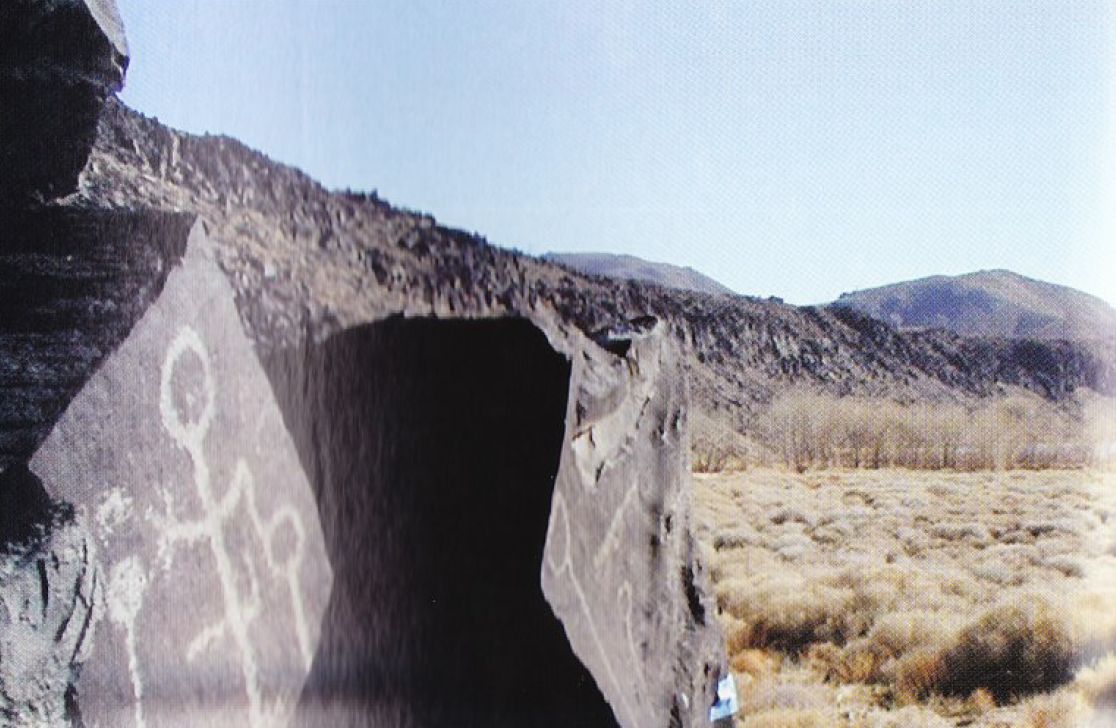
Little Lake is a shallow, spring-fed stretch of water beneath an imposing escarpment of black basalt. In its own right it is remarkable, an unspoiled oasis of grasses and ducks in a region where most of the features called “lakes” are just dotted lines on the map, explained by an adjoining “(Dry).” But what makes Little Lake interesting to archaeologists like Van Tilburg are hundreds of drawings made centuries ago by American Indians who either visited or lived by the lake.
The drawings are petroglyphs, made by bruising a rock face with another rock so that a whitish image appears. Some are clearly identifiable — as mountain sheep, for example, and atlatls (pronounced AT-LAT-uls), which were throwing levers used to launch short spears. Other images are geometric, and still others are open to interpretation.
The mix of subjects and styles here is particularly intriguing, says Van Tilburg. She is well-known in archaeology circles for her research on Easter Island’s monoliths, but she is also director of the Rock Art Archive, which is part of UCLA’s Cotsen Institute of Archaeology. At Little Lake, she says, drawings apparently made by the Owens Valley Paiute — whose culture was centered north of here — appear near artworks in the style of the Coso Shoshone, whose culture arose to the south. Meanwhile, dozens of petroglyphs adorning a cliff at the south end of the site seem to have been done by long-ago travelers.
For years, she says, most archaeologists ignored rock art, here as well as elsewhere, but that has begun to change. While the 25-year-old archive at UCLA — with its collections of photographs, sketches, videos, maps and other data from some 10,000 sites across the state — is the world’s largest repository of information on California rock art, it is also an organization of volunteers who come to places like Little Lake, armed with digital cameras and laser-measuring devices, to document and create modern databases for scholars. So far the archive has produced searchable CD-ROM databases for three sites. This is vital work because a significant portion of the sites have been damaged or obliterated by vandals, development, earthquake and erosion.
This particular weekend, Van Tilburg has mustered a crew of more than 20 enthusiasts — many of them students from the rock-art classes she teaches at UCLA Extension — to help clear up lingering questions in the data from earlier visits. Crews are mapping, measuring and photographing at three locations, scrambling up cliffs and peering at rock faces. “Nobody before us has put this much energy into this area,” she says as she makes her rounds, noting that corrected data from her volunteers will give scholars an important opportunity to test some widely held theories that “are based on a cursory examination of the data.” Little Lake is “an anomaly,” she adds, and intensive scrutiny — along with the latest technology — may yield surprises. “This place,” she says, grinning behind her sunglasses, “is going to set rock art on its ear.”
Among the theories that need testing are two competing hypotheses about the origins of the petroglyphs. The older theory holds that the drawings are related to “hunting magic” — hence the sheep — and were probably made before A.D. 1200, when the sheep disappeared from this area. The newer theory suggests that the images are mementos of “vision quests,” in which shamans sought to draw on the powers of the world around them by inducing hallucinations. The petroglyphs at Little Lake appear to offer some evidence for both theories, Van Tilburg says. But crucial information is still missing, in particular reliable estimates of the images’ ages. The petroglyphs, she says, “could have been made at any time” between the beginning of human activity here, some 10,000 years back, and 1860.
One crew is at work near a lakeside picnic area that has what Van Tilburg describes as “a tremendous clustering” of images — more than two dozen new ones are identified, photographed and mapped before lunch. Nearby, Debra Isaac, a UCLA design major who has become the archive’s expert on image quality, works on a field test of a digital microscope whose high-resolution images could reveal more about patination, the process by which weather and microbes slowly darken the white bruising that makes up petroglyphs. Over at Atlatl Cliff, meanwhile, an aerospace engineer named John Bretney is scrambling over a rockfall to test another advanced technology — a hand-held spectrophotometer, which he hopes will offer precise readings of the difference in color between the petroglyphs and the surfaces on which they were made; the less the difference, the longer the petroglyph has weathered and the older it might be.
At the far end of the lake, teams of volunteers clamber over the cliff where a profusion of petroglyph styles suggests that travelers added images as they passed through. Ji-Son Choi, a UCLA junior, is high among the rocks with Elizabeth Edmunds, a student at South Torrance High School, searching for petroglyphs that have been mapped but not photographed. Even with help from spotters on the ground, the job is a challenge, in part because images appear and disappear as the angle of the sun changes. Already, Choi says, they’ve lost sight of a four-figure group — the two students dub it “Backstreet Boys” — that they know is on the rock face right beside them. Down below, retiree Audrey Kopp ’54, M.Ed. ’55 is peering at the base of the cliff, certain that petroglyph 19-103 — of which she holds a photocopied picture — is in front of her. The task sounds easy enough: Study the pattern of fractures in the photocopy, then search the rock face for its match. But after 10 minutes, Kopp gives up. If the image is there, it is hiding from her.
Still, the day is a success. By the time the sun sets and evening’s chill sets in, many missing petroglyphs have been located, and many others have been mapped for the first time. Van Tilburg’s volunteers gather at the lakeside picnic area for a potluck dinner of stew, vegetarian chili, pasta salads, roast chicken and a delicious tuna loaf concocted by Natalie Ferriz, a French archaeologist who is among the volunteers. Brilliant stars and a waxing moon illuminate the lake, and choruses of frogs serenade the party, gathered close around a campfire with cups of wine and tea. Van Tilburg is laughing and telling stories. In the shadows, mountain sheep drawn centuries ago keep watch.