For decades, muralist Judith Francisca Baca has painted the untold stories and overlooked histories of the city’s ethnic minorities on buildings, outdoor walls and in public places all over Los Angeles. A visual artist with an international reputation, she has altered the outward face of L.A., especially in communities that can now look up to see their own heroes and achievements heralded in bold images.
Venturing beyond visual art, Baca utilizes the mural-making process to span a racial and cultural divide. As a 27-year-old community outreach worker, she first tapped into the team-building power of art in 1973 when she discovered that rival gang members were willing to call a truce to help her create a mural in a city park. Later, as founder of the first City of Los Angeles mural program, Baca saw more than 400 murals produced citywide by 2,000-plus participants in 10 years.
Since then, she has engaged thousands more — the young and old, historical and ethnic scholars, immigrants and pioneers, residents of the barrios and affluent enclaves alike — in the planning, design and creation of public murals.
Baca’s Great Wall of Los Angeles, completed in 1984 along a portion of the Tujunga Wash flood-control channel in Studio City, still stands as a golden example of this collaborative process: The half-mile-long mural, the longest in the world, celebrates the contributions of ethnic minorities to the history of California and America. The work took Baca and a team of 700 residents 12 years to complete.
Today, Baca heads up a much different enterprise at the helm of the UCLA Cesar Chavez Digital Mural Lab at the Social and Public Art Resource Center (SPARC). In a former garage where police squad cars were once repaired, students are enrolled in a groundbreaking workshop/class called “Beyond the Mexican Mural — Muralism and Community Development,” creating art with and for Angelenos. But instead of paper, pencil, paints and airbrushes, students — many of whom have never picked up a drawing pad — use high-speed computers, scanners, electronic tablets, digital cameras and a host of software programs to create large-scale images that blend together elements of real and virtual art.
“We are working on the cutting edge of this field, utilizing absolutely new approaches to muralism,” says Baca, a professor in the Cesar Chavez Center for Interdisciplinary Instruction in Chicana and Chicano Studies and soon to also be on faculty in the Department of World Arts and Cultures.
SPARC, a nonprofit community-education and arts organization, was cofounded by Baca in 1976 before she became one of the few tenured Chicana professors of visual arts in the nine-campus University of California system. Through SPARC, students create digital murals using Baca’s approach of delving deeply into a project through intensive research before generating a single image.
“I learned that art is not about the final result; it’s the process that counts,” says UCLA senior Jennifer Araujo. “Rather than just making art and imposing it on the community, it’s about including the community in what is to be created.”
In six digital murals created for the California Plaza amphitheater titled Witnesses to the History of Los Angeles, students tell the personal histories of people of color: a Filipino farmworker; a former slave who became a beloved community worker; a “cholo” in sunglasses.
Six other student murals hang in the community center of Estrada Courts, one of the oldest housing projects in East Los Angeles. Baca and 15 students worked with residents to create the artworks. “The students literally adopted these families. They ate Sunday dinners with them. They listened to their stories,” says Baca.
The images that emerged from Estrada Courts are poignant symbols of the people’s lives: A photo of a young girl, seen against the backdrop of a bullet-shattered window, dominates one work, while around that stark frame are arrayed images of smiling families and children at play, symbolizing hope for a more peaceful future.
The latest student work ties directly into the rich history of mural-making in Los Angeles, specifically a piece by the late Mexican muralist David Alfaro Siqueiros, América Tropical. In 1932, Siqueiros, whose work is considered on a par with that of Diego Rivera and José Clemente Orozco, was commissioned to memorialize tropical America on an Olvera Street building. Civic leaders envisioned a scene of lush jungle beauty, Mayan temples and happy natives. While those elements emerged as the work progressed, the finished mural — completed by Siqueiros the night before its unveiling after he sent everyone else home — offered a much harsher interpretation: a crucified Mexican Indian with an eagle perched vulture-like above. Siqueiros would say later that he never intended to portray “a continent of happy men, surrounded by palms and parrots, where the fruit voluntarily detached itself to fall into the mouths of the happy mortals.” América Tropical was almost immediately ordered whitewashed.
As his only surviving public mural, América Tropical is hidden behind a protective curtain and fiberglass cover. Conservators have removed the whitewash and cleaned and stabilized the mural, and a campaign will launch in October to raise $3.7 million to build a shelter, interpretive center and viewing platform from which the public can see this once-censored work.
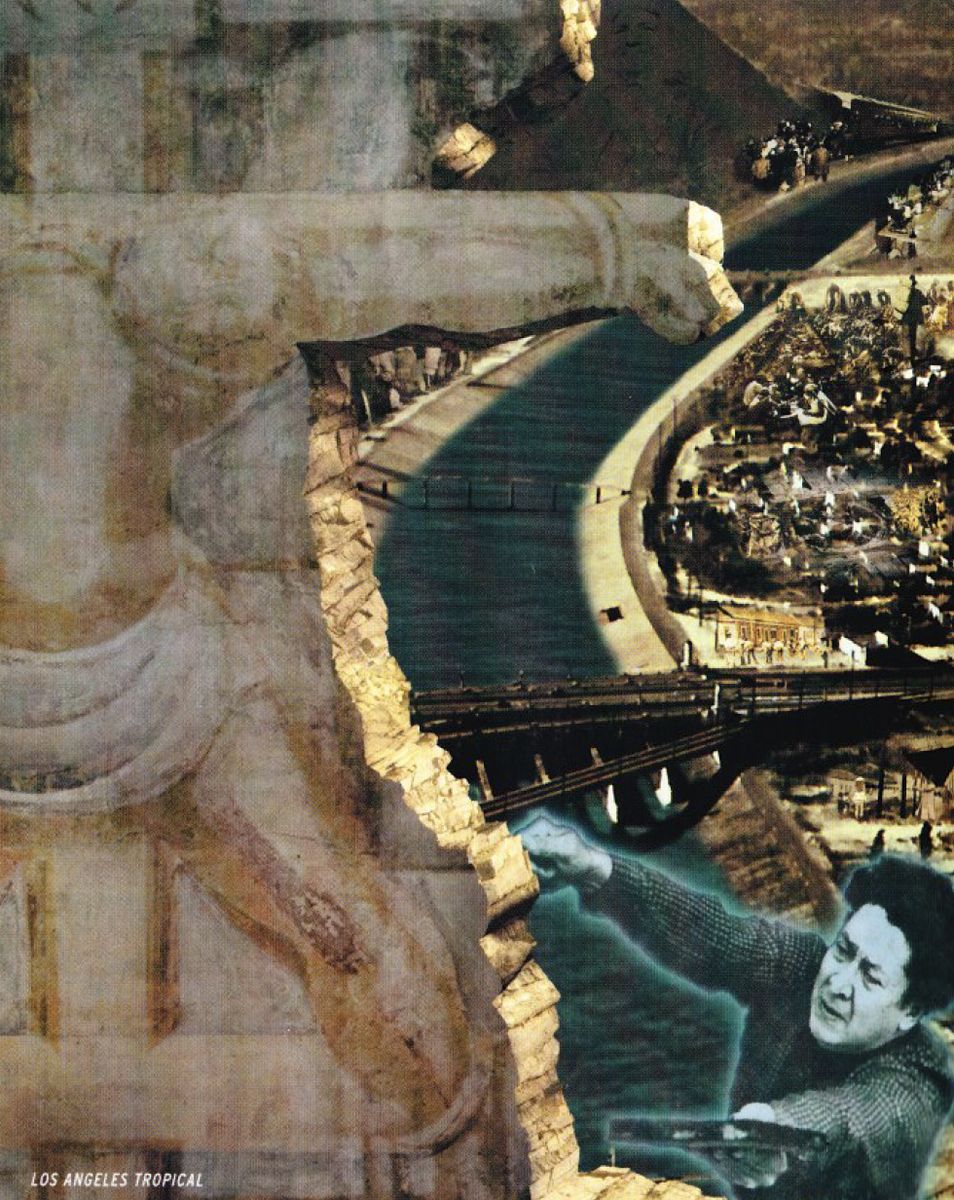
As visitors make their way to the Siqueiros mural center, they also will see in the access way a contemporary mural that places Siqueiros in the context of the social tumult of his time. Using 3-D software to “explode” an image of América Tropical, Baca and her students show the muralist through the jagged outline of his crucified peasant, suspended in space over the Los Angeles River. In Los Angeles Tropical, the far-off landscape below shows fragments of historic scenes of desolation and poverty: breadlines, sweatshops, forced deportations, the Dust Bowl migration.
“When people see this piece, they will understand what was happening at the time he painted it — a vision of Los Angeles at the turn of the century,” says Ramón De La Rosa ’00, who worked on the project. Two more student works, including The Corn Goddess, will eventually be installed in the entrance way when it opens in 2002.
“Being in this class was the most unique learning experience I have ever had,” says De La Rosa. “What we learned went beyond art; we learned to work together creatively. I’ve never had an experience like that, and I don’t think I ever will again.”
Baca’s determination that her students’ work be about more than just the creation of art is evident.
“They must research widely, but they also must have dreams and visions of their own and not just spout back rote information,” she says. “They are creating sites of public memory. They must ask themselves, ‘What should we remember? Whose story should we tell, and why?’”