The technology for monitoring the human body has an inherent problem: The human body is squishy. Materials that conduct electricity to observe our organs must be magnetic. And for something to be magnetic, it usually has to be rigid. But our organs aren’t rigid. They’re irregular blobs of mostly water.
This means that a sensor made of stiff magnetic material attached to our mushy tissue won’t create an entirely flush connection. There are many tiny areas where the inflexible sensor won’t make perfect contact with the skin, heart or muscle it’s measuring. Those gaps make the device less sensitive, accurate and effective.
“Because the materials are solid, they have this mechanical mismatch with human tissues,” says Jun Chen, associate professor of bioengineering at the UCLA Samueli School of Engineering. “So that gives poor conformity. Poor conformity will undermine the performance of conventional solid bioelectronics. After I joined UCLA, I began thinking, Can we develop liquid bioelectronics?”
The answer, it turns out, was yes. Chen’s most recent breakthrough, published in the journal Nature Materials, does just that. Chen is one of the world’s most influential scientists in the science of materials; he’s been working at the intersection of biology and nanoelectronics for years.
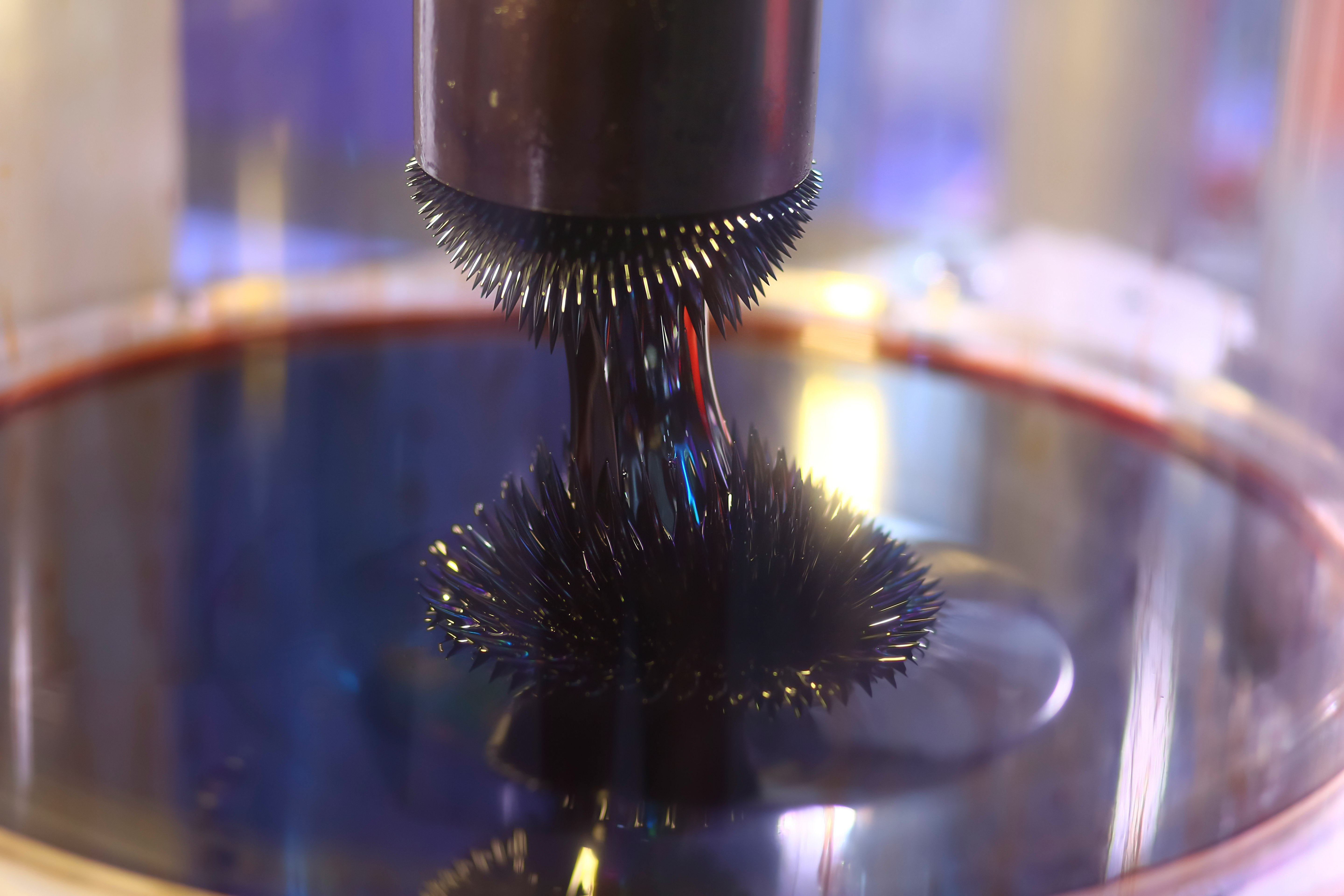
But a liquid bioelectronic material has long been butting up against a physics problem: A fluid magnetic material can’t be permanently magnetic on its own. It requires an external magnetic field to align and maintain the tiny magnetic particles in the liquid, creating a material with overall distinct positive and negative poles. Otherwise, the constant motion of the liquid randomizes the tiny magnets’ orientation, canceling out any overall polarity.
To combat this randomized movement, Chen and his team decided to increase the size of the magnets. Instead of 10 nanometers, the scientists upped the particle size to 10 micrometers, or about one-fifth the size of a human hair. (in contrast, 2.5 nanometers is about the diameter of DNA). While the millions of tiny magnets are no longer buffeted around by the liquid molecules, they’re now heavier and settle to the bottom.
“Just like if you throw a stone in the water, the stone will sink to the bottom,” Chen says, “because of gravity.”
This “sinking” disrupts the magnetism. But when Chen used a strong magnetic field to assemble magnetic particles into a three-dimensional network structure inside the liquid, the support created permanent magnetism with some fluidity remaining. The result is a fundamentally new material called permanent fluidic magnet, or PFM. It still acts like a liquid in important ways, such as being injectable by a syringe, but it also solves a previously unsolvable problem: improving auditory sensors by eliminating air gaps between the skin and the device, leading to improved voice-activated technologies, such as wheelchairs. Chen believes it may also be used in surgical procedures, since it’s easily and noninvasively placed on and retrieved from organs via syringe. He even foresees the possibility that the breakthrough might lead to the eventual replacement of common medical devices such as blood pressure cuffs and pulse oximeters.
“I think the world is marching toward the Internet of Things,” Chen says. “Everything will be reactive to the internet in the future. We want to build up tiny, versatile, soft, implantable bioelectronics to promote the health care of human beings.”
Read more from UCLA Magazine’s Winter 2026 issue.