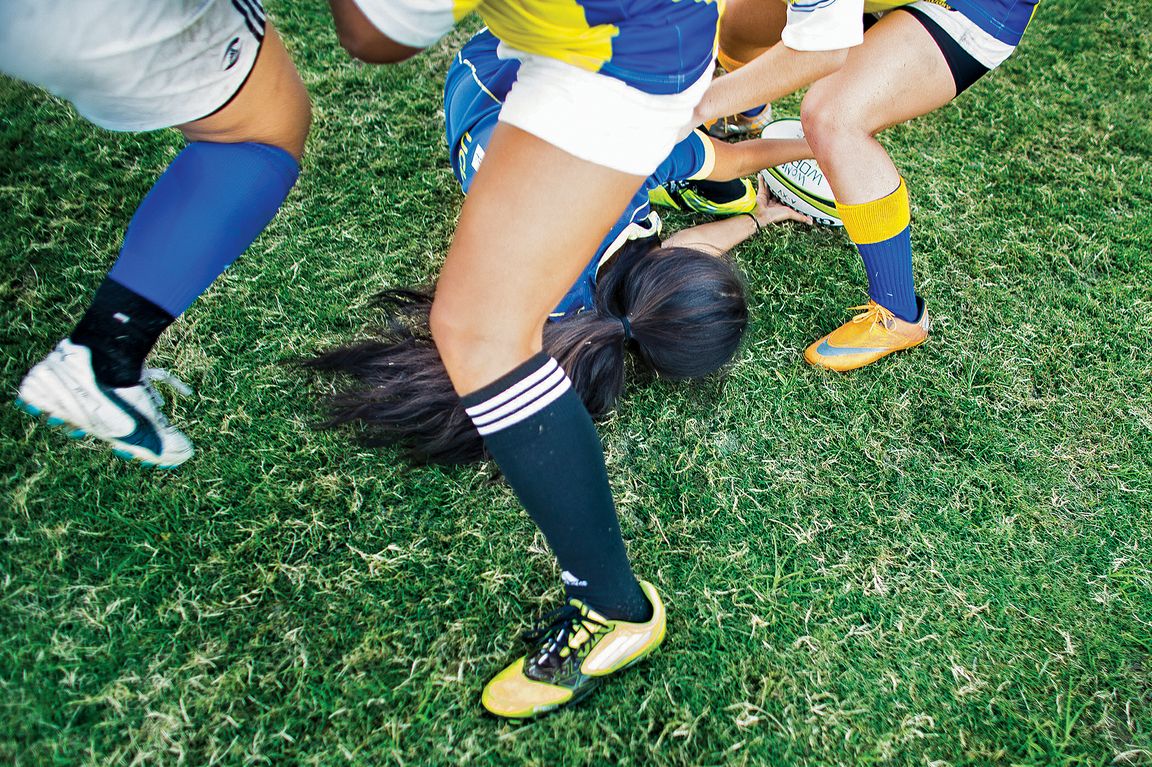
Administered by UCLA Recreation and operated by student officers, club sports in Westwood is big-time. In all, 1,500 Bruins, almost all of them undergraduates, are involved. Positioned between the more casual intramural sports and the high-profile world of intercollegiate athletics, these are student-athletes in the literal sense. But why are these students, with their full academic workloads and part-time jobs, so dedicated to their respective sports? We visited with players on three of the more unusual clubs to find out.
WUSHU
These Kids Are Fast as Lightning
“Wushu? Is that like mu shu? Is it pork, or chicken, or something?”
Karen Mok gets that reaction a lot when she tells people she’s president of the UCLA Wushu Club. Wushu — which means “martial arts” in Chinese — may not be a household word in this country, but it’s certainly something many people have experienced if they’ve seen such popular films as 2000’s Crouching Tiger, Hidden Dragon.
The beauty of wushu — China’s national sport — lies not only in its power, but also in its grace. A seamless combination of gymnastics, dance and weaponry, wushu requires athletes to perform a complex array of kicks, punches, spins and stances (called taolu, or “forms”), upon which they’re judged. Or they may choose to spar (sanda) in groups of two or more while wielding spears, staffs or swords, in which case careful choreography is necessary to avoid injury.
At 9:40 p.m. on this Tuesday night in early October, approximately 60 students have gathered for a UCLA Wushu Club practice in the John Wooden Center. For the next two hours, everyone will gamely follow Mok’s instructions as she takes them through a demanding workout that begins with a warm-up of running and stretches, continues with instruction in various stances and ends with an intense period of conditioning (euphemistically called “happy hour”).
Their hard work will pay off, however, as UCLA Wushu is very highly ranked — second only to UC Berkeley’s club, Mok says, which has been around longer than anyone else’s. UCLA’s club competes in two big tournaments each year: the Chinese Martial Arts Tournament held at UC Berkeley, and the Collegiate Wushu Tournament, which rotates among the different schools.
Mok herself is a wushu veteran, having taken up the sport at age 9. She has enlisted the help of a volunteer coach, JunChang Lu, who will arrive later in the quarter. On this night, however, Mok — a fourth-year senior majoring in physiological science — has the teaching assistance of co-vice president Austin Wang, a sophomore from Palo Alto, Calif.
Like Mok, Wang grew up with wushu and enjoys it for many reasons, including the fact that it requires both physical strength and mental agility. “You have to think about what you’re doing,” he says. “There’s so much mental stuff that goes on. It’s like a never-ending sport, where you can always improve. That’s what I love about it.”
Co-vice president Julie Wang, a junior from Oak Park, Calif., had no prior wushu experience but did have eight years of ballet. “I appreciate the similarities between dance and wushu. They both utilize many of the same skills, including flexibility and memorization of movements,” she says. “Besides, who could say no to running around with a sword?”
Third-year nursing major Anebel Brinkmann admits she was intimidated when she first joined the club in her freshman year. Now, as a safety officer and social chair, she hasn’t looked back.
“It’s still really hard, both mentally and physically taxing,” Brinkmann says. “But I’m more confident in the skills that I have gained, and I feel that I can progress further each year. … I hope to be one of those little old ladies, doing tai chi in the park!”
WOMEN’S RUGBY
Ruck On
In what sport is a score called a “try”? Where “props” and “hookers” immerse themselves in “rucks” and “scrums”? Where the ball must be passed sideways or backwards to be legal?
If you said rugby, give yourself five points. At times erroneously described as “American football without pads,” this sport with the rough reputation has been gaining popularity with Bruin women since 1975, when a group of inspired student-athletes founded a women’s rugby club on campus. In 2005, UCLA Women’s Rugby joined the collegiate division of the Southern California Rugby Football Union and, for the past five years, the fiercely competitive Bruins have earned trips to the College National Championships.
Yet surprisingly, more than 90 percent of UCLA’s current team had never played rugby before joining the club.
“I’d never even heard of rugby, except for that movie with Matt Damon [Invictus, 2009],” says Lianne Pak, a second-year student who serves as the team’s external vice president. She found out about UCLA Women’s Rugby during freshman orientation and decided to sign up. She was not without her misgivings, however.
“I was scared because of all the tackling and everything,” she admits. “But the people on the team, they’re the reason I stayed. They’re really cool people.”
Fifth-year sociology major Lucy Tin was also new to rugby when she joined the team in her freshman year. “It was really intimidating, because these girls were just so serious about rugby,” she recalls. But with her basketball/track-and-field background, Tin was able to power through the exhausting workouts and even landed a starting position as a rookie. Her parents were initially worried about her playing rugby, she says, but they relented when they saw how much she enjoyed it. “My favorite part of rugby is tackling people,” she confesses.
As it turns out, even third-year student Diana Nguyen, the club’s current president, wasn’t familiar with rugby until she got to UCLA. “I had no clue whatsoever,” Nguyen says, laughing. “My freshman orientation counselor shared her experiences [about being on the rugby team], and she told me, ‘Hey, you should join rugby.’ So I watched YouTube videos of rugby. I was like, ‘Wait a minute. You tackle people in this game? What?’”
Three years later, Nguyen is president of the club for the second straight year. She heads an executive committee of approximately 10 members who help her with the many tasks needed to run the club. The team’s schedule this season includes thrice-weekly practices, two tournaments, eight league games, playoffs and, hopefully, another trip to nationals. There is also the group’s annual Prom Dress Rugby game, in which the team plays rugby in prom gowns as a publicity stunt.
Nguyen’s biggest project, though, involves working with UCLA’s Club Sports staff to upgrade her team’s status from Tier One to varsity — taking them one step closer to becoming an NCAA sport.
“I get e-mails from girls who actually played in high school, from out of state, out of the country,” Nguyen says. “They say, ‘I hear you have a rugby team. I want to apply.’ And I’m like, wow! That makes me feel so good. It’s not only good for our team, but it’s good for UCLA.”
SURFING
Totally Tubular
UCLA’s Surf Club has a problem most of the other club teams don’t have: They can’t schedule group practices. It’s not for lack of trying. Mark Harrington, president of the club, has made efforts in the past to organize practices for upcoming contests. But it’s tricky.
“It’s pretty difficult to get everyone together in the same place at the same time,” says Harrington, a fifth year senior majoring in chemical engineering. “Also, it’s hard to predict more than a couple of days in advance — really, more than a day in advance — where the best waves will be. So if you tell everybody to go to Manhattan and it’s a lot better in Malibu, no one’s going to show up at Manhattan.”
Instead, club members practice on their own time, but they’ll often link up with other members. Being on a team is an opportunity for serious surfers to network with each other and get down to the beach together, Harrington explains. The strategy has worked well for UCLA’s team, which was consistently one of the top-seeded teams last season and placed fourth out of approximately 20 teams at the National College Championships in Huntington Beach, Calif.
As a member of the National Scholastic Surfing Association, UCLA’s team regularly competes against other schools on the California coast, including UC Santa Cruz, USC and UC San Diego. During a contest, surfers are entered into “heats,” where they are given 15 minutes to score their two best waves. Adding maneuvers (turns, spins and airs) helps to increase the score.
Prospective members must try out for the UCLA team by going down to the beach and showing Harrington and a few other senior members what they can do. If admitted, they’ll choose whether to compete on shortboards (under 7 feet long) or longboards. Most members surf recreationally, although a few have had sponsors in the past (surf companies such as Billabong or Quiksilver provide money or free clothing in exchange for the surfer putting their sticker on his/her board).
The talent on UCLA’s team has increased significantly over the last few seasons, Harrington says, and a few of its women members have even taken time off school to surf professionally. Chandler Parr, a third-year student, is still considered a sophomore due to her part-time status the last few quarters.
“Juggling school with the competitive tour has been challenging, but I have been lucky enough to have, for the most part, supportive teachers who have been nice enough to let me send my assignments in from wherever I may be and let me make up test exams,” says Parr, who joined the UCLA Surf Club as a way to meet other surfers on campus.
For Jason Schechter, a second-year political science major with a minor in philosophy, joining the club team was a priority. “Before I applied to colleges, I researched to find out what schools had a surf team in California,” he says. “Having a surf team was one of my criteria for a university. After discovering that UCLA had a surf team, I knew that I wanted to come to this school.”



