Editor’s note: This is an article from the Summer 1999 issue of UCLA Magazine.
It’s an eccentric, but beloved ritual that we aspiring screenwriters look forward to every quarter: Lew Hunter, our professor, cheerleader, mentor and muse, totes a duffel bag full of exotic, palm-sized figurines into his class and sets them up around the room’s perimeter. The 137 figurines, collected in Hunter’s world travels, all tell a story. There’s the Russian boy holding a fish and gesturing with his free hand about “the one that got away.” Or the figure of the Taj Mahal, built by a sultan in honor of the wife who gave birth to his 14th child.
The display, Hunter tells us, demonstrates to us screenwriter wannabes our place in the history and panorama of storytelling traditions. “You are here,” he says, “because you are storytellers, too.”
It’s heady stuff for us lowly and insecure students who would give our left arms for the privilege of joining the ranks of the “schmucks with Underwoods,” as Jack Warner once described screenwriters. And that was how he talked about the successful ones.
To us hopeful scribes, whose futures largely depend on our ability to persevere in the face of relentless rejection, calling us storytellers is just one of the uncountable acts of kindness and generosity that we will miss from Hunter.
Hunter, whom friends say has the “energy of 10 men,” is officially taking a long-overdue sabbatical next year in which he plans to finish three books he is currently writing about screenwriting and mentoring. He will continue to serve as a part-time faculty member of the University of Paris-Sorbonne, as a professor at the Croatian Summer Film Academy and a script resource for the Greater African Script Fund.
Hunter and his wife, Pamela, are also moving to Superior in Hunter’s home state of Nebraska, where they will be converting an eight-bedroom historical mansion into a writer’s retreat. When Hunter returns to UCLA, he plans to scale back his teaching duties to just one quarter a year in a gradual effort to retire.
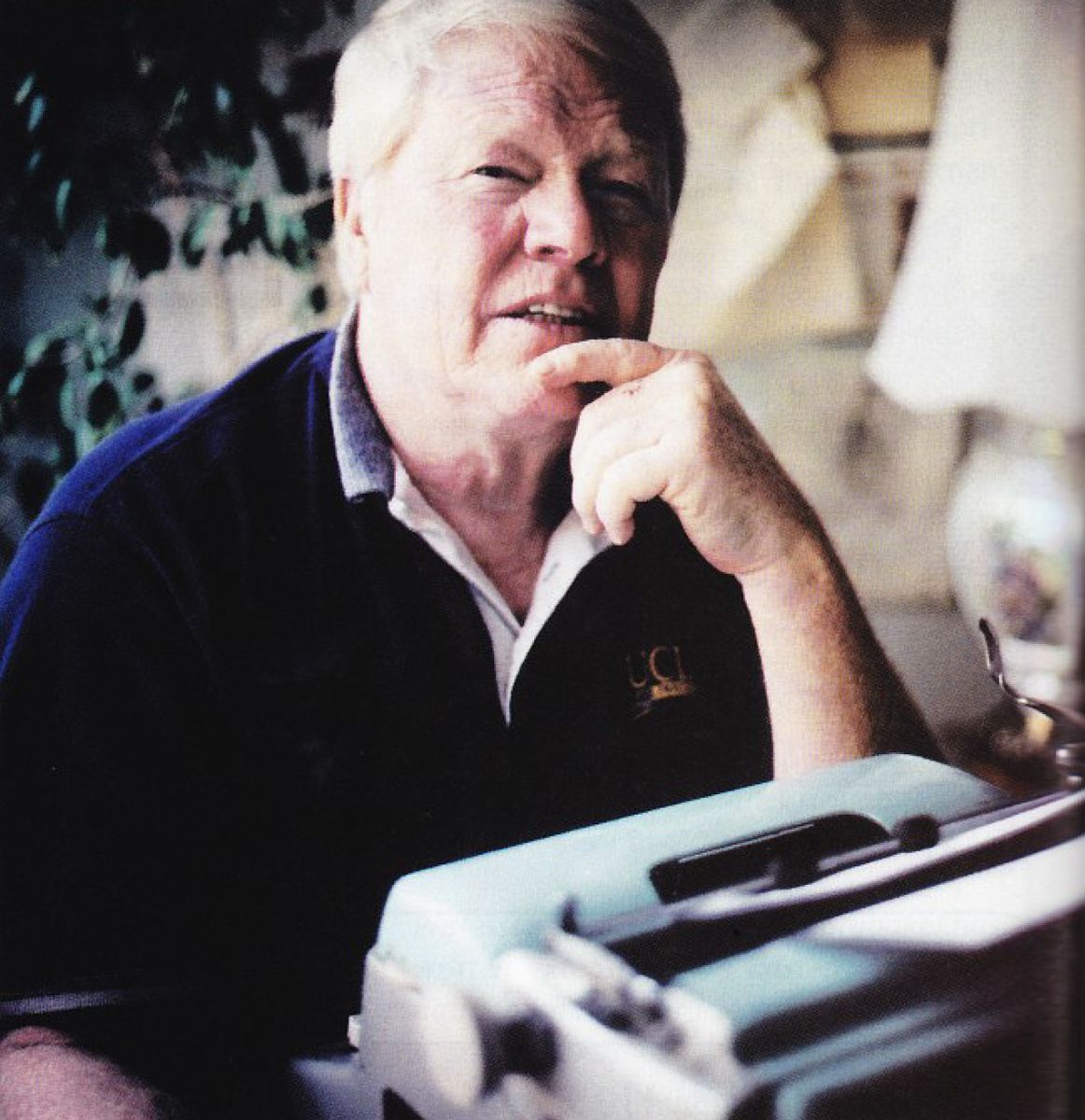
“I love it here. I bleed blue and gold,” says Hunter, co-chair of the Screenwriting Program in the School of Theater, Film and Television (TFT) since 1988. “But I’ve been thinking about how many more fruitful ticks I have on the mental clock before it goes south, and I’ve been wanting to fulfill them in a less structured environment.” Hunter is himself one of Hollywood’s great characters. At 63, he has the boyish good looks of Glen Campbell; a voice as sonorous as John Huston’s; and a homespun, Nebraska farm-boy persona that belies his political savvy and salesmanship ability.
His career as a writer and network executive spans four decades. His list of Hollywood hotshots who will return his calls include Disney CEO Michael Eisner, TV mogul Aaron Spelling, Sony president John Calley, producer Peter Guber and Emmy Award–winning writer/producer Steve Bochco. Yet, Hunter still drives around with copies of unsold scripts (“still available,” as he prefers to call them) in his trunk.
“Don’t let that farm-boy stuff fool you,” says screenwriting co-chair Richard Walter. “He has a cunning, capable grasp of university politics. It comes from his network experience and his background in dealing with creative people in a formal structure.”
Like every screenwriting professor at UCLA, Hunter has a loyal coterie of groupies. What distinguishes Hunter’s groupies from others is that they can cite passages from his book, Lew Hunter’s Screenwriting 434 (now in its 10th printing), as if it were the Bible. Hunter, who frequently refers students to his book and liberally quotes himself, doesn’t discourage the comparison.
“I feel like Saint Paul, treading the Mediterranean, spreading the gospel of screenwriting,” he says. The comment would sound self-important from almost anyone else. But from Hunter, whose legendary generosity surprises even his closest friends, the remark somehow manages to sound humble. “I have always been astounded at his seemingly unflagging energy in his commitment to his students,” says Robert Rosen, dean of the TFT. Hunter’s spirit is perhaps best encapsulated in Writer’s Block, a monthly social gathering of aspiring screenwriters that Hunter and his wife have hosted at their Burbank home for nearly 20 years. Only the civic unrest curfew following the Rodney King verdict could keep the party’s staunchest devotees from arriving on the Hunters’ doorstep.
Although some cynics sniff that the party devolved in recent years to include increasing numbers of has-beens, misfits and posers, Writer’s Block launched at least three marriages, despite its reputation for stale popcorn and industrial-sized bags of chips.
The Hunters hosted their last party in February after putting their house up for sale. The following month, more than 350 students, alumni and friends gathered at the James Bridges Theater to pay tribute to the Hunters for hosting what one speaker called, perhaps a tad hyperbolically, “the most successful social group for writers in the history of the world.”
Hunter, who wore a kilt to the tribute in honor of his Scottish roots, sat with an arm around his wife and two granddaughters on his lap as speaker after speaker thanked him for his friendship, wisdom and generosity.
“In the loneliest profession, he gave us all a home,” says former student David Tichter, a writer who helped Hunter organize the first Writer’s Block in 1979.
“He inspired and encouraged us with an almost freakish, religious fervor,” adds screenwriter Michael Werb, a Hunter alum who co-wrote the blockbuster Face/Off and The Mask.
The stories of Hunter’s generosity are as colorful as scenes from any of his own 50 or so screenplays. He promised his seven grandchildren he would pay for their college tuition. He spent part of a trip to Croatia picking cigarette butts out of the cobblestone streets of an 11th-century village. He put his home phone number in his best-selling book. He cheerfully accepts phone calls well past midnight from anxious young writers needing words of encouragement. He regularly has out-of-town students to his home for Thanksgiving dinner, and he once organized a baby shower for a student who was pregnant with triplets.
When aspiring screenwriters not enrolled in the program call Hunter for advice, he inevitably meets with them, often forgetting to collect even the nominal fee that friends urge him to charge for his script-doctoring services. San Francisco businessman Jonathan N. Zakin, an aspiring screenwriter whom Hunter mentored in just such a fashion, was so impressed by Hunter’s selflessness that he donated $500,000 to the School of Theater, Film and Television to establish a chair in screenwriting in Hunter’s name.
But it’s the house-sized heart that Hunter brings into his classroom — a tiny, claustrophobic room above a noisy rehearsal hall — that we students will most remember and miss. With his African grey parrot, Sunny Ray, perched on his shoulder, soiling his papers and pecking his neck, Hunter is a wise, eccentric and friendly guide on a sometimes frightening, often exhilarating, journey of the soul. In discussions peppered with references to Aristotle, William Faulkner, Ecclesiastes, Marcel Proust, Lysistrada, Phil Aulden Robinson, Tennessee Williams, Mel Tolkin and his mother, Esther, Hunter reminds us that we are engaged in an honorable enterprise to show the world we are not “just taking up space.”
He has strong opinions on everything from the importance of clearly focused antagonists to the ideal number of brads holding a script’s pages together (“Three. You don’t want the readers’ crumbs to fall through the middle onto their laps.”). He hates parentheticals meant to direct how an actor reads (“You’re not going to tell Anthony Hopkins how to play a scene.”). And he insists that scene headers include nothing more descriptive than “day” or “night.”
But the most important lesson young screenwriters need to absorb, Hunter says, is the simple value of “being a decent person.”
“If you’re a decent person, that will come through in your scripts, your characters and your stories, and could help people in your audience become better than they are possibly inclined to be,” Hunter says. His emphasis on human values in an industry known for its shark-like ethics has earned him the respect and devotion of hundreds of students over the years, many of whom have gone on to become some of Hollywood’s top A-list writers.
“What is the one script you have to write before you die?” Hunter asks at the beginning of his seminars. “Will your life count for something? Can you be as good as yourself?”
It is questions like these that challenge us at the core of our humanity and “set the tone for us to write our most soulful works,” says Shelley Anderson M.F.A. ’98, a former student of Hunter’s and a longtime friend.
“Great teachers, great mentors and great men often come to us once in a lifetime,” adds UCLA screenwriting instructor Linda Vorhees, who studied as a student with Hunter. “But in Lew, we have them all rolled up into one.”
Kim Kowsky is a freelance writer in Los Angeles. She is pursuing an M.F.A. in screenwriting in the School of Theater, Film and Television and someday hopes to see her name on the Big Screen.