Editor’s note: This is an article from the Summer 1996 issue of UCLA Magazine.
There’s a good chance that most of us could count the number of great educators in our lives on the digits of one hand. There’s the teacher who got you excited about a subject you thought you hated. There’s the one who inspired you to travel, having opened your eyes to new worlds. Then there’s the one who upended your prejudices. And the one who nurtured your professional dreams. And — who could forget? — the teacher who taught you to think.
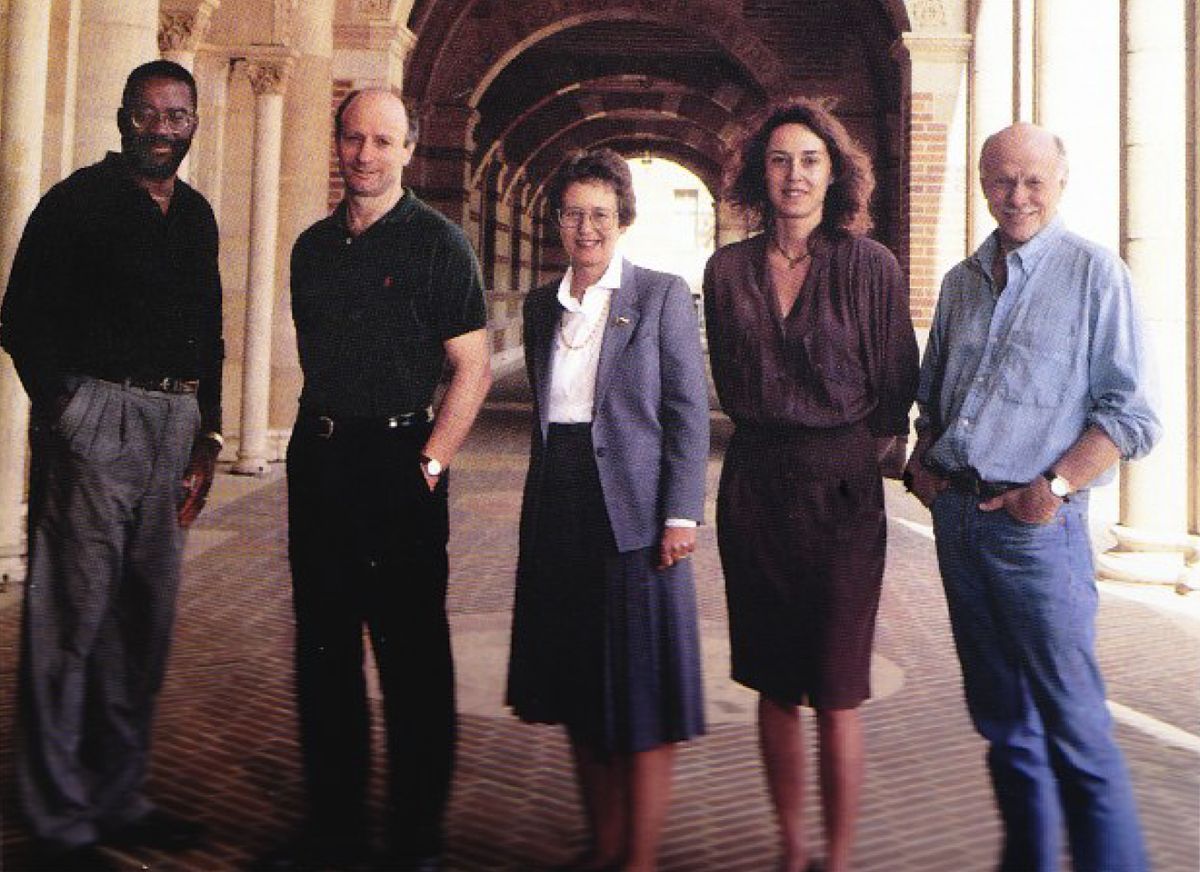
Here we present a full hand of UCLA’s best educators: the five tenured faculty winners of the 1996 Harriet and Charles Luckman Distinguished Teaching Awards. Nominated by academic departments (on the recommendation of students and fellow teachers) and selected by the Committee on Teaching of the Academic Senate, each honoree receives a $6,000 stipend along with the award.
Those chosen have little in common in respect of their areas of expertise, yet they share the corny-but-true characteristics of all great teachers: tirelessness, purpose and passion. They’re the kind of teachers you wish you could go back to school for.
Walter Allen, Sociology
“I love to teach,” says sociology professor Walter Allen, a childlike grin animating his bearded face. “I understood pretty early the privilege and power of teachers — I was saved by teachers.” Allen, 47, grew up in segregated Kansas City, Missouri, but found “magnificent” instructors at his high school. They helped him excel in both academics and sports, and convinced him that although no one in his family had gone past 12th grade, he could succeed in college.
Allen’s aspirations for his UCLA students are even higher. “Over my career,” he says, “my goal is to produce 100 new African-American Ph.D.s, and 500 total. I love mentoring graduate students — coauthoring papers with them, doing joint research projects — and I start when they’re undergraduates by encouraging them to go on to doctoral programs.”
Allen, who came to UCLA in 1989 after 10 years at the University of Michigan’s Center for Afro-American and African Studies, is currently on a teaching hiatus while serving on the demanding Committee on Academic Personnel and completing several research papers. His areas of interest include African-American families and the status of African-American students in U.S. colleges — subjects he discusses eagerly and intently, fixing the listener with a piercing gaze. One imagines that he communicates just as dynamically with students.
“I think of teaching as mutual encounter and engagement,” explains Allen, whose “dizzying array” of teaching subjects has included the sociology of education, theories of race and ethnicity, and medical sociology. “I tell students that knowledge won’t flow in just one direction. And I work them mercilessly and shamelessly — because, as I tell them, each time you extend to what you think is your limit, you find there’s more beyond that.”
He beams when reminded of the Luckman award. “It is just magnificent,” he says, employing his favorite superlative. “Teaching tends to be seen as an avocation, while research is your vocation. But teaching is central to my career — and being recognized for that means more than I can say.”
William Gelbart, Chemistry
A backhanded compliment from an undergraduate student sums up William Gelbart’s pedagogical success. “Professor Gelbart,” the student told the 50-year-old chemistry professor, “I really enjoyed the class. But I still hate chemistry.”
For a non-major, the subject can be daunting, but Gelbart presents topics with a vigor that makes you want to understand all those Greek-lettered formulas. And comprehension is obviously important to him, as he constantly scans the classroom as if to ask, “Any questions?”
Astonishingly, no one’s taking notes. “I like to provide the notes, so that students won’t be distracted by writing things down,” he explains. “Then they can think about what I’m saying. It’s hard to think when you’re writing. I resented the fact that I had to do all those mechanical things in school.”
The child of mathematicians in upstate New York, Gelbart always knew he wanted to be a scientist, but didn’t settle on chemistry until halfway through Harvard. He thus became the one who “left the family business,” since his identical twin brother — with whom, remarkably, he shares a distinct European-sounding accent developed from speaking mainly with each other for much of their childhood — went into math as well.
Gelbart heads UCLA’s physical chemistry division. A theoretician rather than a lab scientist, he’s particularly interested in the physical phenomena occurring in complex fluids such as blood. He’s not just a thinker, though: His trim, athletic physique hints at his abiding interest in sports. He admits that he plays hoops like the football halfback he used to be: Opponents have called fouls on him even before he collides with them.
That same enthusiasm, manifested perhaps somewhat less physically, fuels his teaching. “The guiding force for me is how much I didn’t like being a student — but how much I like what I’m doing now,” he says. “I feel lucky making a living doing exactly what I love to do, teaching a subject I still want to learn.”
Phyllis Guze, Medical School
It’s 8:30 a.m. at the Veterans Administration Medical Center near UCLA, and Dr. Phyllis Guze, bagel in hand, is questioning residents about vaginal discharge. Specifically, she’s asked about how her students discuss the subject with their patients. Admittedly, it’s an odd subject to cover during breakfast, but Guze — chief of the Department of Medicine at the VA since 1988 — handles it with good-humored aplomb.
“I asked her how many partners she had,” reports the resident handling the case. “What do you mean — on her date last night?” responds Guze, setting off laughter from the lab-coated doctors.
It’s not a joke, though: Guze’s job at the daily case study session is to challenge these young doctors to ask the right questions, prescribe the proper tests and make the correct diagnoses. “We have a long tradition in medicine of mentors and role models,” she explains. “We teach by example.”
Guze’s example is clear: “I have a passion for medicine. And I delight in being able to stimulate bright people to develop in their areas of interest. The hallmark of a good teacher is when your students do better than you.”
Guze, 53, took a winding road to her medical degree. Raised in Bayside, New York, she grew up at a time when women weren’t easily accepted into med schools — so she became a P.E. teacher before finally going to USC to study internal medicine. Her own list of inspirational mentors is headed by her late husband, Lucien Guze, with whom she worked at Harbor General Hospital.
She came to the VA in 1981, finding there “an exciting sort of intellectual atmosphere that you try to bring back to the patient.” Her specialization is in sexually transmitted diseases and infective endocarditis — heart disease. Along the path to her present position she also served as dean of education for the UCLA School of Medicine from 1991 to 1995.
It’s not surprising that one of her proudest achievements in that position was a course on “Doctoring,” which covers the humanistic, ethical and community-oriented aspects of medicine. In other words, it teaches M.D.s to be more like Dr. Phyllis Guze.
Judith Carney, Geography
Teaching or research? Cultural geography professor Judith Carney doesn’t see it as an either/or choice. She’s never so inspired — or inspiring — as when she’s sharing her current research with students. After a recent lecture on how African slaves brought rice-cultivation systems to colonial South Carolina — her current focus — Carney’s students actually clapped, she recalls with amazement.
“I’ve been in a lot of really remote places in Latin America and West Africa, and I draw on those experiences in my lectures. I think that’s very attractive to students,” she says, explaining the enthusiastic response. “I also try to teach appreciation for different cultural experiences — and students feel empowered by that.”
Carney’s own cultural experience is quite different from that of most academics. She grew up fatherless, on welfare, in Detroit — without a family car, without books and with no promise of higher education. She became the first college student in her family to earn a liberal arts degree, and then ventured out into the world. She worked as a potter, a stewardess, a waitress — and traveled as much as she could. In Latin America, her attention was “riveted” by the rain forest and by the people’s poverty; eager to learn more, she applied and was accepted to graduate school in geography at UC Berkeley.
Carney briefly worked in international development, but “didn’t find many idealists there.” So she brought her idealism to UCLA in 1989 and a few years later became the first tenured female geography professor since 1956.
“Students tell me I help them think critically,” she says with modesty. “I don’t know how — I just do it. A little bit of magic happens. Plus, I’m enthusiastic; I’m not cynical.”
That, alone, is worthy of applause.
Peter B. Hammond, Anthropology
Most teachers ask students to evaluate them; few actually use the evaluations for self-criticism. But there’s anthropology professor Peter Hammond, a remarkably youthful 67-year-old, admitting that yes, he tends to talk too fast, and yes, he may be too apologetic.
“I think that’s not irrelevant,” he tells about 35 undergraduates in his course, Anthropology 197, titled “The Cultural Construction of Gender: Homosexuality.”
“A lot of us have heard for most of our lives that we’re morally ‘bad.’ It’s very hard to maintain a positive sense of your own identity. The messages that a culture gives do have important consequences for homosexual people.”
For the openly gay Hammond, who’s teaching the first-ever gay studies course in anthropology, even a personal struggle for esteem can be grist for his students’ education. He has been a faculty member in residence at the dorms for five years and holds regular open houses and rap groups.
“I just had the feeling,” he says of his efforts, “that a lot of young folks were struggling with issues, and afraid they were the only one thinking about that at UCLA.”
The son of a Pulitzer Prize-winning economic historian, Hammond says he became an anthropologist to escape the prejudiced confines of his hometown, Glendale, California. He was especially disturbed when Japanese Americans from the community were temporarily interned in Santa Anita’s horse stables during World War II. “As a gay man,” he says, “I felt somehow that I’d be next. I wanted to understand how something like that could happen.”
That led him to applied anthropology, where “you take your understanding of how cultures work and apply it to the resolution of human problems.” He has encouraged students to directly apply their studies through internships in the community. His own research focuses on economic development and culture change in former French and Portuguese colonies in Africa, and as the current chair of the Chancellor’s Task Force on Lesbian, Gay and Bisexual Studies, he’s helping to develop a minor in that academic area.
By serving as a role model, Hammond hopes to give students what he craved growing up. “That’s the way,” he explains, “that you can reenact your youth — and make it come out right.”