Editor’s note: This is an article from the Fall 1998 issue of UCLA Magazine.
Hurtling down U.S. 395 through the high desert on the eastern slope of the Sierra Nevada, it takes an observant driver to catch a glimpse of the stone pagoda-roofed sentry posts rising amidst the endless desolation of sage and scrub. There, for the seeming edification of the local population of jackrabbits, lizards and buzzing insects, rests a marker bearing the inscription: “May the injustices and humiliations suffered here as a result of hysteria, racism and economic exploitation never emerge again.”
Welcome to California Registered Landmark No. 850: Manzanar, the first of America’s 10 “relocation centers” scattered throughout remote areas of the country to which more than 120,000 people of Japanese ancestry — two-thirds of them U.S. citizens — were forcibly evicted and imprisoned during World War II.
Spread among Manzanar’s 813 acres were the trappings of Everyday America — churches, post offices, schools, recreation facilities, gardens, stores, a cemetery — but these attempts at normalcy couldn’t hide the fact that the centers were concentration camps. The camps were surrounded by barbed wire, with guard towers. The guns of armed soldiers on patrol pointed inward, toward the people living there, U.S. citizens who had not been tried or convicted of any crimes, who were put there only because of their ancestry. There were instances when those soldiers did not hesitate to use their weapons with deadly effect against those who vainly tried to flee.
No similar camps were established for people of German or Italian descent. What happened to the Japanese-American community as its population was rounded up and shipped off in the months following the bombing of Pearl Harbor was the mournful culmination of a tide of anti-Asian sentiment that had been building since the late 1800s.
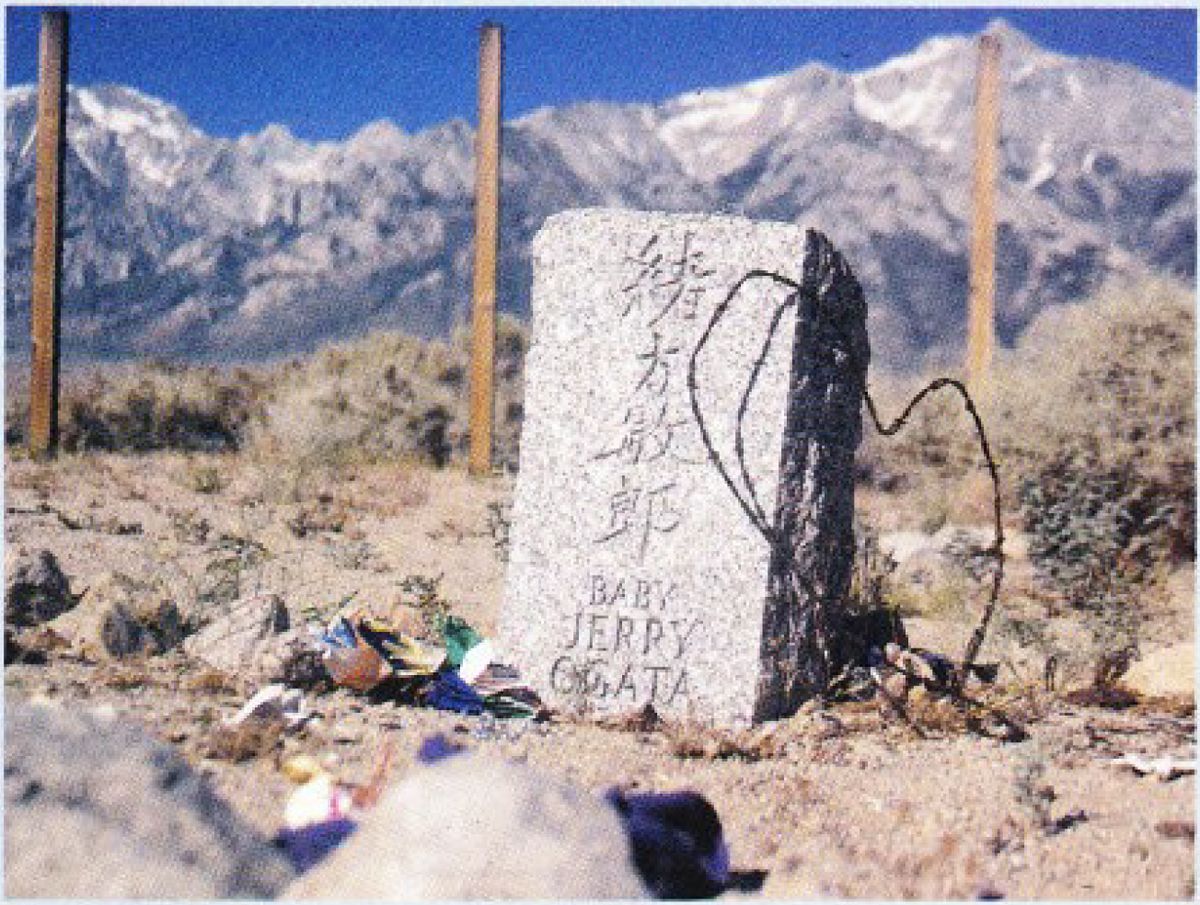
The tar-paper barracks are now gone, and except for the small cemetery with its whitewashed obelisk memorial set against the backdrop of the saw-toothed mountains, little is left among the dirt and sand roads to remind postwar generations of the story of Manzanar or Poston, AZ, or Minidoka, ID, or Jerome, AR.
Executive Order 9066: The Incarceration of Japanese Americans During World War II, a CD-ROM produced by the UCLA Film and Television Archive in cooperation with L.A.’s Japanese American National Museum (JANM), with financial support from Mitsui and Co., tells that story completely and honestly for the first time. It is also an artistic achievement. Awarded second prize for CD-ROMs by the American Association of Museums, Executive Order 9066, which took 18 months to complete, was christened by the Library Journal, “one of the most powerful and well-produced titles we’ve ever reviewed.”
The interactive CD-ROM is an unblinking account of the incarceration, the events that led up to it and its aftermath. In addition to hundreds of photographs, artwork, personal accounts, chronologies, maps, documents, news clippings and historical essays, the CD-ROM includes more than 30 minutes of archival footage — including sections from UCLA’s Hearst Metrotone Newsreel Collection as well as rare home movies taken secretly inside the camps, where cameras were forbidden to internees.
The impetus for the CD-ROM, as well as the source of much of the material, had its roots in a 1994-’95 JANM exhibit, “America’s Concentration Camps: Remembering the Japanese American Experience.” (The exhibit, including an installation of the CD-ROM, is currently on display at Ellis Island through January 5.)
“When I first saw the exhibit, I was knocked out,” says Steve Ricci ’76, M.A. ’79, Ph.D. ’96, head of research and study and director of new media for the Archive. “This was a subject that has been covered so lightly in books and classrooms that it seemed to me there needed to be a way to document it more fully for a wider audience.” The way, Ricci concluded, was through interactive technology. He proposed a collaboration in which the Archive would offer its technological expertise to produce and direct the CD-ROM and the curators at JANM would oversee the content.
“CD-ROMs are not like books. They are not like films or documentaries. They are their own media, their own form,” Ricci says. “Do you organize the information in a linear fashion, like a book? As a film, with a more temporal unfolding of events? Where do you put the photographs in relation to the text? How do you display video so there is context? These are all design issues which have serious implications for how people digest the information.
“If you go into a project like this and think of it only in terms of pages in a book or scenes from a film, you are missing all of the power of this new medium. At the same time, there are no written standards for how to use it in the best way, so it was a real challenge to create something that was visually strong, content-driven and accessible — without making it so slick that the look overshadowed the content.”
In fact, there are few bells and whistles; the most innovative feature is probably a note-taking utility that allows users to write down their thoughts and reflections and incorporate them into the content of the CD-ROM. “The note-taking utility was difficult to create, but we felt it was very important to include,” explains Ricci. “It gives the ability to open a dialogue, to create a living archive.”
A major issue was how to deal with the documentary film footage. The Hearst newsreels are pointedly propagandistic and in favor of the incarceration. In terms of continuity, they are polished, produced with dramatic music and bombastic narration. In stark contrast, the amateur films are rough, uneven, without narration, offering mute, often poignant, images of life as it occurred.
“We have two sets of film — where is the truth?” Ricci asks. “The amateur footage provides actual witness to the tragedy, but the newsreels are polished and slick. They have a completely opposite point of view and played a huge role in the formation of public opinion at that time. So how do we show them in relation to one another? How do we validate them, or do we let them speak for themselves as historical documents? Do we add a warning label that says this footage represents a specific point of view and is propaganda?”
The latter approach was anathema to Ricci. “I abhor the propaganda of the newsreels, but I would be loath to go in there and start futzing around with the content.”
To deal with the issue, Ricci decided to project the video footage against a backdrop of still images, faces of Japanese Americans inside the camps. “These photographs are a reminder of the reality,” Ricci says. “We put the film within the context of the people who lived the experience.”
Professor of documentary film in the School of Theater, Film and Television, Robert A. Nakamura M.F.A. ’75 was 6 when his family was taken from their home in Los Angeles and sent to Manzanar. It fell to Nakamura to compile the home movies incorporated into the CD-ROM. It was an emotional experience — not only for Nakamura.
“People are incredulous,” he says. “They cannot believe it. They ask, ‘Where did this happen?’ They cannot comprehend that it took place in the United States.” That, says Karen Ishizuka, curator of the Japanese American National Museum exhibit, is exactly why Executive Order 9066 is such an important educational tool. The essence, she says, is that people not forget this happened in a country with a strong constitution and a democratic government.
“It goes back to Martin Niemoeller’s quote during World War II: ‘They came for the Communists, but I wasn’t a Communist — so I didn’t object. They came for the Socialists, but I wasn’t a Socialist — so I didn’t object. They came for the trade union leaders, but I wasn’t a trade union leader — so I didn’t object. They came for the Jews, but I wasn’t a Jew — so I didn’t object. Then they came for me — and there was no one left to object.’
“I don’t want children growing up thinking this was something that happened a long time ago to another people and is just a part of history,” Ishizuka says. “We all need to understand that if we are not vigilant this is something that could happen again.”