As I walk into Margueritte Aozasa’s office on the second floor of the J.D. Morgan Center in the heart of campus, she is in the midst of changing her plans to attend the FIFA Women’s World Cup in Australia this summer. Her family had surprised the championship-winning, first-year coach with this well-earned treat. There is only one problem: Her return ticket would have her back home the day after her UCLA squad’s training camp starts. “I have to be here before that day,” she says.
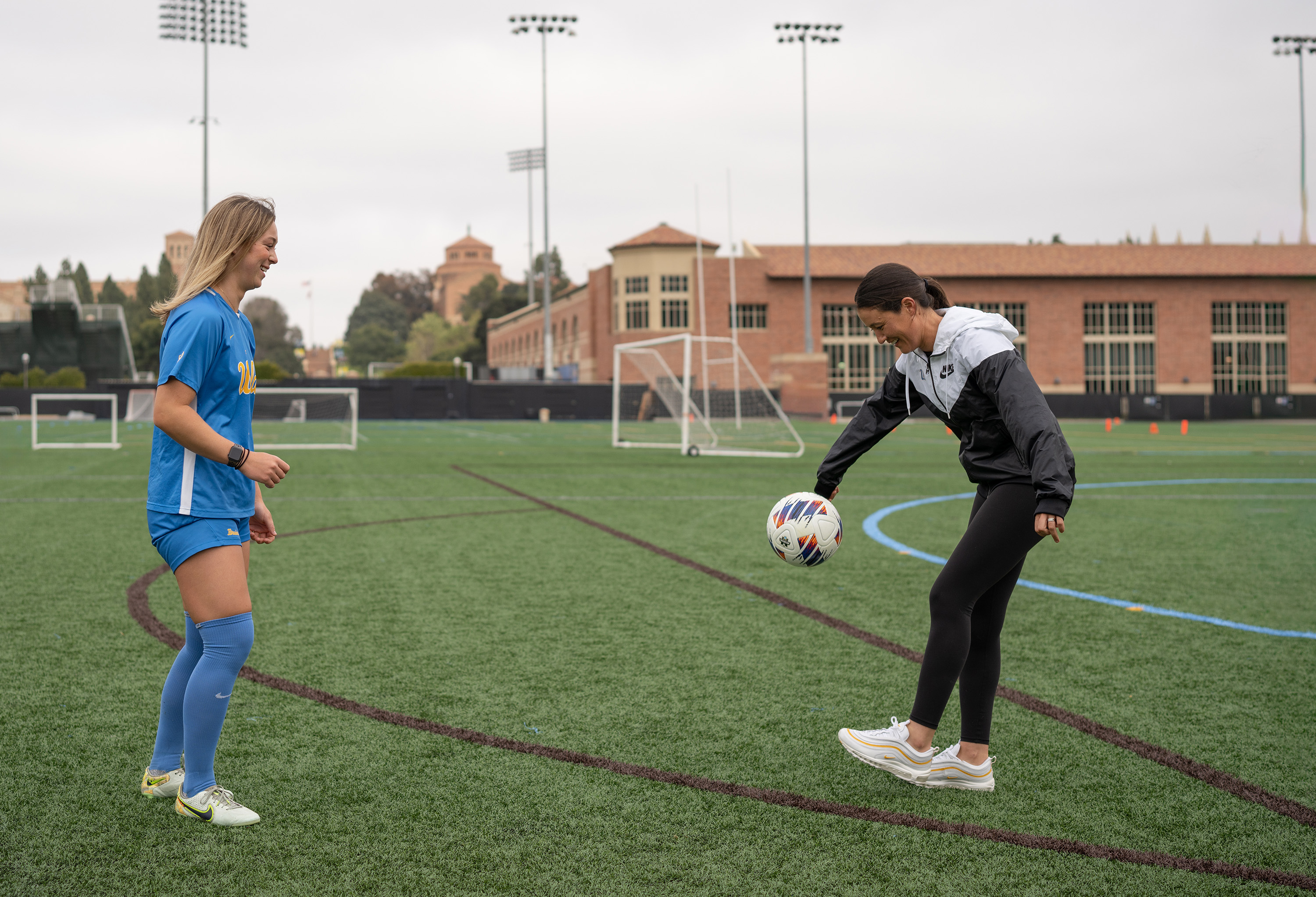
Dressed in a black UCLA Bruins tracksuit and matching ball cap — and sporting a glittering wedding ring — Aosaza, 33, is reflecting on how much her life has changed since December 2021, when she was hired as the head coach of UCLA women’s soccer. A year later, she would be celebrating having led her team to the greatest comeback ever seen in a Women’s College Cup final. On the wet morning of our meeting, Aozasa has just returned to Westwood from working on the road as an assistant coach for the U.S. Under-23 National Team.
Martin Jarmond, UCLA’s Alice and Nahum Lainer Family Director of Athletics, took a gamble with the first head coaching hire of his tenure. Although Aozasa had collected two national championships and numerous Pac-12 honors in her seven seasons as a Stanford University assistant coach, hiring a 31-year-old with no previous head coaching experience was risky. But from the time she interviewed for the post, Jarmond says it was clear that the Mountain View, California, native “was ready to lead.”

Meeting her now, that’s clear to see. One way to describe Aozasa is kinetic. Even when she’s just sitting at her desk, her eyes communicate a competitive drive, a curiosity, a desire to move forward. Her energy is tangible, but controlled. Legendary former UCLA gymnastics coach Valorie Kondos Field ’87 calls it Aozasa’s “quiet strength.” Upon first meeting the new soccer coach, the woman everyone calls “Miss Val” remembers thinking, “Wow, her calm is actually intimidating. She must be the real deal.”
She is. As a four-year starter at Santa Clara University, Aozasa operated in the midfield and also as a center back for the Broncos. There, she says, Head Coach Jerry Smith opened her eyes to strategies and tactics she had never seen before. The adaptability and flexibility Aozasa has carefully woven into the DNA of her Bruin bunch is a legacy of her time playing under Smith.
Aozasa then worked under Paul Ratcliffe ’94, Stanford’s Knowles Family Director of Women’s Soccer, one of the nation’s greatest college coaches. A former Bruins midfielder whose team won a national championship, Ratcliffe served UCLA’s program in the ’90s as an assistant and also as interim head coach for a time. Following his next coaching stint, at Saint Mary’s College, he ended up at Stanford, where he’s stayed for the past 20 seasons. When Ratcliffe hired Aozasa, she was 24 and had no college coaching experience (notice a theme?). His instincts served him well: The two enjoyed great success — including two national championships — over seven seasons.
Aozasa is a lively storyteller, recalling moments from matches and conversations over the past year in vivid detail. From behind her desk, she occupies her hands with a paperclip, her fidgeting revealing not nervousness but a store of pent-up energy and ingenuity. She stays present, she is engaging, and her answers are definitive. She talks like a coach, but one who represents a new breed, with more value placed on being accessible, approachable and player-friendly. “We talk a lot,” she says, “about trust.”
What a Difference a Week Makes
It’s Sunday, Dec. 12, 2021. Within a week, Aozasa will have made the biggest commitments of her life. The shift in her world, between now and seven days hence, will be seismic. By Saturday, Dec. 19, she’ll be married to Mykell Bates, a fellow Santa Clara alum and soccer coach. By Sunday, Dec. 20, she’ll be celebrating her honeymoon on a Hawaiian island. What she doesn’t know on that day, as she stretches into child’s pose, is that she is about to receive a text on her smartwatch that will whip the winds of change into a full-blown cyclone. Her life — personally and professionally — will be entirely transformed by Christmas.
The meditative state Aozasa had worked to achieve in the yoga studio that Sunday was suddenly thrown into a twist — by the news that her dream job was within her grasp. The message was from Erin Adkins, UCLA’s senior associate athletic director, wanting to talk about the possibility of her becoming UCLA’s sixth head coach of women’s soccer.
“From an early age, she showed a willingness to outwork everyone to become the best at what she does. She was a leader, and her teammates would follow her to the end of the world.”
— Albertin Montoya
Aozasa finished the class before having her first phone conversation with Adkins in the yoga studio parking lot. The hourlong chat was fruitful; 30 minutes later, she was on the phone with Jarmond. The next day, she was on a plane to L.A. A marathon day of interviews went well, and then it was back on a plane to the Bay Area and a wedding to prepare for that weekend.
By the following Tuesday, Dec. 21, Aozasa was on her Hawaiian honeymoon and had been offered the job as the new head coach of UCLA women’s soccer. The newlyweds looked at each other in disbelief. “Our lives are going to be so different when we get to the mainland,” Aozasa remembers saying. “We’ve got to move. You’ve got to find a new job. I’ve got to take over a whole team. What is happening?!”
Championship Caliber
What did happen? The Bruins collected UCLA’s 120th overall NCAA championship and their second for women’s soccer, following the first in 2013. And Aozasa led the UCLA women’s soccer team to the title in the most dramatic of fashions, rewriting history in the process: The victory made her the first rookie head coach to win the Women’s College Cup, as well as the first Asian American woman or woman of color to take the trophy home.

It wasn’t all smooth sailing. Aozasa remembers her first week at the helm as shaky. She and her staff were looking to turn around the team’s mentality by implementing significant changes to UCLA’s traditional all-out-attack style of play. Aozasa says, “I just knew defending is really what wins championships.”
She credits the team, buoyed by the nation’s No. 1 recruiting class, with buying in from the beginning. But it wasn’t until the fourth match of the season that she began to see the squad’s true potential. They were talented enough to be a top-five team in the nation. But a road trip that began in Santa Clara before dates with Duke University and the University of North Carolina cemented for Aozasa everything she needed to know about her team. The Bruins pulled off wins on all three away dates, the last two in the sweltering heat of late summer in North Carolina.
It had been at least two decades since any team had emerged victorious versus both Duke and UNC on the road. To top it off, the Bruins lined up with a number of players out of their usual positions, defending in a low block and playing for counterattack chances — atypical for a UCLA team. During the UNC match in particular, Aozasa says, “We had players run 8 or 9 miles in a game on a hot Sunday afternoon. It was pretty special to see the work rate and the commitment to the game plan. I think that gave us a glimpse of what this team has — the intangibles. I’m like, ‘OK, that’s a championship-caliber team.’”
The performances didn’t let up. The Bruins started the season on fire, rattling off 13 straight wins and ending up at the NCAA College Cup in Cary, North Carolina, where the high-flying West Coast outfit blew past fellow No. 1 seed University of Alabama in the semifinal to set up a final showdown with UNC three days later.
A Final for the Ages
The final took place on a Monday night under the floodlights in North Carolina. The Bruins were welcomed to WakeMed by a crowd of 10,000 — (mostly hostile) — fans. It’s difficult to beat a good team twice in one season, and Aozasa’s team found that out the hard way. After playing relatively well, UCLA somehow found themselves two goals down with 15 minutes left to play.
But five minutes later, sophomore forward Lexi Wright scored amid a penalty box scramble, giving UCLA a foothold in the match. There were 10 minutes to go, and the Bruins believed they could go on to win. That belief was not unfounded. The team had not lost a match in which they had scored all year.

The rest is, literally, history. With mere seconds left on the clock, junior forward Reilyn Turner, two UNC defenders and the ball all ended up in the back of the net with 16 seconds left in regulation. UCLA had tied the match. Then, with barely three minutes remaining in overtime, graduate midfielder Maricarmen Reyes pounced on a rebound and scored the game-winner. No team had ever come back from two goals behind to win a College Cup final.
Having captured two national titles before as an assistant coach, Aozasa’s favorite part of the victory was watching those around her taking that ride for the very first time. “I felt a much bigger appreciation and pride watching my players,” she says. “There is nothing more special than the first.”
Want to experience the thrill of the Bruins soccer championship? Read a vivid, graphic-novel retelling.
Destined for Greatness
Albertin Montoya was Aozasa’s first soccer mentor as her coach at Mountain View Los Altos Soccer Club. She played for him for 10 years, then coached for him at the club for 12 more. The bond between the two is more father-daughter than coach-player. It was from Montoya that she learned to instill joy in her players while coaching the sport.
“From an early age, she showed a willingness to outwork everyone to become the best at what she does,” Montoya says. “She was a leader, and her teammates would follow her to the end of the world.”
Aozasa’s passion for soccer is visible even in her mostly spartan office. One noteworthy decoration is a Real Madrid jersey, blotted here and there with the age-weathered, handwritten scrawls of the 2012 UEFA Champions League winners. As we talk football fandom, she expresses admiration for not just Real and Sergio Ramos, but also for Pep Guardiola’s Barcelona (she watches YouTube highlights of Andrés Iniesta when she feels down), and U.S. women’s national team stars Rose Lavelle and Naomi Girma (the latter a player she once coached at Stanford). Whether or not someone she coaches pursues a professional career — “even if they become an investment banker” — Aozasa hopes they’ll still love the game.
One thing that’s never in question is her love for the game. As she plans for her second season as the Bruins’ head coach, Aozasa says, “I’ve been fortunate enough to have never faced the day that I’ve wanted to leave soccer.”
As long as that remains true, UCLA — and the greater soccer community — can consider themselves fortunate, too.
Read more from UCLA Magazine’s Summer 2023 issue.