Editor’s note: This is an article from the February 1997 issue of UCLA Magazine.
“I remember there were rumors about people being lost in the Powell stacks forever. Someone told me that a body had once been found there, that human bones had actually been recovered!” — Estelle Novak ’61, M.A. ’62, Ph.D. ’68
Like just about everyone who ever attended UCLA, when I think about the university I think of the Lawrence Clark Powell Library: History. Tradition. Architectural beauty. The pursuit of knowledge. Backpack imprints on flesh.
See, I was not exactly the most exemplary student. Fact is, when I’d announce I was off to Powell to “study,” my friends knew I was really going to seek out the darkest, most secluded corner of the book stacks, plop my head down on my backpack and crash out. I’d wake up an hour or so later with a mirror image of Nike rayon on my face, complete with alarmingly accurate impressions of the plastic clasps.
Powell was my asylum, a quiet, crepuscular womb of knowledge. I especially loved the stacks — row after row after row of gunmetal-gray shelves lined with comfortingly old books, surrounded by a maze of graffiti-encrusted study carrels, which I found to be perfect upright cots for catching much-needed zzzzzs. True, the stacks never really fit in with the rest of the library’s classic northern Italian architecture (Powell was built in 1929; the stacks were awkwardly grafted on in 1958). But their ungainliness only made them the more endearing to me.
In fact, I loved Powell so much that in my third year at UCLA, I wormed a job working as a student assistant in the undergraduate College Library on the second floor. Following my graduation, I began working in the library full-time and remained on staff for six years. Considering the two or three hours I spent in Powell every day as a student and the eight-hour days I put in as an employee, for the better part of a decade I lived more in the library than I did at home.
Is it any wonder the idea that the old Powell stacks no longer existed, having fallen victim to the library’s recently completed, $35-million seismic overhaul, filled me with dread? All those memories — all those years of sweet dreams — sacrificed to fussy building codes! The new stacks couldn’t possibly possess the unaffected character of the old ones.
“The old stacks were just unbelievable. You couldn’t find your way out of them. That is, of course, assuming you were able to find your way in in the first place.” — James Cheng, director, UCLA East Asian Library
“I wonder if the library is as quiet now as it was then. There were monitors: If you even whispered to the person sitting right next to you, the monitor would come over and say, ‘SHHH!!’” — Frances Garrett ’36
It was with apprehension that I embarked on my own personal tour of Powell one hot afternoon last August, weeks before the official campus open house that was attended by hundreds of alumni, faculty, staff and students. (September was filled with dozens of events celebrating the reopening of the library; I attended many of them.) I just couldn’t wait for the official rededication. I needed to find out what they’d done to my hideaway tout de suite.
I cautiously opened the front door, took a step inside and instantly noticed a huge difference. Could it be? A blast of cold air! Previously, only the stacks had been air-conditioned to protect the books. Students and staff shvitsed. Now the entire building was wonderfully chilly.
I climbed the stairs and took a quick look around; the interior was pretty much as I remembered it. But I was struck by the presence of natural light. New windows at the top of the Rotunda dome and on the south side of the building add brightness that has broken up the pleasant gloom that seemed perennially to fill every nook and cranny. I also found brand-new drinking fountains and bathrooms on every floor — critically important if you spend a lot of time in the library. And with the “Night Powell” extended-hours reading room in operation (open most nights until 2 a.m.), you can now spend more time here than ever before.
I finally screwed up the courage to check out the stacks, and, I’m pleased to say, found that my fears were groundless. The new stacks, situated neatly on the library’s two lowest floors, are, in a word, gorgeous. Roomy and open, they are enclosed by walls painted a bright ivory and pillars covered in Italian stone. Walnut tables and cubicles ground the spaces warmly but authoritatively; the old gray bookshelves have been replaced by stylish metal ones the color of burnt sienna. The good news and the bad news: The stacks have lost the dark, creepy feeling I used to love.
“I remember one night, I was studying in the stacks and didn’t realize what time it was. All of a sudden the lights were turned off and I was completely in the dark. I could see only a very dim light in the distance. Believe me, I packed up quickly and crawled toward that light.” — Gladys Emerson Thomas ’65, M.A. ’68
“When the Rindge Art Collection was given to the university in the mid-’30s, there was a great banquet in the Main Reading Room. Those of us on the planning committee brought candelabra from home for the tables. It was a stunning spectacle, to look down that great, vast room and see those candelabra glimmering. It was pouring rain outside, and as far as I know, it was the only occasion in the history of the university where cars drove right up to the steps of the library. Boys were on hand with umbrellas to take us inside. Dr. Sproul was there, and a great many of the university bigwigs. It was a fabulous occasion.” — Ann Sumner ’26
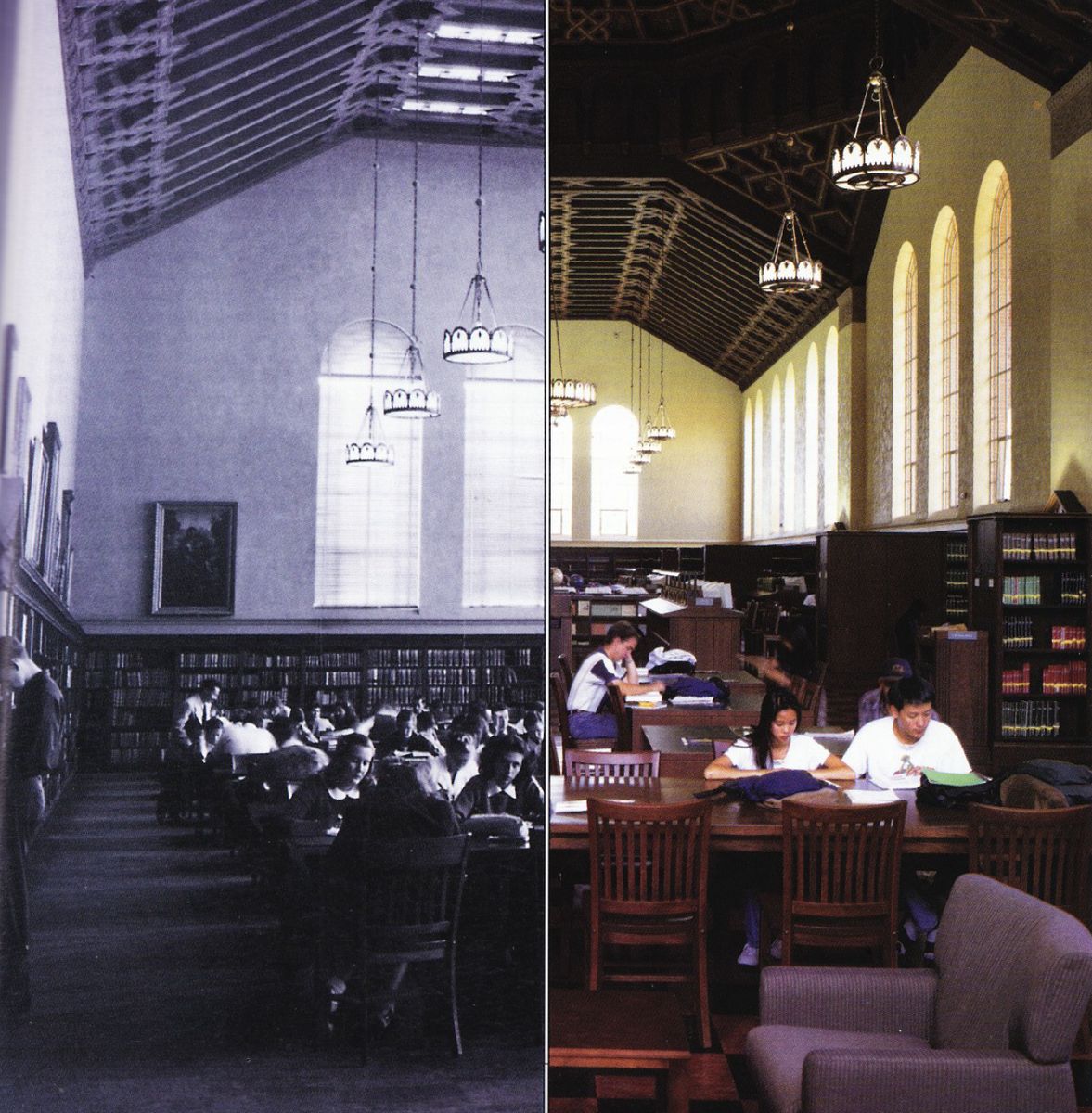
Even as an undergraduate, I appreciated the beauty of Powell. It is a marvelous example of Italian Romanesque architectural style, reminiscent, I was told, of churches in Verona, Bologna and Milan. As an English major, I sought refuge in Powell quite often — and not only when I needed a nap. Especially after fighting the crush of humanity in survey classes of 500-plus students, I welcomed the expanses the library offered in which I could lose myself. It was a sanctuary, tranquil and serene.
Sometime in the late ’80s, Powell, one of the busiest buildings on campus, with thousands of students passing through its doors each day, was identified as requiring major structural reinforcement. So in 1992, the library closed for seismic retrofitting — and didn’t reopen until four years later. Just think: An entire class of students came and went and never saw the inside of this glorious building!
Powell was one of the first four structures built on campus (the others are Haines Hall, Kinsey Hall and Royce Hall). “The Library,” as it was generally referred to in the early days, was later named for UCLA’s second university librarian, Lawrence Clark Powell, a prolific author and bookman who served the university from 1944 to 1960 and recently celebrated his 90th birthday.
Because of the intimacy of the campus in its first configurations (the University Research Library was not built until 1964), Powell, and especially its Main Reading Room, was for decades the very heart of the university.
“In the early part of 1942, my boyfriend, who had graduated in 1940 from UCLA, was on active duty. I remember walking into the main reading room after coming back from a weekend that we had spent together and sitting at one of those big tables with assorted classmates and dear friends. I whispered to them all, ‘I’m gonna get married! I’m gonna get married! June 14 is the date!’ I’ve been in the library many times since, but that’s my fondest memory.” — Margaret Bernstein ’42
“I remember being a little girl and walking all over campus with my grandfather. He told me the history of UCLA and all the buildings. He gave me a special love for the architecture of Powell and the other original buildings. Now when I come back and look around, it brings back a lot of special memories. It reminds me of my own years at UCLA and of my grandfather, Franklin Murphy.” — Erin Crockwell ’93
Each of us has our own special memories of Powell and many of mine are associated with the years I worked in the library as administrative assistant to the College Librarian. My responsibilities were broad and required me to perform more than a few rather unusual tasks.
There were, for example, the free concerts presented by the Music Department one Saturday night each quarter. The library Rotunda’s unparalleled acoustics made it a natural setting for those performances, but was I really the best person to prepare the hall? I was always afraid that something would go wrong — and one night, something did.
The featured performers that fateful January evening were the popular UCLA Madrigal Singers who, under the direction of senior lecturer (now emeritus) Donn Weiss, were to give their annual “Twelfth Night” concert. I did my usual bustling, ensuring that chairs for the audience were in perfect rows and that the student ushers were instructed in the proper drill. The photographer was set up at his vantage spot atop a stepladder, and a synthesizer — the singers’ only accompaniment — was put into place.
The audience (a full house, of course) filed in and was seated. The moment arrived for the concert to begin. Weiss stepped to the front of the stage, bowed to enthusiastic applause and raised his arms. The hall fell into silence. Weiss gave the downbeat, cuing the accompanist. No sound issued from the synthesizer.
I was horrified. What had gone wrong? Weiss would be furious! I would be cast out of my beloved Powell and stripped of my status as a Bruin. I looked in terror at the conductor, but he was calm, smiling. He raised his arms and gave the downbeat once more.
Again, nothing.
I was preparing to resign in disgrace on the spot when the photographer identified the problem: While moving his stepladder, he had inadvertently pulled the synthesizer’s cord out of the wall. We plugged it back in, and the concert proceeded without a hitch. I understand there are plans to resume the “Music in the Rotunda” series now that the library has reopened. It’s a wonderful idea, but please, don’t ask me to help. I couldn’t survive another near-disaster.
Nor would I care to relive the time one of my coworkers came into my office in the library and said, “Wendy, could you call the campus police? Some female students are complaining about a weird guy in the stacks.”
“What’s he doing?” I asked, reaching for the phone.
“He’s crawling around on his hands and knees, blowing air up women’s skirts with a rolled-up magazine.” It was my somber duty that afternoon to report to the police that not only was the Stalker in the Stacks so brazen as to be practicing his peculiar peccadillo during the busiest time of the day, but also that he was using a magazine taken from the library’s periodicals collection.
“When I came here in 1955, psychological journals were kept in a locked cage in Powell with pornographic literature and other such ‘risque’ materials. You had to sign out a key if you wanted to get to the journals. I think anything that used the word ‘sex’ was locked up in there.” — Wendell Jeffrey, professor emeritus, Psychology Department
“My great-grandfather, Charles Henry Rieber, was the first dean of what was then the School of Letters and Science. When I came to UCLA, I went to the card catalog in Powell Library to see what I could find under his name. There was something there! That really made me feel my connection to UCLA.” — Ann Rieber Plauzoles ’67
Students have connected through Powell to UCLA in innumerable ways over the years. Now, with the renovation, there is the opportunity for making new kinds of electronic connections to the university. The upgraded and updated Powell is home to the College Library Instructional Computing Commons (CLICC) and four interactive media classrooms, which together provide more than 200 computer workstations. Throughout the library, 500 study carrels are wired to provide network connections and Internet linkups for students’ laptop computers. It’s a far cry from the technology available during my days in Powell: We thought doing ORION database book searches was practically Star Wars stuff.
But no amount of technology will ever alter the perception of Powell as one of UCLA’s most potent and venerable symbols. Which, of course, puts the library at serious risk every November during the week of the USC-UCLA football game.
Powell is a tough-to-resist target for Trojan pranksters, as I learned one crisp fall day in 1982. I arrived at the library to find that crickets — hundreds and hundreds of them — had been let loose in the book stacks that morning by stealthy USC operatives. Imagine trying to study against the background sounds of a highly agitated mob of crickets. The campus Pest Control crew did their best to round them all up, but for weeks afterward, you could still hear the discomforting chirps of renegade insects in the stacks.
Happily, there are other, more salutary traditions associated with the library. For instance, the first thing visitors see upon entering Powell’s awe-inspiring foyer is the seal of the University of California with the motto, “Let There Be Light” on the floor tiles. On the occasion of the library’s Grand Reopening Dinner in September, this hallowed circle was set off by velvet ropes — lest the uninitiated break a long-standing taboo and mistakenly step on the seal.
The ropes came down following the event and the next day countless students, either unaware of the ritual or unimpressed by it, tromped right over the seal. It hurt me a little bit to see it, but maybe, I’ve been thinking in retrospect, this is not such a bad thing, after all. Since its reopening in late September, the lovingly restored Powell has proven as important a campus landmark as ever: Every seat in the reading rooms is often taken, and lines of those wishing to use the new CLICC lab regularly snake clear out of the room.
As a veteran observer of Powell comings and goings, I believe that this could well be the first year in its long and illustrious history that the library attracts more than a million visitors. Personally, I have no problem with that. The lovely new stacks look like they can sleep hundreds of students comfortably. And I’ve already got my spot staked out.
“The seal in the Powell foyer is representative of UCLA and, like the flag, you don’t want to tread on it. The custom in my day was not to step on the seal, but I’ve talked to lots of more recent alumni who never heard of the tradition. Well, at least one person remembers.” — Judy Postley ’45