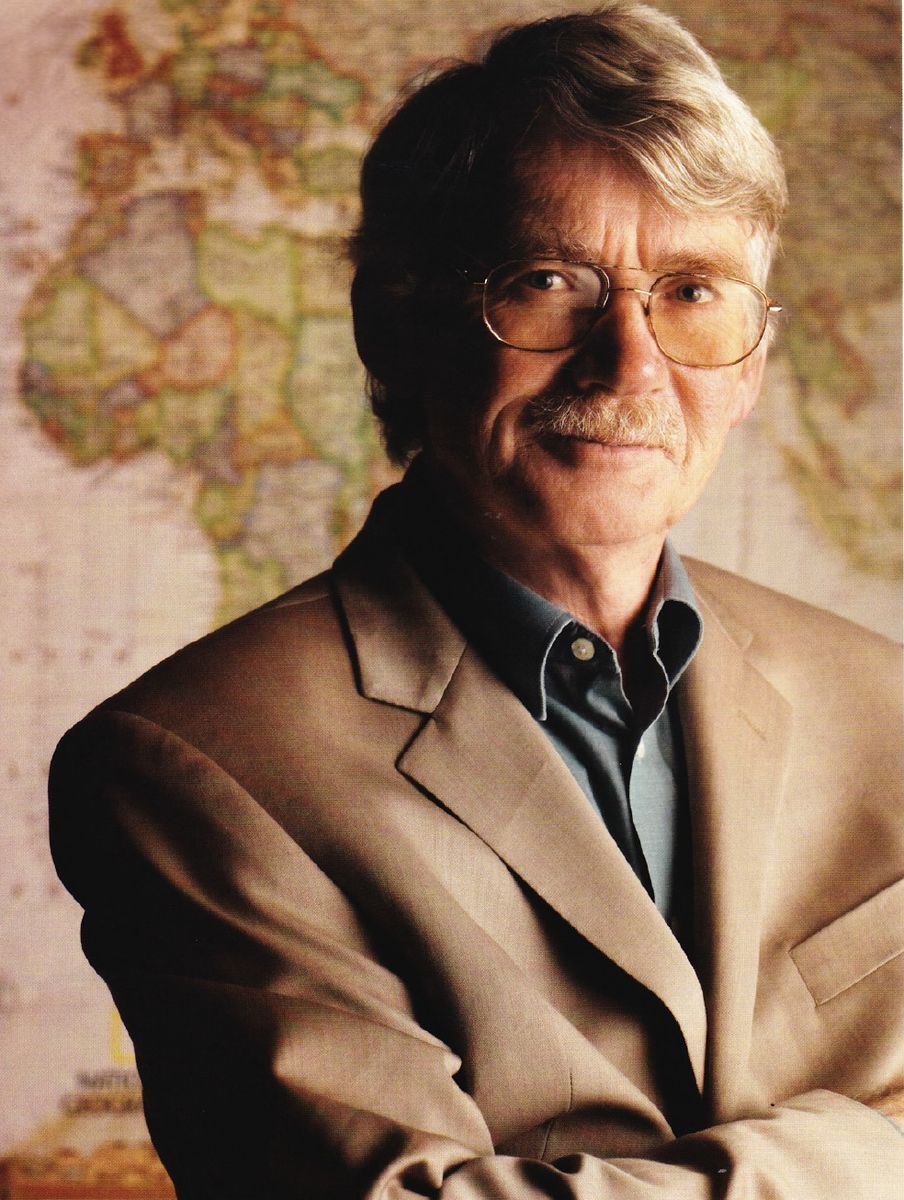
“Life,” John Lennon wrote, “is what happens while you’re busy making other plans.” For Lennon’s Northern England contemporary Michael Mann, this quip’s no joke; it’s a way of life. Mann wouldn’t be teaching at UCLA at all (and probably wouldn’t be an American citizen) if he hadn’t been busy making other plans in 1986 to promote his groundbreaking study of empires, The Sources of Social Power; and he was in the middle of not one but two book-series projects when life happened in a very big way on Sept. 11, 2001, unleashing events that have dragged this globally recognized practitioner of “comparative sociology” from the relative gentility of historical analysis to the crossfire of Fox News.
In his early 60s, an age when other professors might be busy making plans to retire or at least slow down, Mann is working at a frenetic rate. This spring alone, the sociologist was busy talking up his October 2003 critique of current U.S. foreign policy, Incoherent Empire (which won him Germany’s prestigious Friedrich Ebert Foundation award in May), overseeing the July publication of the six-country study Fascists, and preparing yet a third book for release in September, called The Dark Side of Democracy: Explaining Ethnic Cleansing. It is no wonder that the slim, bright-eyed and mustachioed Brit is currently — and finally — on sabbatical from teaching.
“I’ve never worked as hard in my life,” he says with a weary smile. “This came up all of a sudden; I certainly didn’t plan it this way.”
That Mann has a career in sociology at all, let alone as one of the field’s leading lights, is, like Incoherent Empire, also somewhat of an accident. Born and raised in Manchester, England, in a “lower-middle-class household,” he made it through a modern history degree at Oxford in the early 1960s without picking up much in the way of direction. “I didn’t work terribly hard,” Mann recalls. “I had no real idea what I wanted to do; I thought I might become a social worker.” In fact, had he chosen differently at one key point, he might have become an agent, not a critic, of empire.
“I was actually approached about becoming a spy,” he says with a dry chuckle. “I took the examination for working for ‘government communications.’ I didn't know what it was. … They invented a foreign language; you had to translate in and out of it.” He did well enough to be invited for a follow-up interview, “but when I got there, it dawned on me for the first time what this was about.” He reckoned that Her Majesty’s Secret Service was no place for a Guardian-reading campus liberal from the industrial North.
Around then, the Oxford Department of Social and Administrative Studies, where Mann had trained to become a probation officer, was approached by the General Foods Corporation to do research into the effects of moving one of its factories from central Birmingham to the countryside. “They asked me if I wanted to do it and get my Ph.D. in the process,” he says. “It fell in my lap, and I thought, why not?”
Mann conducted a “very intensive” study of 300 employees before and after the factory relocation to see “who made the move and who didn’t make the move, and why.” The results were eventually published by Cambridge University Press under the title Workers on the Move: The Sociology of Relocation. What he found was at the time something of a revelation: “People were much more attached to work, and to their immediate nuclear family, than they were to their local community.”
Why do people put up with or even embrace less-than-ideal conditions? It’s a tough question with complicated answers, and it underpinned Mann’s 1971–’77 work at Essex University, where he helped build what The Times of London has called the United Kingdom’s “finest sociology department.” In 1973 he published Consciousness and Action in the Western Working Class, which was followed by two collaborations with sociologist R.M. Blackburn: a 1975 paper on “The Ideologies of Non-skilled Industrial Workers” and a 1979 book titled The Working Class in the Labour Market. By the end of the 1970s, when he had moved from Essex to the London School of Economics, Mann was shining brightly enough to be included in the Sunday Times’ list of the 100 people it predicted would have the largest impact on the 1980s.
But much as he enjoyed the roll-up-your-sleeves empiricism of interviewing workers from dreary factory towns, Mann still maintained his boyish love of history and was becoming increasingly interested in the broader issues suggested by his research. If humans were acquiescing to the status quo, as his work indeed seemed to infer, what did that say about the strategies and practice of those who held the reins of government?
And so Mann decided to compare modern society to ancient Rome. “What should have been a couple-of-pages study,” he says, “gradually changed into a historical narrative of power.” It also changed Mann’s life, and perhaps the very discipline of sociology itself.
“The Sources of Social Power,” says UCLA Sociology Department Chairman Roger Waldinger, “is really a reanalysis of world history from the very beginnings. There are very, very few people who can do this with the level of mastery and sophistication of which Michael’s capable.”
The first volume in the planned trilogy — A History of Power From the Beginning to A.D. 1760 — took the academic world by storm when it was released in 1986. Leading sociologist Anthony Giddens called it a “sociological classic”; the word most frequently used to describe the book is “seminal,” and Waldinger says “it remains an absolute must-read.” Sources won the American Sociological Association’s Distinguished Scholarly Publication Award, plus second place in the Amalfi Prize for best social-science book published in Europe. It was translated into German, Japanese, Chinese, Italian and other languages.
Mann’s achievement was to take a subject already picked to death by historians — the Roman Empire — and provide a brand-new conceptual framework for understanding how it maintained (and eventually lost) dominance. The professor’s thesis, from which all his subsequent work has sprung, is that empires require four types of power: military, political, economic and ideological. They may emphasize one pillar more than the others, but if any of the four is neglected for too long the whole structure will topple.
Not only did Mann break new theoretical ground on an age-old question, he helped legitimize the generalist field of “comparative sociology,” a category that requires stepping into the fiefdoms of anthropology, archaeology, art and history.
“I think what is really striking is the very high opinion with which he’s held by historians,” Waldinger says. “It’s not just the sociologists who like him.”
The book’s enduring success, though it may look obvious in retrospect, was anything but at the time. Which, as serendipity would have it, has much to do with how Mann and his wife, Sociology Professor Nicky Hart, ended up at UCLA.
“Now for a sociologist to write such a book was very unusual, and I thought this book might fall completely between the cracks. … I thought it might sink without a trace,” Mann says. “So I thought, well, what could I do?” What he did was contact every far-flung university professor he knew and arrange an ad hoc lecture tour.
“Americans assumed when I was coming to give these talks that I must want a job — and that was not my thought at all!” he says. “But by the time the tour came off, it became clear that the book was a great success … and three places offered me a job.” One of them was UCLA.
“Los Angeles has kind of a globally awful reputation, so I was really surprised when I came here and found it beautiful,” Mann says. “We had just been in London in February … so we thought, let’s go to L.A. for a year and then come back. We didn’t intend to stay, but stay we did.” Indeed, Mann found UCLA and Southern California so congenial that he eventually acquired an American passport. “I now have dual citizenship,” he says, “so I’m no longer sure what my nationality is.”
Volume 2 of the trilogy, The Rise of Classes and Nation-States, 1760–1914, came out in 1993. Essentially rejecting Marx’s notion that everything boils down to economics (“I was always asking, could one actually find an instance where one form of power was primary, and the answer would be ‘no’”), Mann examined in particular the relationship between the development of capitalism and the development of war, and also the ideological and political role that a resurgent nationalism played during what historians sometimes call “the long 19th century.”
The second volume was also well received, so Mann began researching Volume 3, covering 1914 until the present day. That was until life, in the form of a particularly good research library in Madrid, made another mess of his well-laid plans. “I realized there’s so much more information available on the modern era than there is for centuries past,” he says. “I began to write a chapter on fascism … but it eventually turned into two books.”
But even as he was finishing these two books, which argue that fascism and ethnic cleansing were just the most extreme versions of the dominant modern-day governing paradigm of nation-statism, along came the U.S.-led war against Iraq.
“The moment came in March and April 2002 when I realized that the governments of the two countries where I am a citizen were combining to invade another country for rather dubious reasons, and they were going to do it whatever anyone else said,” he recalls. “I was convinced this was going to be a disaster. And I was convinced also that the war on terrorism was going to be a disaster, so I thought that I had a duty to actually say it as publicly as I could. And I really derived my confidence that it would be a disaster from my historical comparative work.”
Using the same four-point analysis of empire, he concluded that the Iraq War was doomed to failure (“What astonishes me now,” he says, “is how accurate I was”), because, in his view, U.S. policy emphasized military power at the almost total expense of political and ideological. In addition, Mann concluded that the comparatively unilateral war would increase, not reduce, the number of terrorists and create a deadly and unnecessary confusion between international networks like Al Qaeda and regional movements like Hamas and Hezbollah.
“My argument,” he writes in the introduction to Incoherent Empire, “can be illustrated with a rather ghastly metaphor. The American Empire will turn out to be a military giant, a backseat economic driver, a political schizophrenic and an ideological phantom.”
As the passage illustrates, Mann writes in a colorful, direct style — “I hate academic jargon and scholastic language,” he says with a wince — and his feelings about the current role of the United States in the world are quite pessimistic. But they also contain a kernel of optimism — that nation-states, regardless of their excesses, have done away with the Age of Empire; that Americans in any case do not actually have much appetite for the “imperial project”; and that some form of messy global compromise will eventually become possible once America begins its inevitable retreat from hegemony.
By that time, Mann will probably be done for the moment with the Fox News world of Hannity & Colmes (where he was told last spring that “if you and people like you had your way … the Iraqi people would still be living under terror [and] the world would have to fear [Saddam’s] weapons of mass destruction”), and back pursuing the quieter pleasure of finishing off The Sources of Social Power’s long-awaited Volume 3. But if the past is any guide, don’t wonder if Mann’s next work has surprising relevance to the modern-day.