Editor’s note: This is an article from the Fall 1999 issue of UCLA Magazine.
As you read these pages, take a moment to glance skyward and consider a small craft, packed with sensitive instruments designed and operated by UCLA scientists, hurtling at nearly 10 miles per second through the infinite void of space en route to a historic landing on Mars.
Entering the home stretch of an 11-month sojourn that began Jan. 3 atop the nose of a Delta II booster, the Mars Polar Lander already has logged more than 120 million frequent-flyer miles. It is now a mere 17 million miles from its rendezvous with the fourth rock from the sun, which, if you were a stowaway onboard the spacecraft and in possession of a good telescope, would appear as a crescent in the distance.
As the lander speeds through the dark serenity of space, a much different scene is unfolding on the home world, in Westwood, the heart of the science project for the first-ever landing in the south polar region of Mars. Here, in the UCLA Science and Technology Research Building near the intersection of Gayley and Weyburn avenues, members of the UCLA-led team in charge of the scientific payload on board the lander — the Mars Volatiles and Climate Surveyor (MVACS) — are engaged in what might be described as a state of controlled chaos. Between now and the lander’s scheduled touchdown on Dec. 3, they are holding round-the-clock operational readiness tests and conducting daily health checks of the instruments aboard the craft. Once it has landed, within the southern region at about 76 degrees south latitude and about 190 degrees west longitude, the real work begins as they execute the scientific experiments designed to pry loose the secrets of the Red Planet for an eager and curious audience.
Earthlings have, after all, always been captivated by Mars, whether it’s science fiction or science fact. In 1997, millions tuned in to watch the off-road escapades of the Sojourner Rover, delivered to the surface aboard Pathfinder, as it broadcast the first surface-level pictures of the planet in more than two decades. But that was primarily an engineering experiment, designed to test technologies such as landing airbags and rovers planned for use on subsequent missions. This current mission, Mars Surveyor ’98 (which includes the Mars Polar Lander and the Mars Climate Orbiter), is science driven and picks up where the 1976 Viking missions left off, probing our nearest planetary neighbor for clues to its past, present and future.
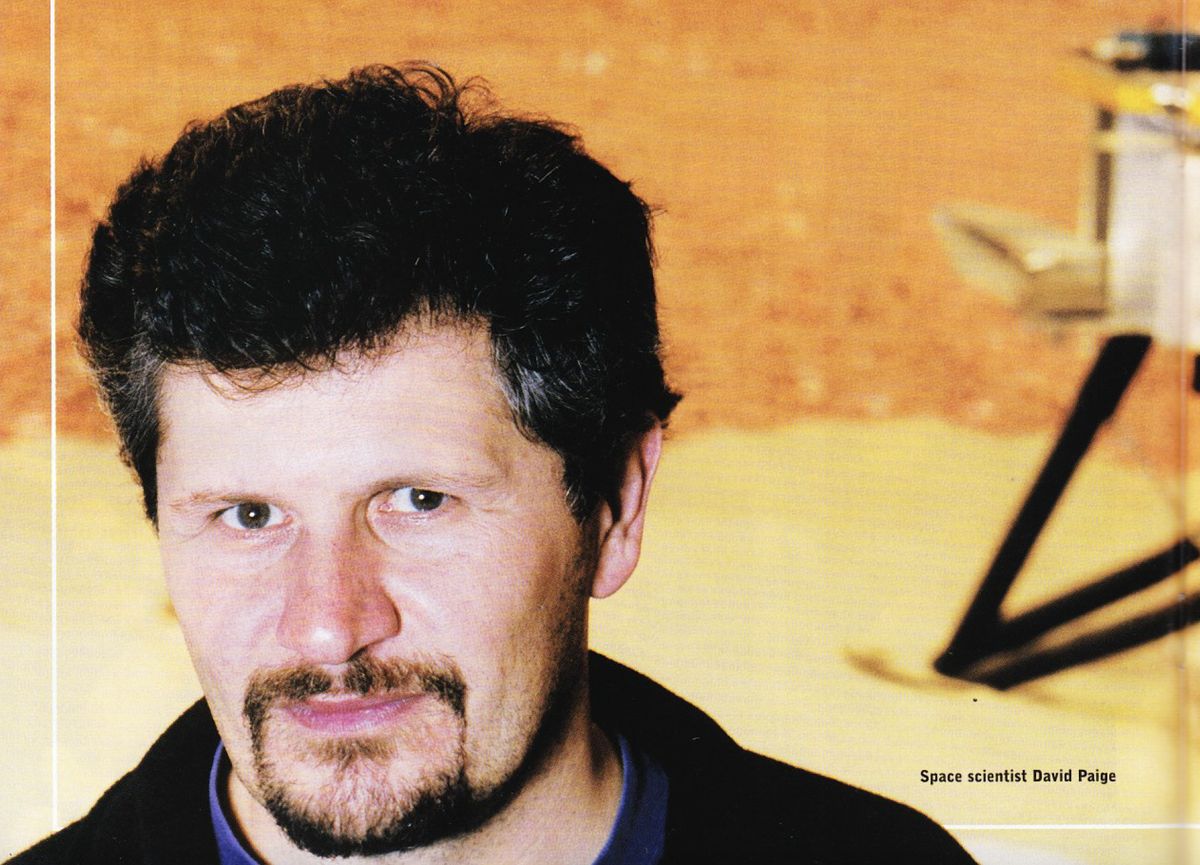
And for the first time on a space mission of this scale, NASA has put an academic at the helm of the design and operation of a group of scientific instruments aboard the spacecraft. David Paige, associate professor of planetary science, is in charge of the science package that will return data on the Martian atmosphere, climate, meteorology and surface volatiles — the ice, frozen carbon dioxide and liquid water whose distribution and behavior over time can provide a window into a planet’s history. Among the most intriguing questions that Paige and his team hope to open a window on is how a planet that was once warmer and wetter evolved to its current cold, dry state, and whether Mars’ past water-rich climate could have supported life. And in the longer view, NASA hopes to learn whether the volatiles have the potential to be used as a resource by future human inhabitants.
Sitting in Paige’s scattershot office, the boyish, unassuming scientist glances at his upcoming calendar. “No week or month is like the one before,” he marvels. “It’s certainly not your standard academic life.”
Nothing is standard about the role Paige and UCLA are playing on this mission. After opening the process to competitive bidding, NASA in 1995 assigned Paige the task of creating and operating the MVACS integrated payload. The project, which includes major participation from the University of Arizona, NASA’s Jet Propulsion Laboratory, Lockheed Martin and institutions in Germany, Denmark, Russia and Finland, fits with NASA’s resolve to carry out better, faster and cheaper space missions. The combined initial planning cost for the two Mars Surveyor ’98 missions — the orbiter was launched a month ahead of the lander — is $193 million, or $72 million less than the development cost of the Mars Pathfinder lander mission alone. Paige established the integrated payload concept, in which the individual instruments work together synergistically, with these cost limitations in mind, and the payload’s design bill came to a relatively modest $20 million.
Several important instruments are incorporated into the lander science package. The Mars Descent Imager (MARDI) will acquire and analyze close-up pictures of the landing site during descent; a Light Detection and Ranging (LIDAR) experiment will utilize a microphone capable of picking up the first recorded sounds from the Red Planet; and the MVACS package will integrate features divided into four categories:
- the Stereo Surface Imager, which will transmit highly detailed color images of the area around the landing site, which later will be converted into three-dimensional panoramas;
- the meteorology package, which will measure wind direction and speed, temperatures and atmospheric pressure — and use a sensor to measure vapor, carbon dioxide and isotopic concentrations in the atmosphere;
- the 2-meter-long robotic arm — as strong and flexible as any human arm — which will scoop soil from the Martian surface to be analyzed by the UCLA team;
- the Thermal and Evolved Gas Analyzer, a collection of eight ovens and a tunable diode laser spectrometer to heat and analyze samples.
The payload will be exploring brand-new territory, and the polar terrain that the spacecraft is targeting will surely appear dramatically different from the turf scouted by the previous Mars lander missions — something like the contrast between Santa Monica and the South Pole. Paige explains that the south polar region was chosen because the colder conditions and more variable climate make it the area most likely to harbor a wealth of trapped volatiles and revealing geologic formations. Of particular interest to the scientists are the polar-layered deposits, a geologic unit that contains the type of fine-scale layering that offers historical records of climate fluctuations, just as records of the Earth’s climate are maintained in the polar caps of Antarctica and Greenland.
While providing the scientists with a treasure trove of material for study, the severe environment of the polar region poses a greater threat to the spacecraft’s safe landing and survival than the previously visited mid-latitude sites. Finding safe but scientifically interesting terrain was the challenge of the mission’s scientists and engineers over the summer as they weighed the crucial decision of where to land. To make the final selection, they augmented data from previous Mars orbiter missions with new data returned from the Mars Global Surveyor Orbiter, which relayed images of the target sector in June.
Says Paige: “I’m sure we’ll be surprised when we see what the landing site looks like on a human scale, because no one knows.”
What scientists do know is that Mars was once nothing like the dry wasteland it is today. The Viking orbiters and landers that arrived in 1976 found valley networks and winding flood channels that, while currently dry, were most likely carved by flowing water — the key ingredient to fostering life. Viking provided compelling data on Mars’ geology, atmospheric water vapor and surface meteorology, but it was limited to the planet’s mid-latitude region. “Mars has a total land area at least the size of Earth’s, with diverse climate zones and geologic structures,” says Paige. “You might consider ours to be the first mission to try to sample some of that diversity.”
“This is just like any other trip, except we’re going to Mars,” muses Paige during a rare break. “When you’re planning for any trip, you figure out where you want to go, plot your course on the map, get together all of your gear and make necessary provisions.”
Among the many differences, of course, is the inability of the “travelers” to relax during transit. By summer, with the lander still five months from its final destination, the pace in Westwood is frenetic. Much of the action centers around the MVACS facility’s test bed — an operational mockup of the lander inside a 300-square-foot sandbox — where the team members conduct dress rehearsals by running various sequences designed to monitor how the instruments are functioning en route. The calibration is especially important given the fact that MVACS is an integrated package of instruments; a glitch in one can create havoc elsewhere.
“We’ve tried to minimize the cost and risk by incorporating as many previously used items as possible, but in almost all cases these instruments are new in terms of what they’re actually going to do,” says Paige. Laboratory tests are one thing, but whether they’ll behave the same way on Mars is another. Last January, trying their best to simulate Martian conditions on Earth, Paige and a colleague journeyed to Antarctica’s dry valley regions to test the capabilities of the robotic arm to dig samples out of the cold, dry soil. So far, so good.
In mid-July, the flight team began initial operational readiness tests, using copycat versions of the spacecraft and instrument components to simulate the first four days of the surface mission. “It’s our first chance to see what it’s like to be operating, and to make any necessary corrections,” Paige explains while overseeing one of the tests. Still, no amount of preparation can ensure a smooth mission. “Based on past experience, we’re guaranteed to have snags of various types, and we can only hope that they aren’t insurmountable,” he says.
Most problems are indeed solvable, but with a full plate of experiments to run, significant delays could prevent the job from being completed. The scientists will want to take advantage of each moment on Mars, because the mission must end just short of three months after landing. The lander, which operates on solar power, is arriving in late southern spring, when the sun will be above the horizon throughout the day. In the early part of the mission, local Mars surface temperatures are expected to top out at a relatively toasty zero degrees Celsius. Toward the end of the summer, as the sun dips closer to the horizon and temperatures cool, the lander will have more difficulty generating solar power and will be forced to spend more time in its energy-conserving “sleep” mode. On March 1, 2000, the lander will see its first Martian sunset, and the clock will strike midnight on data-collection efforts.
Paige has little time to reflect on the cosmic significance of what is about to happen. That’s probably for the best, since all the preparation in the world can’t guarantee that the mission’s scientists will ultimately collect the data they need to draw conclusions about our neighbor planet.
“The payoff for all this work is at the end,” Paige says. “Until we actually land and begin to gather data, we won’t know whether we’ve been successful.”
While the science being conducted in space is obviously the most significant aspect of the mission, coordinating and keeping things together in Westwood is a monumental task in itself. To spend a few minutes with Karen McBride is to know what communications overload in the information age can be like.
Her multitasking skills on this project have been, and will continue to be, severely challenged. As operations manager of the Mars Polar Lander’s UCLA science team, McBride is a scientist and administrator, as well as a public spokesperson and behind-the-scenes troubleshooter. On this day, she is barely able to utter a sentence without being interrupted by the ringing of her phone, the beeping of her pager or a knock on her office door. Getting through her long to-do list is an exercise in battlefield triage.
Everyone who visits the UCLA facility comes away surprised at the small size of the science team — it’s a core of only 20 or so people, one-third the number on the Pathfinder mission.
“NASA wanted to do two missions [the Mars Polar Lander and the Mars Climate Orbiter] for the price of Pathfinder,” McBride says with a smile. “So we work very, very hard.”
On this summer day, McBride is brainstorming with UCLA’s Communications Technology Services office in anticipation of the stress that will be placed on the telephone lines and data communications network. She has brought in Stephen Salyards, a geophysicist who was a colleague of Paige’s during their doctoral studies at Cal Tech, for the formidable task of ensuring that all of the MVACS communication links run to their full potential. That includes the NASA-provided dedicated line to the payload, as well as the UCLA branches of the mission’s Web site, where many of the images from Mars will first be displayed. Two years ago, the Web site for the Pathfinder mission was besieged by viewers anxious to download images of the Sojourner Rover. Salyards points out that the ranks of Internet users have roughly doubled since then, and he’s bracing for 100 million to 200 million hits on this mission’s first day. “We’ll be putting up real-time data, and our challenge is to get this content out without swamping UCLA’s or JPL’s backbone networks on Dec. 3,” he says.
Salyards became hooked on the space program as a child in the late 1960s, when his grandmother, who knew people at JPL, fed him a steady diet of Mariner educational kits. Last January, when Salyards took his 7-year-old son to Cape Canaveral Air Force Station to witness the Mars Polar Lander launch, he was able to re-experience the miracle of space travel through innocent eyes.
Ashwin Vasavada remembers being about the same age as Salyards’ son during the Viking landing on Mars. “Ever since I saw those first pictures of a different planet from eye level, as if you were standing on it, I was inspired to go into this field,” he says. Vasavada, who graduated from UCLA’s Department of Earth and Space Science in 1992, hoped at the time he’d be able to return one day to help Paige with this mission. After completing his Ph.D. studies at Cal Tech, he was asked by Paige to join the MVACS team.
“It’s a very profound experience, being involved in pushing the limits of knowledge of our environment and existence,” says Pierre Williams, a first-year Ph.D. student in geophysics and space physics at UCLA, who worked with Vasavada and Paige on the selection of the landing site. Williams stumbled upon the position as an undergraduate, when he took a class taught by Paige and approached him one day for advice. Paige offered Williams a job with MVACS on the spot. “I experienced a true natural high,” Williams recalls.
Updating the Web sites as the data arrives will be another major challenge. “There’s going to be so much coming back,” says Kelly Zito M.S. ’98, who was hired for the task immediately after completing her graduate studies in meteorite science at UCLA. “We’re going to have to sift through the data to decide what people will be interested in seeing, present it in a voice that will make sense to a general audience and then put it on the Web as soon as possible.”
Despite the insane workload and not-enough-hours-in-the-day schedule that McBride shoulders, make no mistake: McBride, a former staff research associate of Paige’s at UCLA who went on to serve as a JPL science coordinator and sequence engineer on the Galileo mission to Jupiter, is having the time of her life.
“We’re part of a team that’s making history,” she says. “To me, that’s one of the most awesome things you can do.”
As you sit down to Thanksgiving dinner in November, the Mars Polar Lander will be eight days from its final destination. At 12:05 p.m. PDT on Dec. 3, a Friday — approximately 4 a.m. local Mars time — the lander is scheduled to touch down on the surface, unfold its solar panels and point its radio antenna toward Earth. At that point, the rehearsals will be over for the MVACS team and the real work will begin.
If all goes well, the first images of the Martian south polar region will make it back to Earth within an hour of the landing. (The video delay will be 15 minutes, the time it takes for the data to travel at the speed of light.) “Certainly the pictures will drive home the point that we have landed on an alien surface and there’s something new to see,” says Paige. The first images won’t offer much perspective, but within a couple of days, a color panorama view of the horizon as it appears from the landing spot should be available. By about that time, the lander will have settled in, and the MVACS team will be able to begin using the robotic arm to start acquiring samples from the Martian soil.
“We can’t do everything in one day,” says Paige. “We see this as a story that will unfold. Hopefully, the story will become more interesting as we’re able to dig deeper and deeper below the surface data.”
The MVACS scientists will not have long to review the data coming in, given the time constraints and the need to adjust the testing strategies based on the information they receive. But the data will also serve MVACS and other researchers long after this mission is complete. “We’re still learning things from data we acquired on the Viking missions more than 20 years ago,” notes Paige.
When the sun sets on March 1, the lander will be frozen in place for more than an Earth year during the cold and dark Martian winter. In 2001, when spring returns to the southern polar region of Mars, there is a slight chance the thawed lander could come back to life. NASA’s Mars program, meanwhile, will remain in perpetual motion. Future Mars Surveyor Program missions are planned for roughly every other year through 2013.
“This is part of a long-term process of getting to know our nearest neighbor in space,” says Paige. “Eventually, traveling to Mars will not be considered unusual.”
But in 1999, there’s nothing mundane about a journey to the Red Planet. So once this is all over, MVACS team members will give tours of the mission control facility, sharing the wonders of the Mars journey. “We hope to inspire a new generation of students,” Paige says. At that point, a university professor could believe his mission was truly accomplished.



