Editor’s note: This is an article from the Fall 1997 issue of UCLA Magazine.
When Paul Boyer was a brand-new graduate student in biochemistry at the University of Wisconsin, dairy cattle and their reproductive problems were much on researchers’ minds in the great cheese state. So the young graduate student was put to work investigating why a deficiency in vitamin E caused sterility in animals. What Boyer discovered in his study of enzymes and metabolism didn’t boost Wisconsin’s herd, but turned out to illuminate one of nature’s most tantalizing enigmas — and, as it happened, to earn Boyer the 1997 Nobel Prize in Chemistry.
“It illustrates what often happens in science,” says Boyer, now 79 and a UCLA professor since 1963. “The discoveries you make aren’t necessarily what you were looking for in the first place. It’s simply serendipity. And I have a tendency to be lucky.”
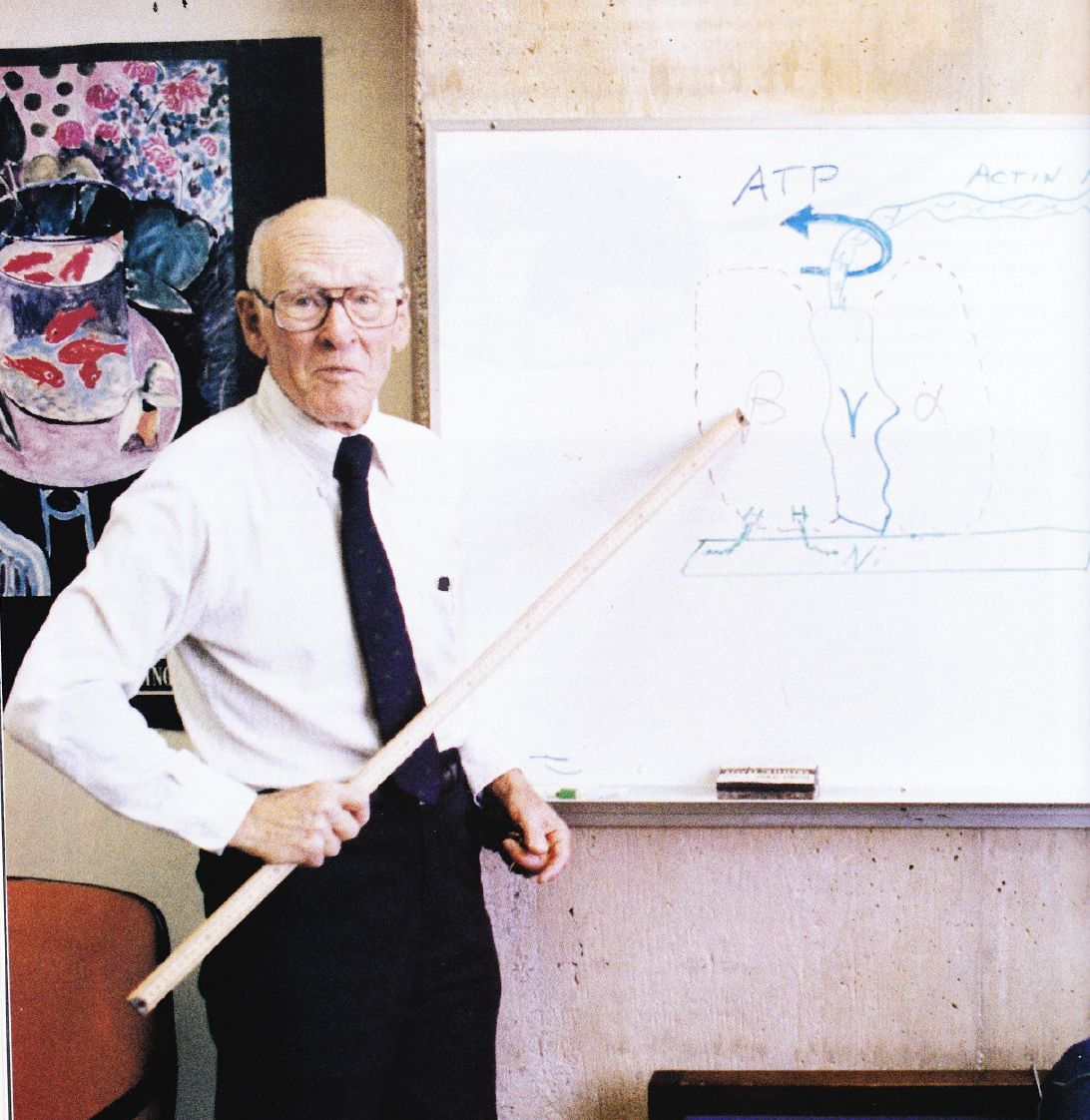
But luck, as they say, is the residue of design. Boyer’s dogged persistence through more than half a century spent in the lab finally paid off when he untangled a Gordian knot that had stymied scientists for decades. His landmark achievement: an understanding of how cells create and distribute ATP (adenosine triphosphate), the ubiquitous substance that provides energy for all living organisms, from bacteria to man.
Over several decades, the biochemist discovered the intricate mechanism by which various subunits of the ATP enzyme work together in an extraordinary way — like rotating gears, levers and ratchets — to generate energy within a cell. This energy is stored by the ATP molecule in a form that cells can use for brain and nerve function and muscle contraction, among other critical processes.
“What Paul proposed was a bold idea,” observes Arnold Berk, director of the UCLA Molecular Biology Institute that Boyer founded in 1965. “He said the ATP synthase, the enzyme that produces ATP, works with a rotary mechanism, much like a windmill, that captures energy from the flow of protons to fuel the batteries of the cell, the mitochondria, by turning the mechanism and ratcheting it around.”
Boyer’s novel proposal raised many an eyebrow. Papers were published refuting his rotation theory. Some graduate students on his own research team thought he had gone a bit too far and told him so. “It was a strikingly different concept of enzyme action,” Boyer admits. “They were never known to act this way. But when I looked at the data, the only logical explanation I could come up with was rotation. It was frankly so beautiful and so logical that before we even had all the evidence, I had the feeling it was going to be correct.”
Since Boyer’s series of breakthroughs on ATP, further discoveries by a colleague and co-winner of the Nobel, Cambridge University’s John E. Walker, have proved the farsightedness of the UCLA scientist’s vision. And just last spring, a team of Japanese scientists using advanced techniques filmed for the first time the ATP enzyme in its strange, whirling dance.
“All you saw was this little fuzzy white thing moving around,” says Boyer, who hopes to use part of his prize money to help the postdoctoral students he credits with doing much of the grunt work in basic science. “But to me — the gratification I felt when I saw this was so deep. I thought of all the wonderful people I’ve worked with in the lab all those years. It was very satisfying.”