“It was 1965, and we had just won the United States Volleyball Association collegiate championship. Pauley Pavilion had just opened, this huge, beautiful facility, and I wanted to get my team into Pauley. We were playing in the men’s gym then. I found out that the Japanese team would be stopping in Los Angeles, so I proposed to [Athletic Director] J.D. Morgan ’41 that we have a triple-header in Pauley [UCLA men vs. USC men; U.S. women vs. Japanese women; U.S. men vs. Japanese men]. After the matches were over, J.D. said to me, ‘Al, I’m going to see to it that volleyball becomes an NCAA sport!’ … It took him a few years, but in 1970, volleyball became an NCAA sport.”
Al Scates ’61, M.S. ’62
Head Coach UCLA Men's Volleyball Team
As early as 1951, UCLA students realized they could no longer get by without an all-purpose pavilion in which to hold convocations, rallies, general student body meetings, commencements, dances and other events likely to draw the attendance of all 13,000 registered Bruins. So they lobbied the administration. They formed an ASUCLA Pavilion Committee. They organized “Pavilion Week.” Finally, they sang — literally raising their voices together at Spring Sing in the Hollywood Bowl to raise funds for a pavilion drive.
Progress was slow in raising the money needed to build the arena until 1963, when Regent Edwin W. Pauley personally pledged to match, dollar for dollar — up to $1 million — funds raised by alumni and friends. The alumni succeeded in raising $1 million, student fees constituted $1 million, the state kicked in $2 million and Regent Pauley honored his pledge of $1 million. In June 1965, Pauley Pavilion — a sparkling, $5-million, state-of-the-art facility named after the Regent who helped jump-start the project, was introduced to the campus community.
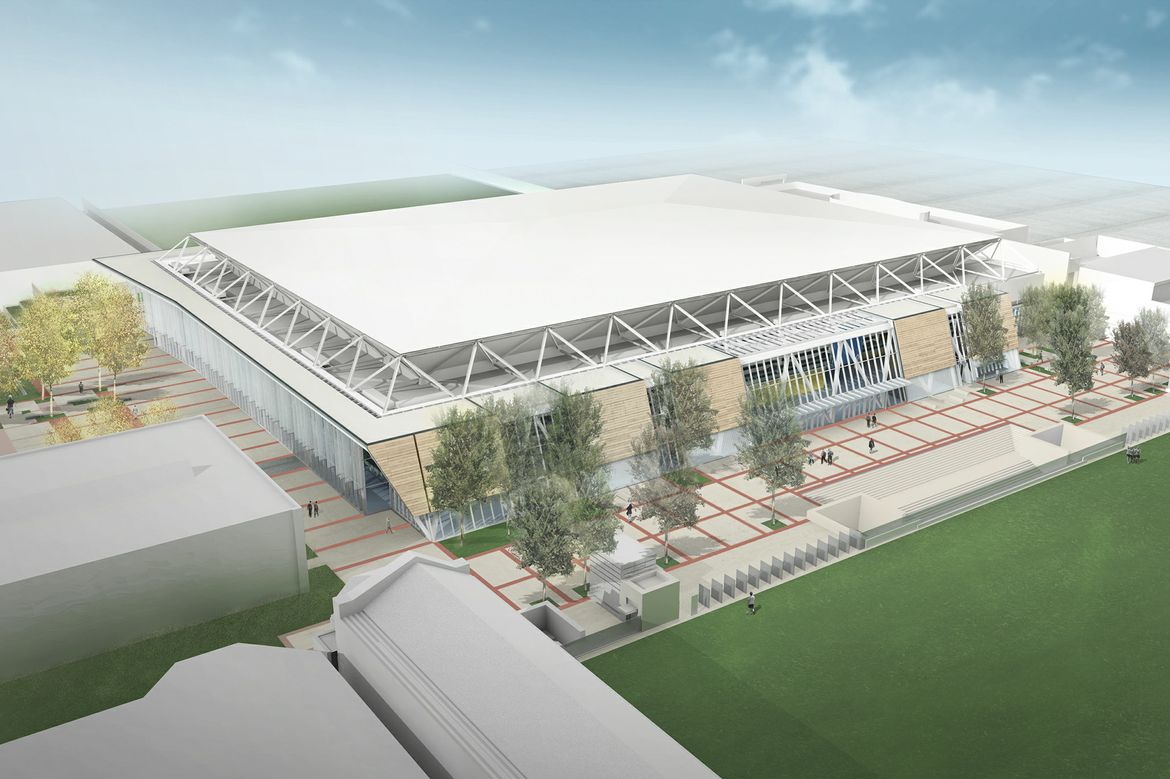
Forty-four years ago, the venue “was the finest, most advanced, most admired multipurpose arena found on a college campus,” says UCLA Athletic Director Dan Guerrero ’74. Today, though, time’s toll is all too apparent. Pauley’s infrastructure is deteriorating; its athletic facilities are inferior; its seating substandard; its aisle steps dangerous; its technology antiquated; and its restrooms and concessions woefully inadequate in number and quality. In order to overhaul the aging facility, an estimated $185 million is needed.
Singing is unlikely to help this time, so the UCLA Athletics Department has instead launched the Pauley Pavilion Campaign of Champions, a $100-million drive that will help expand and renovate the venerable old arena. As of August, the campaign had already secured $52.5 million in gifts and pledges and was working on raising the remaining $48 million. The final $85 million will come from UCLA campus support and long-term debt funded by UCLA Athletics. The new Pauley is scheduled to open in the fall of 2012.
“After more than 40 years, we’re ready to bring Pauley Pavilion into the 21st century,” says Guerrero. “And we will do this while maintaining the traditions of the past. We’re excited about the opportunity to make Pauley Pavilion the first-class facility that our program and community deserve.”
Building on Tradition
Guerrero’s first step was to visit the family of the late Edwin Pauley to talk about the possibility of renovating the pavilion. Matthew Pauley M.B.A. ’97, Edwin’s grandson, says they were immediately supportive of UCLA’s project and vision. Next, Guerrero and his staff consulted with their counterparts at comparable universities that had undertaken similar projects, including USC, Missouri, the University of Virginia and Washington.
Focus groups were brought in over the past few years to meet with UCLA Athletics staff and the project’s consultants and architects. Season-ticket holders and donors were well-represented, as were undergraduate and graduate students and student-athletes. Jamie Arneson, president of the student support group The Den, is pleased that students will have prominent seats along the south and west sides of the court.
“We wanted the student seating to be done in such a way that the student impact on the game would be maximized,” she says. "I believe there is a large potential for the students to affect the outcome of a game, and when students are in the student section, it is their responsibility to do everything in their power to make Pauley a feared place to play.”
Mike Sabes ’09, former chair of Rally Committee, likes the fact that the original structure will remain generally intact. “The classic elements that give Pauley its historic, simple beauty will be preserved,” he says. “Pauley Pavilion is a major hub in the UCLA community, and many people probably want Pauley to remain the way they remember it from years ago.”
In With the New
“My inauguration was held at Pauley [in May 1969], although that was a difficult time. The People’s Park incident at Berkeley had just taken place. There had been a major confrontation at the regents’ meeting a day or two before. The governor, Reagan, insisted on calling in the National Guard. We made a decision to reduce the frivolity of the [inauguration], to make it more solemn than normal. So it was a somber affair as far as inaugurations go, but it was a wonderful experience, nevertheless.”
Charles E. Young M.A. ’57, Ph.D. ’60
UCLA Chancellor Emeritu
Much of the “old” Pauley will be preserved but exhibited in brand-new ways. For example, the championship banners that currently hang along the perimeter of the court will be displayed in an “X” configuration in the middle of the ceiling, near the state-of-the-art video scoreboard and LED message system. The new seating bowl increases the number of seats from 12,800 to nearly 14,000, bringing fans closer to the court.
The building will contain lobby space; a new concourse that will run completely around the arena; more concession stands; and three times the number of toilets. Electrical, water, fire and seismic safety systems will be upgraded and new step aisles and handrails will help fans reach their seats safely. Student-athletes will be able to take advantage of new locker rooms, a film room, a lounge, a strength/conditioning room and a sports medicine area. There will also be a subterranean Pavilion Club, located on the north side of the building, that will be used for campus events and is also where donors may enjoy a pregame or halftime beverage during UCLA basketball games.
In July, fans received packets in the mail that described the new seating plan and contained their point totals in the Bruin Priority Point Program, which was created to equitably rank individuals in the seat-selection process. Priority points are based upon support of UCLA, including gifts to the Campaign of Champions. Season-ticket holders will have until March 31, 2011, to accumulate points; once that date has been reached, fans’ point totals will be “locked in” for selection purposes.
“We knew that cost would obviously be an issue, so we tried to balance out the seating plan and offer as many different price points as we could,” says Ross Bjork, senior associate athletic director for external relations in the Athletics Department. “The best seats would command a higher price, but there are affordable seats for everyone. People may feel that they got priced out, but our message to them is, why don’t you wait and see how the process unfolds? Understand that there are prices available for all levels.”
Chuck Winner, a longtime UCLA season-ticket holder and grant-in-aid sponsor for basketball and football, has his own philosophy about the increased ticket prices. “If you want to go to the athletics program, it has to be supported,” he says. “And it seems to me that the people who enjoy the program ought to be the ones to support it. I’d gone to Pauley Pavilion when it was first built, and I used to go to the games when they were at the Pan Pacific and the old Sports Arena. So I felt that Pauley had seen better days and we really had to do something about it. It just seemed obvious to me that when you’re competing for recruiting and all the other things that go on in Pauley, we really needed a better place.”
It’s a tough economic climate, however, and people are questioning why UCLA is undertaking such an extensive project now. Even at campus Town Hall meetings to discuss the state’s budget cuts, staff members were asking about Pauley — why couldn’t the campus refocus its fundraising efforts on earning donations for other, more pressing needs? Chancellor Gene Block and Steve Olsen ’77, vice chancellor of finance, budget and capital programs, explained that funds raised for Pauley could not legally be used to solve the campus’ budget problems in other areas.
At a July meeting before the UC Regents, Block said, “It’s critical to note that none of the funds proposed for Pauley can be used to mitigate the impact of the state budget crisis and cuts on campus.” Not only that, he added, going ahead with the project in this recessionary market would actually save millions in terms of lower construction costs.
Come and See the Show
With UCLA’s continued success in basketball, volleyball and gymnastics, it’s easy to forget that other events take place within Pauley’s walls. Concerts, debates, convocations, commencements, theater performances, celebrity dinners — Pauley has seen them all.
John Henson, director of rental events for UCLA Performing Arts, has helped organize some amazing concerts in Pauley for the past 20 years, ranging from the Jerry Garcia Band to Lenny Kravitz to Bob Dylan, Joni Mitchell, Van Morrison. His favorite concert? Phish.
“I was 21 and working as an usher at Pauley during the 1984 Olympics. That was the year the U.S. men and women did really well in gymnastics. Seeing the U.S. team win all those medals, as goofy as it sounds, and hearing the national anthem play because they had won a gold medal was certainly an amazing occurrence. To see it happen so often was even more fun.”
Bill Power ’86
Usher Captain at Pauley
“Their audience is so unique — a counterculture audience, kind of like the next generation after the Grateful Dead,” Henson says. “[Their managers] were really good at planning ahead. They said, ‘Look, the audience is pretty harmless, but they are going to come early and in droves. You’ve got to give them a place so they don’t take up Westwood.’ So we actually set up a ‘Phish Village’ in what was Lot 32 at the time. They parked there and they partied there for 24 hours, and then they walked to Pauley for the concert.”
Susan Brown is assistant director of events and facilities operations for Cultural and Recreational Affairs; her husband, Paul Brown, is assistant director of events management for Athletics. Together and separately, they have overseen all manner of events in Pauley over the past several years, including “VH1 Rock Honors: The Who”; a Tribute to Frank Marshall featuring Jimmy Buffett; the 1984 Summer Olympics (gymnastics), President Bill Clinton’s appearance at UCLA’s 75th anniversary convocation; the 1988 presidential debate between George H.W. Bush and Michael Dukakis; summer camps; and Spring Sing.
One event that keeps coming back to Pauley is the Nickelodeon Kids’ Choice Awards. Because it’s an arena venue, Pauley is more conducive to the Nickelodeon show, which is more of a concert event. “One year, one of the stunts for the slime did not go as planned and the stunt man almost broke his leg,” says Jack Raab, director of the UCLA Events Office. “He was injured pretty badly, but — true to show biz — he played like he wasn’t hurt and continued with the performance. The show must go on!”
Royce Hall and Powell Library may be more iconic campus landmarks, but Pauley Pavilion is surely the most beloved. Take a cue from someone who knows: John Wooden.
“I was at UCLA for 27 years,” Coach says. “Many wonderful things happened to me while I was there, but nothing compared with getting Pauley Pavilion. It was just like manna from heaven.”



