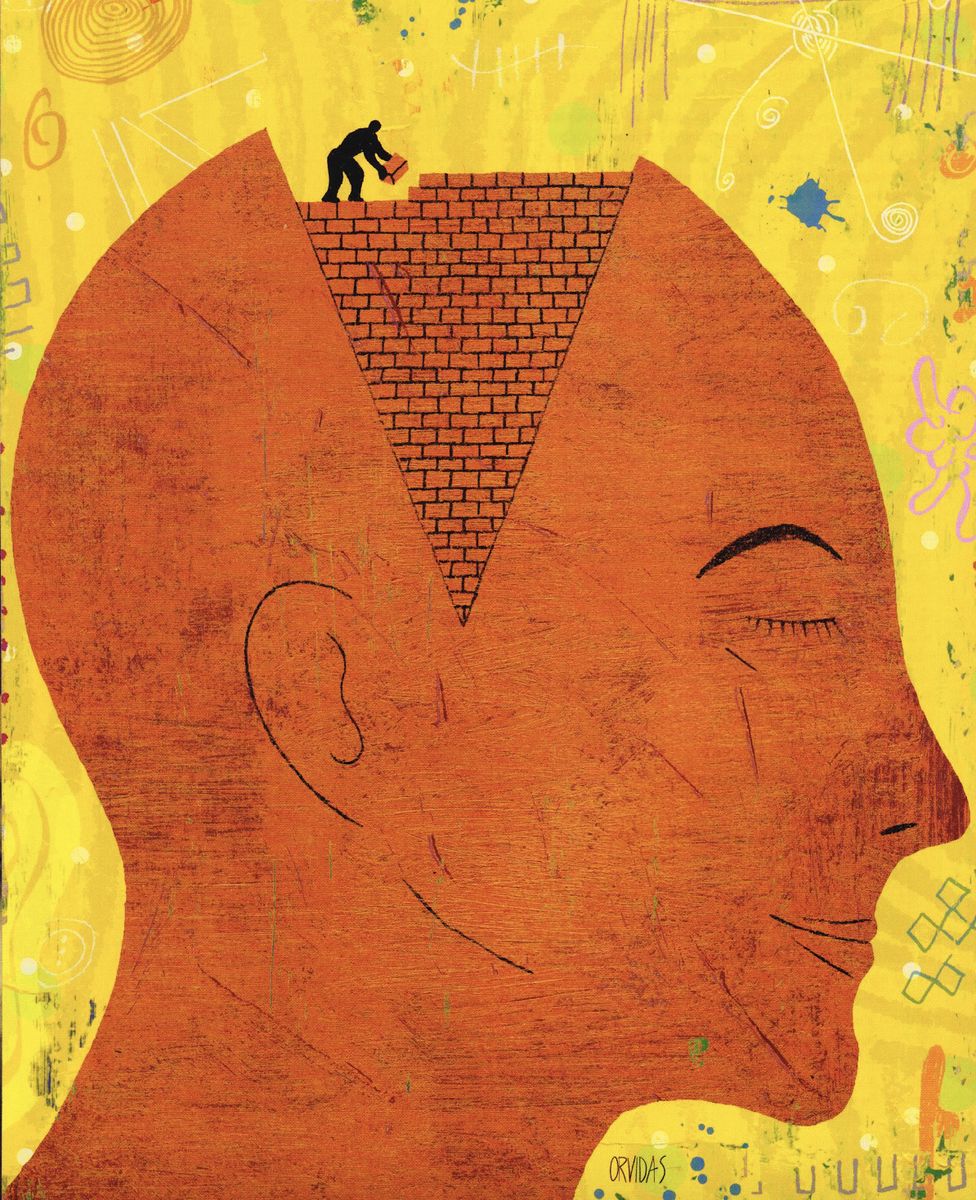
Americans are losing it. Living in chronic-stress mode, our days running 24/7, we are driven by an insatiable appetite for more — a bigger home, a faster car, a thinner cell phone, a sharper television, all that is new and different and exciting. All this new, more, better, bigger, faster, sooner, now, now, NOOOWWW is driving us to the edge. As a nation, we are more anxious, more depressed. Patterns of self-destructive behavior such as obesity and addiction are on the rise. Our communities are eroding; our leisure is evaporating. Even our children are suffering in this highly competitive world: Kids born since the 1970s are more apt than earlier generations to have anxiety disorders, depression and attention-deficit disorder, especially in affluent families.
But here’s what’s really interesting: “Americans’ restlessness and acquisitiveness are actually hard-wired into our brains,” says Peter C. Whybrow, director of UCLA’s Neuropsychiatric Institute (NPI) and author of American Mania: When More Is Not Enough (W.W. Norton & Company, 2005). “What’s happening to us is entirely predictable — though not inevitable — if you understand the way in which neurobiology works.”
Human beings are still operating, Whybrow explains, with the needs-driven brain systems that evolved over eons so our ancestors could respond quickly to the demands of the environment in their day-to-day struggle for survival. Programmed to satisfy ancient hungers while living amidst 21st-century plentitude, we now find ourselves doing more and getting more, yet craving still more. And we call that the American Dream.
“The American Dream is fascinating to me,” says the British-born-and-educated Whybrow, who has lived in the U.S. for 30 years (though he still retains his English accent). Chasing after that dream has us often on the move. Migrants by temperament, Americans are among the approximately 2 percent of the world’s population who move from place to place, Whybrow notes, while the other 98 percent live and die within 50 miles of where they were born.
“We’re a self-selected group of people here, many of us running on a treadmill trying to catch the dream, this El Dorado, trying to embody it in some sort of physical space,” Whybrow says. “But we can’t. We fail to realize that the dream is ephemeral.”
Couple this with the fact that we’re losing touch with family and community, which traditionally instill important life lessons and constraints, and we’re really in trouble. “We’re pushing ourselves to our physiological and psychological limits and beginning to actually cause ourselves harm,” Whybrow says. “We’ve got to find a different way to go.”
Finding that different way is a quest Whybrow is embarking upon not only in his writing, but also in an ambitious plan to rebuild NPI. His vision expands upon the institute’s strengths in neuroscience research and patient care and couples those with a community component to help people learn how to better take care of themselves, creating a center that is as much a destination for sustained well-being as it is a place to come when that well-being is threatened. Whybrow is working on collaborations with UCLA Extension, the School of the Arts and Architecture and other campus entities to develop such community-oriented offerings as museum-like exhibits illustrating the relationships between mind, body, genetics, community and culture; a teen-oriented coffee house to provide adolescents with a place for increased social interaction; and training classes to help children with attention-deficit disorders to better focus.
Since his arrival at NPI in 1997 from the University of Pennsylvania, where he was chair of psychiatry, Whybrow has been collaborating with leadership from UCLA’s David Geffen School of Medicine, consulting with Los Angeles community members engaged in thinking about NPI’s future, and working with a team of 370 full-time physicians and research-scientist faculty members, 700 clinical faculty, 1,300 staff members and 350 graduate students to formulate a vision for the new NPI.
Last June, their plans received a substantial boost — a $25-million endowment from Terry S. Semel, chairman and chief executive officer of Yahoo! Inc., and his wife, Jane Bovington Semel, founder of ijane inc., a nonprofit production company that works to address public-health issues through entertainment. In recognition of their generous gift, the institute will be renamed the Jane and Terry Semel Institute of Neuroscience and Human Behavior at UCLA.
“We want our gift to instill an even greater commitment on the part of UCLA and other universities to strive to match scientific excellence with humanistic care, compassion and the development and dissemination of self-care tools,” the Semels say. “We hope to build a stronger bridge between academic research and community outreach to promote emotional well-being among individuals, families and communities.”
The Semel Institute will reflect NPI’s tremendous growth since its beginnings in 1957, when the California Senate passed a bill to establish the institute to work with the state’s Department of Mental Health. Today, the institute is comprised of laboratories and research centers that last year received $140 million in grants, a bustling outpatient department and the Neuropsychiatric Hospital, which for 12 consecutive years has been named by U.S. News & World Report as the best psychiatric hospital in the West.
NPI has established a reputation as one of the world’s most comprehensive and innovative neuroscience centers. In recent years, faculty members have made significant contributions to the understanding and treatment of such diverse illnesses as autism, anxiety and obsessive-compulsive disorders, schizophrenia, manic depression, Parkinson’s disease, multiple sclerosis, addiction, Alzheimer’s disease and a variety of eating disorders.
Yet NPI remains something of a well-kept local secret. “We have one of the finest institutes of human neuroscience in the world right here in Los Angeles, but what we know inside of the university is not readily available to people who live outside in the community,” Whybrow says. The Semel Institute presents the opportunity to transform neuroscientific knowledge into genuine self-knowledge. Plans are for lectures, exhibits, community programs — a unique academic-community partnership that creates a true place of belonging.
“There’s a hunger out there for connection,” Whybrow says, “especially among young people, who feel so out to sea.”
“The new Semel Institute will be a compassionate gateway,” says Jane Nathanson, a psychotherapist and NPI community board member who has staunchly advocated outreach beyond the traditional bounds of medicine. Two years ago, she and her husband, Marc, founded the Nathanson Family Resource Center at Neuropsychiatric Hospital to provide families of patients with a comfortable meeting place, a library and Internet access to learn about disorders ranging from autism to Alzheimer’s.
The Semel Institute will strive for more of this “user-friendliness,” Nathanson says. She imagines people congregating in a pleasant park-like space built into the new architectural design, socializing, enjoying lectures and films and educational programs that will bring experts together with community members.
“We want to make the institute a place people will come to not only when they’re ill, but when they’re healthy,” she says.
Why this focus on community? Because, as Whybrow elucidates in American Mania, community is an essential facet of human life.
“Human beings love to live in community, in stable social groups,” he says. “When things are in balance … we don’t get greedy because the give and take of social interaction prevents that from happening.”
In America, however, we tend to foster unstable, highly competitive groups. “Most people live in a small dormitory community, travel and work in another community, vacation in another community and have family in another community,” Whybrow notes. Lacking deep connection to others, “the compassionate integration and interaction that enable us to learn essential behavioral principles that ensure health and happiness — we’ve tended to lose that. We’ve lost the community-support system that enables us to thoughtfully manage our environment.”
With these problems as a cultural given in this time-starved, information-saturated world, Whybrow says, “We have to be ingenious,” working to consciously create that which used to come naturally.
Initial architectural renderings for the new institute reflect its community mission, showing easy access from the streets and sidewalks of Westwood and an architecturally embracing environment. Laboratories, patient-treatment areas and community offerings will meld in a series of welcoming pavilions, each with a different focus. One pavilion might, for example, highlight culture and health and would include, along with clinic areas, classrooms for parent training, after-school tutoring for children and drop-in centers for art and music.
“Rather than your coming into the great campus through the gates, entering into the proverbial ivory tower, this would be a much more interactive portal between the community and the institute,” Whybrow says.
We all need to pay particular attention to our health in a culture that has come to breed unhealthiness, says Whybrow. “We learned a few decades ago that tobacco smoke is toxic, carcinogenic. So if you happen to smoke a lot of cigarettes, the chances of getting lung disease are extremely high. Our fast-paced world is potentially toxic as well because we haven’t figured out how to live with it. We’ve got to stand back and ask ourselves, how do we live with this very complex, supercharged environment we’ve created? How could I learn to cope … to relax, and why is it important to relax?”
He cites as a potential solution the work of the Norman Cousins Center for Psychoneuroimmunology of the NPI, directed by Michael Irwin, professor in the Department of Psychiatry and Biobehavioral Sciences, which invites members of the public to lectures and seminars about its research in mind-body interactions and their implications for health. Also under development is NPI’s Mindful Awareness Research Center, founded by Susan Smalley M.A. ’81, Ph.D. ’85, professor and co-director of the Center for Neurobehavioral Genetics. Mindful awareness, Smalley says, is known to have positive effects on the brain and the body, as well as to foster a sense of interconnectedness from which caring communities naturally evolve.
“Today, there is often little time for reflection, for greeting a friend or colleague, for taking the time to pause and enjoy the ordinary things in life — a sunrise, a smile from the guy at the Starbucks counter, a child’s query,” Smalley says. “In creating a community of individuals, a healing process emerges and there is an increased sense of well-being.”
William Yang, an assistant professor-in-residence in NPI’s Department of Psychiatry and Biobehavioral Sciences who studies the neurodegenerative diseases Huntington’s and Parkinson’s, is eager for these opportunities to reach a greater number of community residents.
“As scientists, it is our responsibility to actually communicate to the public what we are doing,” he says. “We know that people with these diseases and their families are suffering. I would like to give people hope — we’ve made exciting advances already and much more is about to happen for brain disease.”
“The Semel Institute can act as a resource for the emerging science of human behavior, perhaps to help schools and families learn more about brain development and behavior,” says psychologist Andrew Fuligni of the institute’s Center for Culture and Health and associate professor-in-residence in the departments of Psychiatry and Biobehavioral Sciences and Psychology. Fuligni studies child development — in particular, how adolescents adjust to their culture, with a focus on Asian and other immigrant families in the Los Angeles area.
“There are a lot of myths out there about how you’re born with the brain that you have and lose cells as you go on,” he says. “But the brain is actually developing and changing throughout one’s lifetime. We can give people hope in human potential and the ability to adapt and develop.”
Intelligence and self-understanding, says Whybrow, can shape neurobiology. Our brains prompt us to seek reward, but the brain doesn’t know what to do in an affluent environment of excessive reward. “The only way to positively resolve our current challenge is through intelligence and empathic understanding, to use the rational part of our brains to think. We learn empathic behavior from each other. We need a public campaign to help people think about how to take care of themselves and those they love.”
In envisioning his ambitious plans to put the Semel Institute on L.A.’s map, Whybrow draws comparisons with Disney Hall in downtown L.A. “Los Angeles has always had a great orchestra, but people didn’t know how great it was until Disney Hall came along,” he says. “The Semel Institute is going to be like that, bringing the public in for a whole new understanding of neuroscience.”
He is hopeful that many members of the Los Angeles community will come to the table to share his vision. “Collectively, we can do some wonderful things for Los Angeles,” he says. “I’m very passionate about the potential we have here.” While our unlimited pursuit of material reward could lure us to self-destruct, “our social intelligence can enable us to do things that biology will not.”
And if we keep that dictum in mind, our uniquely American quest for a dream need not destroy us.
“We must distinguish material pleasure from happiness,” Whybrow says. “I want people to reconsider their dreams. It’s really a matter of thinking about ways in which we can sustain our dreams without the rampant materialism.
“If you get someone to really think about it, usually their true dream is not to have a bigger house or smaller cell phone,” he says. “Our truest dreams are to do something meaningful with our lives.”