Editor’s note: This is an article from the Fall 1997 issue of UCLA Magazine.
On a Tuesday morning, just months before he was diagnosed with throat cancer, and before surgeons removed his voice box — an organ that he used more often and better than most men — John Liebeskind was on his usual 6 a.m. walk around Rancho Park golf course, across the street from the 20th Century Fox lot. He was striding along Pico Boulevard, when a car swept to the curb as if to cut him off. He stopped. The car door swung open. And there inside, Liebeskind could see his wife, Julia, and son, Ben.
“Excuse me, professor,” said Julia, “but only members of the National Science Academy allowed inside.”
“What?” Liebeskind asked.
“You’re in. You’ve been voted into the National Academy!” Julia exclaimed.
The National Academy of Sciences. The country’s most prestigious scientific society, an elite club whose members include Einstein, Pauling, Salk, Feynman and UCLA’s Elizabeth Newfeld. Knowing he was on the short list for election to the academy, Liebeskind had joked, “I don’t know how much pride you can take in being a member of an organization where the average age is deceased.”
The overwhelming honor, which comes suddenly and is forever yours, was bound to rest a bit uneasily on Leibeskind’s shoulders; he redefined “self-effacing” while establishing himself as one of the world’s most highly regarded pioneers in the field of pain. Before his death from cancer at the age of 62 in September, Liebeskind, a research psychologist, was an outspoken expert — and critic — on pain and its treatment. In the late ’80s and early ’90s, his laboratory at UCLA produced a remarkable series of experiments demonstrating that animals recovering from surgery suffer significant immune suppression. In particular, when rats with lung cancer are in pain, their tumors grow, but when they are given pain killers, the animals’ immune systems rally to contain the growth. The studies helped explain, among other things, why undermedicated patients rehabilitating from surgery are so highly prone to infection.
“The dictum ‘pain does not kill,’ sometimes invoked to justify ignoring pain complaints, may be dangerously wrong,” Liebeskind wrote in a widely circulated editorial titled “Pain Can Kill.” “Our results suggest it is not only safe to use analgesic drugs for controlling cancer pain in man, it may be unsafe not to.”
Liebeskind became something of a crusader in an effort to upend traditional medical thinking, which telegraphs to patients the message that agony is virtuous. Implicit in the physician’s offer, “We could numb that pain for you, if you’d like,” is the presumption that there’s something noble about suffering. Liebeskind questioned why healers question a patient’s instinct to artificially separate himself from his pain. Perhaps pain isn’t growth, Liebeskind asserted, though common wisdom holds otherwise.
A social thoroughbred, first-class talker, wizard at working the phones and widely respected researcher who spent 30 years helping doctors understand the baroque psychobiological processes that occur when humans are hurting, Liebeskind was an irresistible lobbyist for a scientific establishment not renowned for leaping to embrace radical new ideas.
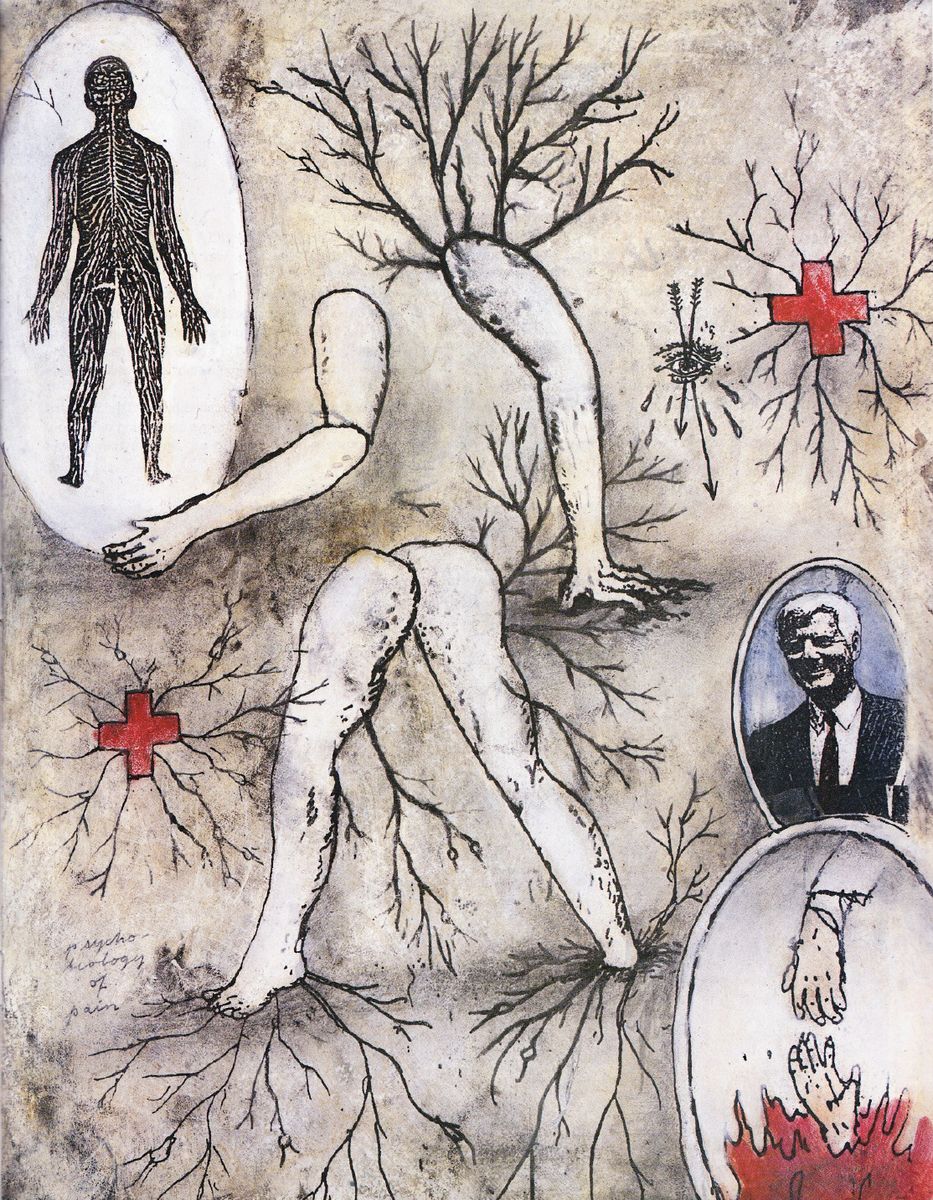
When Liebeskind joined the UCLA faculty in the mid-’60s, the field of pain research was as empty as a Bosnian minefield — and about as well mapped. Most doctors understood the body’s response to, say, a burn essentially the same way Descartes did: Fire touches skin and sends a flare through nerve fibers to the brain, which registers the sensation and tells the body to jump. “Just as by pulling one end of a rope,” Descartes wrote in 1644, “one makes to strike at the same instant a bell which hangs at the other end.”
This peripheral nerve theory, as it’s called, pictures the body as a Rand McNally of one-way pain pathways converging on a central-city consciousness, and served to explain everything from paper cuts and stubbed toes to hammered thumbs. But it could not account for more exotic phenomena, such as the fact that athletes and soldiers could suffer awful wounds and feel nothing for hours. Or even for the universal balm of rubbing a wound: Why should that help if pain shoots directly into the brain?
In a classic 1965 Science paper, a pair of researchers named Ronald Melzack and Patrick Wall proposed an answer. Perhaps, they reasoned, pain signals compete with other nerve impulses to pass through a kind of “gate” before reaching the brain. Sensations of touch move primarily along long nerve fibers, for example, which conduct impulses faster than the short fibers along which pain moves. Rubbing a wound may therefore block or close this gate so that the burning or stinging can’t pass through — thus soothing the pain. The authors speculated further that the brain continually mediates any experience of pain from above; that is, it may deaden the sting in some cases (during riotous battle, for instance) and amplify it in others (if a wound has been too long ignored). Pain, like most of life, is largely in the brain.
“The gate theory of pain was the single most influential piece of writing ever done in the field of pain, and it solidified my interest in this area,” Liebeskind recalled in an interview last June. “I think it was very exciting to me that this was sort of a new, open, virgin territory. I came to see that if I entered this field and did anything at all valuable, it would have an impact because there was so little going on. And I wanted my work to have an impact.”
It didn’t happen overnight. His first five years at UCLA were full of false starts, even confusion about which questions to ask. He was a man in search of a good experiment and, in one of the all-time near misses, was almost denied tenure. “It was a very close call,” remembers Bernie Weiner, a colleague who knew Liebeskind from graduate school. “It should make us think more about how fast we make these decisions and how long things take in science.”
Finally, in the late ’60s, the young UCLA professor and his first group of graduate students, using implanted electrodes to produce pain in the brains of rats, suddenly observed something bizarre. “A student named Tom Wolfe was conducting some studies on the difference between central pain (caused in the brain) and peripheral pain,” recalls Huda Akil, then a lab post-doc and now a professor of anesthesiology at the University of Michigan. “And in the process, he stumbled onto the observation that there were brain sites that, when activated electrically, seemed to slow down the responses to peripheral pain. The rats behaved as if they felt no pain.”
The lab’s senior member, David Mayer, mapped out the brain sites that seemed to turn off the pain, determined the right frequency to produce the effect and, with Liebeskind, prepared a paper on this stimulation-produced analgesia (SPA) for the journal Science. “John was an excellent writer, obsessive-compulsive about it,” says Mayer, now a professor of anesthesiology, physiology and anatomy at Medical College of Virginia. “We would argue and argue about a single word. He spent an incredible amount of time agonizing over these things, and I think this helped us articulate the two major insights in that paper.”
The first of these, Mayer’s, was that the stimulation didn’t turn off nerves, but rather turned on a system that was already there — a well-organized, separate, internal pain-killing apparatus. He speculated that a narcotic like morphine actually engaged the exact same machinery. The second insight, this one Liebeskind’s, was that all of this pain-killing was happening not in the brain but in the spinal cord.
What Liebeskind and Mayer were suggesting was unheard of — that the body produces its own opiate-like drugs and that the brain could administer these drugs to powerful effect. Few scientists were convinced. No one could explain how such an internal drug-delivery system would work, and evidence that it existed at all was paltry. Those who did believe — John Hughes and Hans Kosterlitz at the University of Aberdeen, Avram Goldstien at Stanford, to name several — were already scrambling to isolate natural painkillers in the brain, working largely on instinct and faith. Liebeskind’s data not only confirmed they were on the right track, it pointed to where the numbing process was taking place, allowing them to map those opiate receptor sites. A year later, in 1972, when Huda Akil presented data confirming Liebeskind and Mayer’s suspicions, John Hughes was about to make history with his isolation of enkaphalin — the first of the so-called endorphins.
There was, however, a small problem with Liebeskind’s masterpiece: Science had rejected it. It was interesting, the reviewers said. There was nothing wrong with the methodology. But it wasn’t about to set the world on fire.
Liebeskind was dumbfounded. He had proof the brain could block pain itself, from the top down. But the nameless reviewers couldn’t see it. So he did what came naturally: He picked up the telephone and dialed Science editor John Ringle, who answered on the first ring. After introducing himself and making a few gentle inquires, Liebeskind made his pitch. “Mr. Ringle,” he remembered saying, “I don’t know if you’re a Mister or a Doctor, and if you are a doctor, I don’t know what field you’re trained in. But I really believe that this is an important piece of work, and rather than just rewrite this and submit it and have you send it out for review again, I would like you to look over it yourself. If you don’t think it’s really interesting and important, then you tell me that and you won’t hear from me again about it.”
After spicing up the introduction and adding a lengthy discussion section, Liebeskind and Mayer resubmitted the article. Shortly thereafter, in the December 24, 1971 issue, their reputations were launched. So, too, was what came to be known as “The Ringle Wrangle”: the persistent application of Liebeskind charm to the gatekeeper of America’s most august scientific forum. “It was the first,” says Mayer, “of many Ringle Wrangles.”
In contrast to the archetypal modern lab portrayed in Bruno Latour’s Laboratory Life — a hierarchical, political, suspicious, cutthroat congregation of egos — Liebeskind’s UCLA shop was an oasis for freethinking. Huda Akil joined the team in 1969, newly arrived from Syria and not long out of college. “I learned a great deal from John, but also from Wolfe and Mayer, who were very generous,” she says. “In turn, I fixed pots of Turkish coffee, told them weird tales from the Middle East and, as I gained more knowledge in the field, argued with them about experiments and interpretations.”
Former students credit Liebeskind’s success to style as much as scientific instinct. “There’s a lot of false modesty in successful research scientists,” says UCLA psychologist Frank Krasne, a friend and colleague of Liebeskind’s. “They’ll say, ‘Oh my students did it all,’ or ‘I’ve been lucky to get good help.’ But in John’s case, he really believed it. He felt his students had done it all. At the same time, these great results kept happening and happening in his lab. I mean, most labs just aren’t like that.”
It was the students who collected the data, assessed its significance, then went to Liebeskind for context and judgment. This interaction worked, as a rule, the way it did with Mayer and his SPA results — student and teacher talking and challenging each other until they discovered what it was they really thought. Liebeskind boiled those sessions down, stirred in his own magic dust and voila — you were in print. “If you found something you thought was interesting or intriguing in the lab, you worked like hell to convince John,” said a student at his mentor’s memorial service. “And if you could convince John, he’d convince the world.”
Liebeskind proudly called himself a “discussion-section scientist,” referring to the last section of a journal article in which authors put their results into a larger context and speculate about what they might mean. “He had a command of the literature, he could see the larger implications of students’ work, and most of all he could make sure others understood those implications,” says Marcia Meldrum, a science historian who worked with Liebeskind at UCLA on an oral history of pain research.
The conversations in Liebeskind’s eighth-floor Franz Hall office weren’t always about spinal synapses and pain pathways. “Whenever someone needed to see a professor, or had a problem, any problem — their mother was dying, they were depressed, their mentor was treating them badly — they ended up in John’s office,” says Krasne. “That’s where they’d go first.” It was one of the few places on campus where an anxious student could get good advice, a dose of therapy and the sensation of being in the company of the Scientific Community. If you had a question about endorphins, John would just as soon call Hans Kosterlitz in Aberdeen or Avram Goldstein at Stanford, one of those who’d done the original research. A question about the gate theory might be put to Ronald Melzack himself, at McGill University in Montreal. If a student had a question about reincarnation one suspects, Liebeskind would have tried to put a call through to Saint Augustine.
“The image I’ll always have of John is this,” says Gayle Page, a lead author on several of the early papers that came out of Liebeskind’s lab and now a researcher at Ohio State University. “He’s in his office, on the phone, talking us up, telling someone about the work we were doing, standing up and talking and looking out the window, his hands in his pockets. And there’s a student there, too, sitting in that chair.”
In the Great War, Studs Turkel retells the infamous World War II story about the soldier who parachutes into a tree, breaks both legs and suffers such harrowing pain that his bowels empty. But he hangs there for days, unable to move, in excruciating pain, shamed into silence even as fellow GIs pass beneath him. Psychologists have used the tale to illustrate how exhaustion, fear and especially shame can turn even strong-willed patients mute and leave them lying silent on hospital beds while pain wracks their bodies — even when narcotic relief is just a push of the call button away.
“I’d seen it happen,” says Page. “I had been a practicing nurse for 10 years, and I’d seen kids lying there in pain after open heart surgery, and I couldn’t do anything to help them. We had all these concerns about narcotics, that they’d make patients addicts, all these myths, and I kept thinking about the kids lying on their backs after an operation: How did they feel? So I went to UCLA on a mission.”
She ran into fellow missionary Liebeskind while taking his “Psychobiology of Pain” course and made a suggestion. “I proposed to John that we try an animal model to test the idea that pain after surgery can be physically damaging,” Page remembers. “Previous studies had reported immune suppression after surgery but hadn’t tried to do away with that suppression by using anti-pain medication. He was skeptical, I knew, but said let’s go ahead anyway, and immediately took me into his lab.”
Page entered a shop chockablock with geneticists hard at work — researchers looking at gender differences, others studying pain inhibition and still others measuring opiate tolerance. Liebeskind’s small lab brimmed with enough expertise to isolate immune cells, establish their effect on specific tumors and breed rats for precisely this purpose — to carry out, in short, exactly the kind of trials Page was longing to run. Working with Shamgar Ben-Eliyahu and Raz Yirmiya, among others, Page rigged the studies and began playing with narcotic doses. “We quickly found a morphine dose that was pay dirt,” she says. “It restored immune response in these rats completely.”
It was exactly the ammunition Liebeskind, a founder of the International Association for the Study of Pain and the American Pain Society, had been waiting decades for. Finally, he could challenge conventional treatment of pain. “He could now make more aggressive arguments,” says science historian Marcia Meldrum. “He could say to doctors, ‘You can dose patients with antibiotics until the cows come home, but insistent pain is dangerous and may counteract all your efforts.’” Soon after, the American Pain Society organized dozens of seminars on undertreatment, and the early ’90s saw the opening of the first wave of pain clinics, multidisciplinary centers with physiologists and anesthesiologists, even acupuncturists. Liebeskind’s campaign dovetailed nicely with Norman Cousin’s message that mood, influenced by pain as well as other factors, could affect the course of disease. For a while, pain treatment became a hot topic in the mainstream press, with articles written on, for instance, cancer pain and arthritis.
Former students of Liebeskind’s, including Page, Mayer and Akil, now hold influential positions. And there is one woman, a nurse, who wrote recently of treating a man who was in agony, suicidal, dying of lung cancer. “What I learned in John’s classes gave me the confidence to ask the medical personnel whether the man could have more pain medication without threatening his health and safety,” she recounts. “As it turned out, they realized he was being undertreated. They increased the dosage to where the man said he was comfortable. A few days later when I saw him again, he was not nearly as preoccupied with killing himself. He was even smiling and joking.”
Since the early ’90s, the scrutiny of pain therapy has somewhat cooled. “It’s nowhere near where we think it should be,” says Gayle Page, “but there are pockets where doctors understand and many pain clinics.” And there are the irrefutable data, the sum of a lifetime of Liebeskind’s humanist vision. During that early morning walk several springs ago, when his wife and son drove up bearing great news, Liebeskind chose not to get into the car. He sent his beloved messengers home and decided to press on alone.
He continues west on Pico, past the Crown Car Wash and St. Timothy’s, then turned left on Patricia, around the driving range, and on past the early-bird golfers, now visible through the shaggy eucalyptus along the back nine. He strolled through the wet coolness there, the scientist and crusader and father, walking for a while in his own rich company. With the sun about to break through the cloud cover, John Liebeskind, a fellow on a happy morning walk, a man of good works and devoted friends, a newly minted member of the National Academy of Sciences, felt no pain.