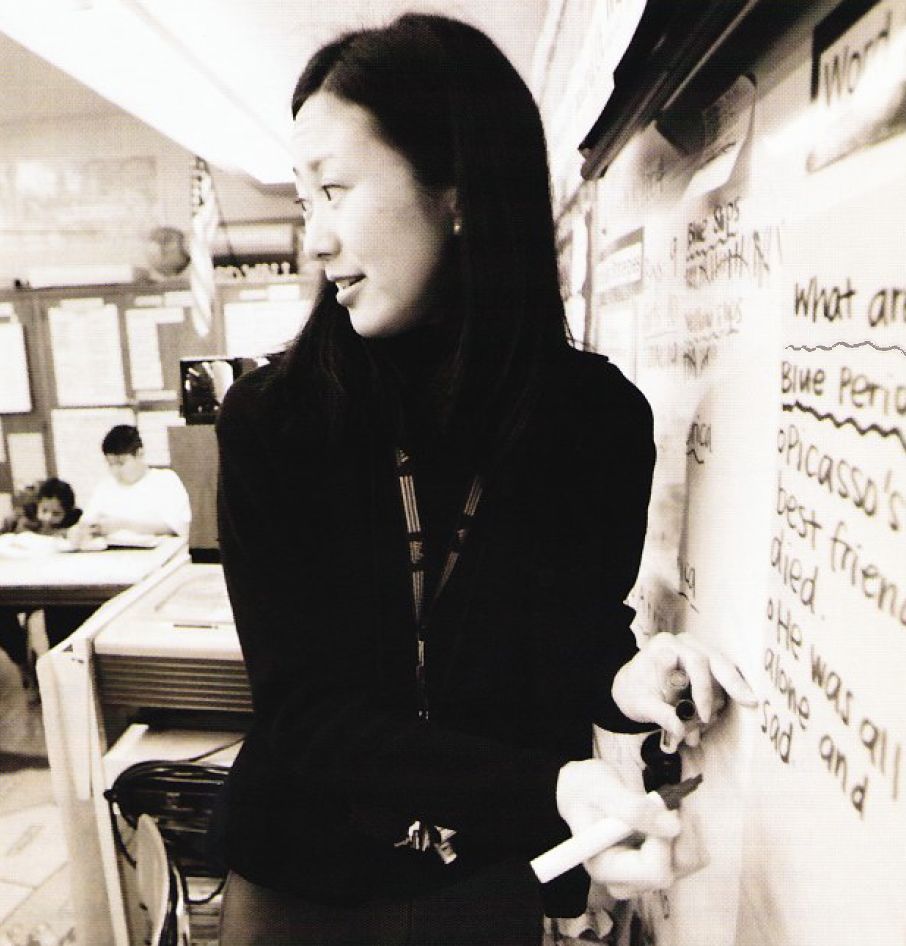
After 14 years as an elementary school teacher, Lynn Gallandt was physically and emotionally spent. She adored her first-graders at Moffett Elementary School in Lennox but felt that the expectations on teachers were too great, and she no longer believed that she could measure up. Though Gallandt desperately wanted to give her kids the individualized attention they needed, the constant pressure of maintaining discipline, being a surrogate parent, and meeting the challenges of mandated curriculum and standardized tests left little time for anything else.
“I just wanted to be in the classroom teaching,” she says. “I just wanted to get in there and teach.”
Each day brought some new disappointment, and it ate away at her self-confidence. As she drove home to Long Beach after work, she would think, “I’m not doing any good for anybody.”
With three young children at home, the veteran teacher made the difficult choice in 2000 not to renew her contract for the coming fall. By quitting elementary education, Gallandt became another statistic of a crisis that is undermining the nation’s educational system: the flood of talented, experienced teachers who are walking away from their careers.
The conventional wisdom holds that burgeoning enrollments, smaller class sizes and retirements have led to an acute shortage of teachers. But researchers have found that the real crisis is not one of supply but retention. Teachers are abandoning their classrooms at an alarming rate. Each year, more leave than enter the profession. In 2000–’01, the nation’s schools lost in excess of 287,000 teachers — 55,000 more than had been hired the previous year, for a net loss of 24 percent, according to education researcher Richard M. Ingersoll of the University of Pennsylvania.
In the 2003 report “No Dream Denied: A Pledge to America’s Children,” the National Commission on Teaching and America’s Future likened the problem to “pouring teachers into a bucket with a fist-sized hole in the bottom.”
The dilemma is a critical one for the state, says California Superintendent of Public Instruction Jack O’Connell. “You don’t just want to constantly keep recruiting teachers on the front end of the pipeline if you’re losing them at the back end of the pipeline,” he says.
Low salaries may be part of the problem, but they are not, as many might expect, the main catalyst that is spurring the flight. Teachers “know coming in that their salaries are not going to be high,” says Megan Franke, director of the UCLA Graduate School of Education & Information Studies’ Center X, which specializes in urban-teacher preparation. More often, teacher attrition is associated with a lack of support from administrators and feelings that they have little or no control over their professional lives.
At Moffett Elementary, Gallandt worked under a supportive principal, JoAnn Isken ’75, Ed.D. ’76, who is a faculty adviser for Center X’s Teacher Education Program (TEP). But over the years, Gallandt says she came to believe that the world outside the school system neither appreciates nor understands the demands that are placed on urban teachers and schools.
Mandated curricula, state standards and annual standardized testing sound like fine ways to boost student achievement and make teachers accountable. But children do not learn in lockstep, Gallandt argues. Some learn quickly, others slowly. Some are visual learners, others auditory. Some kids have parents who read to them every night, others grow up in bookless households. When teachers are given little latitude to be creative or tailor their lessons to the specific needs of their students, it is a formula for frustration.
Teachers, Isken says, are “caught between the demands of the policymakers and the reality of the child.”
She spoke of a fourth-grader who enrolled at Moffett in February but was unable to read in any language and could write only his first name. “Policymakers expect this child in the month of May to take a fourth-grade exam and … perform on this exam at a level of proficient or above,” Isken says. If the child fails the exam — which is more than likely under the circumstances — it is a black mark against the school and the teacher.
Gallandt persisted in the classroom longer than most. Nationwide, 1 in 3 teachers leaves the profession during the first three years of teaching, and 46 percent leave during the first five years, according to the U.S. Department of Education’s National Center for Education Statistics.
Sadly, the schools with the highest rates of teacher attrition are those that can least afford it. Schools in high-poverty urban areas, already underfunded and under-resourced, often must replace one-fifth of their teaching faculty each year, says Karen Hunter Quartz Ph.D. ’94, assistant director for research at UCLA’s Institute for Democracy, Education & Access. While retirements have been rising in recent years, they account for only a fraction of total turnover.
The Los Angeles Unified School District — where 86 percent of schools are urban — retains teachers at a higher rate than any other large urban district in the country, says LAUSD Human Resources Chief Deborah Hirsh. Still, the district each year replaces an average 6 to 7 percent of its 36,000 teachers. This year, the rate of new hires will rise to 9 percent, or 3,300 new teachers, in part because the district must replace a large number of uncredentialed teachers in compliance with the No Child Left Behind Act, Hirsh says.
What makes the retention problem particularly distressing is that the “leavers” — educationese for teachers who get out of the profession for reasons other than retirement — tend to be among the best and the brightest, says Quartz, lead author of “Retaining Teachers in High-Poverty Schools: A Policy Framework,” forthcoming in the International Handbook on Educational Policies. Many of them have advanced degrees, or an academic major or minor along with an education degree. Leavers also include secondary math and science teachers, and bilingual and special-education teachers — the cadre of educators who traditionally are in the shortest supply.
When Gallandt — who has experience as both a special-education and bilingual teacher — told Isken she was calling it quits, the principal was “devastated” to learn she was losing “a wonderful teacher who connects deeply with children and families.”
Experts say the revolving door at urban schools exacts a terrible and unacceptable toll: Children who are most in need are not getting a quality education.
Good teaching comes through experience. Yet many teachers in their first year feel themselves drowning in a sink-or-swim environment that offers little support as they stumble through false starts while learning to manage their classrooms, familiarize themselves with the curriculum and develop their own style. On top of that, novice teachers often are given the most difficult classes, or they are assigned to urban schools that have a hard time attracting qualified teachers and often fill vacancies with unlicensed teachers or full-time substitutes. When children are assigned to inexperienced teachers year after year, it perpetuates the cycle of underachievement for urban youngsters, many of them low-income children of color, Quartz says.
High turnover is a circular problem. When the teaching staff is in flux, cohesiveness, continuity and collegiality among the faculty break down, Franke says. Schools must spend so much time and effort recruiting and training new teachers that their overall effectiveness suffers. The result is a negative work environment that pushes other teachers to leave as well.
Some attrition among teachers is inevitable. It’s probably a good thing that a teacher who discovers that he or she is ill-suited to the profession finds another line of work. But experts say that many good teachers could be kept from running for the exits if only they had the right kind of training and support. To survive in an urban school, Franke says, teachers need to engage with the community, build coalitions among colleagues and stay connected to their profession in the same way that lawyers and doctors do.
Teaching can be a lonely business. “Sometimes you’re in there all day with 140 or 160 kids and you’re wondering, does anybody care about me, is anybody thinking about me?” says Doug Waybright, principal at Carson High School.
TEP provides new teachers with a support system that helps them overcome that sense of isolation, hone their craft and develop coping mechanisms to deal with daily struggles. Second-year students, who teach in one of four Los Angeles-area school districts, work under the guidance of field supervisors and faculty advisers — all former teachers who themselves have gone through the same struggles.
“Once a week, someone would come in and check on me and see if I needed anything,” says David Swanson ’00, M.Ed. ’03, now in his second year of teaching math at Fremont High School in South Central Los Angeles. “You could just talk about a student being horrible or acting up, or curriculum ideas, like, ‘I really need to teach this lesson but I don’t know how to do it.’ It was a real comfort for me to know that if I needed them, they were there.”
Building strong relationships with fellow faculty members is equally important. When Nancy Florez-Muro decided to go back to work after her second child started school, she enrolled in UCLA Extension’s program leading to a multiple-subject teaching credential. Florez-Muro started teaching immediately with an intern credential at Lake Center Middle School in Santa Fe Springs. Nights and weekends, she attended classes at Extension, which offers as many as 1,000 courses annually to keep teachers updated on materials and new teaching methodologies. There, she forged bonds with classmates who were traveling the same bumpy road as she was, learning to teach math to rambunctious middle schoolers.
“Everybody didn’t always have an answer, but we helped each other figure a way through,” Florez-Muro says. “If you stay in your own classroom and you don’t network, you could end up thinking, ‘I am not worth anything.’ It’s that collegial support that really gets you through,” she says.
This type of networking helped Florez-Muro over a rough patch in her career. Several years ago, she says, she had a conflict with a principal who she felt was treating her unprofessionally and not giving her leeway to employ her own creative ideas. The worse Florez-Muro felt she was being treated, the more she doubted her own competency. She might have thrown in the towel had it not been for colleagues who assured her that she was indeed doing a good job.
Florez-Muro stuck it out. The principal has since left the school.
At UCLA’s TEP, graduates are plugged into a network of urban educators. Groups of alumni meet once a month to talk about new developments in the field or grapple with problems that arise at work. Some become mentors or subject-matter experts for teachers who are just starting out. It’s an important way for teachers to feel that they are part of a professional community and that their skills and experience are valued in society, says Jody Z. Priselac ’74, Ed.D. ’99, executive director of Center X.
Mindful of the kinds of pressures that drove Gallandt from teaching, Isken also does all she can to create a supportive and stimulating environment for her new crop of teachers, many of whom come out of TEP. Among them are Diana Manuel M.Ed. ’02 and Bernie Sabad ’99, M.Ed. ’02, who, with colleague Rosalinda Barajas, team-teach a class of 58 first graders.
The three teachers like the arrangement. Each has different strengths, so they all depend on each other for support. They also know that they can turn to Isken for help without feeling like they’re admitting inadequacy.
“Traditionally in teaching, the teacher goes in and closes the door. In some ways, that is sort of what’s attractive in education — you’re in business for yourself,” Isken says. “But the negative part is that it’s impossible to deal with everything that teachers face on their own. Here, we’re a team and you never have to face anything on your own.”
That kind of thinking might help to turn the tide and return teachers to the classroom, where they are needed. Educators and school leaders concerned with these issues know that reversal is critical to the ongoing health of the nation’s education system. And, they acknowledge, it is something that needs to happen sooner rather than later. In the coming decade, America’s schools will need 2.2 million new teachers.



