Editor’s note: This is an article from the December 1998 issue of UCLA Magazine.
It is cold on top of the mountain. Temperatures can plummet to -4 C. High winds — sometimes gusting to 150 mph — can whip snow, sleet and fog into an impenetrable mushy haze. To reach the summit requires dedication and a four-wheel drive because the air is too thin to adequately cool a vehicle’s brakes upon descent. Most rental companies will void your contract if you take one of their cars up here.
It is a remote, demanding place.
But from here, at 14,000 feet above sea level, atop a dormant volcano in Hawaii with the whole of the Pacific Ocean spread out like an indigo carpet far below, the night sky is a jeweled, crystalline veil undisturbed by the pollution of city lights or turbulent air roiling off of nearby mountain ranges.
It is here at the Keck Observatory on Mauna Kea, 2,500 miles from Westwood, that Andrea Ghez comes to stare into the very core of our cosmos. She is in search of the Black Hole. To say that finding it is like looking for a needle in a haystack is to understate the case. What Ghez is looking for — and what she has in fact found! — is evidence of a presence of unspeakable mass, yet virtually nonexistent, subatomic size. Even if it could be superhumanly magnified, it would remain virtually invisible because its gravity “strangles” light waves. And the whipped-up velocity it induces in the orbits of its nearest stars is mostly hidden from telescopes by cosmic dust along the galaxy’s plane that dims the starlight of the Milky Way’s 100 billion suns by a factor of 1 trillion.
Yet, galactically speaking, this node of turbulent chaos is right in our own backyard, a mere 24,000 light years away (that’s about 6 trillion miles a year traveling at the speed of light, to you and me).
“Our galaxy is rather mild-mannered and quiet, and was one of the least likely galaxies to have a black hole at its center,” Ghez says. “Yet, a supermassive black hole at the center of our galaxy is precisely what we have found.”
Her discoveries have sent quivers throughout the space-science community. She and a team of UCLA astronomers presented their “very strong” evidence of the black hole in September at a conference in Arizona, and their research will be published in the December issue of the Astrophysical Journal. The popular press, too, has been tantalized; Discover magazine made it its cover story in November.
“What lies in the center of the Milky Way has been one of this century’s ‘big’ science questions,” says Terry Oswalt, program manager for Stellar Astronomy and Astrophysics at the National Science Foundation. “Andrea’s work has massive implications on our understanding of how galaxies evolve.”
At 33, Ghez is a meteoric star on the UCLA astronomy faculty. Even before the most recent groundbreaking announcement, she was earning accolades and international recognition for her work, not to mention a trophy case full of important prizes. She received the 1998 Newton Lacy Pierce Prize in Astronomy, given for “outstanding achievement” to an astronomer under 36. There has been the 1999 Maria Goeppert-Mayer Award from the American Physical Society for outstanding achievement by a woman scientist. There has been a Packard Fellowship, a Sloan Fellowship, an NSF Young Investigator Award, teaching awards from the UCLA Department of Physics and from Caltech and a host of other recognitions. The chair of her department, Ferdinand Coroniti, calls Ghez’s work “a real tour-de-force … that continues to dazzle and amaze the astronomical community.”
Though she is quite young to have accomplished as much as she has, Ghez’s star has been on the ascent for a long time. When she was 4, she remembers watching the first lunar landing on TV and announcing that she planned to become the first woman astronaut on the moon. Her parents — her father was an economics professor, her mother an art-gallery director in Chicago — didn’t laugh; they bought her a telescope.
Years later, when she decided she wanted to attend the male-dominated Massachusetts Institute of Technology — sort of the Citadel of science — her high school science teacher told her to ignore her counselor’s warning that “women don’t get in there” and apply. Ghez earned her B.S. from MIT in 1987, and her M.S. and Ph.D.s from Caltech.
There’s something of an Indiana Jones mien about her in her alfalfa-colored trousers, black monkey boots and athlete’s grin. Put a wide-brimmed hat on her head and a bullwhip in her hand, and it wouldn’t be much of a stretch to imagine her chasing precious jewels among the ruins of some ancient lost temple rather than jewels in the sky.
There are no star maps on the walls of her cramped office. Its most defining touches are a red velvet couch and a Robert Mappelthorpe photograph of bodybuilder Lisa Lyon in a futuristic choir gown. On her door is taped a fortune — “The night life is for you” — along with cartoons and photographs. Working at the telescope, she favors classical music for those moments when her concentration must be at its keenest, and loud, pulsing rock for the wee hours when it’s tough to keep one’s eyes open. In conversation, her words tend to streak forth like shooting stars. But her rapid-fire delivery does not trouble her students; for them, her lectures convey a palpable excitement and they are engaged by her and enraptured by the science. Many say it is the best class they have.
And there is more to her than just science. She firmly believes in her role as a mentor. “Science was always something I was good at, and I was fortunate to be in an environment where this wasn’t discouraged,” she says. “In my studies, I’ve made very conscious decisions about who I work with. That’s advice I always give to undergrads. I feel strongly about the importance of mentorship roles.”
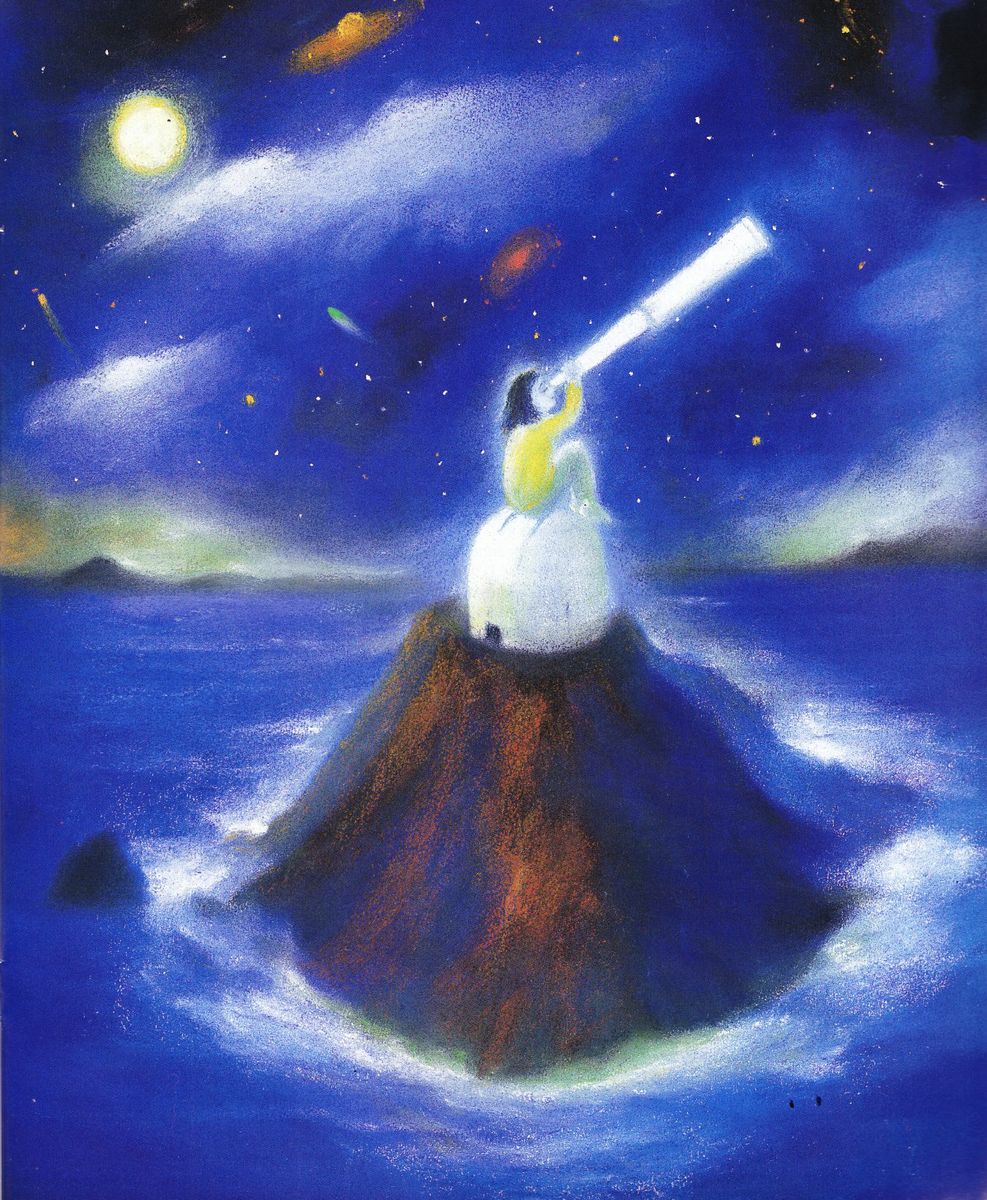
She took that ethic a step further when, in 1995, she published, with Judith Cohen and illustrator David Katz, a picture book, You Can Be a Woman Astronomer (also available on CD-ROM). The book, which received a glowing review and strong recommendation from the School Library Journal, lets girls 9 to 12 know that if they, like Ghez, love to solve crosswords, work jigsaw puzzles or fiddle with Rubik’s Cubes — in other words, if they are solution oriented — they, too, can aspire to achievements at the pinnacle of science.
Her message obviously strikes home with many girls. Ghez’s favorite picture — taped to her door — is of a young girl, maybe 10 years old, with a pretty smile and a blue denim hat to which a big yellow flower is pinned. She is standing in front of a science-project display about telescopes and is holding a copy of Ghez’s book in her small hands. Next to the picture is a note, illustrated with luminous stars and planets, from the child: “Dear Prof. Ghez. Thank you for letting me ask you questions about your job. I hope one day there is a planet or star with your name.”
“I just love that,” Ghez reflects, smiling broadly.
How did she do it?
It’s no small feat to find a black hole, those infinitely dense phantoms created, scientists postulate, from the remnants of collapsed stars (so-called “stellar black holes”) or from an aggregate of stellar holes ( “supermassive black holes,” such as Ghez revealed). Whatever its origin, the mass of a black hole is so dense, that nothing — not even light — can escape its grasp. Yet, when one is in your neighborhood, there are signs. Outside the ominously titled “Event Horizon” — about 10 million miles wide — gravity from a black hole rises to Looney Toon effect, grabbing the near side of a passing star and stretching it away from the backside like the neck of a rubber chicken. In our eeriest sci-fi imaginings — not an approach to which Ghez nor most other astronomers would ascribe, but which serves nicely as illustration — we might envision a black hole, as described by New Zealand astronomer Roy Kerr, as a “magic ring” of infinitely forceful spin, like the eye of a hurricane, through which an astronaut could — POOF! — pass through to an alternate universe.
In the farther reaches of the Milky Way, there is about one star flickering within each three cubic light years of space. Near the middle, where the black hole is supposed to be, the population is a million times that. In a slow pan of the galaxy, the black hole’s glowing “accretion disk” is so inconspicuous that it had been compared by one astronomer to “finding a Coke machine in the desert.”
To find that Coke machine, in 1995, Ghez, using the Keck I telescope, started to track the movement of 100 stars near the galactic core. Over the course of three years of observation from the mountain top, she found that these stars showed the telling signs of influence by extreme gravitational forces.
Within that grouping, Ghez found that a nucleus of 20 stars were spiraling around the black hole at speeds up to 3 million miles per hour, about 10 times the speed at which stars typically move. In order to account for their speed, Ghez determined that an object 2.6 million times more massive than our sun must be concentrated into a single black hole.
“In our first year, we could only collect the data, and we didn’t really know that we could see the faint sources because we hadn’t worked out all the analytical codes,” Ghez says. “But the second year, when we knew we’d gotten the measurements, there was actual cheering. We were ecstatic.”
Just getting a clear view of the center of our galaxy was, in itself, a remarkable accomplishment. Turbulence from the Earth’s atmosphere distorts the resolution of even the most powerful ground-based instruments. “It’s as if you are looking at something at the bottom of a pond,” Ghez says. To overcome that distortion, Ghez made her observations using a technique called “infrared speckle interferometry.” This procedure, which she helped to develop, uses computers to analyze thousands of high-speed, high-resolution snapshots. The result: an image that has at least 20 times better resolution than those made by traditional earthbound imaging techniques.
“It’s like putting on glasses,” says Ghez.
The technique involves working out the timescale on which the atmosphere is introducing the errors — in the realm in which she was scanning, that was about one every 100 milliseconds — and then taking and saving pictures at that interval. Employing a variety of correcting techniques, she produced “diffraction-limited” images: On the screen of her computer, blurry “before” images were shrunk to pin-pricks, giving her the highest spatial resolution currently attainable from the ground or space.
What Ghez had achieved was amazing. The innermost stars in Ghez’s survey moved 3 million miles an hour across space. Light is 200 times faster. From Earth (moving 19 miles each second around the sun at a mere 68,000 miles per hour), Ghez had to derive those distant suns, all of which register as less than a glimmer, even if the telescope could find them. The precision of Ghez’s measurement at the border of the Milky Way’s black hole was such, says UCLA colleague Eric Becklin, “that an observer in L.A. could measure someone in New York turning his head back and forth.”
Her observations — captured in two- or three-day increments every month or so during the course of the year — have revealed insights into our own galaxy that heretofore could only be inferred and supports findings from other research groups reported earlier this year.
“There is an incredible amount of matter between us and the center of the Milky Way to obscure our view,” NSF’s Oswalt says. “Andrea has pulled the living-room shades open a bit and finally given us a good look at what’s going on in our own backyard.”
The black hole has not, of course, been Ghez’s only major find. It’s just her most recent. Using the same “infrared speckle interferometry” technique she, in 1993, found that contrary to prior assumptions, most stars form with a twin, located at distances smaller than that of our solar system. Theories on star formation have typically been based on single-star systems such as our own, despite the fact that in our solar neighborhood, about half of the middle-aged stars have companions. Many astronomers believed that these stars had begun solo and then, by the process of capture, had become binary later in life.
Ghez used her technique to look at young stars, anticipating she would find either no binaries — meaning the capture theory was correct — or the same proportion found in middle-aged stars, suggesting companions emerge in the process of star formation. Instead, she found twice as many companions in the younger stars.
“When you look at a stellar nursery, you see almost all binary stars, and when you see the middle-aged stars like our sun, about half of them are in binary star systems. So there’s a discrepancy,” Ghez says. “There are two models, I think, to possibly explain it. Either all of these systems form as multiple systems and then fall apart by the time they get to the age of our sun, or some systems just form stars more efficiently than others.”
The reverberations of her discovery were immediate: For one thing, “this suggests there might not be as many planets as one might otherwise think,” Ghez observes, since the gravity of twin suns likely would unhinge the neat ring of stardust from which planets are formed.
“Most of these stars are actually separated by the distance between our sun and just inside of, say, Pluto. So they are very close. And the second star is going to disrupt the gas and dust, so I think it’s unlikely that the very closest binary systems are capable of forming stable planetary systems,” she says.
Ghez is not through with black holes. Everyone wants to know about black holes, and she has a lot of time ahead of her to chase them — “People do astronomy for a long time,” she says. “We have two octogenarians in our department, Lawrence Bauer and Dan Popper, and both are still very much at work.” Her next step is to look beyond their velocity to measure acceleration.
“That will help us to determine, we hope, the precise location of the black hole,” she explains. “It’ll take about two years.”
And what does Ghez — surrounded in her office by her Mapplethorpe, her fan letters and freshman physics tests — really feel about a place like the universe?
“I have no idea,” she says. Then she laughs: “It’s big!”



