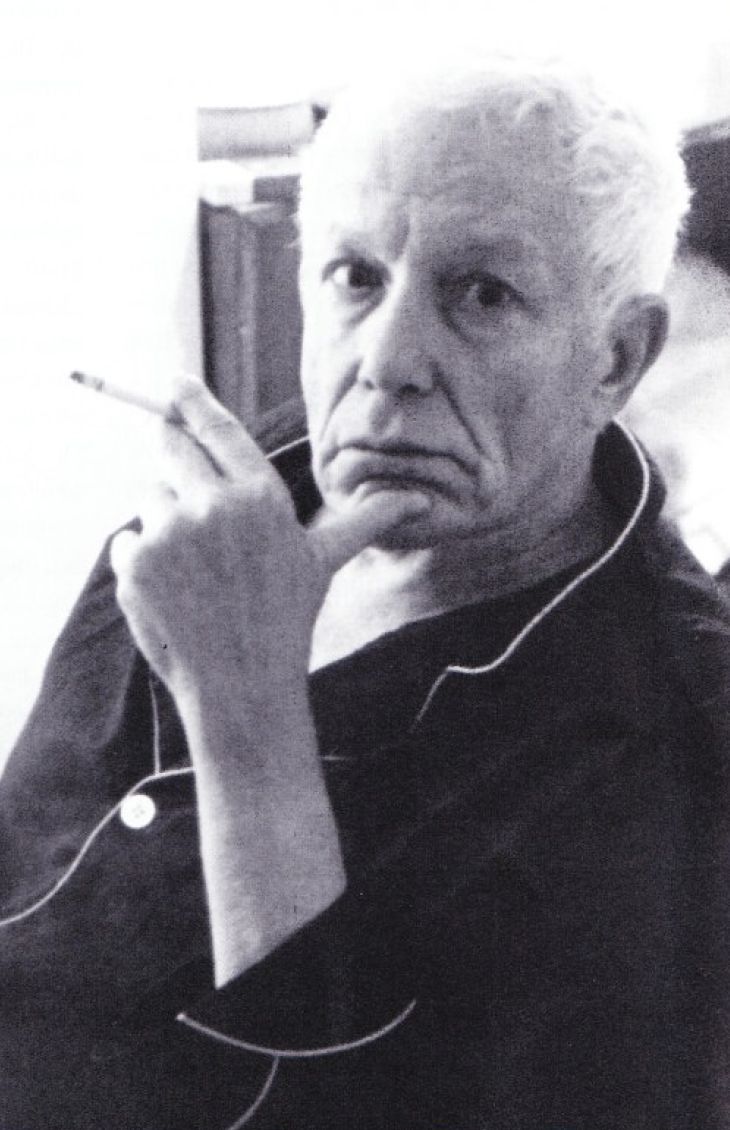
Shortly before Rogers Albritton was admitted to UCLA Medical Center this past spring, he had a telephone conversation with his sister, Heloise Frame, during which they discussed a philosophical question that had long consumed him: How can God, who is good, create evil?
The talk, one in a long-running series of Sunday debates between the siblings, quickly turned to the question of faith. Frame, 73, who practices a form of Christian psychotherapy in upstate New York, told her brother that according to the Scripture, God created both good and evil. As a philosopher, Albritton found it impossible to come to terms with the belief that evil exists so that good may come out of it. To him, that was akin to saying that there’s something positive about smallpox.
Almost until he drew his last breath — he died at age 78 from pneumonia on May 21, 2002, three weeks after being admitted to the hospital’s intensive-care unit — Albritton wrestled with “the problem of evil.” Although hooked up to tubes and monitors, he spent many of his last days trying to unravel the puzzle of evil with philosophers and former students from across the nation who came to visit him. The scene was reminiscent of the death of Socrates, who, too, grappled with philosophical questions right up until his final moments. “Rogers,” says John Carriero, the former chair of UCLA’s Department of Philosophy, “was a relentlessly curious person who would pursue things to their end.”
Indeed, Albritton was one of a kind. At the peak of his career in the 1970s (after coming to UCLA in 1973, he went on to achieve the UC system’s “above scale” status, an elite rank of professorship awarded to only a handful of scholars), he was widely regarded as among the finest philosophers in the English-speaking world. “He was most charming, witty and intelligent,” says Barbara Herman, a UCLA philosophy professor who was Albritton’s student at Harvard, where he taught for 16 years. “He had more style and character than most philosophy departments put together — and he had that till the very end.”
Albritton was born on Aug. 15, 1923, in Columbus, Ohio. When he was 3, he accompanied his father, a research physiologist, and his mother, a chemist, to Thailand, where the family lived for five years. At the age of 5, Albritton was packed off to a British boarding school in India, where he was the only American student. Although the yearlong experience was traumatic in many ways, Albritton seems to have turned it to his advantage later in life. As his sister puts it: “He acquired a chameleon quality that allowed him to both take on and challenge the world view of the people he was speaking to.”
In the classroom, Albritton was famous for doing philosophy in real time. He would tear up his notes and struggle along with his students through complex, extempore arguments. He was also known for engaging in marathon discussions that often lasted through the night. One former grad student recalled an 11-hour discussion with Albritton: “I can’t think of any other philosopher, living or dead, I would rather bounce ideas off of. One conversation with Rogers can illuminate a philosophical problem to such an extent that everything I’ve thought about it before seems irrelevant.”
Albritton belonged to that dwindling group of philosophers who believe that philosophical theories are inadequate in explaining the nature of reality, says New York University Professor Thomas Nagel, a former student. “Socrates was famous for showing that we really don’t have the understanding, and Rogers played the same role,” Nagel says. “With him, you really had to think about philosophy using a natural form of reasoning so that anybody could understand what you were saying and you could lead anybody by gradual steps to a similar understanding.”
There was no one vein of philosophy that Albritton mined. “He just wandered through the world coming across philosophical knots, untying them and moving on without leaving a manual on how he did it,” says UCLA Philosophy Professor David Kaplan ’56, Ph.D. ’64. “He also uncovered knots in places where philosophers had thought there were none.”
Even the most obscure subjects came alive in Albritton’s presence. Herman will always remember the inimitable way in which he once taught an undergraduate course to some 300 students at Harvard. An expert in ancient philosophy, Albritton was lecturing on St. Paul’s Galatian Letters, a topic laden with the concept of “agape,” or divine love. “It was a subject that held absolutely no interest for the students, but Rogers had everyone riveted,” recalls Herman. “He could make you see why there would be some issue that is strange to you and yet could preoccupy someone in another age — and why the matter might be important to you.”
Like Socrates, Albritton had a knack for asking hard questions that forced his students and colleagues to think about things they took for granted. And like Socrates, he was deadly serious about questioning — so serious, in fact, that he was ever suspicious of questions that led to answers. “Philosophy for Rogers was a constant process of digging,” says Gavin Lawrence, another of Albritton’s admiring colleagues at UCLA. “He would explore one line of inquiry and just when you thought it was right, he would backtrack and go another way.”
For example, Albritton once asked Carriero over dinner if he knew he was awake. “My initial reaction was of course I know I’m awake,” says Carriero. “But after much conversation, I came away thinking that even if there was no doubt about my being awake, it wasn’t the case that I knew I was awake.” Six weeks later, the two philosophers dined over the same issue and, says Carriero, “I came away with the opposite conclusion.”
The result of Albritton’s obsession with sheer philosophical puzzlement was that in a career that spanned half a century, he published no books and only five research papers. The joke in philosophy circles was that his last name was short for “All But Written.” That, ironically, began as an Albritton family joke. Like his perfectionist son, Albritton’s father, the research physiologist, was loath to publish his work.
In today’s academic world of publish or perish, Albritton is a welcome reminder that there are some people, prolific writers included, whose contributions to the world lie not necessarily in what they leave behind but in their very presence. What made Albritton an extraordinary philosopher was that anyone engaged in almost any kind of work could talk to him and come away enlightened in some way.
“He could determine if you were making sense and help you understand what you were trying to say,” says Carriero. “Few people have done it so well.”