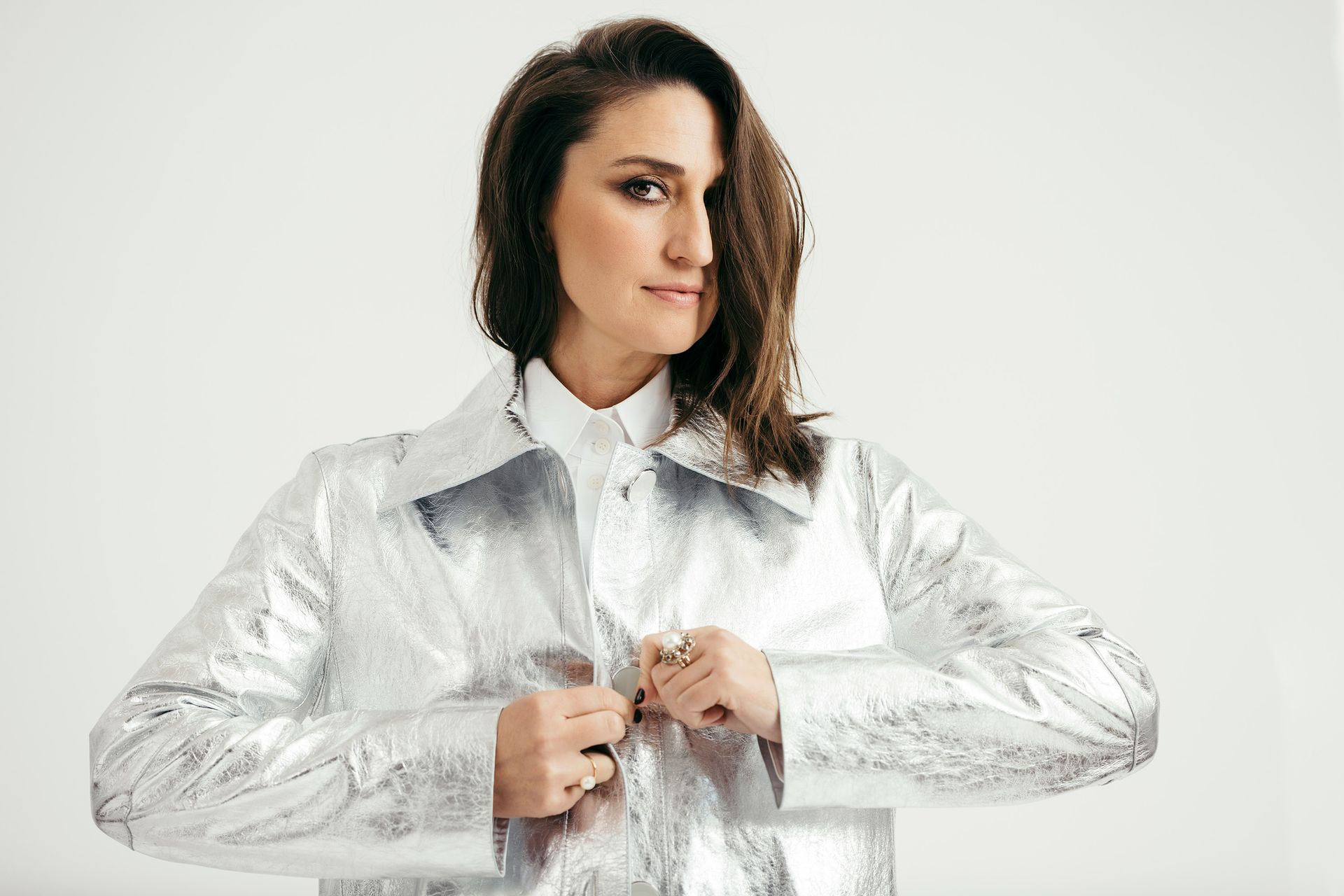
Imagine my surprise to learn that Sara Bareilles ’03 lives just down the road. I live in Woodstock, New York, and Bareilles, who spends much of her time in Brooklyn, has a weekend house in the Hudson Valley, about 20 miles away. On the Saturday morning I drive to meet her for breakfast, it’s snowing — not beguiling flurries dusting all the vernal blossoms, but gobs of wet snow that hit you in the face like a slushie.
When I meet her inside the restaurant, she’s wearing an enormous puffy coat with jeans and a red Fair Isle sweater. She has what a friend of mine calls “’70s babysitter hair,” which is to say, long, layered and unkempt, but totally winning. Zero makeup. Perfect eyebrows. We start laughing almost instantly. She’s just one of those people who make you feel like there’s still good left in the world.
I tell her that the viral, bring-you-to-tears YouTube clip of her singing “She Used to Be Mine” at the Kennedy Center with Rufus Wainwright had been sent to me by a few people and that I couldn’t stop watching it. (The song is from Waitress, the Broadway musical she wrote based on the film of the same name.) “My dad is 80 years old,” she says, “and he’s very proud of me, but every once in a while there’ll be something I do that really sticks, and the Rufus duet is one of those things. He calls me every few days to talk about it: how much he loves Rufus; how he thinks that his delivery really makes him understand the lyrics differently. I mean, he’s gone deep. He just fell off a ladder and broke his femur. Thankfully, he’s OK, but in the freaking hospital he’s playing the video for all the nurses.”
Watch Sara Bareilles and Rufus Wainwright perform their stunning duet at the Kennedy Center:
This tracks. I’ve been sending Sara Bareilles YouTube clips to my friends and family for 18 years, and at some point it occurred to me that this is exactly what Bareilles represents: this infinitely discoverable, watchable, shareable human. Bareilles was signed by Epic Records in 2005, right as YouTube launched. I began discovering her via live performances, such as her astonishing 2013 cover of Elton John’s “Goodbye Yellow Brick Road” at the Variety Playhouse in Atlanta — about which Sir Elton himself said, “There does not ever need to be another cover of this song.” Or her rendition of the Stephen Sondheim classic “Moments in the Woods” from the 2022 cast recording session for Into the Woods.
Certain musicians — think Bonnie Raitt or Aimee Mann — are their music. It feels like the truth runs through them. This is true for Bareilles, too: She perfectly matches sound and lyrics. “That’s the actual superpower of who she is,” says Mona Tavakoli, Bareilles’ best friend from her UCLA days. “It’s not bullshit. You have a feeling about her, and the feeling turns out to be true.” Bareilles isn’t guileless, exactly, but she is kind of a nerd; devoid of cynicism, unafraid to be earnest. “An enthusiast,” says novelist Meg Wolitzer, with whom Bareilles is working on a new musical based on Wolitzer’s novel The Interestings. When I share this with Jessie Nelson, who wrote the book for Waitress, she says, “Completely agree. There’s no disconnect between Sara’s soul and the music that flows out of her. There’s like a portal inside her that really accesses who she is and what she deeply believes and feels, and that’s what she gives to the world.”
"I must have written a hell of an essay"
That Sara Bareilles is from a place called Eureka — a cry of joy over a sudden triumphant discovery — is almost too perfect. Her parents still live there, along with an aunt and uncle and a handful of cousins. She goes home regularly for holidays. In the fall of 2022, Bareilles gave a free concert for over 10,000 people there, just to “put some love on the community” — which, despite its natural beauty, she describes as “scrappy” and “a little seedy.” The city built her a stage in a park and made a festival out of it. “It was,” she says, “one of the best days of my life.”
She grew up immersed in “singing, music and performance,” she says. Her mother, Bonnie, who worked in a funeral home, and both of her sisters (Stacey and Jenny, six and nine years older than Sara) were deeply involved in community theater, and all three of them — and eventually Sara as well — performed in local productions at Ferndale Repertory Theatre. Everyone in the family sings, including her father, an insurance adjuster and part-time logger, who routinely crooned at the piano with a glass of red wine. Young Sara took piano lessons but didn’t love it; today, she’s largely self-taught.
Her otherwise idyllic childhood on the family farm was also marked by pain: Her parents divorced when she was 12, and she was bullied throughout her grammar school years for being overweight. In high school, things turned around. By her senior year, she was a local star, cast as the lead in her high school’s production of Little Shop of Horrors. At graduation, she sang Cyndi Lauper’s “Time After Time” and brought her classmates to tears.
Bareilles had intended to go to San Francisco State University — she’d auditioned for the music department and gotten “a little $2,000 scholarship” — but then, much to her and her family’s amazement, she was accepted into UCLA (“I must have written a hell of an essay,” she says). She showed her acceptance letter to her English teacher, who said firmly, “You must go.” During her freshman year in 1999, she lived on the Hill in Sproul Hall, then moved off campus into an apartment with friends as a sophomore; she studied abroad in Bologna, Italy, during her junior year.
She describes her years in Westwood as “delicious and intoxicating,” as she realized for the first time that life could get bigger. “I was seeing a world I hadn’t even imagined for myself,” she says. I ask if there was a professor who mentored her, and a sly smile spreads across her face. “Maybe we don’t tell UCLA this, but no.” She laughs. “Look, I was so enraptured by this new experience, but I don’t think I quite embodied it. I think I was more of an observer of my own life at that point, and I think that really fed my songwriting. So, like, getting to know a professor? I don’t know [that] I would have felt comfortable taking that risk. I was trying not to stick out. I wanted to figure out how everything worked so I could assimilate … but I never really did.”
Watch Sara Bareilles' performance at UCLA Spring Sing in 2000:
She found community in joining the coed singing group, Awaken A Cappella. “I’m writing this musical right now, The Interestings,” she says, “and it’s about this outsider girl named Jules who sort of gets anointed by this group of really cool kids. And the way Jules talks about it in the book is like, I fell in love with a group of people. And that’s how I felt about my a cappella group.” She cocks an eyebrow. “Can you even be in love with a group? I was in love with this group of people! And then I met the guys from Maroon 5, and started seeing their shows and going on tour with them, and it was just this quicksand life.”
Bareilles describes her friend Mona Tavakoli as “one of my nearest and dearest.” Tavakoli was not only an RA but also a Bruin mascot, “very involved with the whole UCLA environment,” Bareilles says. Tavakoli was also — and still is — in the band Raining Jane, which formed in 1999 at UCLA. The two met at that year’s Spring Sing. “Raining Jane won Best Band,” says Tavakoli, “and then we won grand sweepstakes, or whatever. The following year, Sara won it, and in the year before us, [the runner-up] was Maroon 5, who were then called Kara’s Flowers. So it was just this crazy, fruitful era of musical talent at UCLA — you know, to be sandwiched between Maroon 5 and Sara Bareilles?” Out of that fertile period, says Tavakoli, “Sara was the biggest blossom, the brightest rose, the most fragrant of the bunch.” In the early 2000s, when the Westwood Brewing Company was still a popular hang, “there would be all these songwriter competitions, and Sara would just come and clean house and everyone’s like, What the f---? She’d make you cry, she’d make you laugh because she already had the power of, like, melody and message — you already felt that.”
Bareilles’ calling card, the haunting, introspective ballad “Gravity” — which Billboard once described as her “finest moment” — was written during that time and remains a fan favorite 25 years later. “I wrote that when I was 19, over Christmas break,” says Bareilles. “I saw my high school boyfriend, who I was still in love with. We had broken up before I left, and I would go home and fall back into old patterns. He cheated on me, and it really broke my heart, but then I took him back. I never really forgave myself for that.” It is that last part — the self-reproach — that makes the song so powerful. “Sometimes I think about how I was really young to be writing that song. But it has grown with me.” Like almost everyone else, Jessie Nelson brings up YouTube. “There’s some beautiful footage of her, quite young, at a UCLA talent show, and you can see her, in real time, kind of realizing the impact she was having,” she says. “Discovering her gift.”
A New York state of mind
In the fall of 2012, Bareilles and her sister Jenny came to New York for a month. They rented an Airbnb in Williamsburg for two weeks, followed by another in the East Village. Bareilles pretty much never left. “I moved to New York kind of as an experiment,” she says. “I’d had this cute little bungalow in Venice for about five years, with a backyard and a hot tub and a firepit; I had this really sweet, comfortable life.” By this point, she was a pop star living alone. She had two records behind her and was in the midst of recording a third, The Blessed Unrest, that would feature the anthemic sleeper hit “Brave,” destined to be used in commercials and soundtracks for decades. “I could see pretty clearly down the road that the sort of cyclical nature of the recording artist was going to make me feel claustrophobic. Like, OK, I’m gonna write a bunch of songs, go into the studio, record them, do a bunch of promos, go out on tour, come home, take a little break, start writing. I was just like, ‘Uh-oh. I can just see this is gonna feel same-same really quickly.’”
She went back to L.A. for three months, then officially moved to New York in early 2013 — ”for a year that turned into the rest of my life” — renting a studio apartment on Grove Street in the West Village, right across from the legendary piano bar Marie’s Crisis. “I had never!” she says. “I walked in and, like, What? Everyone’s singing show tunes? I couldn’t have even imagined that kind of place. I was in heaven.” Within months, she got a call from Diane Paulus, director of the American Repertory Theatre, who asked if Bareilles wanted to collaborate on a musical version of the 2007 independent film Waitress. The story is about a young woman who works in a small-town restaurant; trapped in an abusive marriage, she has an affair with her gynecologist. Aside from the show’s many other distinctions — it ran for more than 1,500 performances and was nominated for several Tony Awards — it was the first musical in Broadway history to be led entirely by women: director, music and lyrics, book, and choreography.

“She didn’t come [to New York] with the intention of being a composer of musical theater,” says Nelson, the production’s book writer. “She came with the intention of maybe trying to act a little in a musical. So when Diane reached out to her to compose Waitress, that wasn’t on Sara’s radar. That was, like, a big leap for her. And I don’t know if she told you the story, but Diane told her to go home and watch the film and just see what comes up, and the first song Sara wrote was ‘She Used to Be Mine.’” She was a natural. “Being in the theater with her, watching the first song she wrote as a musical theater composer stop the show and get a standing ovation … talk about validation that you’re on the right path,” Nelson says.
Bareilles now divides her life into before and after Waitress. “It changed my whole life,” she says. Perhaps most importantly, “It made my shoulders relax. I was like, ‘Oh, I’ve been at the wrong party this whole time; I’ve been in the wrong industry.’ Because there’s this other place where I love to be so much, that is nurturing and creative and so much fun. It just made the worrying — Where do I belong in music? — subside. Because I don’t know if that’s really up to me. I don’t know that I’m the one who gets to decide that.”
For the moment, it would seem it’s the directors and producers of Broadway who are deciding for her. And, funnily enough, the musical The Interestings she’s working on with Pulitzer Prize–nominated Yale drama professor Sarah Ruhl, is fundamentally about talent. The story, says Wolitzer, “explores the ways that talent can arrive in someone’s life — and sometimes not arrive. Are you born with it? Did you come from a world where it’s recognized and supported? Or is it that kind of talent that’s going to come out no matter what?” Which sounds an awful lot like Bareilles’ story, going all the way back to UCLA. “I think the book is a masterpiece,” Bareilles says. “It felt so familiar. It’s about this girl who is growing up — she’s kind of a mess, I love her — and who does and who doesn’t grow up. It’s this very human story about Peter Pan syndrome, but played out with a woman instead of a man. I just loved everything about this book. I wrote the first song for the musical before I’d even finished reading it.”
A triumphant return to campus
Bareilles came home to Westwood this past June to give the UCLA commencement address, which she confessed publicly she had a “tremendously hard time” writing, “pulling my hair out, trying to find a way in.” She spoke of the fraught times we are all living through, how cruelty had seemingly become the collateral of choice, and of the lessons she had learned from the death of her best friend, the singer Gavin Creel, in 2024.
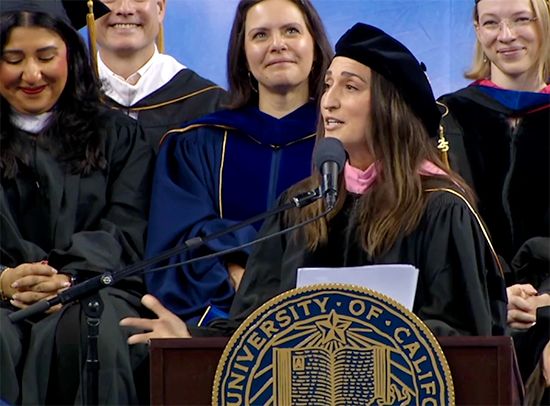
“Your lives will be so many things,” she told the graduates assembled, “and, oh my God, I hope so much of it is wonderful. But when it is not — when it is complicated and thorny and when it inevitably breaks your heart, which it will — I hope that you can reach for the wisdom in that, too. Pain is a skillful teacher, and we are in painful times that can teach us so much, but only if we stay willing and awake to the infinite nature of all of it.”
Back at the restaurant, it’s pushing into the lunch hour, and Bareilles has just drained her second cup of black coffee. “It’s funny,” she says. “I woke up at 5 this morning for some ungodly reason, like, You have got to be kidding me. So I just got up and I have this hard drive of all this old footage that I’ve been meaning to go through because we’re putting together a film about the making of my latest record. And I was going through it mostly to make sure there wasn’t anything too embarrassing. So I was watching myself at, like, 26 this morning, and I could see that I was sort of protecting something, or there was something I was defending. And in this one interview, I’m talking about how I really want to listen to the signs, to that part of myself that is telling me where to go. But I can see the distance between the insecure girl who’s moving through those early moments in my career and then this North Star of like, I want to be someone who’s confident enough to trust my own instincts. And it’s funny, because I feel like I’ve bridged the gap a little bit. But even at 46, I still think, I know I can be the kind of person who can trust her instincts. I’m still struggling with those same issues.”
And yet, as Jessie Nelson says about “Love Song,” Bareilles’ first hit, “Talk about having no governor” — which is to say, pure instinct. “What was beautiful about the writing of that song,” says Bareilles, “is it really felt like I was channeling something. It wrote itself very quickly. I’m someone who very much believes that none of it belongs to me — it’s not mine. We’re vessels, and sometimes we get lucky to catch something that comes through. I was so confused by the music industry at that time. I had all these songs, and the label was like, ‘Yeah, just keep writing.’ And I knew that they were tacitly asking for something that could go on the radio. And so I tried; like, maybe I could write something that sounds like that song already on the radio. And it made me so angry. Like, this is how it happens; this is how you lose yourself. This is how you start giving up too much and sell out. And then I said a little prayer: Can I please just remember why I’m doing this? Who am I in all of this? And that song just showed up.”
Read more from UCLA Magazine’s Spring 2026 issue.