In a wide-ranging discussion held at Chancellor Gene Block’s residence on campus, student, faculty and alumni leaders explored how the crisis came about, what UCLA’s friends and supporters can do about it, and what the university will look like after the crisis has passed. Judy Olian, dean of UCLA’s Anderson School of Management, moderates.
Block: These are truly challenging times. This year, as you know, we’re going to have a 32-percent increase in student fees approved by the Board of Regents in November. And this obviously can jeopardize our core purpose at the university, which is to provide broad access and excellence. We’re pleased that the governor has stated the importance of higher education. But even as we see these positive signs in support, one thing has dwindled over the past 30 years — a long-term decrease in funding from the state. But yet, California’s expectations for UCLA have only grown. The state looks to us to provide a top-tier education, serve as an engine for the economy, provide world-class health care and improve the quality of life all around us. So we’re caught between increasing demands and falling resources. Something has to give. And that’s what we’re struggling with right now. We’re here today to discuss the issues and look for ways ahead and to explore possible solutions. We hope this UCLA Magazine article will give our powerful alumni base clarity on the threats we face and motivate them to support UCLA as voters, advocates, volunteers and donors. So, I want to thank you for what will hopefully be a very productive discussion. I will now turn it over to Judy.

Dean, UCLA Anderson School
of Management
Olian: I’m going to really try to capture the multiplicity of perspectives and constituencies that are around the table. The first question is, please choose one single area where you see budget cuts affecting you or your unit. Andriana, I’m going to start with you.
Trang: As a student, I would just say we really didn’t think this would affect people being able to come to school. That 32-percent increase may not seem like a lot of money for people who are working. But my parents were without work last year. And so for me, either I’ll have to take summer courses and finish early, or take community college classes in the summer to fulfill my general ed requirements instead of taking them here, so I can do my major here. And then one of my acquaintances, she lives on my floor. She doesn’t think she can return next year, because she doesn’t know if her parents can afford it. And she’s taken out so many loans that it’s more beneficial for her to go back home and to work for a little bit and maybe take classes at her community college before coming back to the University of California [UC] to finish her education. I hear [stories like these] from a lot of different people. It’s just been a very eye-opening experience.
Garrell: The crisis has particularly impacted faculty who have more modest salaries, who are already right on the edge of their capacity to manage their lives and pay mortgages and child care, all those sorts of things. The salary reduction and furloughs that we had this year were particularly difficult for those faculty and also for staff. We depend on staff in our departments and laboratories to help us carry out our research and education missions. And they’ve been furloughed. The other area where I think it’s had a big impact is on our ability to ensure that we provide the curriculum for our students, ensuring we can offer as many classes as they need to graduate, ensuring classes don’t get too big.
Welinsky: I’m not immediately affected. But the state is affected. The community is affected. To the extent that if any bright young or even bright old students can’t get access to an education, the community suffers, the business community suffers. Already, California doesn’t produce its fair share of bachelor degrees. And the country isn’t doing the level that it did, either. We’re far below three or four other countries that we compete with. So if students don’t have access, the state suffers, the community suffers and the country suffers.
Gilliam: The seed money that a dean might provide to promising faculty who have new and interesting research projects has dried up. It certainly hampers our ability to respond to the new issues that arise in our fields and to be able to build initiatives and projects and programs around new developments in scholarship and in practice. So that means we can’t hire faculty in emerging fields where we should have some expertise. It means we’re not able to deliver to the graduate students training and education in these new fields. It means that we, in some cases, aren’t able to be involved in national and international discourse around these issues, when we should be.
“We touch people in so many ways. If you’ve used our medical center, if you’ve taken advantage of our arts on campus, if you’ve taken advantage of athletics on campus, there are ways that actually we can bind people in Los Angeles and California to this institution. I do think that we have to play our role better as a public university throughout the state.”
Chancellor Block
Block: UCLA has traditionally been quite committed to improving the K–12 pipeline. And we’ve got some notable activities along that line through the UCLA Community School. But we have plans to expand our university elementary schools in the community, starting one or two additional elementary schools. That has to be put on hold, because we don’t have the resources to do that. Some of our academic advancement programs that will help ensure that more students are qualified for UC admission are being scaled back. And when schools and faculty want to create trans-school or multidisciplinary activities, they don’t have the resources because it goes beyond the support of any one dean to support. That includes some of the most innovative and exciting, sometimes high-risk activities that go on at this institution. Our piggy bank is now not well-stocked to support these activities. So, we’re turning them away. A third area is intellectual property. Creating incubators is expensive. It requires investment and research funding to take great intellectual properties created by this wonderful university and translate them into wealth for California. That effort is being hampered by a lack of investment by the state.
Olian: I think the cuts have had a reputational impact, which pervades a number of areas that are very important to the university, in terms of attracting students, because they have a lot of options. And when you say you’re not attracting students, that is not just about attracting them to the university. It means attracting them to this state from all over the world, because we’re a net importer at the University of California of a lot of talent that ends up coming here and staying. And that’s true of faculty as well.
So, let’s go on to the second question. Looking forward, what do you see are the biggest risks? Howard, I’ll start with you.
Welinsky: Well, the biggest risk really is the lack of developed talent, that we [will be forced to] educate less students in an environment where we’re so highly competitive with the world. And if California is going to continue to be on the cutting edge, it needs the university to be fully funded.
Gilliam: It certainly does put in harm’s way the future growth of the state. In a related way, it risks us not capturing innovation — as a place that discovered everything from the Internet to medical breakthroughs. And, in the largest scale, it raises the specter of the death of public education.
Olian: And what that means in terms of access.
Gilliam: The implication is that only people with money will be able to get a first-rate education, and that puts a stake through the heart of the master plan.
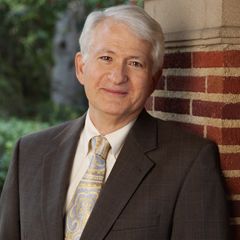
Chancellor, UCLA
Block: Great research universities are moved ahead by extraordinary faculty. And if they see that their careers are not flourishing in California, they’ll go somewhere else in the United States. We’ve got enormous risk in terms of loss of our brightest faculty.
Olian: And the attraction of future very bright faculty.
Garrell: It’s faculty here going elsewhere. The faculty from elsewhere whom we invite to come here won’t. Or worse, we won’t be able to renew our ranks. And if, as a group, we can no longer do the best research and scholarship, we’ll see a decline in federal financing. We’ll see a decline in our research productivity and in our ability to train students.
Trang: You can’t bring in as many qualified students as you want. And that will decrease the diversity that the UCs are known for — the diversity of the students that we have and the diversity of the talent that we produce. And then once you get to the school, you don’t get what you thought you would get. You don’t get the students that you thought you would be classmates with. You don’t get the classes that you hoped to enroll in. And you don’t get the professors whose research you’ve heard of that you hoped would be able to teach you.
Olian: Exactly. It’s about a talent pipeline for the future of California. It’s about a knowledge pipeline for the future of the world, because we’ve been an innovation engine. And frankly, it’s very much about access for a population that is economically disadvantaged, that always had a tradition of transformation through the University of California and through public universities. This is America. We should be enabling what is traditionally America.
Are we ready to be thinking of models that are different from the publicly supported state model? I’ll use the word self-sufficiency here, or a version thereof, a la Michigan, or the University of Virginia. And let’s start with you, Gene, since you’re quite knowledgeable about the University of Virginia [Block was vice provost at U.Va.].
Block: A completely self-sufficient university is an enormous undertaking. As we look ahead, I think what we will be doing is going to be more evolutionary than revolutionary. There will be changes in the way this institution is supported. It’s going to come more slowly than at some of the professional schools that will be on a self-supporting basis. We’ll focus on building up the endowments. But 15 years from now, it will look like a different institution. The state portion will be smaller.
Olian: But it’s already so small; I mean, 9 percent?
“If the Legislature stymies us, if the public continues to be where they are, which is it wants high services but not any more taxes, then another model — not necessarily one I advocate — is that we shrink what we do.”
Frank Gilliam
Block: You don’t want to use that figure. That’s the percentage of our $4.5-billion operating budget that comes from the state, but we need to emphasize that state funds pay for a much larger percentage of core expenses, like faculty salaries.
Welinsky: That has really hurt us in the Legislature, because one of the things that reverberated was the notion that the UC has all these alternative sources of revenue: “You guys can get along better than everyone else who only depends upon state funds.”
Olian: Can we replace what the state’s funding is today without changing the fabric of our student population?
Block: Think about it this way. In order for a good [self-sufficient] university like Stanford to operate, they need about an $11- to $13-billion endowment, something in that range. They charge $40,000 a year to students. It’s enormous. So that’s what we’re facing, because really what you’re saying when you say becoming completely self-sufficient is to become essentially like a private university.
Gilliam: There’s another model that starts from an assumption that the interesting governance arrangement we have in this state makes it very difficult to generate much change at all. So if the Legislature stymies us, if the public continues to be where they are, which is it wants high services but not any more taxes, then another model — not necessarily one I advocate — is that we shrink what we do. That is to say, we have been trying to be a full-service, comprehensive university and offer northeastern, southwestern, Slavic languages and so on.
Olian: How radical will the shrinkage need to be to make this viable?
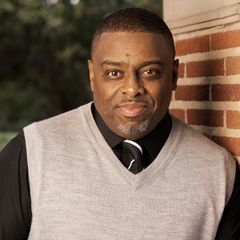
Dean, UCLA School of Public Affairs
Gilliam: I don’t know what the math is. But let me just throw out a number that I think is not an unfeasible one. I think it’s not unreasonable to ask ourselves what we would look like at 70 to 75 percent of what we are now, in terms of students, in terms of everything.
Olian: Total budget.
Gilliam: Total budget. I know it’s difficult. But one could see an argument being made, and one that might sell with the public, that UCLA doesn’t have to do all of those things. Why did they need departments that graduate three people a year? I mean, they maybe have faculty go win a Nobel Prize. So what? What’s that do for me? Lots of campuses don’t have all of these things. It’s another model is what I’m saying, not one I’m advocating.
Olian: OK. So, Andriana, let me ask you a question here. I understand that students are very angry about raising tuition and they direct that anger at the most immediate address, and that’s the university. Is that the most effective target of their ire?
Trang: No, it’s not. Students are coming to recognize that that’s not the most effective way.
Olian: Where should they be directing their concern?
Trang: Well, Facebook has now created a new group to log in with the Legislature. Reports are coming out that it was not the Regents and it was not the university itself that created the increases. Students are understanding it’s not so much what the university can do, it’s the state that promised us this education. We go to class here. We see the professors. No one’s going to forsake us at the school. No one wants to cut the number of classes. The university doesn’t want to make enrollment so difficult that you can’t get a class.
Welinsky: I would hope the students also understand that the governor is a big part of that. You said the Legislature. And that’s true. But if you really look at the funding of UC historically, it had more to do with the relationship between the governor and the university. And the Legislature has been much more passive in going along with the governors when it comes to UC funding.
Gilliam: You think that’ll overpower this as fewer and fewer of the legislators are UC graduates, and more and more antipathy grows toward the UCs?
Welinsky: Well, you’re looking forward. I’m looking historically. I mean, the governor lays out the budget. And he took a very different perspective on the university and CSU [this time] than he has during his last six years. We’ve had governors from both parties — Pete Wilson, Gray Davis — they absolutely were highly supportive of the university. And they made agreements with the university. And then they would add money on top of that. Deukmejian was another governor who was very supportive. So we’ve had a whole bunch of years when we’ve had governors that understood all that the university does for the state. And the Legislature, sometimes they’d add a few dollars here or there. But for the most part, the Legislature was going along with what the governor was doing. Now, could the Legislature do something different? Absolutely. And from time to time, legislators do things that we don’t particularly like.
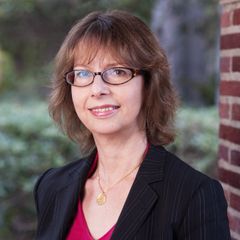
Chair, UCLA Academic Senate
Garrell: Well, frankly, the defunding that’s happened here is not unique. It’s happening virtually at every state university. I just want to come back and connect the dots between two things I’ve said earlier. And that’s that the word privatization is bandied about. And that means different things to different people. But when we talk about the funding model changing, we are talking about perhaps higher fees, higher aid, and greater use of endowments. What’s absolutely essential for the public to understand, and the reason they shouldn’t give up on us, is we’re not going to become a private university like Stanford or Princeton. We will still be a public university. And we bring to that our values: access, diversity, educating the citizens of our state; the scholarship and research that involve engagement with the needs of our community and our state.
Block: And see, that’s a very important point, that there’s a quality and a difference between public universities. It doesn’t just depend on the funding model. UCLA Extension is an example of that. We’re reaching thousands and thousands of adult members and students. Something that typically universities don’t do.
Olian: And I’ll just say that as dean of the school of management, we may end up having a self-sufficient financial model, just because we have to. Our mission of engaging with the community of entrepreneurs, of the business community, of Head Start, of leadership programs around the world, won’t change. So, how do we do that? Ultimately, whether it’s the governor or the Legislature, they are impacted by what they hear from taxpayers. How do we convince the taxpayers that it matters to them that the University of California, UCLA, not just survive, but thrive and excel? What’s in it for them that UCLA is excellent?
Gilliam: What we do not have is a systematic and disciplined communication strategy to talk to the public in ways that resonate. I think the governor was right in this way — and that’s why it’s gotten some traction — is to compare what the state provides to education with what it provides to things like prisons, and ask the public, “What are your values?” Historically, the people of California have had as part of our culture that we’re going to be on the front edge; we’re going to be leaders; we’re going to be a place where new things happen. And it becomes readily apparent to people that you can’t do that if you are spending four times as much to incarcerate people as you are to educate them [in the UC system]. We need a consistent message that comes out of all 10 campuses.
Olian: And what is the content of that message?
Gilliam: I think the content of that message, Judy, is what values do Californians hold dear? I think innovation is a value. I think the future is another value. And where we’ve got the message now is around government — the one thing that people hate and think is inefficient.
Welinsky: A lot of people have benefited from the university, whether from the medical center, from the research, from the businesses, from their own education, and they need to talk with passion. Sometimes the university, just by what it is, tends to be too polite and too intellectual. But alumni can communicate with a passion and maybe not always a politeness. I mean, there’s a reason to be upset with what happened to the university last year. Maybe the chancellor needs to be polite, but I don’t have to be. I’m an alumnus, I’m a voter, and I’m a donor, OK? Maybe we’re just too damned polite.
Gilliam: Can I say one thing about the messenger? If Gene talks, or if Yudof talks, or the deans talk, or Kareem Abdul-Jabbar talks, all of us have a stake in this. We need somebody who is believable and who doesn’t have an obvious stake in the University of California, but is seen as caring about California to make the case. And I don’t see anybody rising to our defense that doesn’t have a dog in the fight.
Olian: I’m going back to the question. What should we be arguing so that taxpayers care?
Block: It’s not only what you say, it’s what you do. We touch people in so many ways. If you’ve used our medical center, if you’ve taken advantage of our arts on campus, if you’ve taken advantage of athletics on campus, there are ways that actually we can bind people in Los Angeles and California to this institution. I do think that we have to play our role better as a public university throughout the state.
Gilliam: But Gene, I mean just to push on that a little bit — we’ve always been involved. We’ve always been involved in Los Angeles in serious ways. We really have. The medical program has been involved in serious ways. Whether it’s the arts, whether it’s business, I mean we’ve been involved.
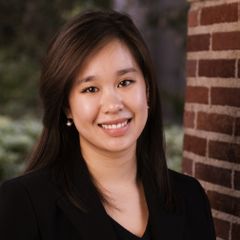
Student, Public Relations Director,
Bruin Belles Service Association
Trang: Through the organization I work with on campus, we go out and meet people in the community as students of UCLA. And they immediately want stories of going to school here. What do you do? What do you study? And so, I would say you can harness your biggest population — students — and send us out as ambassadors. People love this school. We really do. And it hasn’t been emphasized as much, I think, the quality of the students, and how we can come out and speak about the community service aspect of this university.
Olian: I’d like to get this little nugget in. Yesterday, I attended an opening of a charter school on the east side of L.A. that was named the William and Carol Ouchi School. And it wasn’t because they gave a million dollars. It was because Bill [a heralded Anderson professor] has really transformed the way schools run and the way people get educated. And I think to convince taxpayers that UC matters is simply to say we impact your family. It’s woven through the total fabric of a family’s life.
Gilliam: And it’s just a normal family who doesn’t even realize …
Olian: Who doesn’t need a transplant, who is just normal.
Block: A day in the life.
Olian: Let me ask a slightly controversial question. What happens if we become like a Michigan or Virginia, like a lot of other public institutions that are excellent for some people in the state, but not for everybody? What happens if we change that compact of the Master Plan for Higher Education, given its necessity or inevitability?
Trang: I think it’s just disappointing. I remember my senior year of high school, I got a little letter in the mail. And it said, you’re eligible to go to a UC. And that’s what my aim was — yeah, apply to the privates but ultimately go to a UC, because it’s California, it’s my home. And so many students look for that envelope to appear in their mailbox. And to not have that happen devalues California, and it devalues the meaning of us going to school and striving really hard in high school to get to a university where we will be proud to be.
Olian: But you could go to Michigan.
Trang: Yeah, I could go to a school outside of my state and outside of my home and maybe I could get more aid at that school. But the thing is, a lot of the students who live in California, we want to go to school here, we want to graduate and work in California.
Olian: But the problem has become that, because we’re not supporting higher education, the state has taken that convenience and that goal out of your reach. You might have to go out of state, or your younger sisters and brothers.
“There’s a reason to be upset with what happened to the university last year. Maybe the chancellor needs to be polite, but I don’t have to be. I’m an alumnus, I’m a voter, and I’m a donor, OK? Maybe we’re just too damned polite.”
Howard Welinsky
Trang: And I don’t think that students are aware of that, really, because to them, you chug through school. You just want to graduate. And they’re not really thinking about the benefit of going to school here versus the benefit of going to a private. It’s: “How much tuition am I paying? Will I like the dorms?” Not the fact that I should be going to school here.
Olian: You believe it’s your right as a Californian to come to UC.
Trang: Yes.
Olian: And what about changing the fabric by necessity to open it up to others from out of state, from out of the country?
Block: We do that now. Ten percent of our students are out-of-state and international. The question is, what’s the right balance? The University of Virginia is 30 percent out-of-state, probably because Mr. Jefferson thought it was important to have a national complexion to the student body. We’re going to be faced with some very real financial issues about that ratio, because of course the more out-of-state students, the more money there is for all students, to support the institution. It’s a complicated issue, because there are so many Californians that want to come here. It will be a tough decision to make over the next few years.
Gilliam: I think it’s two real simple words: equity and aspiration. I think that the thing that the master plan did is create equity. It said we will provide a world-class education to anybody who qualifies for a modest price. And it’s aspirations. You hear it in Andriana’s voice. It’s that you could be a kid in the Central Valley and UC was within reach for you, and a world-class education. I take your question as: “Why don’t we just say, look, the master plan doesn’t work? We’re going to kill it.”
Olian: Right.
Gilliam: And I think you would have huge equity problems. I think you’d have huge aspirational problems. And a brilliant young student like this goes to Michigan. And guess what? Doesn’t come back.
Block: Well, you know, it doesn’t take much. Most of us ended up going someplace else and never going back.
Olian: Is there a risk that the public will actually not understand this and turn on us for contracting and depriving some students of access?
Warner Bros. Senior Vice President
of Distribution
Welinsky: Unfortunately, higher education tends to be invisible in the mass of all the public issues in Sacramento. There’s a presumption that things are going OK. There’s a presumption that maybe we have a problem with K–12, or with social welfare, or with the prisons. But higher ed is kind of OK. Well, [now we have] a governor come out in the State of the State address and talk about higher ed funding in relationship to prison funding. That’s an extraordinary statement by a governor who hasn’t been too focused on higher ed in his five or six years. And I think the public is starting to feel it now. They realize that the Legislature and the governor went too far in the wrong direction last year, and they have to correct.
Olian: So, you’re actually thinking that the public is supportive of this recalibration.
Welinsky: I’m saying it’s the beginning of the recalibration.
Garrell: In a way, it’s helpful that other states have had exactly the same problems, because people realize it’s not just our dysfunctional governance system in the state of California. It’s not just the particular constellation of legislators that we have for term limits. It’s a national problem.
Welinsky: Except for Texas.
Garrell: Except for Texas.
Olian: OK, so I’m going to end on a positive note here. Every crisis is an opportunity. And the future is still, with all of this, bright for UCLA. What do you see as the bright opportunities because of this crisis and through this crisis?
I’m happy to start. First of all, through this crisis, I’ve been just so impressed that the things that have been babied and protected are student classes and student services; that that has been the absolute last thing that people will touch. And secondly, a real rethinking of priorities and what is core and what is non-core is healthy for an institution. There’s no doubt that we’re going to look different. And we’re going to have some different parts. But management thought, intellectual thought, evolves. And the fields have to evolve with them. And it’s incumbent upon us to make ourselves extremely disciplined and courageous about making those choices.
Garrell: Maybe the analogy is to pruning in the garden, where you can cut away the things that are no longer essential or were vibrant once, but are no longer. And it is that act that creates the opportunities and enables vigorous growth and interactions.
Gilliam: As a new dean coming in at a time when we’re having difficulties, I figured, oh God, this is going to be awful. The faculty are going to be at my throat. And I found just the opposite, that they’ve redoubled their commitment to education. I have people teaching for free. I have people postponing leaves and sabbaticals that they’d planned for a long time. I’ve had departments having a series of retreats to rethink what it is they really want to be about, without much prodding on my part. I’ve had staff not complain. When the rubber met the road, they answered the call.
Olian: And could I just add to that, the power and the vibrancy of the intellectual culture have meant that retention has not been —
Block: So far.
Olian: — as challenging. And that’s what you talked about earlier, Gene. That’s what we have to protect.
Block: I think Frank’s become resilient. And I feel the same thing. There is an enormous resilience on the part of faculty and students that we can get through this. Also keep in mind, there are very positive things going on on this campus. We’re going to get over $1 billion in research funding this year. That’s a startling number. And that supports a lot of interesting science and scholarship. The intellectual excitement at this campus is just spectacular. You know better than I do, actually, that the courtyard of the sciences, where we have three schools sitting in close proximity, with good weather, the chance for really good interdisciplinary work on our campuses is unparalleled.
Olian: Aided now by fantastic food trucks. (Laughter.)
Block: And we’re all dependent on a really healthy hospital — and the performance of that hospital has been just spectacular with the satisfaction of patients and its financial performance. And we get better every year. And fantastic students, inspirational students.
Garrell: And the applicant class this year is bigger than ever.
Block: We have immediate budgetary problems. But in the long run, UCLA is such an astounding institution that we can come through this.
Welinsky: I would hope that alumni use this circumstance as a spark to redouble our volunteer efforts in every way that we can help the university, whether it’s donations, whether it’s talking to their representatives in Sacramento. In any way that alumni participate, it’s truly an opportunity to get involved and help the university. I think we’re all very proud of that diploma. And I think it’s a true opportunity to redouble our efforts in every respect.
Trang: We believe in this university. We believe in its mission and its goals. We support it. And we’re going to stand by it.
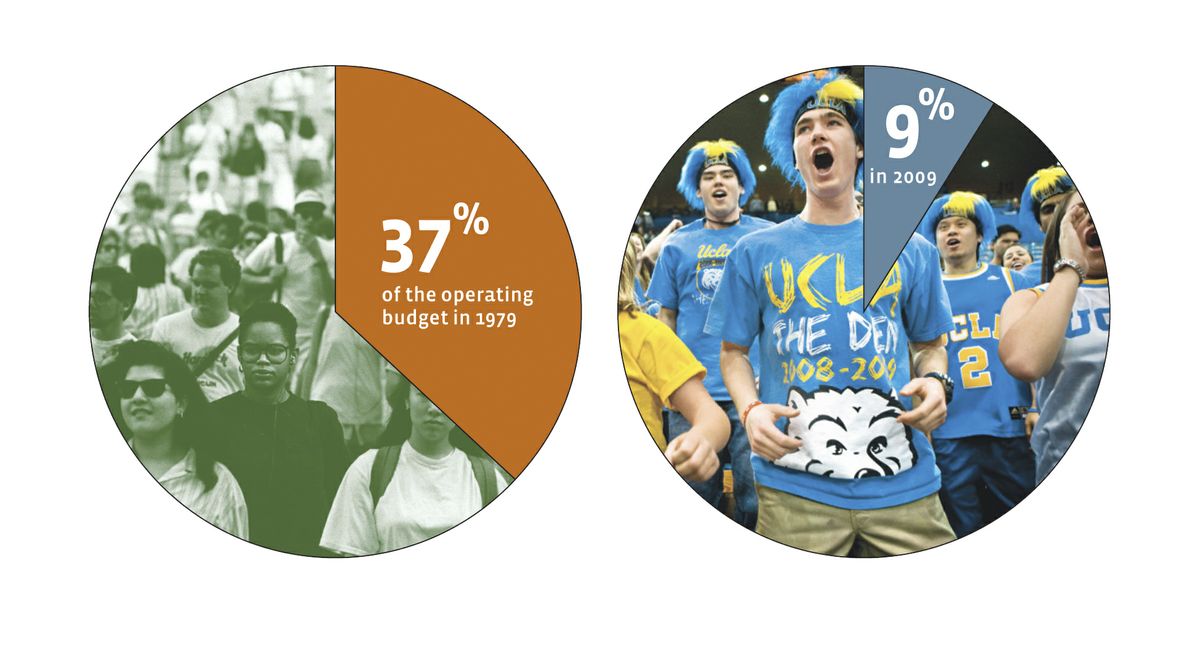
In the past 30 years, state funding has dropped from 37% to 9% of the university’s operating budget. But even that doesn’t show the scope of the threat this poses to UCLA’s mission. That’s because that 9% is earmarked for critical expenses like campus police, faculty salaries — and over half of what the College of Letters and Science spends directly on student education. The budget crisis has created a long list of painful cuts at UCLA, beginning of course with the UC-wide 32% hike in fees. But 570 people lost their campus jobs from February to October 2009. Class size rose. Faculty recruitment was slashed. And the university will be forced to reduce freshman enrollment by 300 students next fall.
The budget crisis doesn’t just hurt Westwood. As the region’s seventh largest employer, all of Southern California will feel the pain of budget cuts at the university. Consider this: If UCLA were to disappear or move to, say, the Midwest, 27,000 people would immediately lose their jobs. After six months, almost another 43,000 jobs would disappear. The crisis could also threaten the $9.3 billion that UCLA generates for the region’s economy every year. And the ripples would extend far beyond our borders. Statewide, UCLA is a talent and innovation machine — and California is in danger of being close to 1 million college graduates short of what the labor market will demand in 2025.



