On March 3, 1999, Anderson School classmates Sean Gjos, Eric Eisner and Ralph Vogel were playing for UCLA’s club team in a national-championship ice-hockey tournament — the first time that the Bruins had made it into the postseason.
The game in Salt Lake City, Utah, had barely gotten underway when Gjos M.B.A. ’99 went shoulder-to-shoulder against a player from Life University, a small college in Marietta, Ga. As they raced for the puck, a body check knocked the 6-foot-1-inch Gjos off balance and sent him crashing into the boards. A moment later he was down on the ice.
Seconds passed. “It didn’t seem like an unusual play or a hard hit,” Vogel M.B.A. ’99 recalls.
Outside the arena, winter clung tenaciously to the city streets; inside, the warm and boisterous atmosphere became subdued as the crowd waited for Gjos to get up. He didn’t. Vogel skated over and kneeled next to his friend. “I can’t feel my legs,” Gjos told him.
There is a perfect if tragic storm of events that occurs when someone sustains a serious spinal-cord injury. The force of the impact is a factor, says Bruce Dobkin, a professor of clinical neurology at UCLA, but so too are the precise angles of one’s posture at the moment of impact and the peculiar biomechanics of torque.
This story is about such a perfect storm — but also about another that was spawned in its wake. Something about Sean Gjos, his friends and the community of UCLA converged on that March day five years ago, and the product of that coalescence today touches lives well beyond their own.
Sean Gjos’ injury occurred about midway down his back, fracturing the T-11 vertebra, compressing the soft tissue of the spinal cord and cutting off oxygen and nutrients to the cells, causing the nerves responsible for sensation and movement below the site of the damage to die.
In the hours that followed, word reached Westwood nearly 700 miles away. Gjos’ roommate and fellow Anderson student Jim Young M.B.A. ’99 was in the apartment they shared when Vogel called. “He told me to sit down, and then he told me Sean had been paralyzed,” Young recalls. “I took a few breaths and I started thinking about what needed to be done.”
At Latter-Day Saints Hospital, doctors operated for six hours, implanting 18-inch-long steel rods around Gjos’s spine to stabilize the intact vertebrae. The only moment of self-doubt that Vogel says he heard from Gjos was after the surgery when his friend confided: “I was just starting to get it together.”
That sentiment would have surprised those who knew Gjos well because, in fact, he appeared to already have it all together. He’d grown up modestly on Manitoulin Island, an outdoorsman’s paradise on Lake Huron in Ontario, Canada. A gifted hockey player from the age of 5, Gjos had the qualities that would have allowed him to coast into adulthood on looks, charm and athletic abilities. Instead, he set his sights on Brown University in Rhode Island, where he studied international relations and played goalie on the university team. He worked several years as an investment banker before pursuing an M.B.A. at The Anderson School — named for another avid Bruin hockey player, John Anderson ’40.
Chalk it up to the proactive mind-set that characterizes the business psyche, but by the time Gjos was out of surgery, his Anderson classmates had begun crafting a plan to help the injured athlete cope with his daunting predicament. Arrangements were made to fly Gjos back to Los Angeles for treatment and rehabilitation at UCLA Medical Center. Meanwhile, “Ralph, Jim and I began asking ourselves, what does Sean’s insurance cover?” recalls Eric Eisner M.B.A. ’99. “What special needs will he have? These aren’t things the average 20-something grad student ever has to think of.”
Some of the hospital and medical costs were covered, but the coverage trailed off when it came to physical rehabilitation, which experts say is crucial if the patient is going to adapt well, Vogel says. “Then, when it came to retrofitting — things like making the home or transportation adaptable for wheelchair use — the coverage disappeared altogether.”
Within days, Vogel, Eisner and Young had begun a fund-raising drive for Gjos. Some generous and prominent benefactors stepped in, among them Disney CEO Michael Eisner, who is Eric’s father, and PepsiCo CEO Roger Enrico, who was slated to deliver the class commencement address. Donations also poured in from Anderson faculty members such as Al Osborne, Eric Sussman ’87 and incoming dean Bruce Willison ’70. Anderson students themselves contributed $50,000.
“Within a few weeks,” says Eric Eisner, “it was clear that this thing, which had begun because of Sean, was going to be much bigger than Sean.”
From that realization came the seeds of what would grow to become SCORE — the Spinal Cord Opportunities for Rehabilitation Endowment, a small foundation that is changing perceptions about disability the way a small pebble changes the surface of a placid lake, perfectly and relentlessly.
Willison, who had been installed as dean just a few months earlier, was impressed by how the nascent organization so quickly developed. “There’s a tremendous bonding that takes place among our students,” he says. “The fact that they undertook this — and still are involved in it years later, when they have so many other things going on in their lives — speaks to the unique spirit and enduring sense of community here.”
At first, Gjos knew little about his friends’ extracurricular efforts. Through April he was being cared for at UCLA Medical Center under the watchful eye of Dobkin, who is one of the world’s leading specialists in the rehabilitation of spinal-cord-injured patients. If Gjos’ injury was the sort of event that Emily Dickinson referred to as a “tongueless grief,” then Dobkin was Gjos’ first sign that UCLA is an institution where strident voices are raised to challenge that grief.
Some 40 years ago, the university established the Brain Research Institute to serve, in the words of its director, Allan J. Tobin, “as the central administrative and intellectual unit for all neuroscience activities on campus.” The 250 faculty members who work in 22 departments encompassed by BRI, says Tobin, “ferry ideas and advances from bench to bedside to business.”
What is striking about these efforts, particularly in relation to spinal-cord injury, is that they were launched at a time when the scientific community was entrenched in certain doctrines of belief that had attained the level of dogma. “The thinking,” says V. Reggie Edgerton, professor of neurobiology, “was that when an individual suffered a spinal-cord injury, you did nothing.” That thinking prevailed, Edgerton explains, because of the notion that nerves, unlike most of the body’s cells, tissues and organs, have no regenerative capacity.
Twenty years ago, Edgerton began dodging this dogma with animal experiments that indicated that regions in the spine contained memories of patterned activities — walking, for example — which could be reactivated through meticulous, specific and repetitive rehabilitation, such as could be performed on a treadmill. The studies in themselves didn’t suggest an actual cure, but they did point to a new horizon of modalities that had previously been unimagined.
The scope of spinal-cord-injury research and rehabilitation activities extant at UCLA today would have been considered wild imaginings a few short decades ago. These activities, according to Dobkin, include research into stem-cell implantation, use of robotic assistive steppers and body-weight-supported treadmills for rehabilitation, and important investigations into the genetic signals that trigger inflammation at the time of injury and how those signals might be manipulated to regenerate nerve axons around the area of injury.
For all this activity, research and hope, Sean Gjos might logically have been a terminus. Instead, he became an impetus.
“Sean got wise to what we were doing,” says Young, “and he did not like being the focus of anything. He came over to me, Ralph and Eric, and said, ‘I know what you guys are doing. I appreciate it. But there have to be other people going through what I’m going through. What can we do to help them?’”
At that point, just four weeks after Gjos’ injury, the fund-raising had surpassed everyone’s expectations. Some $100,000 had been donated, and still more people wanted to give. “One thing we were being asked,” says Vogel, “was, ‘I want to contribute to Sean’s fund — can this be tax deductible?’”
That may be a tough question for a film student or English major, but it was a no-brainer for an M.B.A. candidate. Vogel, Young and Eisner explored the tax options and decided their best bet for attaining nonprofit status was to do it under the aegis of an umbrella foundation. In early April of ’99, they met with Peter Dunn, director of gift planning for the California Community Foundation, and presented him with a plan and mission statement for an organization that they had dubbed SCORE.
As a beneficiary of SCORE funds himself, Gjos is not an active officer, but he serves as the organization’s honorary chairperson. He, Vogel, Eisner and Young — now officially co-founders of the organization — worked to hammer out a mission statement that is forward-thinking, unique and compassionate.
Forward-thinking because it aims to fund researchers who may be overlooked by larger funding organizations such as the Christopher Reeve Paralysis Foundation or the National Institutes of Health. Unique because one of the foundation’s focuses is on activity-based mentoring. “When an athlete is injured doing the sport he loves,” Gjos says, “his instinct is to shrink back from sports and other physical activities.” SCORE’s mentoring program takes active, athletic individuals who have already come to terms with their spine injuries and pairs them up with newly injured people. Compassionate because the fund provides grants directly to injured individuals to help cover the all-important costs of retrofitting residences, workplaces and vehicles.
Today, SCORE is a mature, respected foundation. Dobkin serves as its medical adviser, helping to locate potential research grantees. Thus far, two researchers have received grants to support their work. At UCLA, graduate student Thao Hoang, working in the lab of neurologist Leif Havton, received $7,500 to support her study of the possibility of reimplanting nerves in the spinal cord after an injury. At UC San Diego’s Center for Neural Repair, postdoctoral fellow Armin Blesch was awarded $25,000 for his study of gene therapy as a possible modality to help mend spinal-cord injuries. In addition, 15 spine-injured athletes around the nation have received individual grants of $5,000 or more.
Perhaps the most moving display of SCORE’s outreach is the one that involves no exchange of dollars at all — its mentoring program.
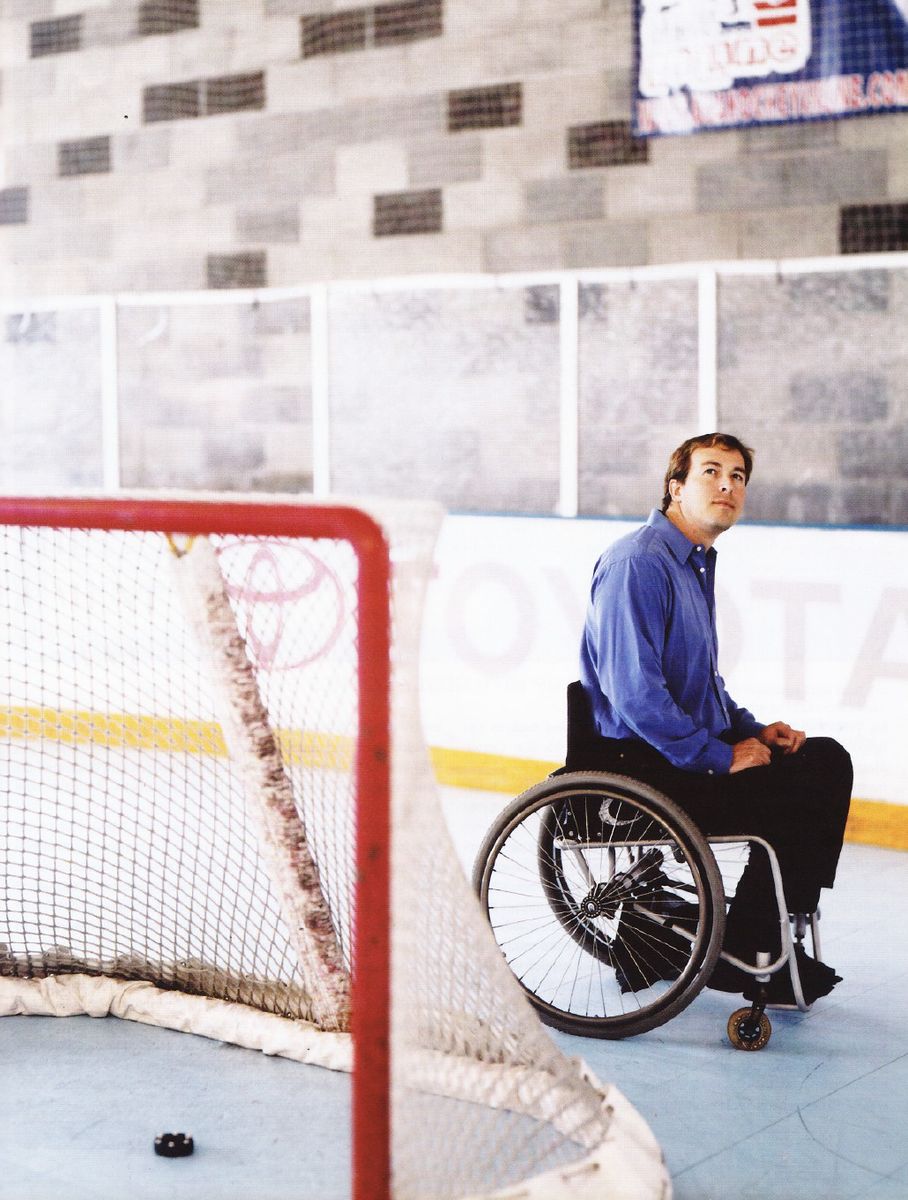
It is 9 a.m. on a late-fall Saturday at the UCLA Aquatic Center in Marina del Rey. The marine layer is still thick, but the harbor and its channels are already alive with the traffic of sailboats, racing shells and kayaks. A group of people, several of them in wheelchairs, has gathered near the ramp, on the harbor’s southern end. Gjos is among them. Though he is sitting in a wheelchair, he still seems to be better than 6 feet tall.
In addition to the disabled people, there are half a dozen UCLA recreation instructors. The injured participants are here to kayak, and the instructors look nervous. “If you’re an instructor and you’re not used to dealing with disability, it can be scary,” says Steve Orosz, the Aquatic Center’s director. “There are a lot of unknowns.”
Inside a small classroom, a sun-bleached, athletic-looking young woman named Kelle Malkowitz begins a presentation on how to teach, assist and work with disabled people in a recreational capacity. At Big Bear, where Malkowitz runs a full-time adaptive-sports program, disabled people share the slopes and mountain trails for activities as diverse as skiing, snowboarding and off-road wheelchairing. The greatest fear instructors have about teaching disabled people “is simply knowing how to talk to them,” Malkowitz says. Also present are a handful of other volunteers who will help with the outing. One by one, they are asked how they became involved in this effort; one by one they say it is because of Sean Gjos and SCORE.
At his office on campus in the John Wooden Center, Mick DeLuca, UCLA’s director of cultural and recreational affairs, explains the unforeseen challenges of being a truly all-inclusive university.
“Before Sean came along,” he says, “what we considered inclusive was providing services upon request. When he came along, he showed us, with his personal drive and interest, that we could greatly improve what we offered.”
DeLuca says the challenge for UCLA now is not just to make accommodations on request, but to truly integrate the university’s recreational offerings so that abled and disabled can exercise and recreate side by side. To that end, the expanded Wooden Center fitness facilities will include cardio machines retrofitted for disabled users, and all campus swimming pools are being retrofitted with automated lifts for wheelchair users and others who are unable to enter the pool conventionally.
It is nearly noon now on that autumnal Saturday. The classroom presentation is over and the group breaks for lunch. Gjos wheels over to the steep, wide ramp leading down to UCLA’s dock and looks out on the water. He’s organized several events like this in the past few months and finds them the most rewarding thing SCORE is able to provide.
In the five years since his injury, Gjos has remained an avid hockey fan. He’s maintaining a full-time work schedule as an investment analyst and consultant, and he spends his weekends outdoors, often maneuvering his hand-pedal bicycle around the Santa Monica bike paths.
Today, the marina waters look a little choppy and someone asks Gjos if he’s worried about being in a kayak.
“No,” he says. “I’m looking forward to it.”
He pauses a beat, smiles, and adds, “I’m just worried about how I’m going to get down this ramp.”