Editor’s note: This is an article from the Winter 1998 issue of UCLA Magazine.
The helicopter appears in the night like a tiny star, bringing life. Within minutes, it sweeps the eastern sky and lands on the roof of UCLA Medical Center, stirring up great gusts of wind. A moment later, a handful of figures run out from under the churning blades. One carries a red and white cooler with the words “Human Organ” boldly printed on it. Near him, rubbing his bare arms and walking at a fast clip, is Dr. John Goss, a member of UCLA’s liver transplant team. The boyish-looking surgeon has on surgical scrubs and tennis shoes but no coat. “It was cold in there,” he says, looking back at the ’copter, which had ferried him and his colleagues from a hospital in Riverside.
Goss had flown to Riverside in response to a call from [an agency that coordinates organ donations for hospitals in the Southern California region]. A liver had become available. At 1 p.m., the 35-year-old surgeon had removed the liver of a brain-dead, 26-year-old man, dissecting it in two in an innovative “split-liver” procedure. Goss did not know the young man’s name or the barest outlines of his life. But he knew that the deceased’s liver would go to save two lives.
As Goss squeezes into a hospital elevator, it is 7:35 p.m. In a few moments, he will join Dr. Ronald W. Busuttil in UCLA’s cavernous O.R., where Busuttil has been absorbed for several hours in surgery to remove a diseased liver. Within a few hours, Goss will step in and finish the complex surgery, using one piece of the donor liver he’d recovered. Meanwhile, the other piece will be used in a second transplant operation going on simultaneously next door. Before the night is through, if both operations go well, one human being will be delivered from near-death, another from a childhood scarred by chronic illness.
Founded by Busuttil 13 years ago, the Dumont-UCLA Transplant Center has evolved into the largest liver transplant program in the world. The preeminent surgeon and his team have performed more than 2,500 transplants, almost a quarter of them on children, the youngest little more than a month old. This makes UCLA one of the most experienced centers for pediatric transplantation anywhere.
The program’s reputation has drawn not only seriously ill patients from across the country but also physicians eager to take part in the work. Busuttil, who earned his M.D. in 1971 from Tulane University and honed his surgical techniques at UCLA under noted surgeon Dr. William Longmire, is a legend in the field. “He’s an incredibly motivated and exciting individual to be around,” says Dr. Ken Drazen, who received his M.D. at the State University of New York and has been a member of Busuttil’s team for eight months. “He makes it his duty to educate those around him.”
A thin man with lively eyes, Busuttil has an energy and charm that are infectious. It is a late Monday afternoon, and the doctor sits in his seventh-floor office in the hospital, recovering from a bout of the flu. He laments how he missed the annual children’s Christmas party the day before. “There were about 150 kids I’ve transplanted who I didn’t get to see,” he says. He knows their stories by heart.
Busuttil performs 80 percent of the 350 liver transplants done at UCLA each year. On occasion, he’ll do two operations back-to-back, a startling thought considering some transplants take eight hours. Dedicated. Tough. Warm. Obsessed. They all describe him. “Burnout does not exist in my vocabulary,” he says without irony. “I thrive on what I do. Most of these people, they’re at death’s door. You can’t imagine how sick these people are. They are the sickest of the sick. Six months after surgery, you literally cannot recognize them.”
Liver transplantation, as a specialty, is remarkably young. When Busuttil began working in the field in 1983, the University of Pittsburgh was the only institution in the country with an established program. Busuttil’s first subjects, as it happened, were pigs; their liver and biliary tree are similar to those in humans. Working alone nights and weekends in the vivarium of the UCLA medical center, he transplanted close to 100 of them. “Then I thought, well, I ought to go see how it’s done in humans,” he recalls, “so I went to Pittsburgh.” He studied under Dr. Thomas Starzl, the brilliant surgeon who headed Pittsburgh’s program, then Busuttil returned home to assemble his transplant team.
On February 1, 1984, Busuttil did his first liver transplant at UCLA, on a middle-aged man who had a tumor. “I told him I had never done one by myself, that UCLA had never done one before either. I told him this was kind of a first, that he had to have faith in us, that we had faith in him, and that we would do all we possibly could to get him through it.” The man lived, but eight months later his tumor recurred. For Busuttil, it was a sobering lesson about the kind of patients he could transplant successfully and the kind he could not.
In those early days, Busuttil and his team were pretty much flying by the seat of their pants. “What could go wrong?” asks the animated surgeon, throwing up his hands. “Not knowing how to select the donor. Not knowing how to select the recipient. The operation was still evolving. The use of drugs to immunosuppress the patient to prevent rejection of the transplant was in its infancy. We were in a real learning phase.”
In 1992, with nearly a decade of successful transplants behind them, the enterprising team attempted a new procedure, aimed at addressing the huge donor organ shortage. As it happens, the liver is the only organ in the human body able to regenerate itself. If you cut the heart, it will grow scar tissue. If you cut the kidney, it too will scar over. But the liver is like a salamander’s tail. “A transplanted liver completely regenerates to fill the cavity the old liver left behind,” says surgeon Drazen. “That’s a mechanism no one quite understands.”
So the team did their first split-liver, taking a donor organ and splicing it in two, then transplanting it into two recipients. The concept was sound, but only one in four transplants took. Discouraged, Busuttil abandoned the procedure.
His team had been operating on children with great results. However, many babies and young children were dying waiting for donor livers to become available. In response, in 1993 Busuttil started the Living-Related Donor Program, in which the parent of a critically ill baby gives a piece of his or her liver to the child. These transplants had a high rate of success, but the surgery put the donor parent at significant risk and was not a viable option for the growing number of single-parent families the team was seeing.
In 1996, Busuttil, encouraged by results reported by German surgeons, revisited the split-liver procedure. Instead of splitting the organ after it was removed from the donor’s body, the UCLA team divided the liver inside it. This refinement transformed the program. The team has performed 35 of the operations to date, in each case doubling the number of patients able to receive transplants.
The split-liver program has proven especially critical in saving the lives of babies who come into the hospital deathly ill. “Most of these children have a condition known as biliary atresia,” explains Busuttil. “The child is born without bile ducts, and cirrhosis of the liver develops. Liver transplantation is the only cure.”
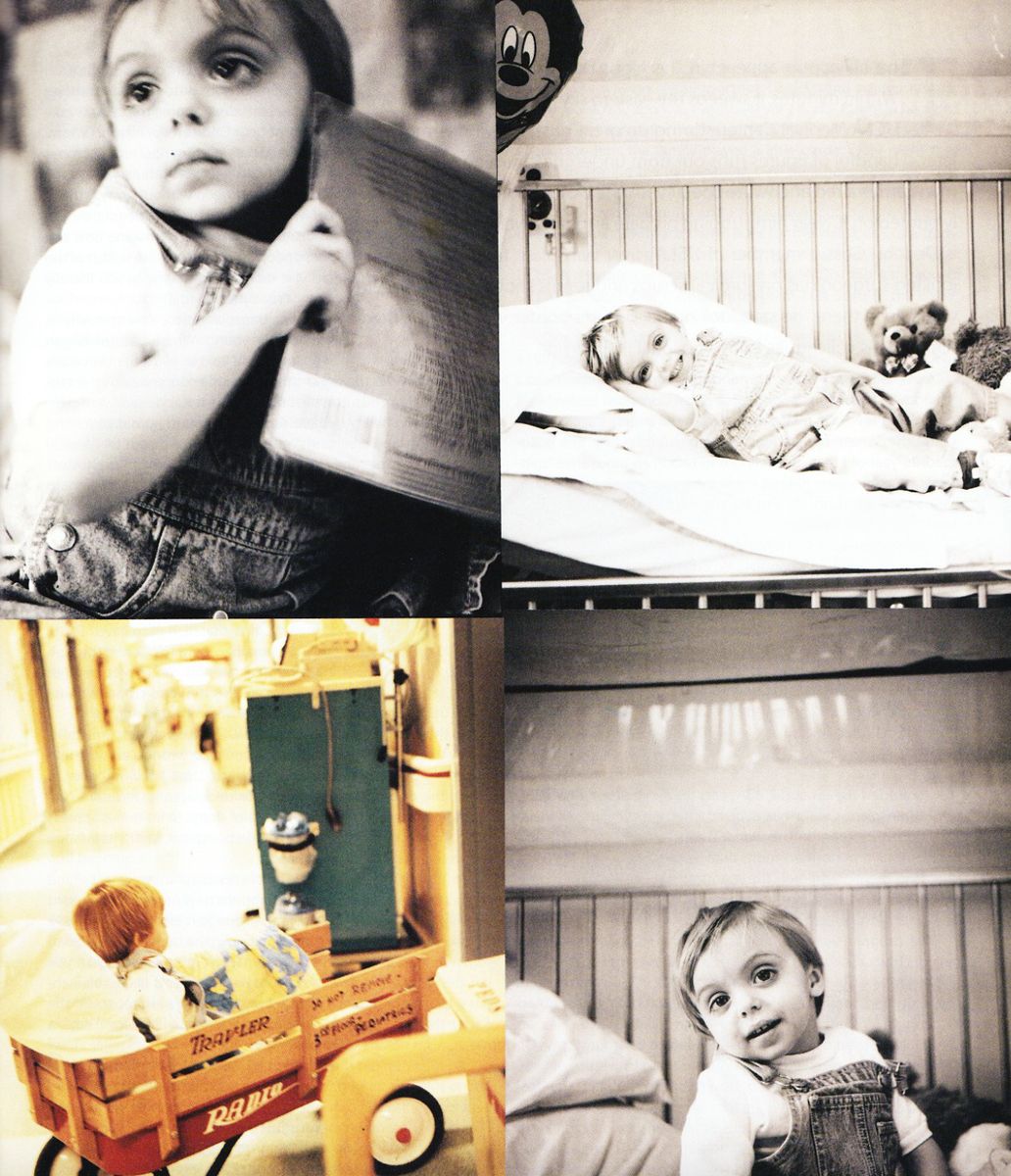
Jadonne Gyswyt has carved out a philosophy of life. Give things up to God. At 38, the earthy Texas native and mother of three has had little choice. Her middle child, 8-year-old Kyle, developed autism two years ago. Andrew, a 2-year-old with big blue eyes and a mop of shaggy blond hair, was born soon after with biliary atresia.
“We don’t understand what causes this problem,” says Dr. Sue McDiarmid, the pediatric hepatologist who’s cared for children in the UCLA liver transplant program since 1984. “It’s not genetic. I’ve listened to the stories a hundred times and there’s no common thread. Babies are born healthy and become sick.”
Andrew was diagnosed when he was 2 months old. He responded well to medication and did not need a transplant immediately. But at a year old, there were signs of fluid seeping from his liver.
One day in October 1997, two months after his second birthday, Andrew began running a fever and had diarrhea. Twenty-four hours later, he was vomiting and his temperature had shot up to 104.6. He was admitted to the hospital, gasping for breath. At first doctors couldn’t determine what was wrong. “Finally they explained to me he had a blood infection,” recalls Jadonne, a small, round woman with masses of brown hair and creamy skin. “It was his peritoneum [the membrane that lines the abdomen]. His belly got so distended that it pushed his lungs up. It was so huge; it was painful to see.”
Andrew was on life support for 12 days and nearly died. He recovered slowly and was eventually sent home. But now he didn’t want to eat, a problem common to babies with liver disease. To encourage him, the family played a little game. Every night they would sit around the dinner table, clap their hands and say “clap, clap, clap!” when the toddler took a bite.
The Gyswyts, Jadonne and Paul, a clean-cut, quiet man of 41, began to mentally brace themselves for the possibility of a transplant. In mid-November of last year, they met with Dr. McDiarmid at UCLA. A charming woman in her late 40s, McDiarmid is the soul of UCLA’s pediatric liver transplant program. Like Busuttil, the cheerful Australian native is devoted to her work. One of McDiarmid’s primary responsibilities is evaluating whether a child is a suitable candidate for a transplant. In Andrew’s case, “the first visit was to decide whether this was it for Andrew’s liver,” recalls Jadonne. “Dr. McDiarmid asked us a lot of questions.”
The Gyswyts weighed their options. Andrew was sick, in fact, quite sick. But perhaps not that sick. An ultrasound actually showed a normal-sized liver. The family’s neighbors in Laguna Niguel pointed out how good Andrew looked and asked, “Do you really want to put your little boy through all that?”
On the other hand, Andrew wasn’t gaining weight; he wasn’t growing. He was still fragile and could have a relapse of peritonitis at any time. “We were faced with the decision to wait until he got sicker or to go ahead and do the transplant while he was relatively healthy,” says Jadonne. “All the doctors felt we should go ahead. Dr. McDiarmid said it would be better for Andrew. The hardest part was trying to imagine what it would be like for Andrew. I asked Paul, ‘Is it right to do this to him?’ He said, ‘Of course. This is his chance to live.’”
On December 8, Andrew’s name went on the national waiting list for a liver. “We couldn’t make plans to do anything,” recalls Jadonne. “Every time the phone rang, I thought to myself, ‘This is it.’”
Nationwide, nearly a quarter of children under age 2 die while waiting for a suitable donor organ. In some areas of the country, the wait for babies under a year can stretch to 290 days. At UCLA, the average wait for babies is 23 days; for children ages 1 to 5, 27 days. All because of the split-liver program. “The children don’t wait as long, so they’re not as sick when they have the transplant,” says McDiarmid. “It’s a huge advantage. There’s almost no mortality.”
On January 8, Ladonne had just gotten up and was getting her two older children ready for school when the phone rang. It was Beverly, one of the nurse transplant coordinators at UCLA. Jadonne quickly called Paul, who was already at work. “He had just started an important meeting, so I beeped him,” she remembers. “I said, ‘We’ve gotta go. They’ve got the donor.’”
At the age of 61, Angel Hernandez’s greatest pride was his close-knit family. Next came his work. For 27 years, the father of four was employed as a laborer and machine operator at Mayer Drums, a manufacturer of large metal barrels, in downtown Los Angeles. The work was hard and dangerous; Hernandez was constantly exposed to toxic paints and fumes. But he did not complain. Whether it was scrubbing the floors of the factory or planting seeds in his well-tended yard, every job, he felt, had dignity. When Mayer Drums closed in 1985, Hernandez took a janitorial job at a poultry slaughterhouse downtown.
Hernandez began feeling sick gradually. In June 1991, he became noticeably worse. He was tired all the time. He was losing weight and began vomiting blood. His family grew alarmed and, since they had no physician of their own, they took Hernandez to a nearby hospital. After examining him, the doctors asked Mrs. Hernandez if her husband drank. “That came as a shock,” says Angel Hernandez Jr., a sweet 19-year-old who serves as translator for his Mexican-born parents. The physicians concluded Hernandez was an alcoholic. His family knew he was not.
Diagnosed with a stomach ulcer, Hernandez was sent home. He unsuccessfully looked for work: No one would hire him because of his illness. His wife, Zenaida, a tiny woman whose long brown hair is streaked with gray, became the family breadwinner. She flipped hamburgers at Carl’s Jr. and, as a licensed day-care worker, cared for two small children in the Hernandez’s modest Boyle Heights home.
In October 1997, Hernandez was admitted to Pacific Medical Center in Chinatown. Following a battery of tests, the doctors had disturbing news. “That’s when we found out he had hepatitis,” recalls Angel.
In late October, Hernandez was hospitalized again, his condition now critical. He could die at any time, his family was told. To Angel, who attends classes at East Los Angeles College and hopes to enter the medical profession, the idea of losing his gentle father was unfathomable. “I thought, ‘He’s never going to meet his grandchildren.’ And I was worried about my little brother, Alvaro.”
The family now had one option: a liver transplant. In December, Hernandez was transferred to UCLA, evaluated by Busuttil and his team, and placed on the national waiting list for a donor liver. But his health was rapidly deteriorating. If a liver didn’t become available soon, he would be too ill to risk the arduous surgery. “He was in dreadful condition,” recalls Busuttil. “He probably had two or three days to live.”
On January 7, at 3 in the morning, the family got the call they’d been praying for: A liver had become available. They rushed to UCLA, only to be disappointed because the donor liver was found to be unsuitable. But the next day, around noon, UCLA phoned again: Another liver had been identified and this one was almost certainly healthy.
When the family arrived at the hospital for the second time, they learned the donor organ would be split. Hernandez would receive the right lobe, the larger part, while a child would get the left lobe, the smaller portion. “I thought it was good,” says Angel, “that my father was going to share the liver with a little kid. It was like a blessing.”
The little kid was Andrew Gyswyt.
At 5:15 p.m., Angel, his 16-year-old brother, Daniel, and their mother said good-bye to Hernandez as he lay on a gurney in the operating wing, ready to be wheeled into the O.R. He probably did not hear them. He was in a coma.
The Gyswyts are saying good-bye to Andrew. He is wearing a child-sized hospital gown, and is leaning against his mother’s chest, his legs limp as a rag doll’s. Jadonne, dressed in dark sweat clothes and looking worn, confers with one of the doctors. “It could be midnight, it could be 11, it could be 1,” he says, predicting the time the operation may end.
“Hi, darlin’,” says a nurse in blue scrubs. She gently pries Andrew from the arms of his mother. Andrew cries feebly, like a frightened kitten, his tiny hands grabbing the air before he disappears through a door down the hall. His parents are left alone, their baby’s stroller of toys and diapers and medicines beside them, a mylar balloon with the words “Get Well!” floating idly above the handle. They push the stroller down the hall, through double doors into the elevator and up to the waiting room.
Busuttil races down the hallway, his surgical garb on. He’s about to begin Andrew’s surgery. This will be his 34th split-liver operation since 1996, but he is not complacent. “If everything doesn’t go perfectly,” he says, “the chances of the procedure failing are significant. That’s the crucial thing about these operations — there’s zero tolerance for error.”
Soon members of the transplant team wheel Angel Hernandez into Operating Room 2. He lies on a gurney, oblivious to his surroundings, tubes springing from his body everywhere. Three surgeons inspect his IVs.
At 5:25 p.m., Busuttil, two other surgeons, two anesthesiologists and two nurses begin operating on Andrew in O.R. 1, a high-ceilinged room bathed in light. All are dressed in pale blue scrubs; the surgeons wear custom-made glasses with magnifying lenses. On a table next to them, neatly arranged in rows, are dozens of surgical instruments, a metal bowl and countless squares of white cotton gauze. A monitor near Busuttil keeps watch on Andrew’s vital signs. The team crowds around the boy tightly, as if protecting him. Someone puts in the first CD; music plays softly in the background.
Andrew is covered by a sea-blue drape, his tiny shape barely taking up half the table. Occasionally a straw-blond patch comes into view at the end of the table. It is the top of the boy’s head.
Busuttil uses a yellow, pen-like cauterizing tool to burn away the abdominal wall and underlying tissues; the terrible smell of burnt flesh saturates the room. As he works inside Andrew, Busuttil scarcely moves. He doesn’t banter with the other physicians. The only time he speaks is to request an instrument, or to ask Dr. Randy Steadman, an anesthesiologist, how the patient is doing. At 6:10 p.m., Elvis is heard crooning “My Way.” An assistant hands Busuttil instruments, while a surgeon suctions fluid out of Andrew’s abdominal cavity. A big metal tub on the floor is already full of blood-soaked cotton cloths.
“How’s the baby’s head?” Busuttil asks Steadman. “Is the baby’s head OK?”
Steadman, a muscular man with reddish hair who wears wire-rim glasses, is the chattiest member of the large team. Whenever someone new enters the room, he grins and calls out hello. He stands near Andrew’s head, monitoring the baby’s heart rate, blood pressure and other crucial measurements, adjusting the medication in his IV lines and supplying blood as needed.
By now, Busuttil has worked his way through the abdominal wall and is nearing the liver. “Hold this back here,” he says. “OK. Let’s see what we’ve got.”
Surgery that Andrew had as an infant will complicate the transplant. “That’s the difficulty with these babies. They have these earlier operations and develop all these adhesions,” Busuttil explains. “The intestines get all matted up in a big ball.”
“Dr. Busuttil?” a nurse says.
“What?”
“The liver should be here at 7:45.”
At 7:35, disco music is playing, but the mood is tense. Busuttil has both hands inside Andrew now, one wielding the cauterizing tool.
At 8:10, Dr. John Goss enters the operating room. Andrew’s new liver has arrived from Riverside by air ambulance. Busuttil calls out to Goss: “We’ve got to do a little bit of work here.”
Goss opens the cooler and inspects the liver, which is cradled in ice. He and another surgeon sit at a small metal table in the corner and stitch the hepatic vein of the donor liver using blue-green thread.
Busuttil and Steadman are at a critical juncture in the surgery. Their voices become urgent.
“I think he’s hypovolemic,” says the surgeon.
“Yeah.”
Steadman hooks a syringe full of blood into an IV line to transfuse Andrew.
“I’m just going to keep doing what I’m doing.”
Busuttil is becoming agitated. He almost has the liver out, but needs a certain instrument. He turns to Goss.
“John, do me a favor, get me a clamp. It’s crucial. How’re we doing, Randy?”
“He’s 85.”
“Give me a 6.0, please.”
The music is silent now. Blood pours into plastic cylinders from the IV lines connected to Andrew.
“OK,” says Busuttil. “I’m going to give it another try.” Leaning over, his concentration just as focused as it was nearly four hours earlier when the surgery began, Busuttil lifts Andrew’s diseased liver out of his body.
Next door, members of the transplant team have removed Angel Hernandez’s liver. It’s hard and gray and mottled as a stone. In neither operating room do the surgeons stop to savor their success nor pause to rest. Their work is only halfway done.
Standing off quietly to the side in O.R. 1, Goss gets ready to sew in Andrew’s new liver. He pulls on surgical gloves and adjusts his surgical glasses.
“Can we get some music, please?” requests Busuttil.
It is 9 p.m. and the Rolling Stones begin to play. The transplant team won’t finish its work until midnight.
Andrew is reborn. Some babies who have transplants experience rejection within the first 48 hours. Andrew’s recovery has been amazing. A large scar zigzags all the way across his pale thin belly, another line snakes up his chest. But those are the only signs that he was a seriously ill little boy.
He was released from the hospital after only two weeks, sooner than some transplant babies, wheeled away from his third-floor room in a Radio Flyer wagon filled with toys. “He’s very happy,” says Jadonne. “He’s back to his old self. He was a sweetheart in the hospital. But as soon as he got back home, he started ordering everyone around!”
She has observed a profound change in her son. “With my other two kids, when they were little,” she explains, “you’d look at them and smile, and they’d smile back at you. Andrew never did that. I chalked it up to his personality. But since the surgery, every time I smile at him, he smiles at me. And it dawned on me: He must not have felt good. Now he smiles all the time.” Andrew will, for the rest of his life, be on a strict regimen of immunosuppressants so his body does not reject his new liver. For the first 100 days, Jadonne also has to give him antiviral drugs through a central IV line. As he gets older, he will face emotional and physical challenges related to the transplant. Some young children who’ve been transplanted don’t grow as much as they should. Later, they lag behind academically. And when they reach adolescence, some become angry or depressed about their medical condition and stop taking their medication. “We’re increasingly aware you can’t just transplant these children and think that you’re home-free,” says Dr. McDiarmid. “These children require monitoring throughout their lives.”
Angel Hernandez is confronting other hurdles. Compared to Andrew, his recovery has been long and frustratingly slow. Hernandez will be in the hospital for perhaps two months. He, too, faces a lifetime of medications to prevent his body from rejecting the transplanted liver. But because of his long deterioration, he will also need extensive physical rehabilitation. Even so, says Ken Drazen, “There’s every expectation he could make a complete recovery.”
For all the members of the Hernandez and Gyswyt families, the split-liver transplant has been a life-altering event. “The liver was a beautiful gift,” says Jadonne Gyswyt, “but it is a gift we cannot take for granted. I have changed a great deal. I try not to make so many plans now. I think more about my children and fill myself with the little blessings they bring.”
Young Angel Hernandez thinks about the donor and his family, people who endured their own terrible tragedy and yet unselfishly gave to two other families they will never know.
“I feel strongly that Andrew now has a second birthday,” Jadonne concurs. “January 8th is his second birthday. Just like I gave birth to my children, the donor gave birth to a new child. I hope wherever the donor’s family may be, they find some comfort in the wonderful thing they’ve done. I’ve thought a lot about how difficult it would be to deal with losing someone close to you.
“How can I say, ‘Thank you?’”