As Gov. Gray Davis and the state legislature grapple with how to address California’s severe budget shortfall, expected to hit roughly $34 billion by the end of the next fiscal year, the University of California is faced with one of its most significant fiscal crises ever.
UC’s budget has been cut dramatically — cuts this year and next are expected to total $373.3 million. To counter cuts targeted at instruction, the UC Board of Regents voted in December 2002 to raise undergraduate student fees $135 per quarter, and UC is considering an additional increase of $270 per quarter for the 2003–’04 academic year.
At the same time, an estimated 700,000 additional students are projected to seek enrollment at California’s public higher-education institutions by the end of this decade. For UC, that means an influx of an additional 64,000 students — the equivalent of a combined UCLA and Berkeley campus — as the system fulfills its obligation under the state’s Master Plan for Higher Education to accept the top 12.5 percent of California’s graduating seniors who meet the minimum requirements for enrollment. For UCLA, the increase would be an additional 4,400 students.
This growth, however, far outpaces increases in education spending. Over the past several decades, state support for UC, as a percentage of the university’s budget, has been on the decline. Today, 22 percent of UCLA’s $2.7-billion operating budget comes from the state.
How will these cuts affect the overall mission of UC in general and UCLA in particular? Can California, in a time of serious economic downturn, afford a top-quality system of higher education? In conjunction with UCLA’s Government and Community Relations, UCLA Magazine invited Bruins now serving in the state Legislature to talk about what they believe is necessary, under these circumstances, to maintain quality and achieve excellence.
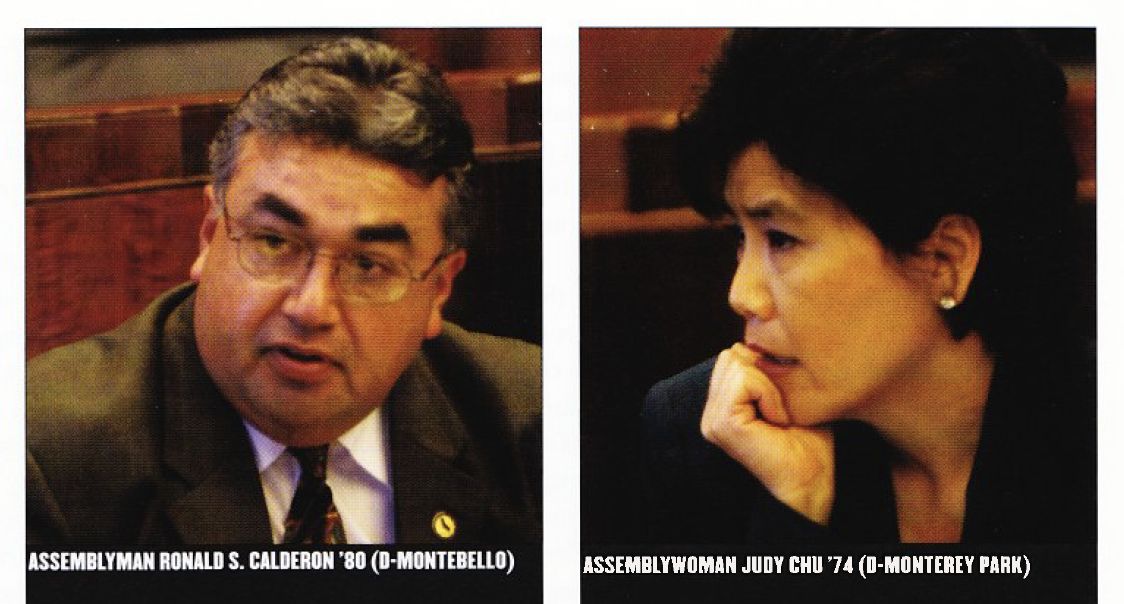
Those who participated were Assemblyman Ronald S. Calderon ’80 (D-Montebello); Assemblyman Ed Chavez ’89 (D-La Puente); Assemblywoman Judy Chu ’74 (D-Monterey Park); Assemblyman Lou Correa J.D. ’85, M.B.A. ’85 (D-Santa Ana); Sen. Sheila Kuehl ’62 (D-Los Angeles); and Assemblyman Keith Richman M.D. ’78, M.P.H. ’83 (R-Granada Hills). Fernando Torres-Gil, associate dean of the School of Public Policy and Social Research, moderated the discussion.
TORRES-GIL: Given the budget crisis, can California afford a world-class research university?
CHAVEZ: If the question being asked is whether we can afford to maintain this premier institution, my response is that I don’t know how we could afford not to maintain it. Think about the new technologies that are generated, about the new medical breakthroughs. UCLA has led the way in these areas. How could we afford not to have an institution such as this that helps to improve the quality of life for our communities?
CORREA: As policymakers, we try to develop a blueprint for the future of California within the context of jobs, international competition, economic growth, cutting-edge technology. Those are the kinds of investments we need to continue to focus on — the things that will lead to breakthroughs in technology that change the way we live on this planet. Of course, the challenge we have today as policymakers is that we have some tough sacrifices to make. Right now it’s a matter of prioritizing.
TORRES-GIL: Should UC seek a funding guarantee such as Proposition 98, which sets a guaranteed minimum funding out of state revenues for K–12 and community colleges?
CALDERON: Every special-interest group would like to have special funding set aside in order to add predictability and to be able to budget, but what we’ve seen in these set-aside situations is that the state loses flexibility. It’s necessary in times of budget shortfalls such as we’re experiencing now to have flexibility. Prop 98 hasn’t really turned out to be the Eden that some thought it would be because while it does make guarantees, they are linked to state revenues. It would be nice to have predictability, but in situations such as the one we’re faced with now we need flexibility.
CHU: As the budget chair for the Health and Human Services Committee, I see the vast range of needs in California. And I have to say that looking at the budget and trying to find solutions, I don’t know that it is in our best interest to have the number of different encumbrances on the budget that we now have. We have this trend with different ballot initiatives of minimum guarantees for particular programs, and it’s getting more and more difficult to balance the budget. I would want to make sure that education is our top priority, but I don’t know if we should be caught in this web.
KUEHL: It’s a difficulty. Set-asides come about through an initiative process and reflect the desire of the voters. I would somewhat sadly say that I’m not certain that the voters would want to guarantee a minimum amount of money to UC because of the way the system is structured so that only a certain percentage of high school graduates can qualify to attend. It still seems to many people like a place that not most people can go.
TORRES-GIL: As legislators, what are some of the competing demands and pressures that you feel when you’re making decisions about funding priorities?
RICHMAN: There are competing demands in every area of the state budget, whether that’s K–12 education, health and human services, public safety or the judiciary. Those are all issues that we need to be concerned about. Some of those issues, in fact, also impact the University of California. For example, if we reduce Medi-Cal funding and thereby reduce funding for UC hospitals, that’s going to place an additional strain on UC.
CORREA: We have to approach the budget with a view to equity. I have spoken with representatives from UC, Cal State and the community colleges, and one of the big issues is assurance that when they take those cuts, it’s shared pain. I’m talking about percentage cuts that should be equal in some way. After all, the missions of each entity are equally important. You can’t have one without the other. When it comes to the kind of budget cuts that we’re looking to propose for the state of California, the three entities have to work more in collaboration.
TORRES-GIL: One of California’s unique approaches is the Master Plan for Higher Education, which laid out specific roles for UC, the California State University system and community colleges. Is it still relevant?
KUEHL: The master plan is essential to the guarantee that every person in the state of California has access and an opportunity to receive higher education. I don’t think that we should change the structure just because we’re in a depressed economy, but rather look at a way to flatten out the ups and downs if we can.
CHAVEZ: Education has always been the No. 1 priority for California, and we have to stay focused on that mission. The master plan is a good starting point. But it still comes down to funding and to making sure there’s opportunity and access for every Californian. We need to find every dollar possible.
CALDERON: I agree with my colleagues. My primary concern with reducing enrollment from 12.5 percent under the master plan is that it would definitely have an effect on minority students and those students whose parents didn’t have an opportunity to go to college. One can presume that the concentration of minority students is greater within the 10 to 12.5 percent segment of each graduating high school class than it is within the top 10 percent. If we were to reduce that range, many of those students would be cut out from the UC, and so I believe it is more important now than ever that we stick with the master plan as it is currently constructed.
CHU: I wonder how successful we actually are in implementing the master plan. I am a community-college teacher, and I see students who thought they’d never have a chance to go to college finally have that chance. But the transfer rate for community-college students to four-year schools is lower than we would like. If our community-college system were really seen as desirable, perhaps we could more successfully implement the master plan, in that we’d have more students going to the community college for their first two years, and then going to the UC system for the last two. And so, we would not fear the tidal wave of students as much. Students have to see community colleges as a viable choice.
TORRES-GIL: Many have expressed concern that raising fees means more limited access. On the other hand, there are those who point to UC as having the lowest fees in comparison to its counterparts. What are your thoughts on increasing student fees to address budget shortfalls?
CHAVEZ: Certainly there are many students who are going to be disadvantaged in a situation such as the state is facing now. They may be in high school, getting ready to graduate and planning to go to UCLA or another school and all of a sudden the student fees are increased significantly. You do the best you can as a parent trying to plan for paying for your child’s college education, but in a difficult economic time it feels as if we could lose an entire sector of students who would have the potential to be successful at UC but, because of the economic circumstances, instead have to make other choices.
KUEHL: Student fees are on the same roller coaster as the state budget. It is that boom-or-bust question; when we’re doing great, we put money into the system, and when we’re doing poorly, we take money out and the UC makes up for it in part by increasing student fees. It’s very hard on families in California when that happens, and I wish there was a way to create a formula so that student fees would go up when the economy goes up and go down when the economy goes down.
RICHMAN: It is crucial that we even out the boom-or-bust cycle that’s resulted in very volatile funding for UC. It can be done by a regular process of investment at the state level from the General Fund, and it can also be done by putting in place a more systematic system of fees that guarantees access to the university for students.
CALDERON: The mantra in higher education is gradual, moderate, predictable. But as we saw in the early ’90s, fees more than doubled in the UC system. The reality is that there’s really no gradual or moderate predictability. Student fees should not be tied to economic indicators unless government and higher-education leaders in this state figure out some ways to restrict the urge to drastically raise fees in bad times.
TORRES-GIL: So what would you propose as a more coherent, analytical approach to fee increases?
RICHMAN: If we were to put in place a regular process of fee increases, which were moderate on an annual basis, and also a process that continued to guarantee access through financial aid to those students that needed it, that would provide a much more stable source of funding for UC. Another thing we should look at is the question of “means testing” for tuition fees, where students’ fees are on a sliding scale based on their ability to pay. Currently, despite the fee increases, UC continues to be a good deal for Californians, and my opinion is that if a family is wealthier, then we should look at means testing the fees.
CORREA: We have to think about long-term management of California’s resources. The problem is term limits — and I’m fully supportive of term limits — but the lessons we term-limited members learn will be gone. What we need to do is essentially put it on you — the University of California, higher education — to go in and talk to the next generation of legislators and say to them that instead of cutting fees during boom years, as was done in the past, the UC would keep them at a reasonable level in exchange for the Legislature creating some kind of a trust fund to help manage through hard times.
TORRES-GIL: The last time we had a huge enrollment surge was in the ’60s and the state responded by adding several UC campuses. Today, we’re planning one more campus while the enrollment surge is predicted to be even greater. How do we handle the need to enroll more students without expansion of new campuses?
KUEHL: The California Postsecondary Education Commission estimated that by the end of this decade enrollment in the state for secondary, postsecondary education would be 700,000 more students than the enrollment in public colleges and universities in 1998. If you look at it in the traditional context of build another building so that everybody can go at the same time, it could be a problem. I’ve always had concerns about the efficacy of such things as distance learning and some of these other new technologies that are available, but just building new buildings alone to manage the influx could be a problem. Even if the citizens of California vote for bonds to pay for some of it, how long can the state keep that up?
CHAVEZ: The growth is an indication that our K–12 system is working, that there are good-quality students who are getting ready to graduate and who want to stay closer to home. We need to have the facilities to accommodate those students. But how do we do that without building new campuses? California is the largest state in the United States, and it has the fifth-largest economy in the world. Somehow we have to make sure that we have the facilities necessary. If we don’t, we limit our potential for continued growth. Some people may look at that as a problem; I look at it as an opportunity. We need to put our heads together and do all that we can, and if we need to find ways to build another campus, then so be it.
CALDERON: Californians just passed a $13-billion capital-expenditure bond, and there’s another $12.5 billion in the works for 2004. That’s probably the largest source that we’re going to be able to find to expand facilities. We can explore other avenues for managing facilities, such as sharing among campuses, but the people of California have shown that they want to build our infrastructure in the colleges, and that should be one of our primary focuses. To find $12 billion or $13 billion from other sources is going to be difficult.
KUEHL: One of the things that I’ve seen in the past 35 to 40 years is a major increase in private gifts to UCLA. I think that the work that’s been done to develop a loyal alumni base, to show the value of UCLA to our communities and as a great research university in Southern California, has really increased the value that people put on UCLA. When I graduated, people thought the state pays for everything so we don’t need to make a contribution as alums. Now, we really understand how necessary it is that people give this kind of support. It makes a huge difference to the education of students.
TORRES-GIL: UCLA is one of the most successful campuses in terms of raising private dollars. But some may say that because we do so well, maybe more of the state money should go to other UC campuses.
CHU: It’s not fair to say that state money should be diverted to other campuses. That would be a disincentive for UCLA to be a fantastic fund-raiser. There is a reason that UCLA is so successful. People feel an emotional connection to UCLA; it truly is the university that has been the equal-opportunity giver, and many people are very grateful for what they’ve received so they give back.
KUEHL: I don’t think people have the impression that UCLA is so incredibly rich because it raises money or because one wealthy benefactor makes a significant donation. The problem, really, is what to do when the state is truly not capable of maintaining the level of support that it’s given in the past, like this year, and how do we handle that in terms of maintaining the university’s excellence? We can maintain the UC system as a world-class institution by making certain that we get every dollar that’s on the table: every state dollar, every private dollar, every research dollar and in bad times, unfortunately, a few more dollars in student fees.
CORREA: Whether we are talking about fund-raising or fee increases or enrollment growth or the need to build more buildings, the bottom line is that this is an important time for higher education in general, and UC and UCLA specifically. Your voices must be heard.