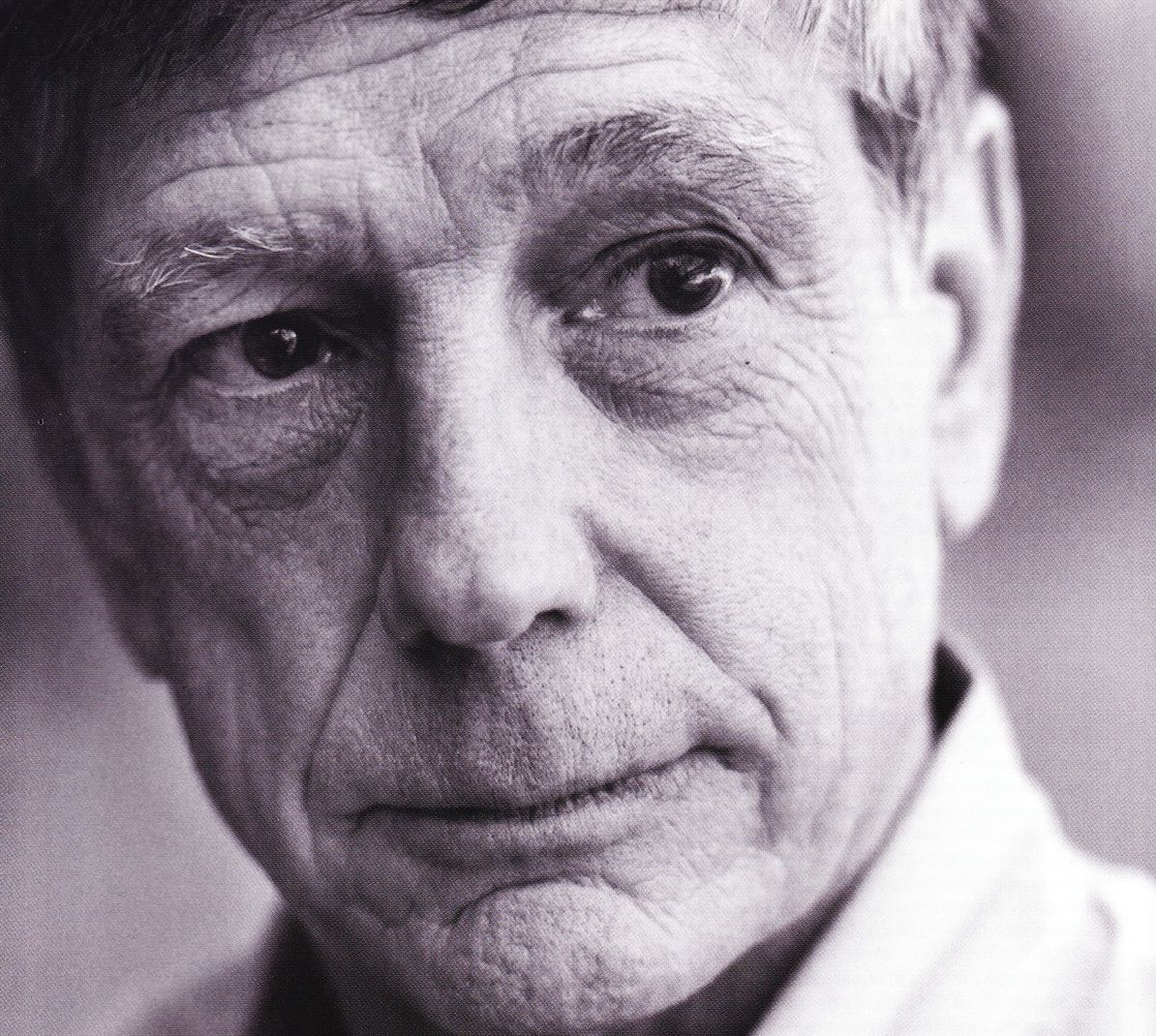
Their friendship began 35 years ago with “a miserable little poem” that a reticent graduate student named Stephen Yenser shared with a rising literary star, James Merrill.
“What I remember is that James took my poem utterly seriously. There wasn’t a touch of condescension in his manner,” Yenser recalls. “He assumed that, for better or for worse, I had slaved over the poem. Which indeed I had.”
Even when Merrill — a recipient of a National Book Award who would go on to win the Pulitzer Prize and comparisons to Robert Frost for his lyrical approach to traditional poetic forms — zeroed in on a particular phrase and declared, “Now that just won’t do!” Yenser didn’t flinch, so convinced was he of the older man’s sincerity. “I was terribly gratified. James was treating me as an equal and thinking about the line as though he himself had written it.”
That first meeting in 1967, while Yenser was a 25-year-old graduate student at the University of Wisconsin, changed his life: “Everything I did after James and I became friends was different because of James.”
Today, Yenser is a UCLA professor of English and director of the undergraduate Creative Writing Program. His own work has won him national and international recognition — the Walt Whitman Award from the Academy of American Poets for his 1993 collection The Fire in All Things and the B.F. Connors Prize for Poetry from the Paris Review — and has been included in two volumes of The Best American Poems series. His poetry and essays have been published in the Partisan Review, Poetry, The Nation, The New Yorker and The Yale Review, and he regularly is a judge in poetry competitions ranging from the University of California’s Poet Laureate Prize to the Pulitzer. As curator of the UCLA Hammer Museum Poetry Series, Yenser has brought some of the nation’s most influential poets to campus — U.S. Poet Laureate Robert Pinsky, Pulitzer Prize-winner Jorie Graham and Bollingen Prize-winner Anthony Hecht have appeared — and the series is considered to be one of the West’s premiere forums for poetry.
Throughout his career, Yenser has established himself as a trustworthy ambassador from a literary realm that strikes many readers as remote and impenetrable. “In his generation, Stephen has emerged as the best critic of contemporary poetry in the nation,” says J.D. McClatchy, editor of The Yale Review.
He also has emerged as a gifted teacher, earning the respect and accolades of colleagues and students alike who praise him for his modest, self-effacing style, sterling credentials and genuine warmth and desire to nurture young talent — a characteristic born, perhaps, from that first meeting with Merrill.
“He treated me like a fellow poet from our first interaction,” recalls Maggi Michele, a Ph.D. candidate who first took a course from Yenser while an undergraduate. “It was like, ‘I’m a poet, and you’re a poet. Why are we just standing here? We should get to work.’”
Says English Department Chair Thomas Wortham: “I sometimes want to walk behind him and put a sign on him that says ‘Great Poet.’”
Yenser and Merrill grew up in very different worlds. James Ingram Merrill was born in 1926 in New York City and grew up wealthy and privileged in Manhattan and Southampton, the son of Charles Merrill, co-founder of the Merrill Lynch brokerage firm, and Helen Ingram Merrill, who published a small newspaper. Yenser was born in 1941 in Wichita, Kansas, the elder son of an aircraft-industry purchasing agent and a nurse who liked to write and occasionally published her poems in such magazines as Ladies’ Home Journal. By the age of 8, Merrill already was writing poems, and while in prep school at age 16, his father privately published a book of his work. By the time Yenser was a teenager, he had been arrested several times and was thrown out of school for fighting.
“I was a punk,” he admits.
A car accident in his sophomore summer changed that.
“My best friend was home on leave from the Navy, and he and I and three other guys got drunk at a nightclub, went home to get a gun with some crazy idea of confronting the bouncer, and on the way had a wreck that killed two of the other passengers,” he says. The friend who had been at the wheel was charged with negligent homicide and went to jail. Yenser was badly hurt in the crash and spent months in traction and a body cast.
“The auto accident and its immediate aftermath constituted the most intense and self-contained period in my life to that point,” he recalls. “Afterward, I started to take everything more seriously — school, reading, writing.”
Yenser explores the experience in his poem “Intensive Care,” which appears in The Fire in All Things:
…under snowpacked nurses’
Suspicious noses, in spite
Of Demerol, in spite of tranquillizers,
Pulleys and wires, they made him almost nightly
(God love their never-say-die attitude)
See how it could be even worse,
The accident that he kept coming through.
Years after the accident, Yenser would have another life-transforming experience when he enrolled in a workshop at the University of Wisconsin led by Merrill. After their first meeting, Yenser and Merrill began to correspond. Soon they were swapping poems, a routine that continued for the next 27 years until Merrill’s death in 1995 at the age of 68.
“Almost everything I wrote went before him first, especially poetry and a lot of my prose, too,” Yenser says. “Even when I wasn’t going to be showing him, say, a draft of an essay, James was always present in my mind. He was my ideal reader. He still is. I don’t even have to think, ‘What would James say?’ It’s ingrained by now.”
Merrill reciprocated, passing most of his poems and much of his other work by Yenser. “Merrill felt Stephen knew Merrill’s own work better than Merrill did,” McClatchy says. “He was so closely attuned to the ins and outs of Merrill’s imagination. Merrill sensed it from the beginning. Stephen was James Merrill’s ideal reader.”
It helped that Yenser was something of a recurring character in Merrill’s work. (En route to Yenser’s second marriage, Merrill left his wedding gift on the seat of a cab along with the only copy of a newly begun novel. Merrill used the mishap as fodder for “The Will,” the eighth of nine poems in his 1976 collection Divine Comedies, which received the Pulitzer Prize. When that marriage dissolved 17 years later, Merrill expressed his disappointment in “Pledge,” an elegy that appeared in his posthumously published collection A Scattering of Salts, which he dedicated to Yenser.)
And as Yenser became a recurring element of Merrill’s work, so, too, Merrill became an element of Yenser’s. Over the years, their friendship transformed to the point that Yenser became a guardian of Merrill’s legacy. His first book about Merrill, The Consuming Myth: The Work of James Merrill, published in 1987, is considered the definitive look at the poet’s work.
Now Yenser is involved in an even more expansive endeavor. He is, with McClatchy, co-executor of Merrill’s literary estate. Together they are laboring to compile and edit a definitive set of Merrill’s work. Collected Novels and Plays is due out in November from Alfred A. Knopf. In it are all of Merrill’s three plays — The Immortal Husband (1956), The Bait (1960) and The Birthday (1947) — and his two novels, The Seraglio (1957) and The (Diblos) Notebook (1965).
The collection joins Merrill’s Collected Poems, which the team published last year to critical acclaim. If all goes according to plan, three more volumes of Merrill’s work will follow in rapid succession through 2007.
“When Robert Lowell died in 1977, he was thought to be the best living poet, yet he’s almost vanished because his executors haven’t come up with a definitive version of his work,” says McClatchy. “Unless good editions of a poet’s work are available, the work goes unread and untaught and it fades from sight.”
Yenser’s friends, students and colleagues insist that if anybody’s up to the task, it’s the unflagging champion not just of Merrill’s work, but of all contemporary American poetry.
In his own right, Yenser recently released a collection of essays on poetry, A Boundless Field: American Poetry at Large. In it, he explores 36 contemporary poets working in an array of styles, including formalism, neoformalism, language poetry and postmodern maximalism.
“There is now such talent as has rarely been seen at once in American poetry,” he writes in the book, which takes its title from the sanguine view of American poetry expressed by Walt Whitman in his 1868 essay, “Democratic Vistas.”
And what of that lost novel Merrill left on the seat of a taxicab while speeding to one of Yenser’s weddings? (Yenser now is married to poet Melissa Berton ’89, with whom he has a 7-year-old daughter.)
Merrill never re-created the work — a chronicle of his dabbling at a Ouija board with his longtime companion David Jackson — in prose. Instead, he recast the material as an epic poem exploring the afterlife. Hence was launched “Ephraim,” the poem that evolved into Merrill’s 500-page masterpiece The Changing Light at Sandover, which went on to pick up a National Book Critics Circle Award.
Knowing such Merrill arcana comes in handy when carrying out the day-to-day duties of the Merrill project. Merrill rarely changed his poems after they first appeared in print, so his literary executors have to reconcile fewer versions of his works than the executors of a frequent reviser like, say, W.B. Yeats. But such work still presents countless editorial quandaries.
Take Merrill’s double acrostic love poem “Fleche d’Or,” which is composed of a single sentence. When originally published in his 1972 collection, Braving the Elements, it had a period at its conclusion. But the period had disappeared by the time Merrill repackaged the poem in two subsequent collections. So the executors had to decide whether or not to use a period.
“I knew his reason for removing the period — the poem’s last words are ‘nothing ends’ — and we had to decide whether to reinstate it in the Collected Poems,” Yenser says. “We decided not to do so.”
And so it went with the more than 500 poems featured in Collected Poems. Of course, not all of the executors’ contributions involve such minutiae. Yenser and McClatchy have won accolades for unearthing 58 poems that had never been collected, some of them unpublished. An example of the former is “Copied Onto the Thing Itself,” a humorous poem written on a gingko leaf that Yenser had the foresight to save after Merrill mailed it to him in 1968.
Although the gingko’s older far
Than most trees here below
This leaf is Art
Nouveau
“Merrill — usually so fortunate in his friends — has been well-served by his executors and editors,” the Los Angeles Times said in naming the 888-page behemoth one of the best books of poetry in 2001. For the 670-page Collected Novels and Plays, Yenser and McClatchy uncovered The Birthday, a short, unpublished play that Merrill wrote as a college student at Amherst. The executors’ stamp will be even more prominent on Merrill’s Selected Letters, tentatively slated as the project’s final volume. Yenser and McClatchy have solicited letters from everyone in Merrill’s voluminous address book. They also ran ads seeking letters. One of the largest groups will come from Yenser’s own collection, which fills six large filing cabinets. From the tens of thousands of letters so far collected, the executors will have to choose fewer than 1,000.
“This is a great chore because Merrill was one of the last great letter writers,” Yenser says.
Not that he is complaining. Yenser insists the project “repays me every inch of the way.”
“When I’m reading Merrill again and thinking about what I’ll write, he is helping me think about new things to do, whether it’s in my own poems or essays,” he says. “It’s a network, a web of relations.”
Besides, it’s the least he can do for a friend.
Merrill felt Stephen knew Merrill’s own work better than Merrill did. He was so closely attuned to the ins and outs of Merrill’s imagination. Merrill sensed it from the beginning. Stephen was James Merrill’s ideal reader.



