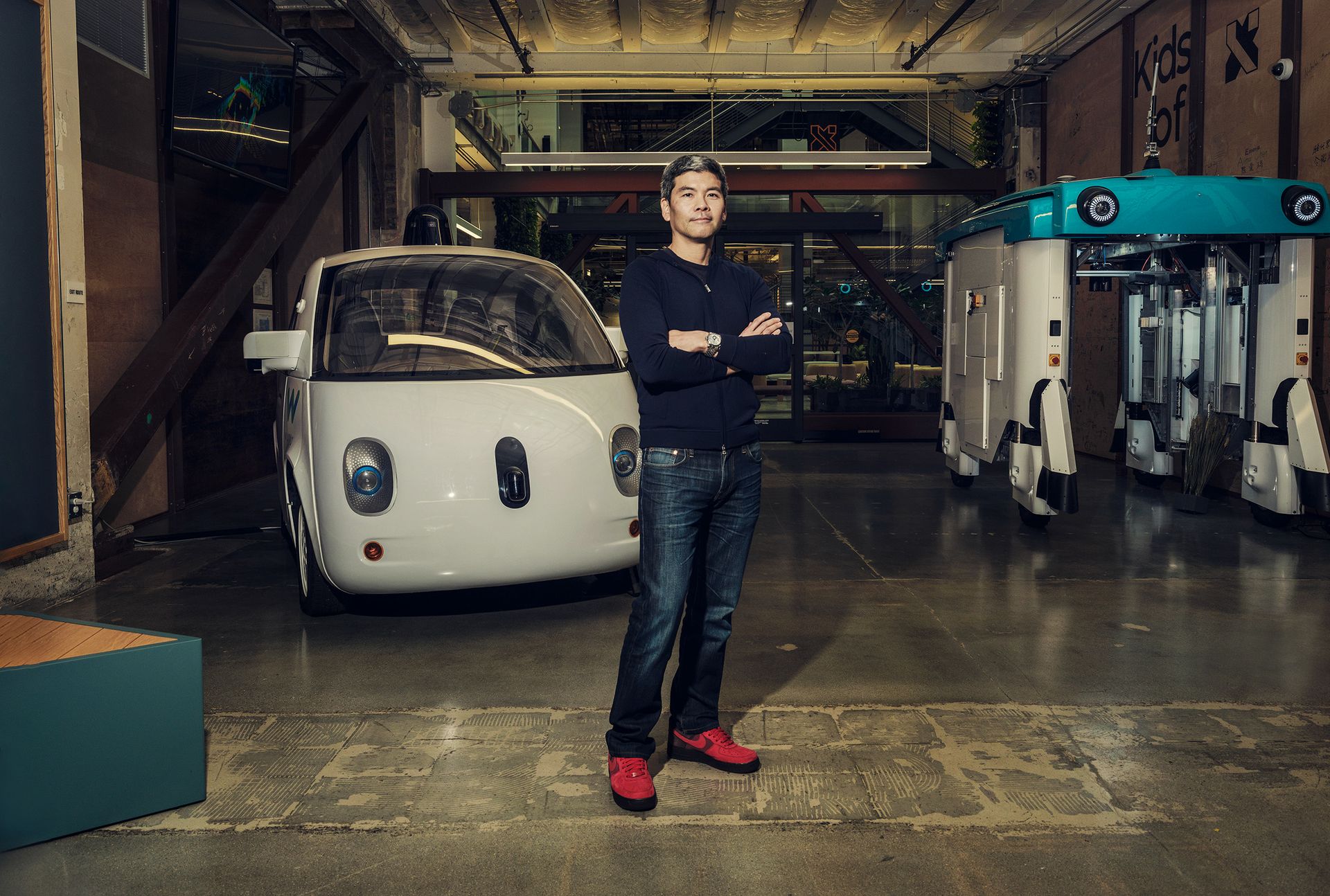
In the race to solve humanity’s most urgent challenges, much of the power — for better or worse — lies in the hands of the world’s largest tech companies. A few Silicon Valley giants, armed with near limitless computing resources, oceans of data and trillions in capital, are competing to see how AI can be the ultimate problem solver. This isn’t about optimizing search results or predicting what you’ll buy next (though they’re surely working on that, too). It’s about tackling climate change, curing diseases, extending the human lifespan. It’s about transforming how we live. And nothing less than reprogramming the future.
It’s a bright afternoon, and Steven Kan M.B.A. ’06 is leading me around the famed campus of one of those tech companies, Google, in Mountain View, California. We pass a beach volleyball court and a big bronze statue that’s a replica of a T. rex skeleton, and then we’re spit out into the rolling, green hills of Shoreline Park. Flower foam art floats atop Kan’s decaf oat milk latte (crafted by a Google barista, natch). But the groovy vibe of the campus belies the serious work going on here.
Kan, 48, who received his M.B.A. from the UCLA Anderson School of Management in 2006, is the director of Other Bets, the arm of Google that oversees its most ambitious ventures: self-driving cars (Waymo), drone package delivery (Wing), AI pharmaceutical discovery (Verily), research into aging (Calico), among other endeavors. These companies sit under Other Bets, but they benefit greatly from their parent company’s computing power and industry sway. They also benefit from Kan’s long tenure at Google, his experience in venture capital and his scientific background.
Kan comes across as attentive and friendly, grounded and calm. He considers questions thoughtfully as he guides me through the campus’ trails, directing me where to go without ever losing track of the conversation. He’s the type who’s always holding doors open for others. It isn’t an act. “There is one Steven Kan,” says one of his earliest mentors, venture capitalist Jim Armstrong ’89. “There is not a mad Steven Kan, there is not a throw-a-stapler Steven Kan. There’s Steven Kan.”
With his salt-and-pepper hair with a shock of white in the front and his standard techie attire — zip-up navy blue jacket, jeans, black sneakers — Kan blends right in with the Googlers who pass by us on foot or aboard the colorful bikes the company supplies. Before joining Other Bets, Kan spent 12 years on various teams at Google. He’s part of its fabric — even as he’s helping weave its future. “It’s a privilege working with great entrepreneurs to tackle these very interesting problems that, hopefully, will have a positive benefit in society,” he says. “And it’s super fun.”
“There’s something about the idea you could interrogate the world”
Raised in Fairbanks, Alaska, Kan was one of three siblings. His father taught physics at the University of Alaska; his mother worked as a civil engineer. Fairbanks is the state’s second-largest city, with a modest opera house and a radio station, though only 30,000 people reside there. (“It’s surrounded by nothing,” Kan says.) But it did get magazine deliveries. Growing up in the 1980s, Kan read Businessweek cover to cover, devouring news about the exciting world of Silicon Valley. “It was high times for Intel, Apple and Steve Jobs,” he remembers.
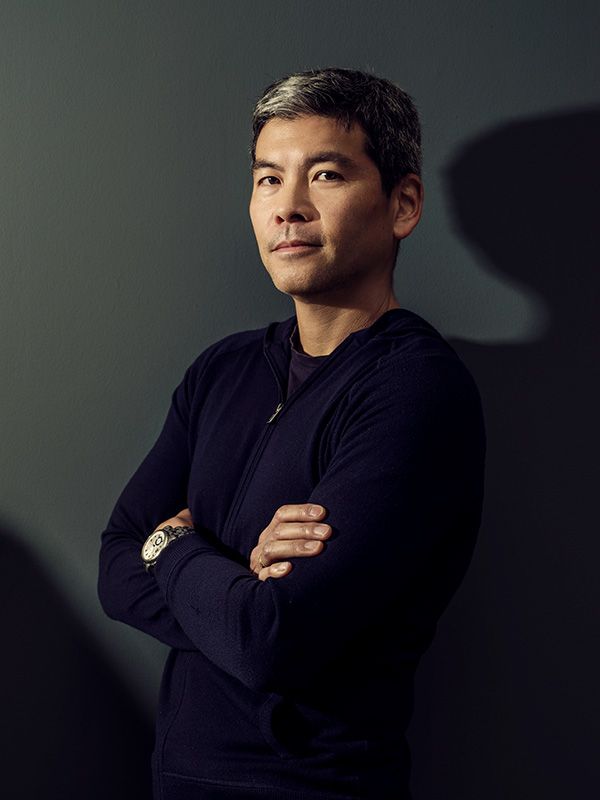
Still, tech didn’t call to him right away. He attended Yale for undergrad and, following in his father’s footsteps, became the only one in his class to major in applied physics, a lens through which he viewed the world. “There’s something about the idea that you could interrogate the world, investigate the world, and identify powerful patterns — it’s a lot of predictive capacity,” he says. While physics would inspire much of his later work, in the end, Kan’s outgoing nature meant that academic research felt too isolating. “You could spend an entire day in a dark lab,” he says.
He always felt oriented toward helping others; in high school, he was tasked by his teachers to act as a peer mediator. After graduating from Yale, he took on more collaborative jobs in strategy consulting, small business investment and finance analytics. While he remained interested in tech, he also wanted to dig into the world of venture capital. To him, it felt like another way to be of service. He was particularly drawn to UCLA’s Deutschman Venture Fellows Program, which provides M.B.A. students with VC training and internship placements. “It was a pivotal decision to go to Anderson,” he says.
Though he initially found Westwood and its surrounding neighborhoods all a tad overwhelming, “for a small-town boy, L.A. was wonderful,” he says. He quickly found his footing in the VC world. In his second semester, the fellowship set him up with an internship, which he followed with a summer internship for Clearstone Venture Partners under Armstrong’s mentorship. “He was obviously bright,” Armstrong says, “but Steven is also just really levelheaded and the voice of reason.”
Despite his junior status, Kan wasn’t afraid to speak up. He once asked Armstrong what he thought after they’d witnessed an entrepreneur cut off a direct report during a meeting. Kan wasn’t just demonstrating his good people skills; he was modeling that he knew what was good for business, period. “Early-stage business plans are a lot of make-believe,” Armstrong says. “You’re backing people who can think on their feet, think as a team. Once respect leaves the room, then nothing else can stay.”
By his second year at Anderson, Kan had arranged his schedule so he could work 15 to 20 hours per week for Clearstone. “I’m surprised it was that little,” Armstrong laughs. “He was there all the time. I’d get there at 8, he’d be there. I’d leave, he’d be there.”
Upon graduation, Clearstone extended an offer to Kan — a rarity for an intern. While some of the investments he spearheaded didn’t work out, others became huge successes. He was instrumental in convincing the company to continue investing in a tech supply-chain company, which was eventually bought by Siemens for $700 million. “If Steven hadn’t done the ground-level work and believed in it, I’m not sure that company would be here,” Armstrong says. “And that [acquisition by Siemens] returned our whole fund.”
Once the Great Recession hit, Kan saw the writing on the wall: There would be fewer investments to scout, fewer deals made. However, he’d embedded himself in one of Clearstone’s portfolio companies, Apture, which was developing web search tools. As Kan began hiring and building a team, he realized that he was becoming more an employee of Apture than of Clearstone. He officially made the switch to the startup world. In 2011, when Google acquired Apture, they acquired Kan, too.
Opportunity knocks … and knocks … and knocks
Kan entered Google during the height of the tech Gold Rush, when Silicon Valley companies were vying for talent by providing the coolest perks. (During his early Google years, David Beckham and Conan O’Brien came to campus.) Meanwhile, his human-first approach began to be noticed by his co-workers. His mentor at Google was Andrew Moore, now CEO of Lovelace AI. Moore recalls that while his own obsession with tech could lead him to jump into meetings cold, Kan would always ask people about their vacations or families. “I’m like the AI, he’s the human being,” Moore jokes. “You can be so much more creative if you think we’re part of a process. And those little understandings you have between people really help bring that out. Steven was very effective at that.”

Kan didn’t expect to stay at Google. “You know, learn the place, get to know the people, build my network,” he says. But every few years, a new opportunity arose. He initially worked to help launch Google Drive; next, he joined the Chrome OS team. After that came Google WiFi, Chromecast, AR and VR and, most recently, Google Cloud, with each role bringing a new product, a different function, a change in scope. “You walk through that door, and that reveals a few more doors, and then you choose another one to walk through,” he says. “Then you look back and it’s been 13 years.”
Kan says that it was his time at Anderson, spent jumping from marketing case studies to finance classes to ethics classes, that helped him become a lifelong learner. “There’s the confidence that if you put me into an environment, I can become useful and then, within a reasonable amount of time, I can really feel I have unique value to add,” he says. That dexterity became particularly crucial when, last year, he was brought into Other Bets, which oversees Google’s venture capital arm GV, private equity firm CapitalG, as well as more than a half dozen “moonshot” companies. The latter are taking on the kind of massive, future-forward projects that sound like the stuff of science fiction — for example, working to deliver internet connection using light, improving fishing through underwater monitoring, and leveraging AI for natural disaster prediction. And those are just a few of the public projects from a single company.
Kan’s role is part fund manager, part mentor. He tracks how the companies are burning cash and evaluates operating plans, but he also gives strategic advice and helps company leaders make connections across Google. “We want to make sure they benefit from being part of the portfolio as much as possible,” he says.

Happiness in the snow
Considering that Other Bets companies are applying AI to some of humanity’s thorniest questions, it may be no surprise that Kan has begun considering how he wants to spend the next chapter of his career — and what legacy he wants to leave. Environmental sustainability is top of mind for him. Kan’s hobbies revolve around the outdoors: kayaking, sailing and skiing. He frequents Lake Tahoe with his wife, their two children and his friends. He goes “when the snow is good — or even when it isn’t,” he admits with a playful smile. “You know when you see those videos of dogs running around in the snow on Instagram, and they’re so damn happy? I just am really happy in the snow.” Meanwhile, he has watched the impacts of climate change unfold in both California and his home state. In Alaska, salmon populations have dropped and wildfires are becoming more common. “Glaciers that were there when I was a kid, that you could see just from the roadside, have receded dramatically,” he says. He knows that, as with climate change, solutions to thorny problems take time. To that end, Other Bets isn’t focused on short-term returns: Kan’s team is considering opportunities that will come to fruition in a decade or longer. Innovative tech takes time; it also comes hand in hand with unique obstacles. There’s a lot of policy to navigate around — for example, permitting drones to zip through the sky to drop off groceries at customers’ front doors, as Wing has begun to do in Dallas-Fort Worth. “When there are breakthroughs or rapid advances in what technology can do, it creates all these opportunities,” Kan says. “It also creates risks.”
His training in physics and systems thinking comes in handy as he navigates the best solutions that will “optimize the benefits and minimize the unintended consequences.” That may sound like bro tech-speak, but coming from Kan, it just feels authentic. It’s no surprise that his favorite law in physics is the second law of thermodynamics, which states that systems left on their own naturally spiral into chaos. He understands that moving toward progress while reducing harm demands focus and energy. And maybe just a bit of Bruin audacity.
Read more from UCLA Magazine’s Spring 2025 issue.