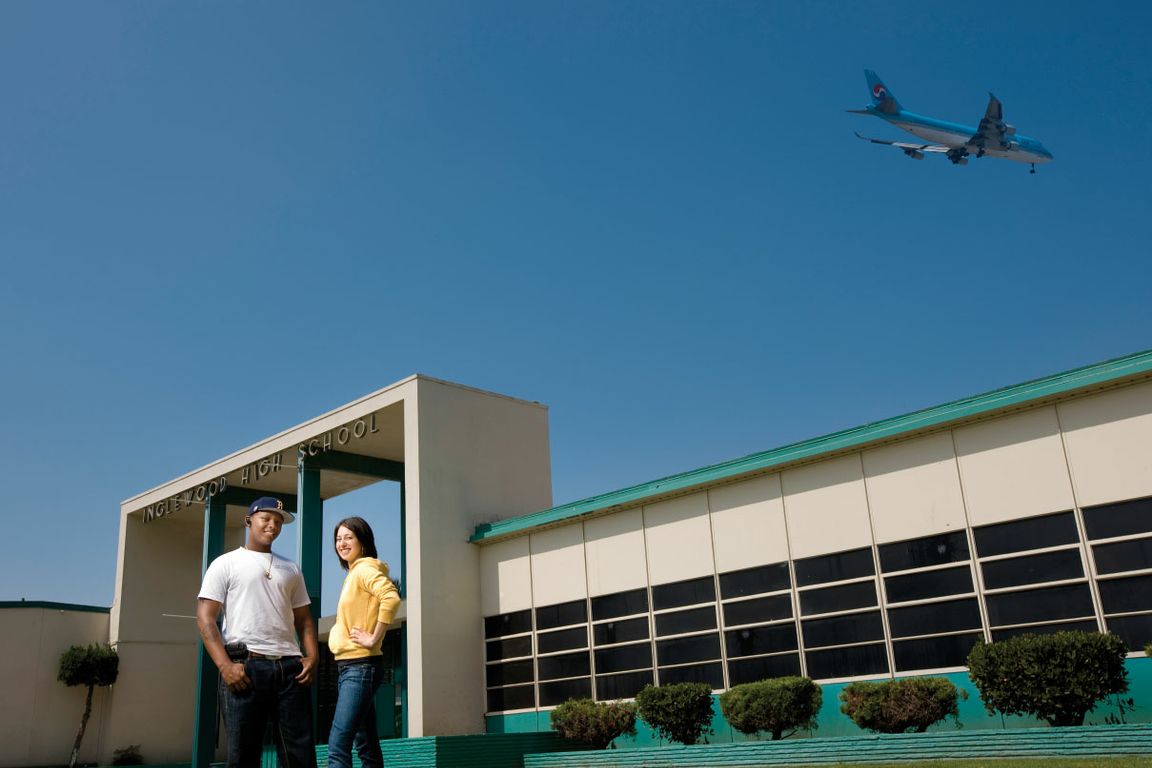
Inglewood High School graduate Timmetrius Henry didn’t always have the respect of his peers, but the incoming freshman has noticed that there’s something about winning two scholarships to UCLA that even gangbangers respect.
Henry — known as “TA” among his friends — recalled his friends’ reactions as the hard-won scholarships piled up and he became his school’s salutatorian.
“The so-called gang crowd, they look at you weird because you’re doing well at school,” Henry says. “So before, it was always, ‘Look at TA, why he trying to do so much work?’ Then, senior year, it was all, ‘Hey TA, will you help me out?’ Now they all say, ‘Man, I wish I’d done what you did.’ They were too busy being cool, but then this year I became, like, the coolest dude on campus.”
In UCLA’s quest to find the most talented students in each of California’s communities, students like Henry are drool-worthy prizes. In the wake of Proposition 209 in 1996, which put the kibosh on admitting or recruiting students based on ethnicity, UCLA has found that winning over underrepresented students with Henry’s credentials is an increasingly complicated dance.
UCLA students who were dismayed by declining campus diversity formed outreach groups to mentor local high schoolers, many of whom start out thinking college isn’t even an option. Now, these student groups are a vital channel funneling underrepresented students into the university.
Working with the Student Initiated Access Center, an arm of UCLA’s Community Programs Office, campus associations like the African Student Union, MEChA, and Pacific Islander and American Indian associations sponsor afterschool college-prep programs that are open to all, and you’re likely to find them putting in 20 hours a week at ethnically diverse high schools.
Even Henry, who was always determined to go to college, credits mentors from UCLA for giving him the edge he needed — and also for wooing him away from other powerhouse universities such as UC Berkeley.
Arianna Taboada, a UCLA junior and one of Henry’s mentors, notes that encouraging local students to put in the effort to prove themselves worthy of UCLA isn’t enough. The idea of coming to UCLA, which is about 38 percent Asian and 34 percent white, intimidates a lot of Los Angeles–area high schoolers.
“I come from a regular, urban public school, and the demographics are totally not the same as they are at UCLA,” Taboada says. That’s part of why she joined SHAPE, the African Student Union’s outreach group. “You mentor at schools like the one you went to, and you’re able to give back to where you came from.”
Once-faltering diversity levels have begun to recover from the drastic drop seen after Prop. 209, and African-American admissions have doubled since the shocking enrollment of only 100 black students in 2006, says Janina Montero, vice chancellor of student affairs.
The competition for a diverse and accomplished student body is steep, she adds. Thanks in part to student outreach groups, more underrepresented students are interested in and eligible to attend UCLA.
“They don’t just have to be eligible, they have to be competitive,” Montero says. She credits UCLA mentors for helping achieve that.
Dante Cruz, another UCLA junior, says it can be unsettling not to see faces like your own on campus. Cruz, now a mentor with MEChA’s Xinachtli program, was once a ninth-grade Xinachtli mentee who wasn’t even considering college.
“I come from South Central, and this is just a completely different world just a few miles from my house,” Cruz says. “When you’re in a class like Latino Studies, it’s not noticeable, but in a mainstream class like math, it’s different. The community just a few miles away from UCLA should be students at UCLA, not just working on facilities and maintenance.”
Cruz is not the only mentor to say that he feels blessed to be at UCLA, and hopes he can help more underrepresented students share in his good fortune.
But UCLA mentors deliberately choose a tough path.
“We have students on probation — both academic probation and juvenile hall probation,” Cruz says. “But they’ll bring you a test and say, ‘Look, I got a B,’ when they used to get F’s — that’s the best. It’s so rewarding.”
Many of the students they reach out to have a radically noncollegiate worldview, says Kare’l Lokeni ’05, who was a mentor in the Pacific Islander Student Association before she graduated and became director of PIER (Pacific Islander Education & Retention).
“For a lot of our students, their mindset is, ‘College is not even an option. If I graduate, maybe I’ll find a job; otherwise I’ll just join a gang,’” Lokeni says.
Many students don’t pay attention to deadlines for submitting college applications or taking the SAT — some don’t even know they need to take the SAT, Lokeni says. Many high schoolers are also baffled by the a–g roster of classes that the University of California requires for eligibility and are overwhelmed by the misperception that they will have to take one set of classes to graduate from high school and juggle a second set of classes to be eligible for college.
One of Lokeni’s former mentees, Carson High School grad Elenasina Smolinski, just completed her freshman year at Westwood. Without her UCLA mentors, “I wouldn’t be at UCLA,” Smolinski says. “They didn’t give me the nudge I needed — they gave me a big push. They knew I wanted to go to UCLA, but they also knew that I was pretty content to go to community college and get sucked into that life that repeats itself generation after generation, where you plan on transferring to a university later but you never do.”
But now, Smolinski is the first person in her family to go straight from high school into college — and, of course, she’s also become a mentor.
Smolinski and Cruz’s journey from mentee to mentor is not an unusual one, and Inglewood High School’s Henry plans to take up that workload, too. Like their own mentors, these young scholars work more hours than they get paid for and sacrifice their social lives to help area high schoolers get involved in local communities and prep for college.
UCLA mentors not only tackle academic problems, they also get involved in their mentees’ personal lives, helping them sort out troubles at home or with friends so they can focus on being students.
The transformation can be stunning.
“At the beginning of the year, I would say to my mentees, ‘What do you want to be?’” Smolinski says. “They’d say, ‘Longshoreman.’ By the end of the year, they were saying ‘doctor,’ ‘lawyer.’”
The barrage of encouragement — academic tutoring, one-on-one peer advising, parent meetings, field trips to UCLA, marathon college application sessions, assistance with personal statements, financial aid counseling and simple friendship — can all ultimately hinge on one “Aha!” moment from the high schoolers. Cruz, now a history major, remembers his moment.
“College was the farthest thing from my mind,” Cruz says. But then a Xinachtli mentor showed Cruz what he was learning in college. While Cruz was bored by the dense dates that filled his high school textbooks, the college history book fascinated him.
“I started thinking, ‘Should I go to college?’” Cruz says. “Just having conversations with these college students and realizing what they were doing made me realize I wanted to see myself in their shoes later on.”
Getting into UCLA is not the only goal, however. For many of the high school students, the mentors’ goal is to get them into community college or a state school or even just involved in their own community. But that doesn’t mean there’s not a special place in the mentors’ hearts for UCLA, confesses Stephanie Zelaya ’07, one of Cruz’s mentors from Xinachtli.
“We were so happy when we heard that he got into UCLA,” Zelaya recalls. And it’s not just another feather in a mentor’s cap — the student organizations are like family, eager to bring their siblings onto campus.
“It’s the biggest time commitment ever, but it’s not a burden at all,” Zelaya says. She even remembers cheering Cruz on at some of his football games.
High schoolers from several of the different mentoring programs shadow their mentors on campus for a day to see what it’s like to be a college student, and some even spend time in UCLA’s Community Programs Office, which several mentors think of as a second home.
The mentors also look out for each other. “We need to make sure we give ourselves enough space to study and do our own work without dropping out,” Zelaya says. “We arrange things like study nights together to take care of ourselves.”
Smolinski recalls how mentoring in Carson sapped her social time, but says she still found a way to combine work and friends.
“The mentors are all like best friends, so when we drive back from Carson, we could all just throw down our books and start studying,” she says.
In that way, “It’s definitely a passion job,” says Taboada, one of the mentors from Inglewood High. “You really have to love it.”
But for her, having a campus job that allows her to do more than restock library books makes it worth it.
“You work with your peers and the local community, working with real live issues and people, not just books,” Taboada says.
Of course, it’s challenging to reach these high schoolers, she acknowledges. But if it weren’t so difficult, the mentors wouldn’t be needed, she says.
“There’s definitely an ‘I don’t need your help’ mentality, but just our being there every day helps develop trust,” Taboada says. “The goal of the program is not that we can help these kids, but to show them that they are amazing already.”
That sense that students are part of the Bruin family brought Henry to UCLA this fall. “The mentors used to bring me to campus to hang out. That was really cool because it felt like I was a student already. Now, it’s like a dream come true that I am a student here.”