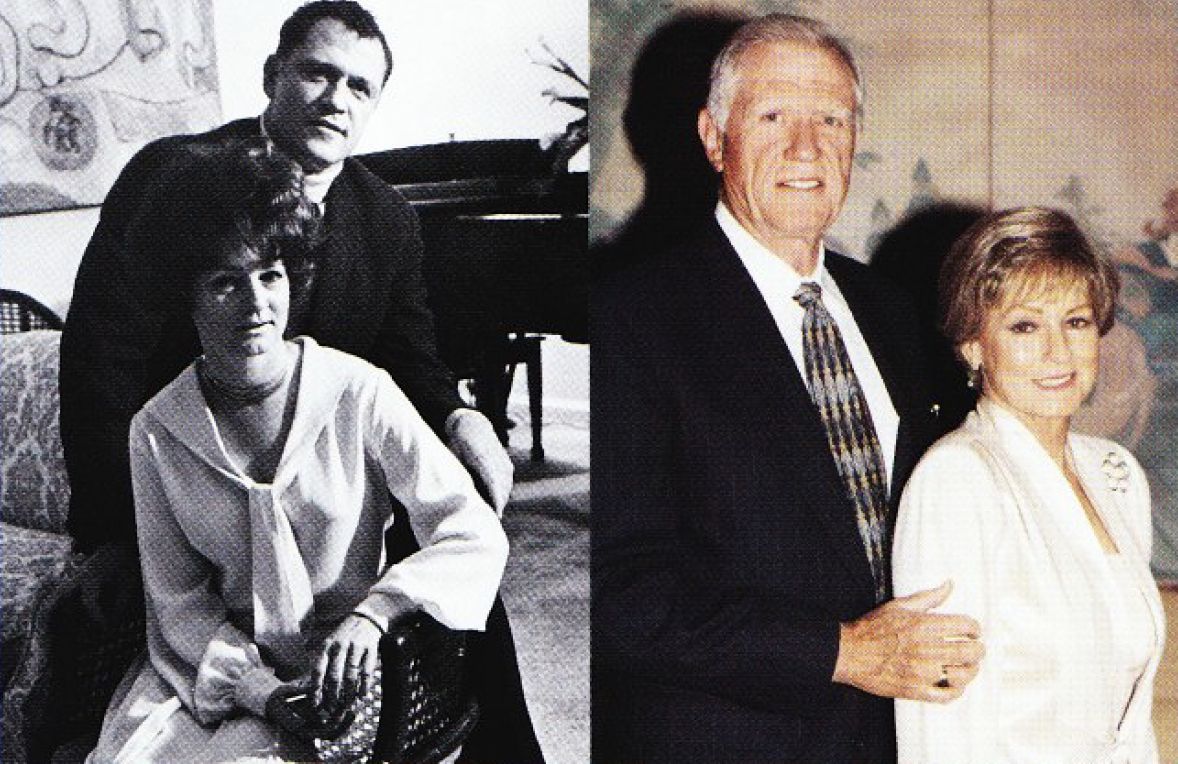
Sue Young amazed everyone she encountered. Her interests were broad and her talents many. For years to come, people will be recounting Sue Young stories, and the yarns will not suffer in the retelling.
My wife, Pat, and I knew Sue ’77 and Charles Young M.A. ’57, Ph.D. ’60 for many years, working, traveling and laughing together with them. We believe that we glimpsed the “real” Sue Young, but our association was largely focused on university interests. There are many who knew and loved Sue for the myriad other aspects of her spirit.
Yet, she really sparkled in her role as the First Lady of UCLA for 29 years, until Chuck retired as chancellor in 1997. The Bruin alumna in her gave rise to determination that UCLA would be outstanding in everything.
Second-best was never good enough for Sue Young, not in academics, or style, or sports, or anything. She was born and raised that way, and the spirit of UCLA simply increased her insistence on being first-rate in everything. She was a superb First Lady — outstanding among her contemporaries. She was attentive to newcomers to such positions, knowing how apprehensive they could be about their role, and she published her experiences to help them address their own campus challenges. She was a kind and good friend. She was assertive, even opinionated, and certainly not always right. All of this made her a fascinating woman to be around. Her death on Sept. 28, at the age of 69, after many years of battling breast cancer, was a terrific blow.
We were in Los Angeles in 1985 for the quinquennial meeting of the International Association of Universities (IAU). Sue organized the social, cultural and visitor events for the meeting, and the results, in the opinion of everyone who was there, were spectacular, the best meeting in every way, before or since. We were introduced to the finest in the arts, sciences and cuisine, and deftly cared for by a regiment of women whom Sue had called upon to help put forward the wonders of Southern California.
No detail was too small for her attention. Sue found out that my birthday coincided with the IAU meeting and she arranged for me to sit with her in the front row for a performance of the Preservation Hall Dixieland Jazz Band. It was such a special treat for me; somehow, she had learned that my father had in his youth created Dixieland jazz arrangements.
Sue also was not afraid to jump into the fray with large organizations, like the Association of American Universities (AAU) and the National Association of State Universities and Land-Grant Colleges (NASULGC). She decided that the spouses of presidents of schools that are members of these organizations should also benefit intellectually and socially from their regular meetings. So, in typical Sue style — that is, juggernaut in pink-velvet gloves — she agitated to have these organizations engage spouses in substantive sessions and exchanges of experiences and views. She joined up with a half-dozen other spouses, among them Pat, who agreed with the idea, to create a corollary experience for spouses that persists to this day.
I recall that at one point, Sue felt that the meetings of these two groups had drifted into a kind of stodginess that was anathema to her nature. She presented me with a plan and a request that I help her. I consented — one rarely did otherwise when Sue called. She decided that we needed to have a show to reveal the latent showmanship among university presidents at a NASULGC banquet. Leaving nothing to chance, Sue wrote the skit, wrote the parodies, selected the music and directed the several of us who had been “volunteered” to perform. Rehearsals were a lesson in how a determined director can get a dozen recalcitrant presidents into line — in this case, a chorus line — and in tune. We loved it. The audience loved it. And the “stodginess” disappeared.
I recall that at one point, Sue felt that the meetings of these two groups had drifted into a kind of stodginess that was anathema to her nature. She presented me with a plan and a request that I help her. I consented — one rarely did otherwise when Sue called. She decided that we needed to have a show to reveal the latent showmanship among university presidents at a NASULGC banquet. Leaving nothing to chance, Sue wrote the skit, wrote the parodies, selected the music and directed the several of us who had been “volunteered” to perform. Rehearsals were a lesson in how a determined director can get a dozen recalcitrant presidents into line — in this case, a chorus line — and in tune. We loved it. The audience loved it. And the “stodginess” disappeared.
Pat and I will never forget when Chuck and Sue accepted our invitation in 1987 to come to Indiana for our Little 500 weekend bicycle-race festivities. What makes it indelible in our memories is our image of Sue, who would not tolerate second-hand cigarette smoke, reacting as a guest at our dinner table, a prominent judge and civic leader, lit up. Without a word, she delved into her handbag and brought out a tiny battery-powered fan, turned it on and blew the offending smoke back at the smoker. At first, he was dumbfounded, then he laughed along with all the rest of us. Sue was right, and she was vindicated.
Sue and Chuck were excellent travel companions, always eager and interested to learn about people and places. We enjoyed many wonderful times together, dining, traveling, visiting and, especially, impromptu singing. It was during one such entertainment that Sue learned, but could hardly believe, that one of my favorite songs is “Jesus Wants Me for a Sunbeam.” While many of our group thought this was hilarious, Sue took me seriously, and when UCLA celebrated Chuck’s long, successful tenure as chancellor with a spectacular banquet, she personally requested of Henry Mancini, who was entertaining at the piano, that he play my favorite song. His response was quite emphatic: “Sue! You’ve got to be kidding!” That’s one time that Sue Young did not get her way.
Our mutual fondness for “Sunbeam” led us to create a two-member Sunbeam Society. We were open to new members, but never found any. Chuck and Pat were “candidate members,” but they never pressed for full inclusion in our elite group.
One practical benefit did result from our Sunbeam Society. In the early days of the thaw in U.S.-China relationships, a group of American university presidents, among them the Youngs and the Ryans, were invited to visit Chinese universities. The journey concluded with a visit to Mongolia. I found it necessary to return to Indiana just before the Mongolia segment, but asked Sue to write and tell me about it. She agreed, but was concerned about the possibility of her mail being censored. How could she be sure that her comments would make it through intact? I suggested that if she found Mongolia to be wonderful, she could send a postcard reporting the visit to be a Sunbeam experience. If it was otherwise, she could refer to it as Moonbeam. Some weeks later, I received a postcard that read: “Greetings from Mongolia,” with “Moonbeam” written over every remaining space.
Sue Young, multitalented, stimulating, irrepressible in spirit, simply would never flinch. She always seemed to have her eye fastened on higher, better things, and she invested her energy and talent in institutions and people. Like all of her friends, we miss her. But we feel her presence in so many ways that make us just want to be better, to do better, because that is what Sue expects of us.



