The homepage of UCLA Recreation splashes open to a simple phrase, popping against a bright yellow background: #ActiveBruin.
Because, really: How can you be on UCLA’s campus and not be active? With seemingly more steps than the Burj Khalifa (Google it), and with verdant hills tailor-made for everything from marathon running to cornhole, the sprawling, 419-acre Westwood campus is perpetually abuzz with activity. Basketball courts and adventure courses, rock walls and swimming pools, fitness centers and dance studios, tennis courts and — if you venture off campus — the newly reopened Marina Aquatic Center in Marina del Rey. If you want to get physical this summer, there’s a facility, class or group right around the next corner more than ready to help you make it happen. (Just remember: Stay hydrated!)
Whether you’re a student, a member of staff or faculty, or an alumnus — and whether your idea of “activity” is just taking a dip in the pool or swimming countless laps the length of it — we’ve got you covered. Read on to find out how to leverage the myriad recreational offerings that will get your blood pumping. And please: Trust us on the hydrating thing.
******
H2-Overjoyed
The Marina Aquatic Center has one message: Come on in, the water’s fine!
Ah, summer is upon us. Finally. Which means that the UCLA Marina Aquatic Center (MAC) is fully open. And what better way to cool off than by kayaking or sailing on the ocean — or learning how to?
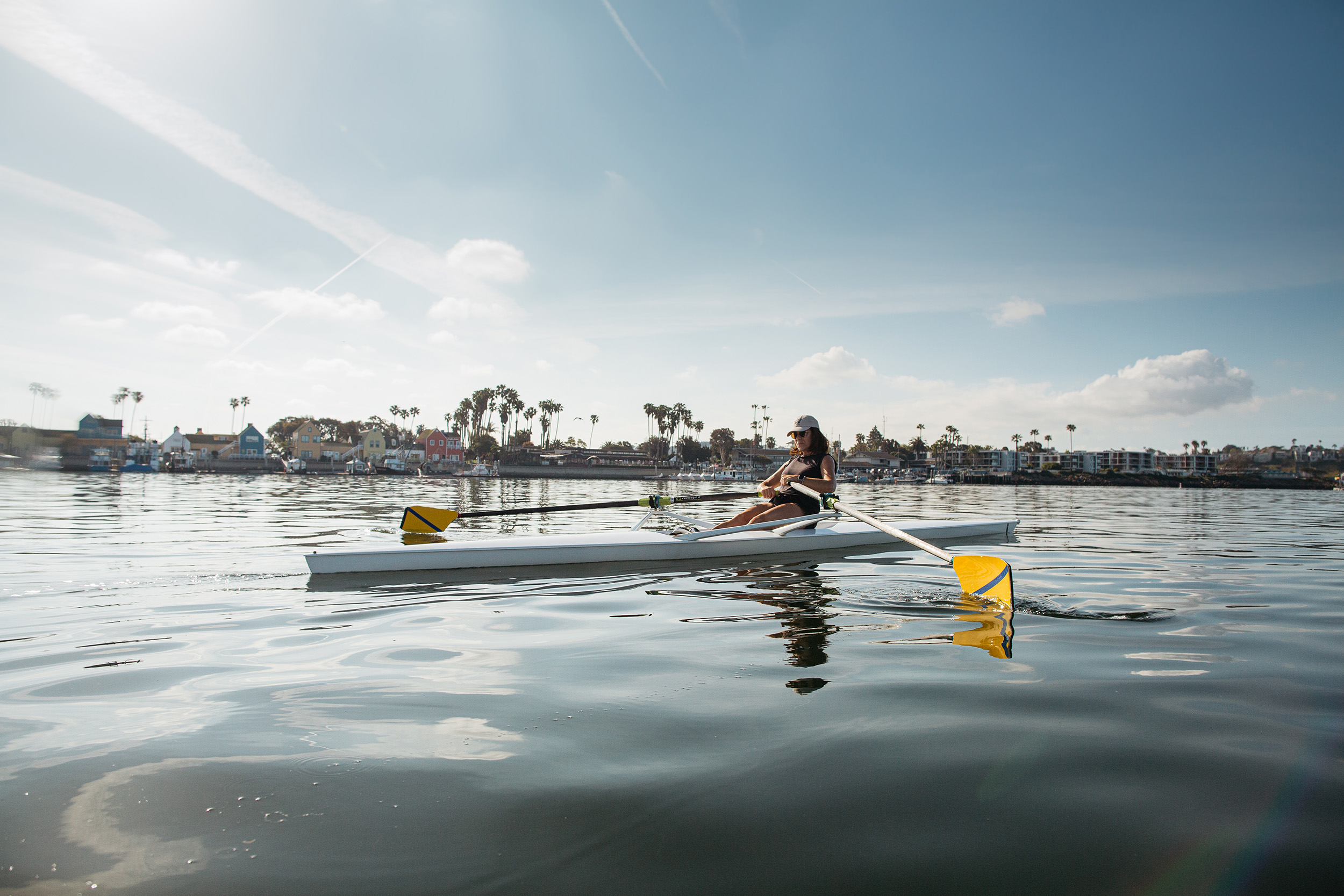
Located about 10 miles from campus in shimmering Marina del Rey, the center was partially closed last year for seismic retrofitting. It’s home to UCLA’s rowing and sailing teams, and visitors walking near the far end of Fiji Way may spot UCLA crew members gliding along the deep blue waters near the entrance channel to the Pacific Ocean.
But you don’t have to be a buff rower to enjoy the facility. Created in 1977, the aquatic center began with instructional sailing and windsurfing programs. In 1991, recreational rowing, kayaking and surfing were added, with youth boating joining in 1994. 2011 brought a stand-up paddling clinic. Today, the sailing and kayaking classes are the most popular; during the summer, qualified sailors who have passed the introductory class are invited to participate in a beginner-friendly summer race series.
And you don’t have to be ready for ESPN2 to enjoy it all — activities are available for all skill levels and ages. Those with no previous experience can rent single or double kayaks or stand-up paddleboards, and enthusiasts of any level can take classes in rowing, sailing and sea kayaking. Children as young as 10 who are water-safe and weigh at least 50 pounds can sign up for sailing camp or lessons; teens 14 and over can take lessons in rowing, kayaking and stand-up paddleboarding. Summer camps for youngsters in third through eighth grade include Bruins on Water, which combines on-water activities and interactive science experiments. (To see all the offerings, check out the aquatic center’s website.)
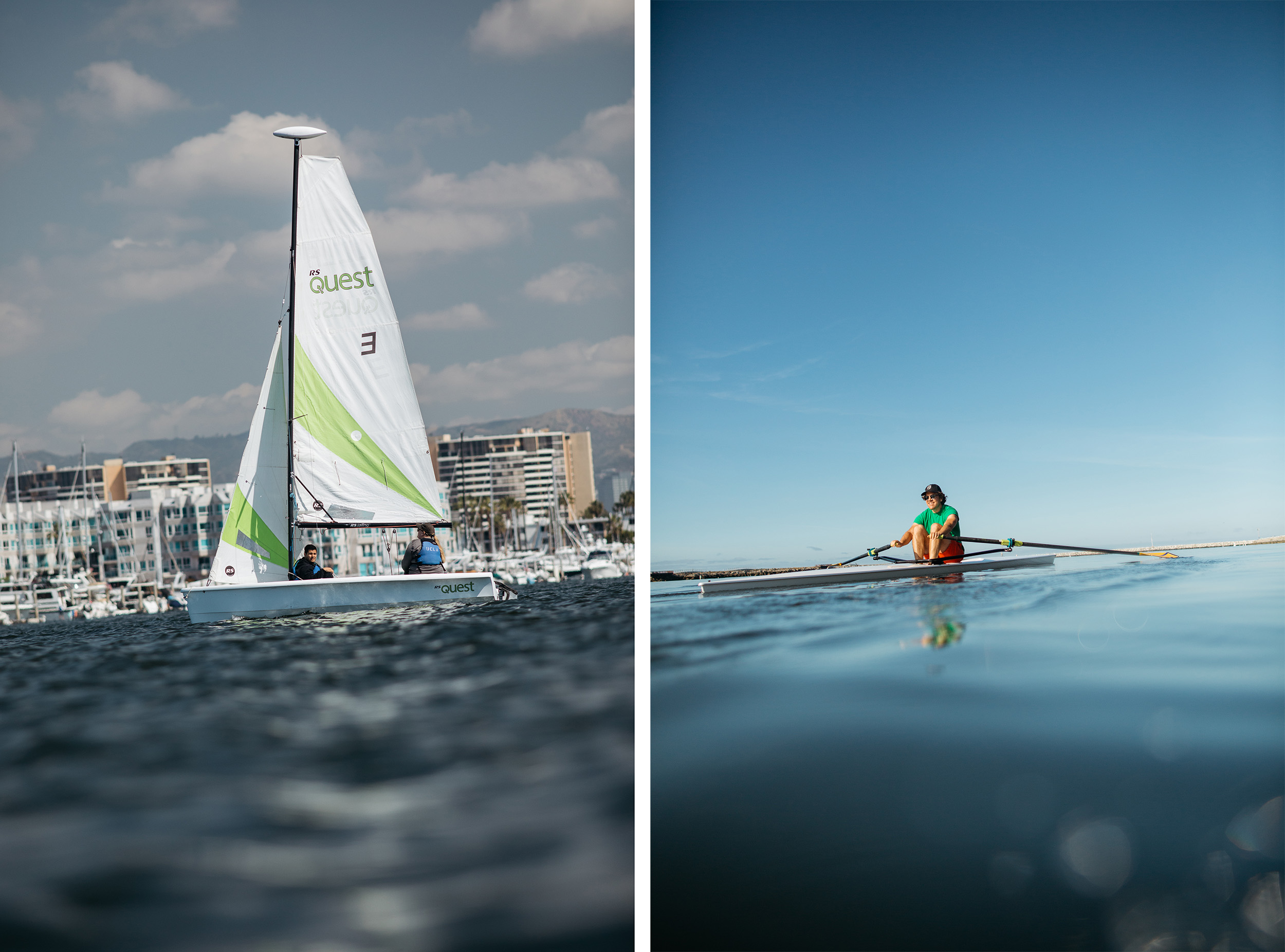
When Ken Hoover M.J.’72 took his first sailing lesson at the Marina Aquatic Center in 2003, he climbed into a small boat with another student and set the sails as instructed. There was a light wind. The boat began to glide through the water. He was hooked, and he’s been cruising the seas ever since.
“I love the feeling of the boat knifing through water, powered only by wind, which you and your crew know how to harness. It’s both exhilarating and relaxing,” he says. “I experienced that on my first day at the UCLA Marina Aquatic Center, and I still anticipate it every time I climb onto a boat.” —Nancy Gondo ’92
******
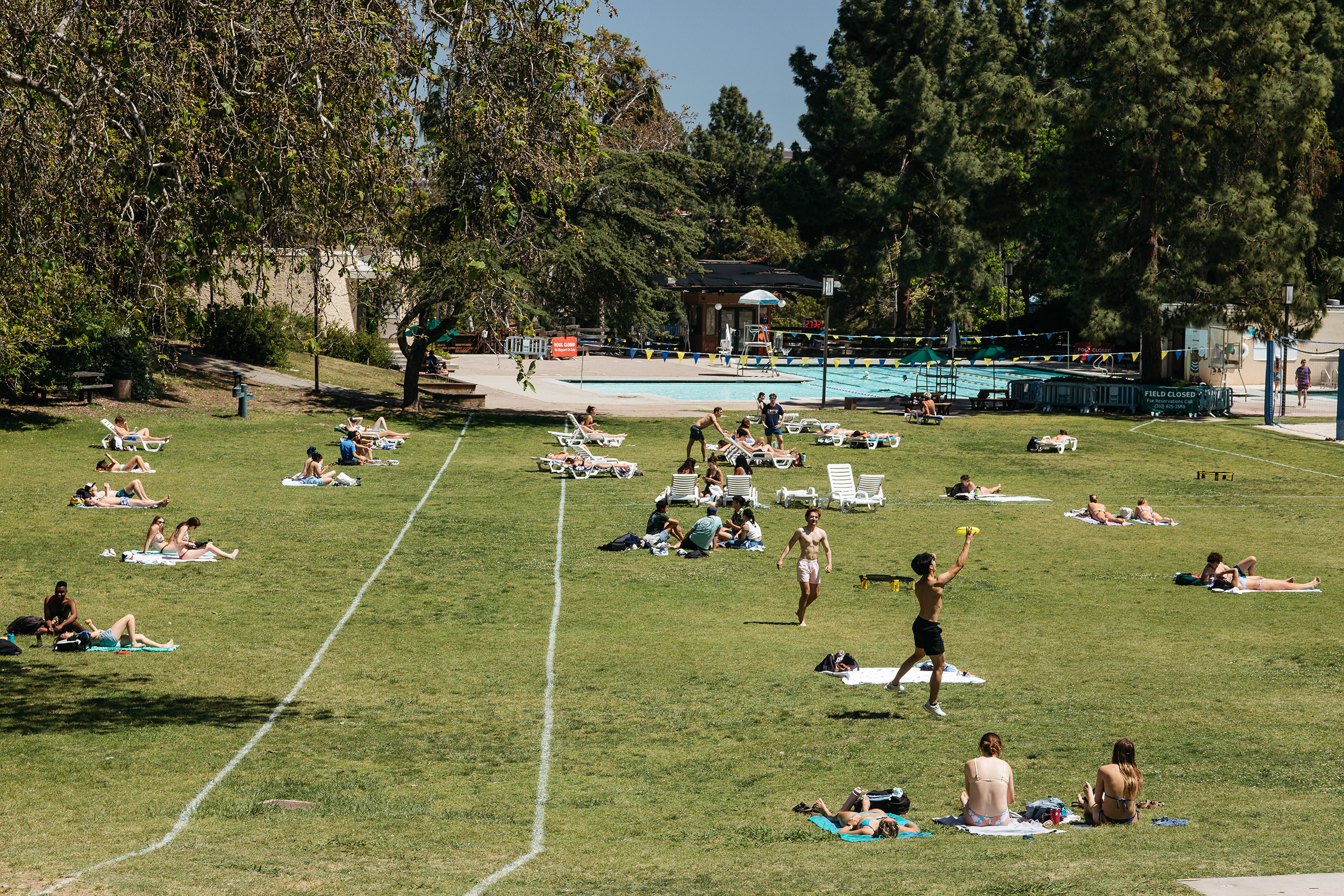
6 Cool Campus Spots to Recreate
This Summer
Get your sweat on at these awesome locales via a UCLA Recreation membership.

CLIMB A zany collection of slopes, corners and overhangs, the Rock Wall is dotted with odd shapes in green, red, yellow and white. The colors define paths by difficulty, so climbers of various abilities can figure out which route is best for them.

SERVE A trio of flagpoles in front of the Los Angeles Tennis Center signals this venue’s vaunted legacy: It was here that tennis legend Steffi Graf played in the 1984 Olympics. Bruin NCAA champion men’s (2005) and women’s (2008, 2014) teams followed in her footsteps.


DRIBBLE Upstairs in the Student Activities Center is the original campus basketball gym, which is also sort of a b-ball shrine: On the west wall, preserved under glass, is the chalkboard used by John Wooden to diagram plays for his teams from 1948 until Pauley Pavilion opened in 1965. Collins Court, in the Wooden Center, offers more indoor courts, while Hitch Courts, amid the residence halls, adds an outdoor location edged by trees.

CLAMBER A tree-filled setting perfect for its climbing, balancing and obstacle courses, the Challenge Course is a favorite for team-building and is home to the Den Camps for new students.

SWIM Just 2 feet deep in its entry area, the Family Pool welcomes kids, waders and floaters. Serious lap swimmers gravitate to the Park Pool below it. From beginners to Olympians, the water is waiting and welcoming for everyone.

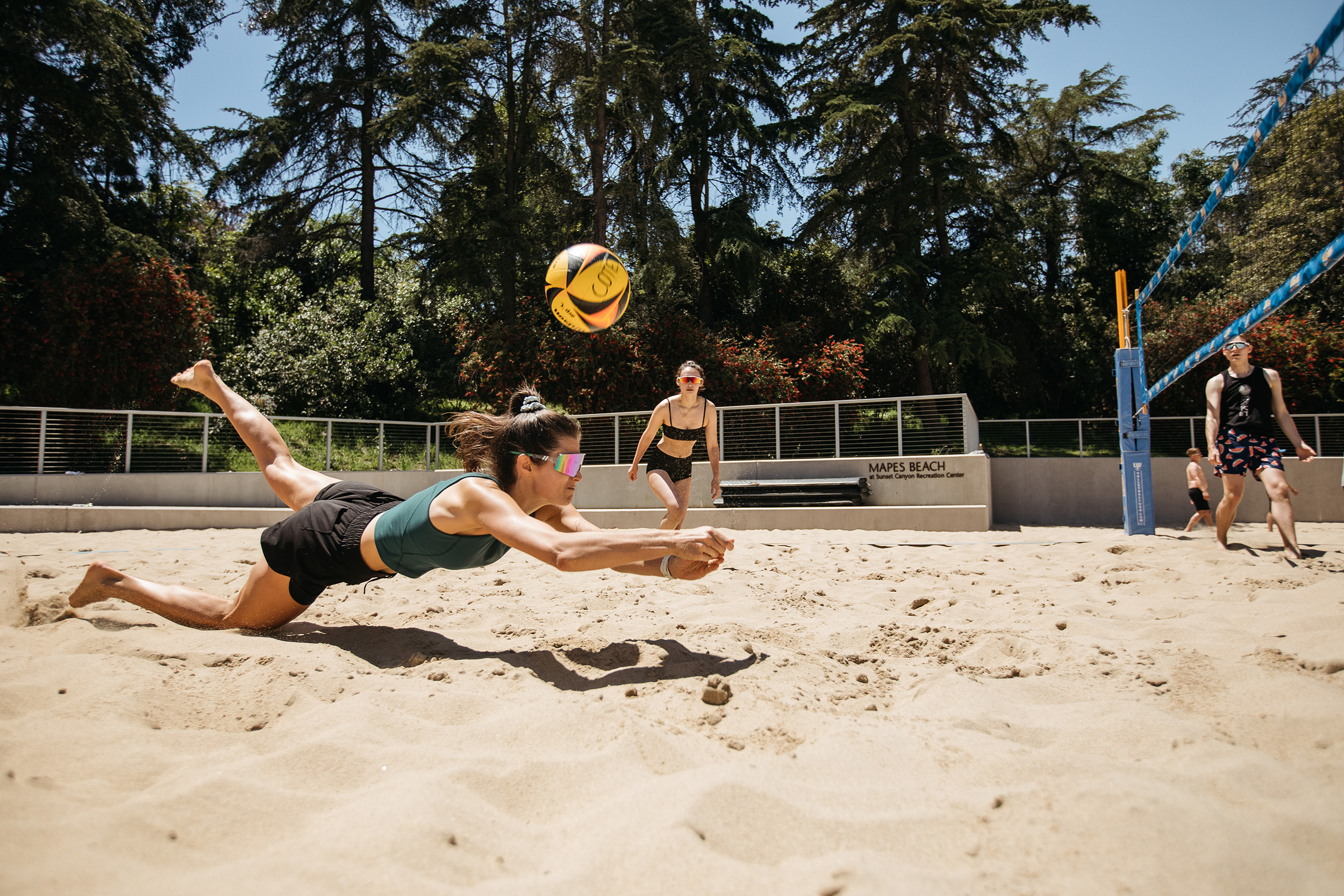
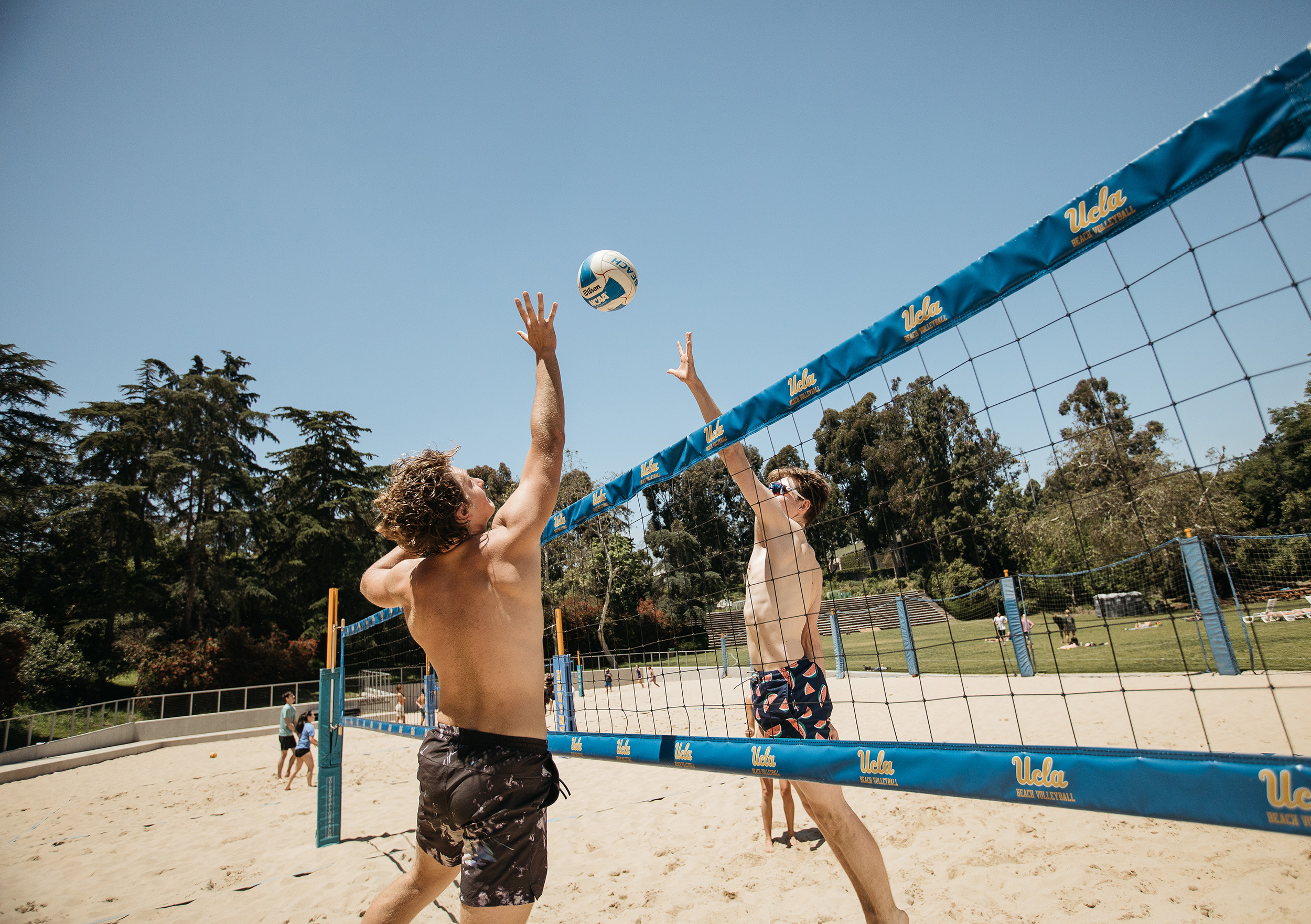
SPIKE Almost 7 miles from the Pacific, Mapes Beach opened in 2020 as the new home for UCLA Beach Volleyball. Book court space and channel your inner Karch Kiraly ’83.
—Anne Pautler
******
Adaptive Recreation: A Playing Field for All
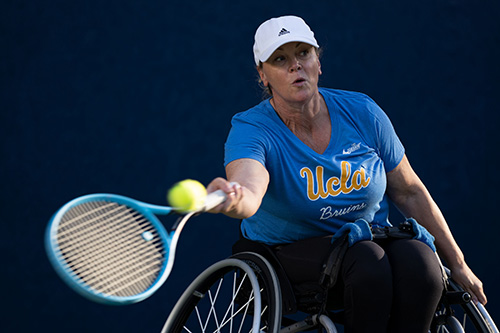
Wendy Pasinski may not be able to run across the court like Venus Williams, but her wheels — and her backhand — can move just as fast. As part of a legion of differently abled athletes, she’s part of the heart of UCLA Adaptive Recreation, where athletes overcome physical challenges with the drive, heart and determination to rival those of any Olympian. Just ask the handful of Paralympians who have come out for a scrimmage during the program’s coveted wheelchair basketball offering, or members of the LA28 team — Olympians included — who have been scouting the program ahead of the 2028 games. Nothing quite says “Faster, Higher, Stronger — Together” like UCLA Adaptive Recreation, but the program’s participants don’t need the IOC to tell them that: Many have been involved since the program’s inception nearly a decade ago, showing up religiously for rigorous sports and conditioning, and — perhaps even more importantly — community. Other adaptive offerings at UCLA, such as applied martial arts, have been extremely popular. Program leaders hope that one day, if the NCAA embraces adaptive sports, UCLA will be able to compete against other colleges — and will be a destination for adaptive student-athletes. —Madeline Adamo
Read more about adaptive recreation at UCLA here.
******
The Other Trophy Case
There’s a whole world of top-class athletes — and UCLA sports champions — beyond the NCAA.
We all know that UCLA is overflowing with athletic talent. But not every world-class student-athlete on campus competes in the NCAA: Many participate in what are termed “club sports,” so-called because they are administered by student officers rather than by the intercollegiate athletics department. But these student-athletes are competing just as hard as their showier counterparts. “Club sports are highly competitive,” says Megan Normansell, program director of competitive sports for UCLA Recreation. “They travel and compete against other universities. A lot of the clubs we offer are competing at the highest level that their sport offers.”
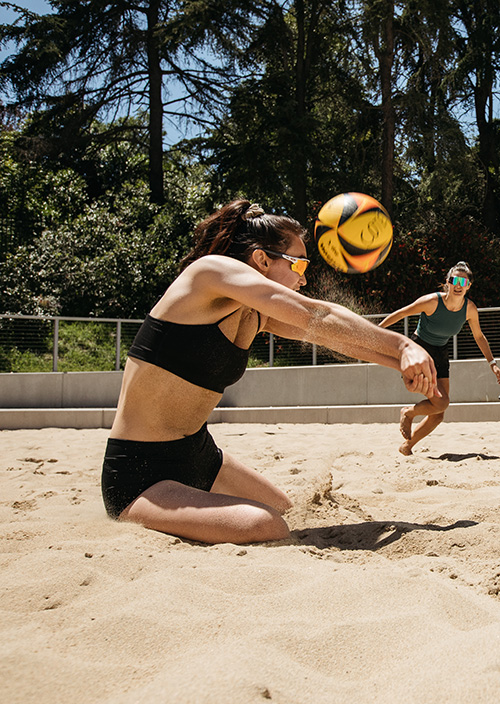
Want some hard numbers? Consider that UCLA has the third-largest club sports program in the nation, representing 54 club sports (more than half of which compete nationally), more than 2,800 athletes, 438 student officers, 72 full- and part-time coaches and 17 full- and part time athletic trainers.
Club sports teams welcome walk-ons — players who are students admitted to UCLA through the normal process, not on athletic scholarships. Competitions take place on both the individual and team levels. Programs range from rugby and climbing to Olympic sports — think everything from Brazilian jiu-jitsu to figure skating — to others that operate under a club-level governing body while coexisting with an NCAA equivalent (e.g., lacrosse, soccer and swimming).
They also win. A lot. Here, we show some love to the competitors whose incredible club accomplishments in the last year have earned them prestigious titles — and the right to be recognized as Bruins at the top of their game(s).
- Gabriel Galen ’23, Climbing (Bouldering)
- First place, 2022 USA Climbing Men’s Collegiate National Championships
- Lucas Lacamp ’23, Men’s Rugby
- 2022 Men’s College Player of the Year finalist
- Current member of USA Men’s National 7s
- Tennis — 2022 USTA Tennis On Campus National Champions (2nd consecutive title, 3rd overall)
- Men’s Soccer — 2022 Open Division Fall National Champions
- Women’s Soccer — 2022 Open Division Fall National Champions
—Delan Bruce
******

Different Strokes
How I found bliss in a kayak.
As a UCLA senior, by necessity I spend a lot of time on campus indoors. (A lot.) Craving a change of scenery — and enticed by the prospect of free kayaking — today I am wending my way to Marina del Rey, ending in a parking lot with an adjacent bike path, where pedestrians and cyclists assemble in a mass effort to chase the afternoon sun.
Invigorated and more than a little excited, I don sandals, flash my Bruincard at the check-in counter, and get fitted for a life vest. An older gentleman in charge of the equipment briefs me on the ways of the water, the fisherman’s hat he wears lending an added degree of authenticity to his spiel. “That flag there” — I squint in the direction of his finger, see an American flag whipping in the distance — “that’s where the marina ends and the ocean starts.” I assure him I won’t be kayaking beyond the flag. He inquires about my kayaking experience, to which I respond emphatically, “Oh, I have plenty!” Satisfied, he sends me on my voyage, armed with a paddle and the last-minute warning to avoid the group of sailboats since “it’s their first time out there.”
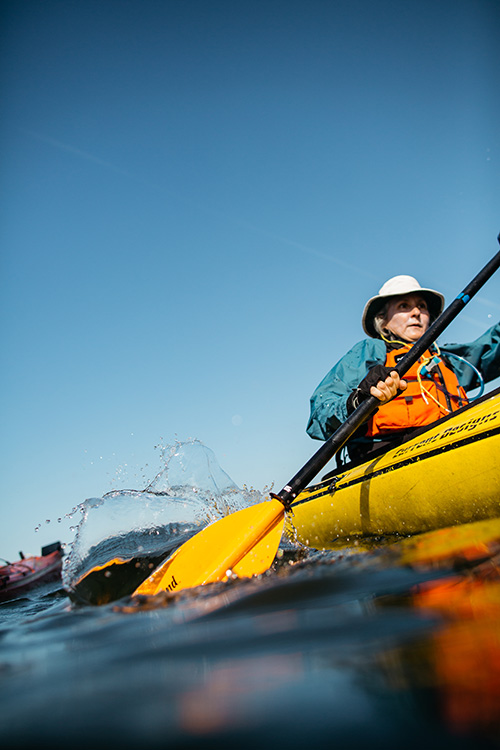
Once I’m out on the water, I feel a newfound clarity settle in, magnified by the ocean breeze and my proximity to the frigid water. I dip my paddle in — right, left, right, left — forming an easy rhythm despite a considerable lapse in practice. (“Plenty” may have been a slightly aggressive answer earlier.) Steering right, I avoid the flag and move further into the marina, quickly immersed in sensory pleasure. Seagulls guffaw overhead. The water, lapping against various boats, creates a unique, soothing soundtrack.
As I soon discover, the landscape of the marina is more varied than I initially surmised. Fisherman’s Village, a waterfront mall that looked rather unremarkable on my drive in, now seems vibrantly captivating from my perch in the water — the charm of the orange and blue buildings and the picturesque lighthouse make me feel like I’m on a sightseeing tour of Nantucket. As though on cue, a sea lion emerges 10 feet from my kayak, playfully diving around my boat and taking merry pleasure in my startled reaction. Paddling a little further, it becomes obvious where my visitor came from. A stretch of wooden docks lies just ahead, each one harboring dozens of sea lions basking in the midday sun.
Heeding the advice to avoid the sailboats, I cut across the main thoroughfare of the marina, weaving around the departing yachts. On the other side, there’s a distinct collectivistic element in the way people greet each other as they pass in their respective vessels. A group of fellow kayakers goes by and asks for song requests, their portable speaker serenading everyone within their radius. It’s almost as though we’re different people on the water. Or maybe we’re just better versions of our everyday selves.
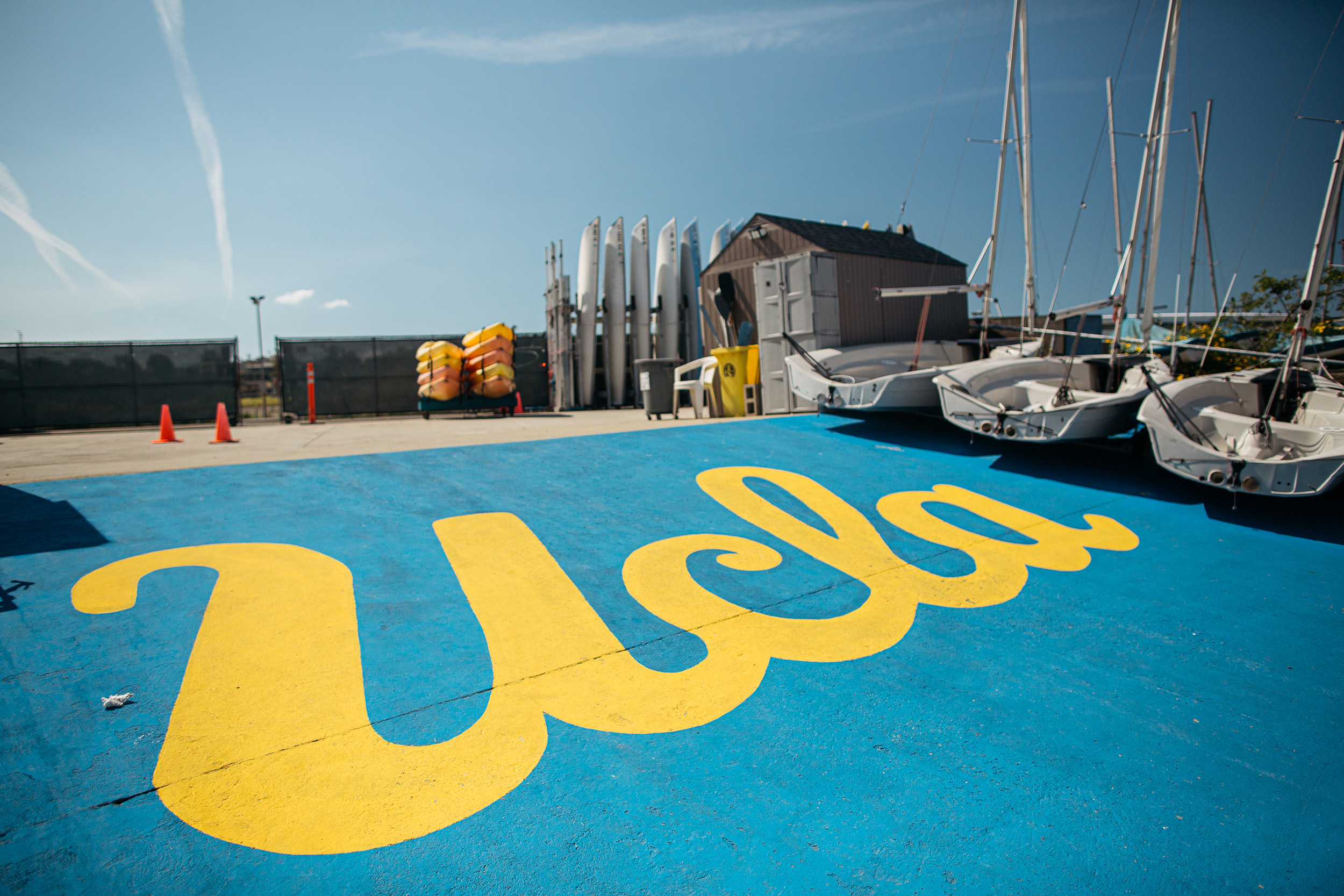
I rest my arms, allow the natural flow of the competing currents to direct me nearer the docked boats, where their monikers make for amusing reading material. I survey the shore for the boat ramp painted with the telltale blue-and-gold “UCLA.” The older gentleman greets me with a “Back already?” I reluctantly cite my fatigued arms.
As I help him take the kayak out of the water, he encourages me to come back soon. I assure him I will. —Karenna Meyer ’23
Interested in kayaking? Rent equipment or take classes at the MAC.
Read more from UCLA Magazine’s Summer 2023 issue.