When Vanessa Morris arrived at Locke High School in South Los Angeles to teach freshman biology, she found a curriculum that was inconsistent from class to class, inadequate texts that were little more than disjointed collections of articles, poorly equipped labs and limited opportunities for students to conduct meaningful experiments.
Walking into such a situation might have been daunting for some freshly minted teachers, but Morris ’00, M.Ed. ’01 was not deterred. She just kept pushing, collaborating with other science teachers to lead a drive to standardize lesson plans and acquire appropriate equipment like test tubes and protective goggles.
“Every little thing took so much time and an enormous amount of energy to get accomplished,” she says. “Nothing was easy.”
On top of that, their efforts were not always warmly received. While the administration was generally supportive of her desire to make improvements — “I think we were flying under the radar as far as they were concerned, and they weren’t paying too much attention to what we were doing,” she says — the reaction of many of her colleagues in other departments was “very negative.” It was as if they thought “we were trying to overthrow the system,” she says. “I think a lot of them felt very threatened by what we were doing.”
But Morris and her fellow science teachers persevered, and today, all freshman students at Locke enroll in biology, where they have appropriate standardized textbooks, dissect squid, observe cells through new microscopes and conduct other experiments that teach them the essence of scientific inquiry.
“We fought really hard to change the curriculum because it wasn’t very rigorous; it wasn’t preparing the students for college-level classes,” says Morris, who now heads the science department at Locke, and whose methods have become a model for other departments wanting to make improvements. “We wanted to make instruction hands-on and inquiry-based, to make it so that students wouldn’t be bored in the classroom and could receive the best education we could offer to them, not something second-rate. We wanted our students to learn by doing.”
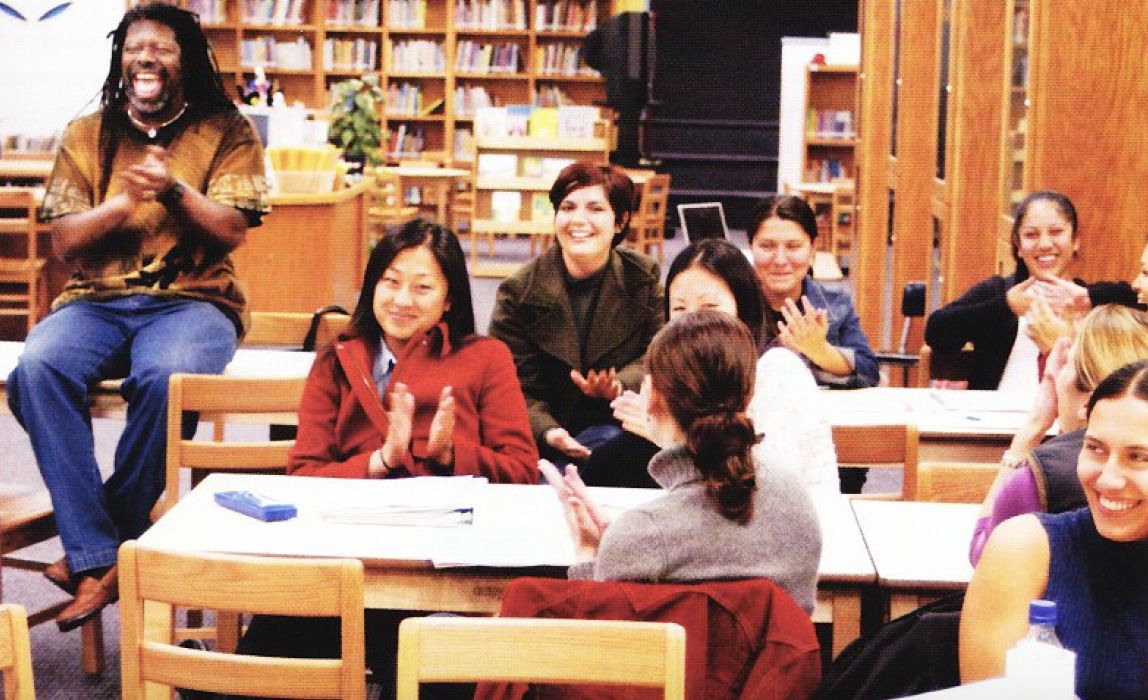
Doing is exactly what it’s about for Morris and others emerging from UCLA’s Teacher Education Program. Like Morris, many of those teachers — trained specifically to work in urban school settings and advocate reform — head directly to assignments with K–12 campuses in poor neighborhoods throughout Los Angeles County.
“I wanted to come to a tough school,” Morris says of her choice to join the faculty at Locke. “I expected that there would be challenges here, but I wanted that. I also knew that this was a place where I could go into any niche I wanted because basically everything was wide open. This was a place where I knew I could make a difference.”
Once considered a boutique program that produced few credentialed teachers, UCLA’s Teacher Education Program (TEP) in the Graduate School of Education & Information Studies has doubled its number of annual graduates in the past seven years. Last year, 170 students completed the program to receive their master of education degree and a full teaching credential. UCLA, in fact, supplied more credentialed teachers to the Los Angeles Unified School District than any other teacher-preparation program in the 2002–’03 school year, according to an LAUSD report on recruitment, outpacing even California State University campuses, which collectively constitute the largest producer of teachers in the state.
“UCLA’s Teacher Education Program does much more than provide our district with excellent, dedicated teachers,” says LAUSD Superintendent Roy Romer. “TEP works hand-in-hand with us to make teaching relevant to a school’s community, to meld the latest pertinent research with classroom teaching, to encourage professional development and to keep teachers on the job.”
The transformation of UCLA’s program comes amid increased public and political pressure to improve student achievement, which in turn has shined a bright light on teacher quality. California’s drive to reduce class sizes, launched in the mid-1990s, dramatically increased teacher demand by offering school districts financial incentives for smaller K–3 classes. But it also carried the unintended consequence of increasing the percentage of uncredentialed teachers in the classrooms, according to state-commissioned reports. Moreover, regulators, educators and elected officials now are wrestling with how best to comply with the federal No Child Left Behind Act of 2001, which requires, in part, that states provide all K–12 students with a “highly qualified” teacher by 2005–’06.
“There’s a great debate in the education community about the essential characteristics of effective teachers — how much subject knowledge is necessary, how much experience in the classroom is needed and how best to acquire these skills,” says Brian M. Stecher Ph.D. ’82, a senior social scientist at the RAND Corp. in Santa Monica who studies education issues.
At UCLA, there are several avenues to a teaching credential. The core program requires a full-time commitment over two years to earn a master of education degree and a full credential. A second program, developed cooperatively with the UCLA math and science departments, enables undergraduates to complete a bachelor’s degree while simultaneously beginning to meet their credentialing requirements — the route taken by Morris, who earned UCLA undergraduate degrees in marine biology and environmental science. A third provides a path for uncredentialed K–12 teachers to earn their preliminary credential through 15 months of coursework offered in the evenings and on weekends.
All three programs aim to prepare teachers for where they are needed most — urban schools in low-income neighborhoods.
About 12 percent of California’s K–12 public school teachers in 2002–’03 were “under-prepared,” according to a report last year by the Center for the Future of Teaching and Learning, a Santa Cruz, Calif.–based non-profit organization that explores ways to strengthen California’s teacher workforce. The center defined under-prepared as those teachers working without having met state requirements for a preliminary credential, which include a bachelor’s degree, specialized coursework in teaching methods at an accredited certification program, supervised student-teaching experience and passage of competency exams. Students in high-poverty areas are nearly three times as likely to have an under-prepared teacher as students in more affluent neighborhoods.
“The students who live in our poorest communities, the children most in need of our best teachers, are assigned to teachers who are the least prepared to meet their needs,” states the report, which was cosponsored by the University of California and California State University systems.
To help meet that long-standing need, UCLA education-school administrators revamped their Teacher Education Program in 1994. Since then, UCLA has forged partnerships with four subdistricts within LAUSD, as well as with three other districts: Centinela Valley Union High School District, Lennox School District and Lynwood Unified School District. UCLA teachers-in-training perform their classroom observations and student-teach exclusively at schools in these districts with high percentages of uncredentialed teachers and students receiving subsidized lunches (a standard measure of poverty).
“The feeling was, these were the places where teachers were most needed and where we could make the most difference,” says Aimée Dorr, dean of the Graduate School of Education & Information Studies. The change also made the Teacher Education Program consistent with the mission of the graduate school’s Center X, which aims to reform urban education in Los Angeles County through a research-based, community-focused philosophy guided by social justice. Says Eloise Lopez Metcalfe ’64, M.A. ’83, Ph.D. ’92, director of the Teacher Education Program: “We put our teachers where our rhetoric was.”
Center X administers not only the Teacher Education Program but also multiple research-based professional-development and community-outreach programs intended to help children in low-income schools gain access to a quality education. One program in particular has proven highly effective in helping to boost the math scores of LAUSD students.
According to Center X administrators, some of the bigger roadblocks to a quality education reside most frequently in low-income, urban settings — scarce resources, cultural and economic factors that affect the learning environment, and lowered expectations that make academic excellence an afterthought.
For example, poor nutrition resulting from economic hardship or cultural mores leaves many students unprepared for classroom learning, say UCLA-prepared urban-school teachers. Absences from illness that should last two days stretch out over two weeks because a family lacks access to affordable, quality health care. Home environments without proper supervision or work areas conducive to learning prevent students from completing assignments. Violence on the street and in school — a gun that a student was carrying once went off in Morris’ classroom; no one was injured — spread fear and anxiety. Earlier this year, Morris said, some students couldn’t reach school because of a police investigation into a neighborhood shooting. “Attendance is our biggest problem,” she says. “I never know who is going to show up.”
Teachers entering this environment need a specialized set of skills, says Associate Professor of Education Megan Franke, director of Center X. “These teachers need to understand and appreciate the community in which they are teaching,” she says. “They need to know
At Locke High, for example, Morris utilized the collaborative concepts she learned at UCLA to help push through change in the biology curriculum. She drew strength from four other TEP graduates and a field adviser who helped make the case that students deserved a full lab experience. “You can’t do this alone,” she says.
Like Morris, other Teacher Education Program graduates put into practice the principles they learned at UCLA.
At Moffett Elementary School in Lennox, fifth-grade teacher Ryan Williams ’98, M.Ed. ’01 moves beyond classroom instruction and dives into community issues as adviser to the student government’s community committee. UCLA encourages community involvement as a way to reach kids outside the classroom, and Williams harnesses students’ desire to improve their neighborhoods by organizing cleanups and visits to a local homeless-services center.
“The whole idea is to make kids realize that they can be agents of change in the community,” he says. “They learn an important lesson — that they’re in control of their community … and they can see change occurring because of their actions.”
A little more than 8 miles away at Jordan High School in Watts, Felipe Barragan M.Ed. ’99 pushed to make English-as-a-second-language and history materials more culturally relevant to his students, many of whom are Spanish-speaking immigrants or children of immigrants. “You can read Steinbeck, and you can also read a book by Tomás Rivera,” Barragan says. “Both of them are going to provide ability and skills in reading and writing, but we just needed to offer more that would engage students.”
In the highly diverse universe of urban Los Angeles, teaching outside of cultural context is counterproductive, say Teacher Education Program administrators, graduates and teachers-in-training. “Isn’t the essence of teaching knowing your students?” asks first-year education graduate student Bill MacDonald.
Graduate education students such as MacDonald say they chose UCLA for its emphasis on educational equity in urban schools, its strong support network and solid grounding in education theory and research. But while they may appreciate the academic study of teaching methods, not everyone is convinced it’s the best way to prepare teachers.
Some reports have suggested that there is no reliable link between pedagogical training and classroom success. In 1999, for example, the Thomas B. Fordham Foundation, an educational-research advocacy organization in Washington, D.C., argued in a policy statement that it is more important for teachers to earn college degrees in the subjects they wish to teach and that state certification standards and education-school curricula actually deter potential teaching candidates.
“Traditional training programs should be closely scrutinized for their length, cost, burden and value,” the report states. “Is a two-year time commitment really necessary, for example?”
One organization frequently cited as a successful alternative to traditional teacher-preparation programs is Teach for America. Launched in 1990 with a grounding in a national-service ethic, Teach for America recruits liberal-arts graduates from colleges, trains them for five weeks and places them exclusively in low-income urban and rural schools in 20 regions across the country; a minimum two-year teaching commitment is required. Teach for America, which recently recruited on the UCLA campus, reports that more than 10,000 people have participated nationwide.
“The popularity of programs such as Teach for America … indicates that the prospect of teaching without first being obliged to spend years in pedagogical study appeals to some of our brightest college graduates,” states the Teaching Commission — a panel of leaders in government, business, philanthropy and education — in its January 2004 report “Teaching at Risk: A Call to Action.” Unlike the Fordham Foundation, however, the Teaching Commission urges states to raise teacher-certification standards and universities to bolster admission and academic requirements for teacher-preparation programs.
Metcalfe says the push for such programs as Teach for America and efforts to loosen teacher-education and certification standards are born of concern that the education system is failing students. “There’s a tremendous frustration right now that things don’t seem to be any better,” Metcalfe says.
One major question is what exactly constitutes a qualified teacher, says Lauren Jones Young, director of institutional initiatives for the Chicago-based Spencer Foundation, which investigates ways in which education can be improved around the world. “And how exactly do you develop those qualities in an individual?” she asks.
The foundation has awarded grants to UCLA and other universities to support the development of education researchers. “One of the challenges to the profession is developing richer evidence about how to prepare teachers who can foster learning among the linguistic and culturally diverse students who make up today’s classrooms,” Young says.
Much of the recent focus on teacher preparation and quality can be traced to the Bush administration’s No Child Left Behind initiative, which seeks to improve student achievement, in part by ensuring that all students have a “highly qualified” teacher by 2005–’06. The legislation defines “highly qualified” as those teachers who have demonstrated subject-matter competency and who have obtained a credential, or are enrolled in a preparation program leading to a credential. Regulators with the California Commission on Teacher Credentialing and the state Board of Education — pressured by teacher unions, school boards and scholars, among other interest groups — are working out the details of precisely defining such standards and how and when to implement them.
Similarly, researchers for the Center for the Future of Teaching and Learning cite “a debate within the state about the significance of formal teacher preparation and credentialing and the adequacy of alternative routes” to teaching. They advocate more stringent standards for teacher preparation. “We contend that a basic credential is only a starting point for becoming an accomplished professional ready to help all of his or her students meet rigorous academic standards,” says the center’s 2003 report.
That’s a view generally endorsed at UCLA. “No teacher goes out there fully developed,” says Dorr, who adds that it is imperative that teachers have access to institutional support and continuing education.
Whatever the outcome of the ongoing debate over standards and teacher preparation, UCLA Teacher Education Program administrators say they’re sticking with their mission to prepare teachers for the urban schools where the need is greatest. While continually seeking ways to improve the program, administrators say they have no immediate plans to shift away from a two-year, full-time program that integrates a study of teaching methods with fieldwork. “That won’t change,” asserts Franke. “We believe very strongly that students need to understand theories about the best way to reach kids.”
Thus far, UCLA’s approach is drawing sharp interest among future teachers, with applications for admission at a record high. Some 600 students applied for 150 available spots in the core program; previously, 200 to 250 applicants was the norm. But administrators say they’re concerned that proposed state-funding reductions to recruitment and scholarship programs and simultaneous fee increases will dampen interest among potential teachers, and that other proposed budget cuts will make it more difficult to meet teacher-preparation demands.
“We’re at full capacity right now, and without additional funding we cannot even contemplate growing,” says Metcalfe. Given the state’s budget crisis, she says, the program is more likely to shrink than expand, and it must rely heavily on gifts from private sources. In fact, many students in the program already benefit from the private support of numerous individuals and organizations. These include such benefactors as Robert and Marion Wilson, as well as the Flora Family Foundation, the W. Clement and Jessie V. Stone Foundation, the Milken Family Foundation and the Ahmanson Foundation.
As for Vanessa Morris, she says teaching freshman biology and leading the science department at Locke High is by turns exhausting and exhilarating. “Even the smallest things you want to accomplish are difficult. It’s physically and emotionally draining,” she says. “Everything is a big battle.”
During the tough times, Morris leans on colleagues and mentors for support, draws on the concepts of collaboration and community, and counts herself fortunate for the specialized training she received and the availability of ongoing support.
Says Morris: “The worst thing a teacher can do is be in isolation.”
MATH PROOF
Relatively low math scores in the Los Angeles Unified School District have been a longstanding concern, but there was a significant turnaround after UCLA stepped in to develop a specialized training program for kindergarten, first- and second-grade teachers in partnership with LAUSD.
In 2002, LAUSD second-graders on average scored better than 53 percent of all students on a nationwide standardized test, up from 44 percent the previous year. Such an increase is considered a sizable gain.
“Obviously, we were pleased,” says Marie Stevens M.Ed. ’88, an elementary mathematics specialist and the district’s point person on professional development in mathematics instruction. She noted that the UCLA-LAUSD collaboration now has been expanded to include other grade levels.
Ongoing professional development is critical to the success of teachers and their students, says Jody Z. Priselac ’74, Ed.D. ’99, executive director of Center X, a unit of UCLA’s Graduate School of Education & Information Studies where researchers and practitioners collaborate to design and conduct programs to prepare and support teachers in urban schools. The professional-development program in mathematics instruction was developed within Center X.
The program, known as LUCIMATH (Local School Districts, UCLA, California County Offices of Education, Institutes of Mathematics), was developed to help address a history of low student math scores on standardized tests resulting, in part, from teachers poorly prepared in mathematics instruction, Priselac says.
Teachers who completed the professional-development program reported enhanced confidence in teaching math, according to a 2003 report submitted to LAUSD by the Graduate School of Education & Information Studies. “While we cannot claim to be the reason that mathematics scores have risen in the district, we can make the case that we have contributed to the increase,” the report says.
Rosalie Potts, a teacher at 93rd Street Elementary School in Los Angeles with 30 years of classroom experience, found the UCLA program to be “a real eye-opener.”
“I feel like I’m guiding the children to a greater understanding of numbers and math sense,” she says.
Drawing on extensive research about the teaching and learning of mathematics, Center X and LAUSD officials worked with the UCLA Department of Mathematics to develop a curriculum intended to enhance mathematics subject knowledge among kindergarten, first- and second-grade teachers and familiarize them with the state’s newly approved math textbooks.
“It’s hard to teach what you don’t understand well,” says Priselac, who heads the professional-development program in mathematics instruction in Center X.
The curriculum also aims to make teachers better aware of how children learn math. It encourages teachers to implement new teaching methods, such as asking questions in a particular way that generates discourse, while carefully listening to students’ responses for clues on how to reach them. “When you understand that as a teacher, you understand how to push [students] to the next level,” Priselac says.
Teachers, for example, are encouraged to use number sentences to gauge student learning. A sample question might read: 8 + 4 = ___ + 5. How a student responds “tells us what they understand about the ‘equals’ sign … a key piece of understanding mathematics,” and a key guidepost for additional learning, Priselac says. If a student responds “12,” the teacher knows he or she incorrectly believes that a correct answer always follows the equals sign. When a student responds “7,” he or she “understands that the equals sign means ‘the same as,’” Priselac says.
More than 6,400 LAUSD kindergarten, first- and second-grade teachers have completed the program since April 2001 — approximately two-thirds of all LAUSD K–2 teachers, according to the district.
The keys to the success of LUCIMATH, Priselac says, are the program’s foundation in extensive research, its comprehensiveness and the interaction it promotes among teachers to improve their skills. These concepts have been applied to other continuing-education collaborations between UCLA and other school districts and in other grade levels, as UCLA attempts to build on the improvements seen in LAUSD second-grade math scores.
“We still have a lot of work to do,” Priselac says. “This is where we needed to begin; this is not where it ends. We saw gains [in math scores], and we want to continue to see gains.”
TEACHING TEACHERS FOR A DIVERSE SOCIETY
UCLA’s Graduate School of Education & Information Studies is among the leading centers in the nation training the next generation of education and information-studies leaders. Founded a decade ago through the merger of the schools of Education (launched in 1939 as the first professional school on campus) and Library and Information Science (created in 1958), GSE&IS has established UCLA as the only major research university in the country to combine these two areas into a single, cohesive unit. Together, the two departments embody the school’s commitment to understand and improve educational practice, information policy and information systems in a diverse society.
UCLA’s education department — ranked No. 3 in 2004 among all public and private universities nationwide by U.S. News & World Report — is known as a leader in the study of student testing and assessment, teacher education and professional development. The Department of Information Studies is nationally recognized for its research in digital archives and libraries, multimedia databases and the social implications of the Internet.
“Our school has a very special character to it — one I’m very proud of and one that I take great pleasure in supporting and promoting,” says Dean Aimée Dorr.
The school comprises about 900 graduate students, 70 tenure-track faculty, 30 non-tenure faculty and 550 staff. It hosts two dozen research centers, institutes and programs. Among them:
Center for the Study of Evaluation & National Center for Research on Evaluation, Standards, and Student Testing: Pioneer developer of scientifically based evaluation and testing techniques in education.
Center X: Provides pre-service and in-service professional education for K–12 and community college teachers and seeks to radically improve urban schooling.
Corinne A. Seeds University Elementary School: The country’s only university-based pre-kindergarten-through-sixth-grade laboratory school.
Institute for Democracy, Education & Access: Works to make high-quality public schooling and successful college participation routine in low-income neighborhoods of color.
Principal Leadership Institute: Rigorous, 15-month program leading to a master’s degree, with service or instructional credentials. — Anne Burke