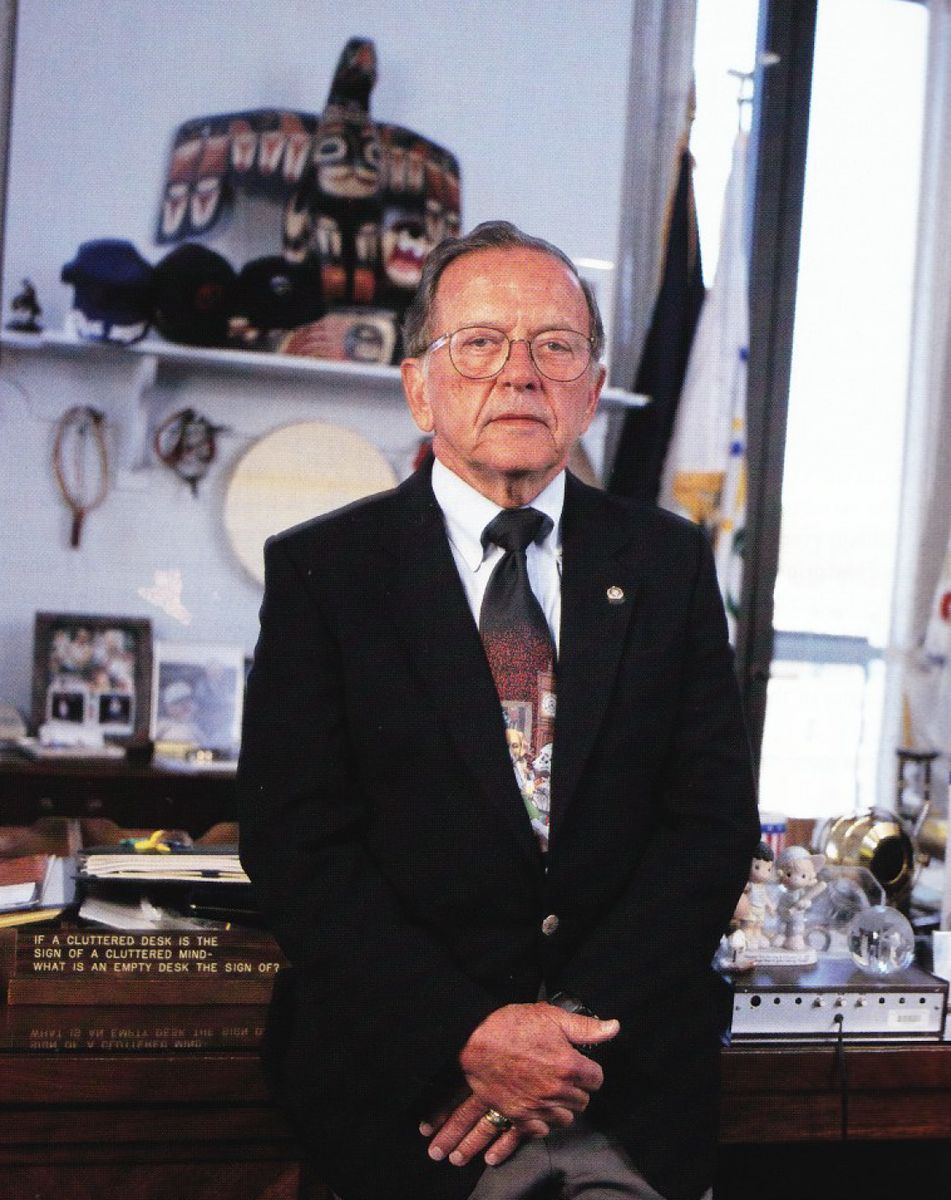
If you ever visit the nation’s Capitol and see a man stalking the halls with the snarling face of the Tazmanian Devil leaping from his chest, that would be Ted Stevens. And you can be certain that someone is going to have a very bad day.
As a chief architect of federal spending, Sen. Ted Stevens ’47 of Alaska often has to knock heads to get the work done. It’s a high-stress job requirement from which he does not shy away, a fact that has earned him a reputation as a grouch and a bully.
It is a rep that he relishes. After 32 years in Washington, he’s still a roll-up-the-sleeves kind of guy who doesn’t at all mind climbing down into the pit and getting dirty, if that’s what it takes.
THE BLUSTER AND GRIT of legislative life is a long way away from what Stevens fondly recalls as “the halcyon days” after World War II, when the young Army Air Corps veteran was surfing the Southern California waves and making the grade at UCLA. Back then, Stevens was a brash political science student without a clue about where the future might take him.
He had no idea that the advice of his constitutional law professor, J.A.C. Grant, to pursue law because he “had a knack for it” would lead him to the frontiers of the Alaska Territory as a federal prosecutor breaking up prostitution rings and sending bank robbers to prison. Or that the infant state would later reward him by sending him to the U.S. Senate, where he now is Alaska’s fiercest advocate and benefactor.
Those were “great days,” Stevens reminisces from his chair in what must be one of the most magnificent seats of power in the Western world, an office suite adorned with hand-painted frescoes and glimmering chandeliers with a view down the Mall toward the Washington Monument.
But that was then and this is now, and Congress isn’t always a nice, friendly club, especially in the early fall when the 13 spending bills that keep the government rolling have to get out of Stevens’ committee and be signed into law by the president.
Stevens — the only Bruin in the U.S. Senate, where he is the sixth most-senior member — is the no-nonsense chairman of the Senate Appropriations Committee. Virtually every dollar of every check the federal government writes has his fingerprints all over it.
It’s not an easy job. If it’s not budget hawks like Arizona Republican Sen. John McCain taking shots at Stevens for sending too many of your hard-earned dollars north to his home state, then it’s Democrats harping about misplaced spending priorities of the Republican Party, to which Stevens belongs.
Some days all this takes a little more strength than he can muster on his own.
And that’s when the ugliest, most feared piece of cloth on Capitol Hill, his Tazmanian Devil tie, comes out of the closet. Stevens puts it on and he becomes “one mean, miserable SOB” — the very words he used to describe himself when he first took up the chairman’s gavel four years ago and pounded the committee to order.
“When I wear ties like this on the floor, people understand I really mean business,” Stevens says.
That’s the jazz from Taz.
TRUTH BE TOLD, despite a reputation he works hard to perpetuate, Ted Stevens is not an unrelenting grouch and bully. He does, however, thrive on debate, and he loves to mix it up. He is most articulate when he is the most exercised. It’s as if the blood flow doesn’t hit his brain until he is in a lather over something.
This fall, for example, when President Clinton vetoed a spending measure, saying he could not “in good conscience sign a bill that funds the operations of the Congress and the White House before funding our classrooms, fixing our schools and protecting our workers,” Stevens responded in classic froth: “He’s in for it! I will not take a threat from the President of the United States. This is an open declaration of war against Congress.”
Many people confuse Stevens’ passion with anger, says his longtime friend Michael Phelps, UCLA’s Norton Simon Professor, chair of the Department of Molecular and Medical Pharmacology, chief of the Division of Nuclear Medicine and director of the Crump Institute for Biological Imaging. But, he says, “when Ted hits the passion button, you better not be on the same street going the other way.”
Phelps, the inventor of the PET scan, was introduced to Stevens through California industrialist and education reformer Norton Simon. He describes countless hours during which Stevens, Simon and he would debate lofty issues. There was one time, he recalls, when he and Stevens, who was in Los Angeles to speak to the Veterans of Foreign Wars, got into a discussion that stretched out for hours.
“He missed his talk at the VFW, and they never invited him back,” Phelps laughs.
At age 77, Stevens loves a good joke, and he doesn’t mind if it’s a little naughty. Fishing is his passion, the one thing he’ll make time for to relax. He’s a wine connoisseur. And sometimes Stevens, an exercise fanatic, simply refuses to act his age.
Stevens spent much of his youth with his aunt and uncle in Manhattan Beach, swimming and surfing in the chilly Pacific combers. (His favorite board is propped in the corner of his office in the Hart Senate Office Building, and among all the artifacts of public life that clutter his suite, it is the item Stevens seems to cherish most.) A few years ago, he and a boyhood friend, Russ Green, headed down to their old beach haunt for a little body surfing. The ocean was a bit rough, Stevens admits, but he and Green are good swimmers and they didn’t think much about it. As they were bobbing in the waves, they soon noticed that the lifeguard had moved from his perch and planted himself at the water’s edge, anxiously watching them.
Green’s wife was furious that the lifeguard had gone on full-geezer alert, but Stevens, who worked his way through UCLA as a lifeguard, thought the scene was hilarious.
“I said that if I’d seen two old codgers going out in that kind of water, I probably would have told them to come in,” he says, laughing uproariously.
STEVENS ARRIVED AT UCLA in April 1946 as a second-semester freshman. Before the war — during which he was a pilot in the China-Burma-India theater, earning two Distinguished Flying Crosses, Air Medals and the Yuan Hai medal awarded by the Republic of China — he had spent a semester at Oregon State University. He buzzed through UCLA in just 19 months, graduating in August 1947 with a bachelor’s in political science and a minor in economics.
He was a member of the Delta Kappa Epsilon fraternity and, for a while, lived in its fraternity house.
“I have many fond memories,” Stevens says. “I was just out of the service. Practically all the people I had gone to college with before the war were dispersed around the world, and many didn’t return.
“My aunt and uncle raised me there in Manhattan Beach. I just felt I had been away a long time, and so I decided I would go to UCLA. There I met a whole new group of people. We worked hard, studied hard, played hard.”
Colleges and universities throughout the country were swamped with returning veterans with money from the GI Bill lining their pockets. It was a strange time, Stevens says. “They were anxious to help us get on to somewhere else,” and requirements were waived and credits were given for wartime training “so we could get out the door and on to graduate school.”
Among Stevens’ courses was a life-changing constitutional law class taught by James Allan Clifford Grant, a political science professor and former department chairman who died five years ago at age 93.
“He inspired me to go to law school,” Stevens says. “He was sort of a mentor, talked to me a great deal. He was very interested in counseling young guys who came out of the service. Professor Grant helped me a lot because he thought I had a knack for the law.”
After UCLA — to which Stevens still is connected as a board member of the School of Public Policy and Social Research and as a life member of the UCLA Alumni Association (he received the Alumni Association’s Professional Achievement Award in 1971 and the Public Service Award in 1984) — he enrolled at Harvard University’s law school. His law degree took him to Washington, D.C., where he met and married his first wife, Ann, and worked in a small firm with Alaska clients. (Ann was killed in 1978 in a plane crash that Stevens miraculously survived. He married Catherine Bittner Chandler two years later.) From the D.C. law firm, Stevens landed a job in Fairbanks, where he was soon appointed U.S. Attorney. There are marvelous stories, which Stevens insists are overblown, about him strapping on pistols to lead the way during police raids. Some Fairbanks old-timers say a picture of him with a pistol on each hip used to hang in the county courthouse.
Stevens became steadfast friends with C.W. Snedden, publisher of the local newspaper, who helped get Stevens a job in the Interior Department in Washington, D.C., just as Alaska statehood was grabbing the interest of the Eisenhower administration.
Later, Stevens returned to Alaska and entered politics. In December 1968, Gov. Wally Hickel appointed him to fill out the term of Sen. Bob Bartlett, who died suddenly. Hickel was in Washington at the time, awaiting President-elect Richard Nixon’s announcement of a series of cabinet nominations, including Hickel’s own nomination to Secretary of the Interior.
“Nixon said, ‘Wally, what are you going to do?’” Hickel recalled in a 1995 interview. Hickel rattled off the names of a few possibilities for replacing Bartlett. Last on the list was Stevens, whom Nixon knew.
“The president looked at me and asked, ‘Wally, do you have the courage to appoint Ted?’ And I said, ‘I want to do what is right.’ Ted Stevens was a survivor, in my opinion.”
Stevens has been in the Senate ever since. His hand has shaped every major bill affecting his state, including the Alaska Native Claims Settlement Act, the law authorizing the trans-Alaska oil pipeline and the Alaska National Interest Lands Conservation Act. This is not to say that Stevens is totally Alaska-centric. He is a strong voice on behalf of federal spending for health care and is responsible for large increases in the research budgets of the National Institutes of Health and the Centers for Disease Control. Stevens is an important supporter of amateur sports and a leading proponent of gender equity in collegiate athletics under Title IX. And he is a major player in telecommunications legislation, sponsoring the commercialization of bandwidth, or frequencies, that has helped to spawn the rapid growth of everything from cell phones to satellite television.
In addition to chairing Senate Appropriations, Stevens also is chair of the Defense Appropriations Subcommittee, a platform from which he has advocated for increased spending on military readiness; improvements in pay, benefits and housing for military personnel; and for an Alaska-based National Missile Defense System.
ALASKA IS NOT like any other state. Lay it over the Lower 48 and its 591,004 square miles would cover most of the western half of the country — a fact Stevens delights in reminding his Senate colleagues of.
For the most part, the state is all mountains, glaciers, tundra, forests and seashores so fabulously beautiful and unspoiled that people who see it for the first time are often struck dumb with awe. But after the last tourist has left in September and the last eider duck has taken flight for a warmer climate, there are some 610,000 people or so left behind who are trying to make a living.
For many of them, just getting from one place to another often is an enormous difficulty, and when it comes to prying loose benefits from the federal government, Stevens is their top gun. A budget fight from 1998 is an instructive example of his clout. In October of that year, when Congress was rushing to adjourn for the election season, Alaska’s all-Republican congressional delegation was at loggerheads with the Clinton administration over a road to connect the tiny village of King Cove with the even smaller settlement of Cold Bay, hundreds of miles down the Alaska Peninsula. It was a matter of survival, as they saw it. During the long, harsh winter, King Cove residents needed a way to drive to Cold Bay, where there was an all-weather airport. Without a road, residents had to rely on small boats or single-engine planes to cross bay waters to Cold Bay, and many risked death or injury each year trying to do so in emergencies.
The problem was that the road would cross through a wilderness portion of the world-famous Izembek National Wildlife Refuge, perilously close to where waterfowl by the millions feed on eelgrass to fatten up for their annual migration. The King Cove road suddenly was one of the hottest environmental controversies in Congress as the White House was poised to veto the legislation.
As often happens in these matters, the King Cove road showed up as a Stevens rider on an appropriations bill and resolving the impasse turned critical; if Congress was to send the Interior Department a 1999 budget to keep its doors from closing, the road issue had to be settled. King Cove residents were prepared to build the road at their expense; all they wanted was a land trade so that they could cut the road through the refuge.
Katie McGinty, then the head of the White House Council on Environmental Quality, trekked into Stevens’ ornate appropriations committee office on the first floor of the Capitol with an offer from the president that the administration thought looked pretty good. If Stevens would yank the rider, the White House would see to it that medical emergencies would never be a problem in King Cove again because a fully staffed medical clinic would be built there.
Stevens flatly rejected McGinty’s offer, saying he was prepared to fight the issue all the way to the Oval Office unless the administration got serious about a road. A few days later, Erskine Bowles, then Clinton’s chief of staff, called on Stevens in an effort to settle the issue. Bowles pulled out a paper and read from a list of three options. The administration would do the clinic. If that wasn’t acceptable, it would build a year-round airport in King Cove. And if that still was not acceptable, the administration would finance a new road or ferry system that skirted the refuge.
“We’ll take them all,” Stevens snapped.
Stunned, Bowles accepted. King Cove would get $20 million for a new road, $15 million for a new airport and $2.5 million for a medical clinic outfitted with the most modern telemedicine equipment available.
Says Stevens: “I don’t like to be in the position of defending $37.5 million being spent. But if that is what it takes to help our people, that is the way it has to be.”
EVEN WHEN Stevens isn’t sporting his Taz tie, his reputation for an explosive temper and an in-your-face negotiating style usually gets him his way. “I’m an old prosecutor,” he is fond of saying. “I know how to use my temper, not lose my temper.”
Recently when the appropriations committee was negotiating an increase in conservation funding, Stevens strolled into the room just as a deal was about to be struck, demanding that another half-billion dollars be added to provide assistance to coastal states like, say, Alaska. Staffers inside the room described Stevens’ 11th-hour demand as being like a time bomb going off.
He didn’t get his way that time; the negotiators added in only $400 million, then quickly signed the deal.
In the four years that Stevens has been chairman of appropriations, the flow of money to Alaska has been so pervasive in the state’s economy that economists have coined a phrase for it: the “Stevens effect.”
“Whenever there is a gathering of economists, the Stevens effect typically is talked about, and everyone smiles,” says state labor economist Neal Fried. “It’s a well-known economic fact.”
When the Census Bureau published its annual report on per-capita spending this spring, Stevens’ influence was evident. In one year, the federal cash flow to Alaska shot up 10 percent, making it No. 1 in the nation, reclaiming a position it lost five years earlier when military base closings and realignments cost the state hundreds of millions of dollars. While military spending continued to decline last year, federal construction soared.
Stevens’ staff estimates that through the senator’s direct intervention, federal spending in Alaska now approximates the state’s annual budget of nearly $1.5 billion. For the most part, the money is not going for huge projects and buildings that will be monuments to his legacy; it is going for basic infrastructure needs for a young state still trying to find its perch on the 21st-century economy.
Hundreds of millions of dollars are to install sanitation and safe drinking-water systems in rural, mostly native, villages, where “honey buckets” are standard. Last year Stevens created a five-year, $30-million program — the most aggressive in the nation — to attack fetal alcohol syndrome in his state, which has the highest alcoholism rates in the country. There is disaster aid to fishermen who have struggled because chaotic weather patterns have reduced harvests.
Money is going to the state railroad, harbors, roads, ferries and airports. And it is going into hundreds of social-service and health programs, reflecting the senator’s deeply held belief that the state’s worst enemy is the cycle of despair and dependency many rural residents endure daily.
“My mission is to try to make Congress understand that the promise of statehood is that we should have the ability to establish a workable private-enterprise economy in areas of Alaska that want it. And that’s basically 90 percent of the state,” he says.
Programs also are sprouting up throughout the University of Alaska system because of Stevens. A decade ago, Stevens sent $25 million to the university’s Fairbanks campus in a controversial move to establish it as a supercomputing center. This year, virtually without any attention on Capitol Hill, he is sending even more to upgrade those computers because the center’s international ranking had slipped.
One of his more lasting creations, however, may be the Denali Commission. Patterned after the Appalachia Regional Commission, the state-federal panel was created and funded during Stevens’ first year as committee chairman in an effort to find a more efficient way to bring about coordinated infrastructure improvements in rural Alaska.
The commission’s budget next year will be nearly $50 million — virtually double this year’s. There has never been a hearing in Congress about the need for the commission. This year, for the first time in its own budget submission to Congress, the White House included a line item for the panel, quietly making it a permanent fixture of the government’s annual spending blueprint.
“Ted Stevens brings home money for transportation and things like that, but he also uses money to put Alaska ahead on things like fetal alcohol syndrome, telecommunications and the Denali Commission — all wonderful programs. The money is a good reflection of Stevens’ values and character,” says Alaska’s Democratic Gov. Tony Knowles.
For his ceaseless efforts on behalf of the state, Stevens in March was named Alaskan of the Century.
WHEN YOU FLY into Anchorage now, you land at the Ted Stevens Anchorage International Airport. The ceremony marking the airport’s renaming was held in July, staged in an airport hangar the size of four football fields.
Among the guests were Secretary of the Army Louis Caldera and Jane Garvey, administrator of the Federal Aviation Administration. Stevens’ closest friends in the Senate, Democrats Fritz Hollings of South Carolina and Daniel Inouye of Hawaii, also were there.
Four U.S. Air Force F-15s screamed overhead as the national anthem was played. During the ceremony, Anchorage Opera baritone Robert Klink sang a parody of the song “They Call the Wind Mariah”: “Away up here, we have a man, his wit is always ready. He’s our own, our very own, and we call him Typhoon Teddy.”