
Dale, homeless for decades and seriously ill, is ragged, pale and of uncertain temper — a peace-loving man, he says, unless you mess with his dogs or his beer. And yet, at 62, he has both a bold dream and a prayer that maybe only UCLA Health can help make come true.
The dream, says the graybeard in a tattered trucker cap, is saving enough coin from doing odd jobs around West Los Angeles to put down a deposit on a $50,000 lot next to a fishing hole in his native Michigan. His hope is that UCLA can help, he says, to “set me up right” in his battles with diabetes, emphysema and leukemia, at least long enough for him to make it home one last time.
“These are good people, at UCLA. Every week they come to me, find me somewhere on the streets around here, and they bring me my medicines,” he says, not moving from the driver’s seat of an overstuffed Ford Explorer idling near a Rite Aid. He says every limb aches, all the time.
“I am not the best patient. I remember the pills in the morning, not so much those I have to take at night,” he admits ruefully, “but these people make me want to live. And life is good, isn’t it? So, I will do it for them.” He grins. He needs to see the UCLA traveling dentist, too.
From his torn-up car seat, Dale opens up to internal medicine doctor Agnieszka Gryguc-Saxanoff as she talks him through his regimen; she spends the following hour focused over a laptop inside a specially equipped UCLA van, setting up Dale’s medical appointments for the next few days. “This is why I step out of my hospital [Ronald Reagan UCLA Medical Center] to join this community outreach team — you can make such a direct and personal difference to people in great need,” says the friendly physician known as “Doctor Aggie.” “Coming from Poland, where we have a public health service, it is upsetting to see the gulf between rich and poor in this city. Sometimes it feels like it is only the caring agencies like UCLA Health that are bridging that gap.”
UCLA Health, By the Numbers
• 5 hospitals
• More than 280 clinics across SoCal
• 98,900 ER visits each year
• 3.8 million annual outpatient visits
• 5,700 nurses
• 3,650 clinical faculty
• 1,370 medical residents and fellows
At less than three years old, the Homeless Healthcare Collaborative is just one of several recent UCLA initiatives to bring health care into the myriad communities of Los Angeles. It is the essence of UCLA collaboration, with experts gathered from all corners of the campus — doctors, nurses, psychiatrists and social workers — and packed into a fleet of Ford vans to reach the most vulnerable people where they live. The serious cases are taken to UCLA and affiliated facilities around the county because, in the words of Doctor Aggie, “UCLA is the best.”
It’s not always easy. Marcus Dillard II, a UCLA community health worker who has built relationships with the wariest among the unhoused, recalls an angry stranger harassing UCLA Health workers, calling them “criminal enablers” and literally chasing them down the street in a high-end car before posting an angry video on Instagram. Thankfully, that incident is an outlier; the fact is that UCLA’s helping hands are critical for providing help to the county’s unhoused population of 75,000.
“We are just a small part of what UCLA offers L.A.,” Dillard says. “But we are out there where it makes a difference.”
Indeed, with its ongoing work in pioneering surgery and genetic research, implementing Grand Challenges to tackle depression and create a healthier environment, championing preventive care, rethinking nutrition, and supporting researchers and offering emotional support to those involved in community outreach, UCLA Health remains one of the most prestigious health systems in the nation. It’s also the nexus of an audacious challenge thrown down by philanthropist Jane Semel in 2013: to make UCLA the healthiest campus in the United States. “You can’t change the world,” Semel has said, “but what you can do is change one place, prove that it works, and then the rest will follow.” UCLA is not an island, campaigners quickly realized: to reach this goal they had to improve health outcomes in the communities around the campus, too.
There is consensus that after being challenged in the COVID-19 pandemic, UCLA’s interconnected jigsaw of care agencies is stronger than it was a decade ago. But what does a truly healthy UCLA look like? Does that mean one where treatment is easily accessible for all? If so, UCLA Health, which employs more than 30,000 people and deals with nearly 100,000 ER visits a year, is a clear indicator of progress toward that goal of accessibility; in the past decade, the number of UCLA Health clinic visits has nearly doubled. Similarly, the UCLA Health Jonsson Comprehensive Cancer Center now treats more than twice as many patients as it did a decade ago. The orthopedic surgery department has increased the number of patients treated by 40%. That is a lot more people feeling better.
Trickier to measure is the effect of actions to prevent future health crises, such as banning tobacco on campus, hosting public debates to reframe reproductive health care at a time of social division, and improving nutrition in campus eateries. Or safety initiatives such as curbing campus speed limits from 35 mph to 20 mph. Some of those changes may not pay off for years. But this year, the Semel Healthy Campus Initiative Center (Semel HCI) team will publish hard data that suggests, in preventative and social care, UCLA is setting a gold standard for the world.
Who would expect anything less from this university? Certainly not Dale. So, a dozen years in, with many new health programs unfolding, just how are we doing on making UCLA the healthiest campus in the nation?
We went looking for the answers.

Are we prepared for the next pandemic?
How will we survive the next (inevitable) pandemic? Experts take some comfort in how quickly UCLA adapted during the first days of COVID-19 in 2020. “In 2014, when a single patient turned up with Ebola in Dallas, the U.S. thinking was that the medical systems should be prepared for a single infectious person, or maybe a family, which we could contain,” recalls Dan Uslan M.B.A. ’16, UCLA Health’s chief infection prevention officer and an infectious disease professor. With COVID, it was different. “When nursing staff started falling ill, we realized we had to think bigger, rethink contact tracing at UCLA, step up stocks of PPE,” Uslan says. “We were more prepared than many places, but we did not realize then that we only had five years to get ready — and it was still not enough. You cannot expect the unexpected, but you can imagine the worst and learn from it.”
Judith Currier, a professor of medicine and an infectious disease specialist at UCLA Health, recalls how quickly the UCLA lab teams that were focused on HIV teamed up with National Institutes of Health groups in seeking to understand the COVID virus.
While at least 2 million COVID tests were conducted by means of SwabSeq vending machines across campus, Currier’s researchers were toiling literally day and night. Working in new, railroad car–sized labs, the researchers liaised with freshly diagnosed patients who did not know what was happening to them. In the early days, no one did.
It was a terrifying and exhausting time for everyone, Currier says. Yet within months, her team had rebuilt the existing system, from work patterns to remote treatments — especially vital when COVID was followed by mpox. Along with their NIH colleagues, the UCLA team helped heal the nation.
“It would not have been possible without the existing UCLA structures and expertise in dealing with unfamiliar pathogens,” Currier says. “We must maintain those and be vigilant for the next wave.”
Robert Kim-Farley M.P.H. ’75, professor-in-residence and an epidemiologist at the UCLA Fielding School of Public Health, says that COVID was a ghastly “sweet spot” for our society — not so terrible that it upended society like a medieval plague, but not so geographically or demographically isolated that it could be ignored by groups who felt unthreatened by it. “But [with 1.1 million deaths in the U.S.] it was still brutal, and to deal with the next inevitable pandemic we must lean even more on the science,” he says. “That means not just the biologics, which were amazing — look how quickly our global community discovered the vaccines, even when supply chain issues meant we were short of vials — but also, in a world being remade by social media, the political and anthropological sciences, too. We have great psychologists and marketing people on campus who can shape the next messaging campaign with our students now.”
Can we, at last, beat cancer?
In 2022, President Joe Biden launched his “Cancer Moonshot,” a pledge to halve the death rate from cancerous diseases by 2047. The White House funded such an ambitious vision after looking at the escalating rate of research successes across the nation, where one breakthrough seeds others.
UCLA is a leader in this arena: Since 2014, the UCLA Health Jonsson Comprehensive Cancer Center— ranked among the nation’s top cancer centers by U.S. News & World Report — has led efforts for or contributed to 25 FDA–approved new cancer treatments or protocols. But the work goes back decades.
One such critical breakthrough, benefiting millions of women, was Herceptin, the first gene-based drug to fight breast cancer to be approved by the FDA, in 1998. It was developed by Dennis Slamon, M.D., chief of hematology-oncology at the David Geffen School of Medicine at UCLA. The stubborn character and groundbreaking work of Slamon, the son of a West Virginia miner, were celebrated in the 2009 Lifetime biopic Living Proof, with Harry Connick Jr. in the role of Slamon.
Relaxed and dressed casually, Slamon, seated at a Jonsson conference table in Santa Monica, explains his method. “Thirty years ago, oncologists smashed cells and hoped they destroyed more bad ones than good,” he says. “The death rate was horrific. We identified the HER2 gene, the carcinogenic source in 20% to 25% of these cancers, and attached antibodies to it to stop it from replicating. People told us this approach would not work, but the data said otherwise. Now we are going through trials using parallel methods to improve outcomes in lung, esophageal and colorectal cancers. Those have been exhilarating breakthroughs. But what lies ahead at UCLA could be just amazing.”
UCLA’s cancer-buster pipeline is set to grow dramatically, agrees fellow oncology pioneer Antoni Ribas, with the opening of the California Institute for Immunology and Immunotherapy. It’s part of the 700,000-square-foot UCLA Research Park, currently under construction on the site of the former Westside Pavilion shopping mall, 2 miles from the Westwood campus. “This will bring people from all disciplines under one roof — the spark of big ideas will be a big bang,” says Ribas, director of the Jonsson Cancer Center’s Tumor Immunology & Immunotherapy research program.
The Barcelona-born physician is another UCLA groundbreaker. “Twenty years ago, I started looking into late-stage melanoma [skin cancer], which did not attract many specialists because its outcome was so grim — 90% loss. So many doctors were stuck repeating treatments that were not working, but I realized that the melanoma carcinogens were hiding from the body’s immune system, tricking it, turning it off,” he says. “So we found a way of turning on the defenses, and the fatality rate in late-stage melanoma has fallen by half.” The approach has improved outcomes in 35 other cancer regimes.
Immunotherapy and genetic profiling will transform the cancer field over the next decade, say doctors Daniel Geschwind and Clara Lajonchere. The pair study the records of 200,000 patients who have shared their biological data with UCLA, helping the Institute for Precision Health predict what hazards may lie in the paths of these patients — including inherited and environmentally triggered cancers — and prepare individual plans to deal with these. It’s all part of the emerging field of predictive medicine, which includes the study of why some people are more resilient than others. The institute, founded in 2016, is already a leader in the field. “If we can get the cost of full-body genetic screening down to $100, which is on the horizon, we can prevent much pain and hardship,” says Geschwind, who is the Gordon and Virginia MacDonald Distinguished Professor of Human Genetics, Neurology and Psychiatry at UCLA.
So, are we truly on the cusp of beating cancer, which used to kill 1 in 3 of us? “That is a bold goal,” says Ribas, “but I can see a time, a few years down the road, when we don’t need specialist cancer centers — instead, it [will be] an illness we deal with in general medicine alongside everything else. And that would be a new world.”

Something to see here
Arriving at UCLA from Duke in 2023, ophthalmology professor-in-residence Greg Field is among a younger generation of researchers whose energy is helping the UCLA Stein Eye Institute to evolve. He is not only shepherding Ph.D. candidates through their process, but he’s also leading his own genetic research into retinal disorders (“The retina is the only place you can look into the brain without drilling a hole,” he says cheerfully), which could ease currently incurable macular degeneration. There’s more. “If genetic tools can deal with that retinal condition, the neurological lessons may also apply to Parkinson’s and Alzheimer’s,” he says. “So much connects at UCLA.”
The Stein Institute is working on preventative programs because, as Field’s recently published evidence suggests, eye doctors have a shockingly short time — sometimes only weeks — before occasional conditions such as night blindness turn into something more permanent.
The institute is dealing with vision challenges both for the young — East Asian students, for example, are reporting more myopia — as well as an aging population, which government data suggests could result in the number of Americans developing cataracts doubling by 2050. The first modern cataract surgeries, in pre-revolutionary France, could take hours, without anesthetic; today, at the Stein Institute, the procedure can be over in 30 minutes.
In May 2024, Doris Stein Eye Research Center ophthalmologist Aya Barzelay-Wollman revealed how her team carried out retinal surgery — peeling away the eye’s membrane and inserting subretinal injections — by inserting in the eye a 1-millimeter-wide probe operated by a robotic arm. It was controlled in real time through a 3D microscope embedded in the probe’s own eye. According to the journal Investigative Ophthalmology & Visual Science, this delicate engineering has “redefined the landscape of retinal surgery.” And it will help many Californians to see more clearly into the future.
A truly Grand Challenge
While for many of us, the odds for leading a physically better life are improving by the decade, the challenge to our mental health — whether from volatile economic change or the constant doomsday drum of social media — feels more hostile than ever. Even before COVID ramped up social isolation and psychological fragmentation, UCLA was researching new ways of dealing with this medical and social crisis through a massively ambitious program: the Depression Grand Challenge (DGC).
The DGC was launched in 2015 with a simple but ambitious mission: to understand the genetic, social and environmental factors behind clinical depression and, by 2050, to produce enough useful data to cut the burden of depression by half. No other university has taken on such a daunting task.
With nearly 50,000 Americans dying of suicide each year and self-reported tides of anxiety rising, especially among the young, public interest in the issue of mental health is increasing — and so is funding for meeting the challenge.
Yet even the basics are controversial: Physical medicine has yardsticks; mental health requires rulers. “One issue is definition,” says DGC director Nelson Freimer. “We now understand it’s a spectrum. But we are still using 100-year-old assessment methods, mostly by what [patients] choose to reveal to a clinician, and what the clinicians can read. We need an objective standard of depression, and we are working that out.”
The Depression Grand Challenge is essentially a collaborative effort, involving not only the UCLA Center for SMART Health, which is training the next generation of UCLA bioscientists, but also exogenous partners such as Apple. That partnership’s digital mental health survey, covering 3,000 people, was described in Time magazine’s health influencers 2024 survey as a “landmark” study that “increased emotional awareness” of participants.
The DGC is monitoring work in once controversial areas of research. The UCLA Center for Cannabis and Cannabinoids and the UCLA Ecological Medicine & Psychedelic Studies Initiative, both within the Semel Institute for Neuroscience and Human Behavior, are investigating scientifically validated treatments for mental distress. There is currently a proposal to build a “green lab” on the roof of the Semel Institute, where scientists would be able to grow psychedelic plants and test them in neuroimaging facilities below. This could all happen in the near future.
The DGC is also taking a closer look at other little-explored issues. For example, while we know about postpartum depression, what about depression during pregnancy? For some, what is supposed to be a joyous time is instead stressful and miserable. It’s another stigma to be challenged, and addressing and supporting such conditions could generate long-term mental, physical and social benefits. In identifying this issue, UCLA is once again ahead of the curve.
Finding calm in a rough world
During lunch hour on a recent Wednesday, the auditorium of the Hammer Museum at UCLA is packed with UCLA staff and visitors who have stepped out of their busy daily lives and come here to … picture themselves walking through a peaceful wood.
The gathering’s facilitator, “Dr. Ali,” otherwise known as Ali Mossaver-Rahmani of the Semel Institute for Neuroscience and Human Behavior, reads a passage by poet Mary Oliver that touches on the session’s sylvan theme: They give off such hints of gladness/I would almost say they save me, and daily.
Collectively, breathing slows. Over the next 45 minutes, people are visibly calmed, visibly cheered.
“You could feel the change,” a first-timer says.
Mossaver-Rahmani, a teacher in the Semel Institute’s mindfulness program, is today a part of the Jane Semel challenge. This challenge means not only improving the connections in the network of “hard” medical services available across UCLA, making sure more people have access to doctors and mental health professionals, but also creating novel ways of helping people get ahead of health challenges such as diabetes before they arise. And where do people seek health advice? Online, of course.
So over the past eight years at Semel, the Healthy Campus Initiative — under associate vice provost Wendelin Slusser — has set up seven online “work groups,” or interactive websites, to help people find their way to better health. Also called “pods,” these sites cover a lot of terrain. The BEWell pod offers tips on exercise; EngageWell proffers advice on how to talk with each other (another post-COVID social issue); and MindWell lays down a path to help reduce everyday anxieties. The sites have so far released 81 podcasts.
The pods also host live events and classes, such as the lunchtime of arboraceous relaxation. The Eatwell pod includes food grown at a biodynamic (holistic and organic) garden at the Sunset Canyon Recreation Center, where 31 raised beds flanked by fruit trees are tended by volunteers, happy to find a green space for green thumbs in the city. Between the summers of 2023 and 2024, 174 students worked on the plots; a thousand more followed it all on Instagram.
Much of the leafy produce is prepared in Semel HCI’s UCLA Teaching Kitchen, an element in the FITWELL pod where students and others learn how to prepare healthy food from scratch, from a basic guacamole to a spicy apple Bundt cake. And if they miss a step, the recipes and baking instructions are all online.
“For some learning to eat well, not just ‘grab ’n’ go’ stuff, is a revelation — and a key to a more illness-resistant life,” says Slusser, who argues that good eating is also about social justice and dealing with food scarcity in one of the richest cities in the world.
A recent study indicates that anywhere between 20% and 40% of UCLA students have reported food insecurity, which ranges from not being sure where the next meal is coming from to actual hunger. Food insecurity can undermine not only a student’s academic career, but also their entire UCLA experience, affecting sociability, confidence and relationships. UCLA recently instituted changes to make sure that students who cannot afford their housing and meal payments still have full access to on-campus dining. And students have taken up the cause themselves: The Food Closet in the Student Activities Center offers free food gathered by volunteers for those in need, no questions asked. Established in 2009, the Closet has been followed by ventures such as CalFresh, which helps students apply for food stamps, and Bruin Dine, a joint effort with UCLA Dining Services that in 2022 distributed to 5,000 students more than 9,000 pounds of prepared food from the dining halls that would otherwise have gone to waste.
Slusser says, “We are working towards creating a more well-rounded, healthier, happier experience for everyone at UCLA and in our communities.”
Health on the move
On a quiet Monday afternoon in a parking lot near the Westwood fire station, flurries of Ford vans decked in familiar blue-and-white livery are parked at the ready. The vans represent the tip of UCLA’s engagement in the communities surrounding the university — and a lot further afield. A powerful metaphor for UCLA’s health efforts, they carry treatment to people far beyond Westwood, connecting UCLA medical facilities located between San Luis Obispo and Orange County. UCLA health workers are on the move 24/7, bringing Bruin health excellence to where it’s needed most.
When the side doors are thrown open, every van is revealed to be a miracle in compact medical specialization. The ExtraCorporeal Membrane Oxygenation system, or ECMO, is the only mobile system of its kind on the West Coast — a heart-and-lungs emergency room on wheels, credited with saving thousands of lives. The UCLA Health Mobile Stroke Unit has provided time-critical aid since 2017 to patients on their way to the hospital, and the UCLA Stein Eye Institute has been operating a mobile eye-testing clinic for 50 years. In 2022, Delta Dental donated $1.67 million to establish the UCLA School of Dentistry MINDFUL Project, which brings mobile dental care into retirement homes. Its target: to serve 6,500 patients by the end of this year. There is a critical need, with 40% of nursing home residents having no teeth at all.
The UCLA Health Office of Community connects different UCLA programs around campus and in the community. Its collaborations with community health programs run by the Los Angeles Lakers, Chargers, Dodgers and Sparks teams can involve deploying star athletes in places such as Nickerson Gardens, the largest public housing development in Los Angeles, at events where kids can both meet their heroes and have their eyes or teeth checked.
Community outreach efforts extend around the globe: Donated supplies and volunteer medical staff have been airlifted into earthquake-stricken Turkey and Armenia, as well as Haiti and Ukraine. “It is important for UCLA Health to be engaged at times like this,” says Mike Burke, chief of UCLA’s International and Business Development Services. “Supporting high-priority humanitarian efforts is something we’ve done for many years. To mobilize an effort that brings together internal and external teams, undergraduate students, medical students and the many people who represent the global community that is UCLA unifies us. It is priceless.”
Three weeks after the UCLA Health Homeless Healthcare Collaborative team visited Dale in West Los Angeles, he’s parked near his vet’s office, again eating McDonald’s. This time, he’s wearing a UCLA baseball cap. He seems to have better color in his face. “I have gotten to the hospital and the news is, if not good, not as bad as it might be,” he says, always sanguine. “So I’m going to keep going. UCLA cannot roll back the years. I am too [damaged] for that. But now I’m looking forward.”
Wendy Slusser says this hope is the key for all the various and varied UCLA drives toward a healthier campus. “Jane Semel’s challenge,” she says, “is only one way in which UCLA is creating a healthier campus, but, because we are all connected, we all share a vision: to help you leave work or school at the end of the day healthier than when you arrived.”
A New Home for Mental Health
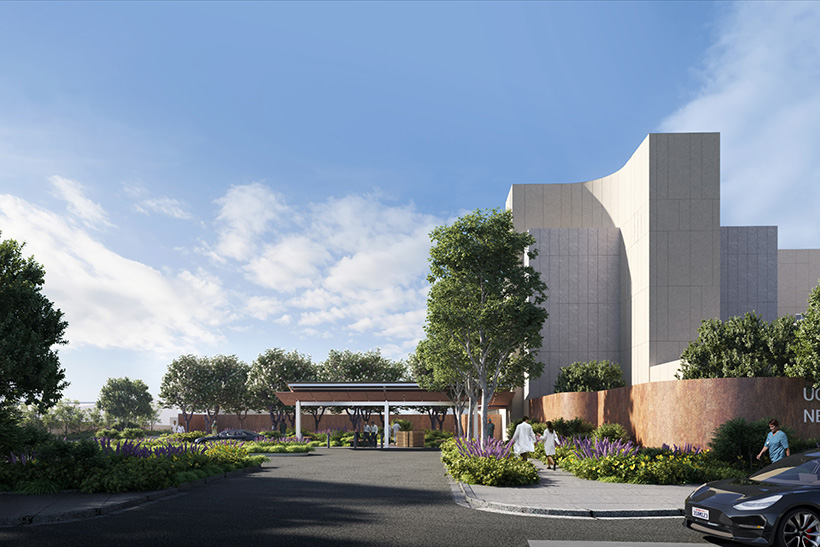
UCLA Health is on track to open a new neuropsychiatric hospital next year. The $452 million investment will relocate the Stewart and Lynda Resnick Neuropsychiatric Hospital, currently within UCLA Ronald Reagan Medical Center, to the Mid-Wilshire district. “UCLA Health has made an extraordinary commitment to expand its world-class inpatient acute psychiatric care,” says Erick Cheung, chief medical officer of the neuropsychiatric complex. The new hospital will have 61% more beds than the current location, as well as a crisis stabilization unit for emergencies. “As wonderful as the facilities will be,” Cheung says, “it’s the extraordinary people working in them that will make it all come together.” —J.R.
Read more from UCLA Magazine’s Winter 2025 issue.




