While we puzzle over whether to purchase a Prius or a pickup, and if now’s the time to invest in those chic energy-saving appliances, the people at UCLA’s Office of Intellectual Property (OIP) are way ahead of us. Their mission of connecting UCLA researchers with industry manufacturers and investors gives them a ringside seat on our future. By marrying science and business, they are fostering innovations today that promise to turn the status quo on its ear in the next five years or so, making us more mobile and self-sufficient than we can currently imagine.
Sound like an exaggeration? Here’s just a sampling:
The OIP is helping along a patented process that uses the maligned E. coli bacteria to make new biofuels for our cars that are cheaper and easier to transport than ethanol and nearly as efficient as gas. The office also is supporting plastic solar cells that we will be able to drape on our homes and elsewhere to generate all the energy we need, and maybe more. On the health front, the office is promoting portable medical treatments by spreading the word about a wearable artificial kidney patented by two UCLA professors to replace dialysis.
“We are often the first to see how research from our faculty will be impacting some of the most important parts of life,” says Kathryn Atchison, vice provost of intellectual property and industrial relations and head of the OIP.
Currently 180 companies are licensing patented UCLA technology. And the trend is considerably upward: The number of firms that have optioned or licensed patented Bruin tech has grown about 20 percent a year in recent years, says Atchison. (An option agreement usually lasts a year, while a license agreement lasts up to 20 years.)
From July 2006 to June 2007, a total of 38 U.S. patents were issued to UCLA inventors and 50 new license and option agreements were signed by outside industry, according to the OIP. During that period, UCLA earned $21 million in royalties and fees for inventions developed by faculty. Of that, the inventors took home $7 million.
“In the past, scientists like me could spend 10 to 15 years on esoteric work” that stayed in the lab, says James Liao, UCLA professor of chemical and biomolecular engineering. “It is immensely satisfying to see your work used for something directly benefiting society within your own lifetime.”
UCLA’s best minds have always been good at inventing technologies that impact the larger world. For instance, research patented at UCLA in the 1980s led to the familiar nicotine patch. Fast-forward to June 2007, when a cavity-fighting lollipop hit the market, thanks to Chinese herbs research by UCLA microbiologist Wenyuan Shi. Now the collaboration between academic researchers and medical, technology and energy industries is even more pressing as federal dollars that used to help pay for this research have dwindled.
Business can see a clear competitive benefit. “Our association with a key scientist is a tremendous help in our company’s credibility with investors,” says David Glassner, vice president of bioprocessing and engineering at Gevo, a biofuel company that is working with Liao. “The money guys want to back the first and the best.”
The challenge is that professors and industry obviously come from very different environments. “It is not a natural fit,” says Dina Lozofsky, vice president of IP development and strategic alliances at Solarmer, a solar product start-up, and the former director of technology commercialization at UCLA’s California NanoSystems Institute. “Professors’ top priorities are to educate students and share their work by publishing,” whereas “companies, on the other hand, want to keep their exclusive new technology secret until it hits the market.” Sharing it with the world, as professors do, is the last thing they want, she says.
“Recognizing the difference in cultures between academia and the business world,” explains UCLA Acting Executive Vice Chancellor and Provost Scott Waugh ’70, “UCLA moved to an academic leader under a vice provost in 2005 to increase faculty’s ability to commercialize technology developed as part of their research program.”
Besides making these connections, the office also offers businesses access to a valuable talent pool; companies involved with the OIP often hire UCLA grads who are already well-versed in key research.
Read on for the skinny on three Bruin breakthroughs that could rock your world — maybe sooner than you think.
SIMPLE SOLAR
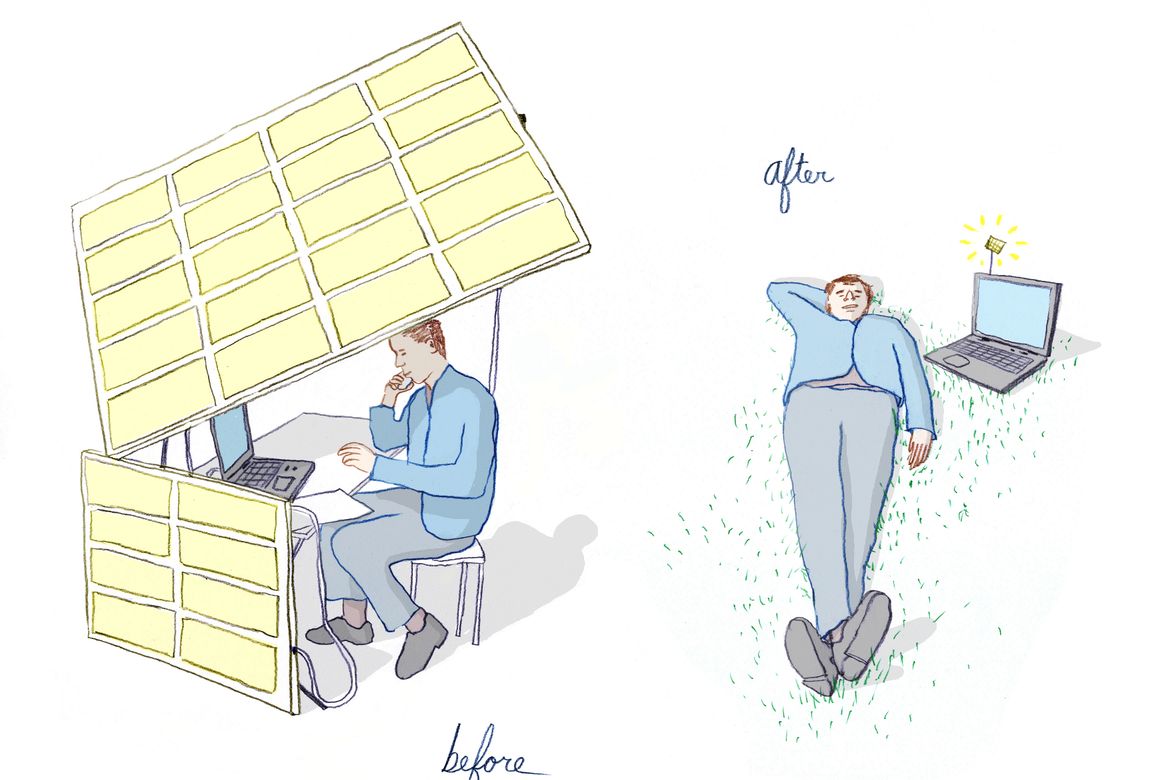
Most of today’s solar cells are made of crystalline silicon and are heavy and expensive to install. Yang Yang, professor in the Department of Materials Science and Engineering at UCLA’s Henry Samueli School of Engineering and Applied Science, wants to change all that. His solar cells are made out of polymers — common lightweight plastics — that are as thin as a plastic garbage bag and much cheaper than traditional solar panels.
Seven patents developed by Yang’s lab have been licensed by Solarmer Energy in El Monte, Calif., a company formed to commercialize prototypes of flexible, lightweight, translucent plastic solar cells that will last for at least three years, according to Woolas Hsieh, founder and president. The prototypes will be available by late next year and in about two years, the cells could be installed on laptop computers and other portable electronic devices. The devices would be charged whenever they are placed in indoor or outdoor light — much like solar cell-powered calculators, says Yang.
Within the next five years, the same technology could be used to make sheets of thin, semi-transparent plastic that is easy to attach to windows and walls and will inexpensively generate enough electricity to run a household. Yang broadly estimates the price of such plastic cells will be less than a quarter of today’s $20,000 to $30,000 price tag for buying and installing silicon-based solar panels, making it possible for an average home to function “as a little power generator,” he says.
By having the company handle the manufacturing side while Yang simultaneously handles research, “we can be faster to market,” he says. “For university researchers like me, California entrepreneurs’ appetite for risk is a fantastic opportunity.”
A BETTER BIOFUEL
Ethanol’s days may be numbered. Genetically modified bacteria are being recruited to synthesize a new biofuel for our gas-guzzling autos that is cleaner, cheaper and easier to use than ethanol, thanks to technology patented by James Liao, UCLA professor of chemical and biomolecular engineering.
A new process using E. coli bacteria allows ethanol manufacturers to turn sugar into an alternative product — isobutanol — which is nearly as energy-dense as gasoline, can be cheaply transported by pipeline like gas (ethanol’s tendency to absorb water means it has to be shipped by truck to avoid pipeline corrosion), and can be used in any gasoline-fueled vehicle without modification. Liao predicts that motorists could be fueling up with a blend of isobutanol and gas within the next few years, if everything goes smoothly.
That’s the plan of Gevo, a 3-year-old Pasadena, Calif., biofuel company that has licensed Liao’s technology and put Liao on its scientific advisory board to guide the commercial development of the new process. “Our process would not be nearly as close to commercialization if we didn’t have Dr. Liao’s technology,” says David Glassner, Gevo’s vice president of bioprocessing and engineering. The collaboration grew out of a teacher-student friendship. Gevo board member Doug Cameron was a professor at the University of Wisconsin specializing in metabolic engineering, where Liao was a student in the same field. The men kept in touch over the years and in 2006, Cameron told Liao about a start-up he was backing that was seeking innovative biofuel technologies. Liao jumped at the chance to license his research, with the support of the OIP.
Liao anticipates that in the next few years, isobutanol will come from non-food plants and agricultural waste. By then the bacteria used in the processing also will probably be more versatile than E. coli. “Today’s biofuels are just a stepping stone” in the significant impact biofuel will have on reducing our demand for gas, concludes Liao. And you know what that means? Subsequently lower gas prices — and wouldn’t that be a welcome change?
MOBILE MEDICINE
Medical technology can work wonders. For kidney-disease patients, not having to be hooked to a dialysis machine for hours at a time, several times a week, is a big one. Enter artificial wearable kidneys, worn as a belt under the clothes or as part of the apparel, which keep blood chemistry and salt and water balance at steady states the way a normal kidney does. More importantly, an automated wearable artificial kidney accords patients the freedom to live a more “normal” life and frees them from the servitude imposed by current treatment modalities.
Those quality-of-life desires weigh heavily on Drs. David B.N. Lee and Martin Roberts, professor of medicine and assistant professor of clinical medicine, respectively, at the David Geffen School of Medicine at UCLA. Dr. Lee is also a consultant nephrologist and Dr. Roberts a dialysis research consultant at the VA Greater Los Angeles Healthcare System. Their breakthrough in the technology of wearable kidneys led to a worldwide exclusive licensing agreement between UCLA and Singapore-based AWAK Technologies Pte Ltd. to develop and market their device.
Most wearable kidneys are hemodialysis-based, in which blood flows out of the body (extracorporeal circulation) to come into contact with an artificial membrane for purification. This, unfortunately, means patients wearing the kidneys require continuous treatment with blood-thinners to prevent clotting and face the constant danger of accidental disruption of the blood circuit and possible fatal bleeding. The Lee and Roberts wearable kidney is peritoneal dialysis-based, which means no extracorporeal circulation is required. And used dialysate, the material that has abstracted metabolic waste and excess salt and water from the patient, discarded in current practice, is regenerated and reused. So the device is “bloodless” and “waterless.”
Indeed, “the certain belief that the device will benefit our patients with end-stage kidney disease is a strong driving force that keeps us hanging in there,” concludes Dr. Lee. “To us, it is not who gets there first, but rather that someone gets there.”