Editor’s note: This is an article from the February 1997 issue of UCLA Magazine.
When I went to UCLA in the early 1970s, my father wrote a check for $212 each quarter for my student fees. I lived in an apartment that rented for $90 a month, which I split with a roommate. We survived on Ragu spaghetti sauce. That I would finish school in four years was not an issue.
I neither had to work during the school year nor did my parents have to borrow money to pay my way. Summer jobs in a can factory back in Kansas provided me with all the extra cash I needed for the next school year. While my college education was not free, the cost was not particularly burdensome for a middle-class family living, as could be done in those days, on a sole breadwinner’s wages.
For decades, however, Californians had enjoyed the promise of a free education from kindergarten through college. And it was a truly extraordinary promise. In the early 1940s, both of my parents went to UC Berkeley, then the nation’s finest public university. They paid only books and board. Nothing like a UC education, in Berkeley, Los Angeles and across the entire system as it expanded up and down the state, was offered anywhere else in the United States.
California’s modern blueprint for its colleges and universities, the Master Plan for Higher Education, enacted in 1960 and still in force, pledges as a matter of public policy a tuition-free education to all who are qualified. But over the past three decades, California’s commitment to its future has steadily eroded as “student fees” have first crept, then shot, upward. “A free education was absolutely one of the pillars of the Master Plan,” observes Warren Fox, executive director of the California Postsecondary Education Commission, which regulates higher education in California and is the steward of the plan. “And we’ve lost it.”
The University of California’s (UC) nine campuses now charge “educational fees” and “registration fees.” The California State University system (CSU), with 22 campuses, charges a “university fee” and an “instructional-related activities fee.” The state’s 106 community colleges charge students an “academic unit fee.” Call these costs what you will, the fact is the price of higher education in the Golden State is a lot higher than it used to be.
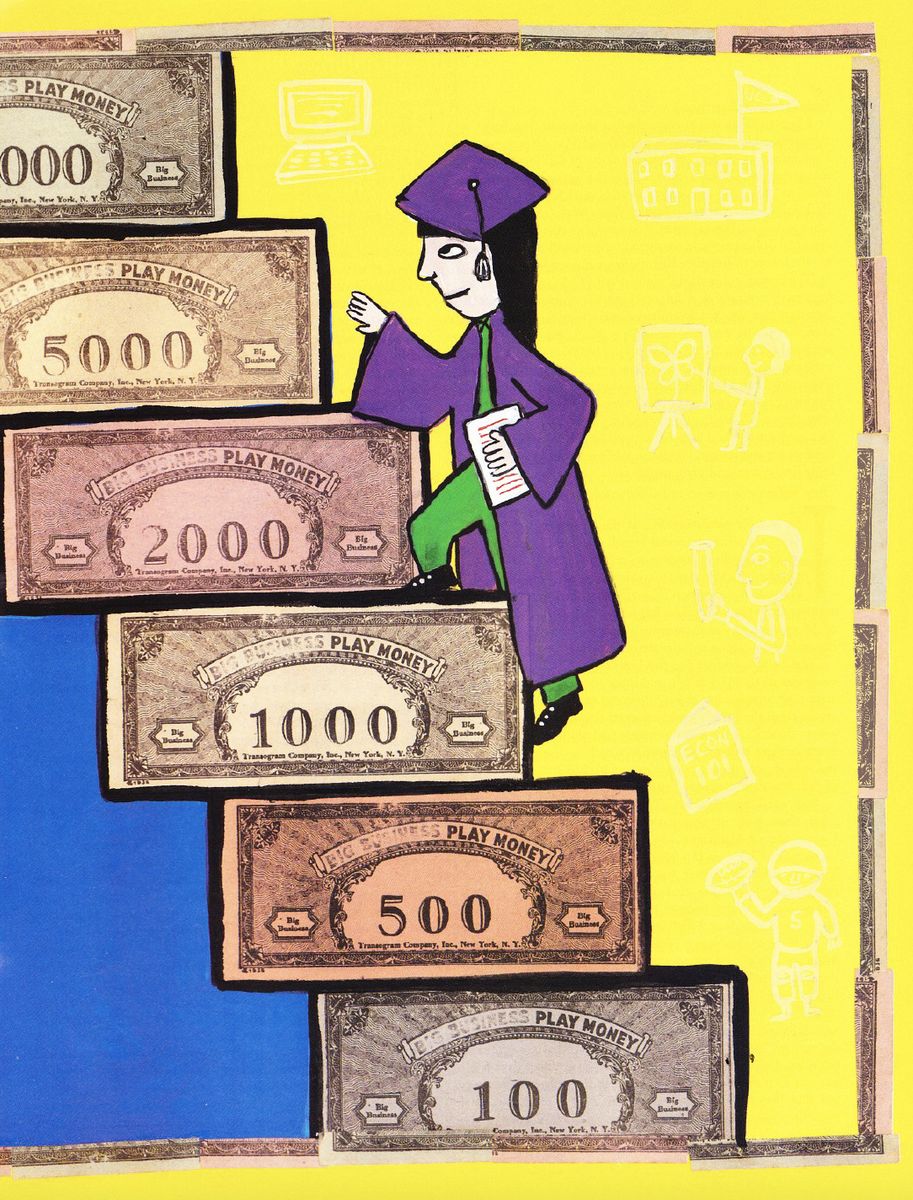
My generation, in fact, was perhaps the last to benefit from anything resembling California’s post-World War II promise. Students in the University of California system today pay $4,166 a year in fees; these may go up as much as $370 a year by Fall 1997. The cost of room and board at UCLA is, on average, an additional $6,400 a year — and Berkeley is even pricier. Today’s students work longer hours while in school, borrow more to meet rising costs (an average of $4,300 a year) and are forced by economic constraints to take longer to complete their undergraduate educations.
The cost of going to the University of California today manifests itself not only as a financial burden on students and their families, but also profoundly on society-at-large. The career choices made by students, particularly those who go to UC’s professional schools and are faced with $10,000 a year in fees, are undoubtedly skewed by what they spend on their educations. This contradicts one of the public university’s central purposes: to produce graduates who will take lower-paying public service jobs after they graduate to give something back to the community. UC graduates — California’s best and brightest, who despite rising fees are still trained largely at public expense, now increasingly find it financially impossible to serve those most in need.
The steadily escalating fees at the University of California mirror a wider national trend. Over the past 15 years, while household income rose 82 percent, college tuition climbed 234 percent nationally, according to the U.S. General Accounting Office. During the same period, state support across the nation fell by an average of 14 percentage points; universities have become increasingly dependent on tuition to balance the budget.
The annual budget for the University of California’s nine campuses totals $11.1 billion and is enormously complicated. The state now provides less than 20 percent of the funding; the bulk comes from the federal government, through individual and corporate donations, from endowments and student fees. (UC also operates three national laboratories, which are entirely funded by the federal government to the tune of $2.3 billion a year — only slightly less than the cost of instruction at all the campuses.)
Still, the University of California is less expensive, if only by a bit, than most other top-tier public schools including the University of Michigan ($6,074 annually), the University of Virginia ($4,648) and the State University of New York ($4,656). Moreover, the price tag on a UC education is substantially lower than that of private universities. The estimated annual cost of an education at Stanford University, for example, is $29,000 a year for tuition, books and living expenses.
By these standards, an education at a UC campus remains a bargain. “I think our fees are quite reasonable,” says former UC President Clark Kerr, widely viewed as the author of California’s higher education master plan. “Those who benefit so much themselves” — meaning college graduates who will earn an average of 80 percent more over their lifetime than those without degrees — “should be able to pay it.” Nevertheless, there are many inside UC circles who believe that the problem with fees is not so much that they are the highest in the university’s history, but that they shot up so drastically in such a short period.
Indeed, UCLA Chancellor Charles E. Young favors high fees for the windfall they provide to fund student aid. Currently the UC system’s fee structure returns to students fully one-third of all fees collected in the form of financial assistance. In 1993–1994, the last academic year for which statistics are available, the university awarded an average of $7,105 to each of the students who qualified for aid.
Young argues that the high-fee, high-aid structure has enabled the poor to have wider access to college than might otherwise be possible, and there is considerable statistical evidence proving that he is correct. Especially with affirmative-action admissions considerations on the way out in the UC system, the ability to subsidize low-income students could prove essential to maintaining any semblance of diversity in the university’s student body.
With their fees, middle- and upper-income students are, in effect, carrying the tuition load for lower-income students. The result has been steady enrollment increases in the 1990s for two groups: low-income students, who receive aid, and high-income students, for whom fees are not an issue. At the same time, however, enrollment has steadily shrunk among the middle class, defined as those with a yearly family income between $30,000 and $90,000. “The dilemma is what is happening to the middle class,” confirms UC system budget director Larry Hershman. “More people are going to have to save and borrow.”
High fees for higher education in California were not born of economic necessity, but were an outgrowth of political expediency. In 1967 California had a new governor: Ronald Reagan. He sensed public disgust growing with student protesters’ disrespect for the taxpayers who were giving them a free, first-rate education. By the end of the 1960s, there were more than 200 arrests at UCLA, UC Berkeley and UC San Diego; in 1969 alone there were 584 arrests at San Francisco State College. Voters saw little reason to coddle students they viewed as spoiled children and Reagan rode the electorate’s collective resentment into the statehouse.
In his first year in office, Governor Reagan argued that the state should stop subsidizing protesters and start making students pay tuition for their education. His position was hugely popular with the populace. But Reagan was opposed by Assembly Speaker Jesse Unruh, who found unconscionable the idea of scuttling California’s promise of a free education.
By virtue of their elective positions, both Reagan and Unruh were members of the UC Board of Regents, and they faced off at a heated regents meeting in the UCLA faculty center on Aug. 31, 1967. Some regents, particularly oilman Ed Pauley, pleaded with Reagan that day not to bring up the tuition issue. Pauley did not want to go back on California’s promise, nor did he wish to see the governor embarrassed. But Reagan rebuffed him, replying, “I for one have no intention of discussing anything but tuition.”
Arguments on both sides were heard and the regents voted 14-7 against Reagan’s tuition proposal. Then they broke for lunch. When they returned, Reagan was all smiles. During the break, a deal was brokered that has held firm to this day: The regents agreed to accept a “charge” on students so long as it was not called “tuition.” The letter of the Master Plan’s guarantee of tuition-free higher education was preserved, even as its spirit was made a mockery.
By the early 1970s, the regents had imposed more than $600 in charges a year; fees mounted steadily through the 1970s and ’80s. Students and their parents grumbled, but the increases were relatively modest and consistent through the gubernatorial terms of Democrat Jerry Brown and Republican George Deukmejian.
But in the early 1990s, as the California economy slid into its worst downturn since the Great Depression, the Democratic-controlled Legislature and Republican Governor Pete Wilson increasingly saw student fees as the way to keep the state’s higher education systems afloat. The debate in Sacramento was not about whether to raise fees, but by how much. In 1980 UC student fees were $1,634 a year. Fifteen years later, they had nearly tripled. And other segments of public higher education in California were hit even harder: Community college fees tripled in just 10 years.
As fees climbed, enrollments plummeted. Estimates are that 200,000 students disappeared from California’s college and university campuses in the early 1990s. The devastation suffered by the CSU system could be seen a few miles away from the state capitol as CSU Sacramento closed two of its four dorms.
Two years ago, with the economy recovering and Democrats exploiting student fees as a campaign issue, Governor Wilson proposed a “compact with higher education” to stabilize fee increases and forestall further budget cuts. His proposal called for an annual 4-percent real increase in state appropriations to higher education and steady 10-percent student fee increases. So far, the state has done better than the compact provides. For the past two years, the Legislature has “bought out” the student fee increases by providing enough additional funding to replace revenue the fee hikes would have produced. The budget game is now played thusly: The UC Regents propose a student fee increase, the Legislature and governor come up with the extra money, the regents defer the increase. It appears to be working: With fees stabilized, enrollments have begun to recover. The entering UC class this fall was the largest since 1991.
The game will be played again this spring for the 1997-’98 budget cycle. For the third year in a row, UC officials proposed a fee increase — 9.7 percent this time, which would cost the state an estimated $33 million to absorb. This time around, however, the university did not seek a total buyout of the proposed increase. Included in the $370 in added fees each student may be required to pay is a $40 “technology fee” intended to generate a $4-million down payment on the overhaul and modernization of UC’s computer systems and teaching technologies. UC President Richard Atkinson says he wants this new fee imposed on students systemwide, regardless of what the state does. He also anticipates increasing the technology fee each year into the foreseeable future.
Last fall, Atkinson argued that the proposed fee hikes are in keeping with the compact made with higher education by the governor, and that it is time for the university to uphold its end of the bargain. “There is no question the university has been faced with very tough problems these last few years,” Atkinson says, “but I think we have served the state well. Now we must ensure that our programs remain of high quality.”
Earlier this month, however, Governor Wilson proposed a full buyout of student fee increases — including the technology tax — and proposed providing additional funding for one of Atkinson’s highest priorities: increasing UC faculty pay. Currently UC professors are paid an average of $73,000 a year, but still lag about 3 percent behind faculty at comparable institutions.
Wilson’s proposal is headed for the Legislature, where it faces an uncertain future. There is currently some talk among lawmakers of recommending a fee decrease in the opening gambit of the budget game.
However the issue is resolved this time around, the governor’s compact itself — on which the wrangling is predicted — leaves some feeling uneasy. Jess Bravin, a Boalt Hall law student who is the student representative on the Board of Regents, points out that the agreement with Wilson is of recent origin and temporary duration. “We speak of the ‘compact’ like we’re talking about the Mayflower Compact,” says Bravin. “The most important compact is the one made between the state of California and California families in 1868, when UC was established. In 1992 or so we decided to pass on to families the cost of instruction. But this is a very significant violation of a much earlier and more important compact.” For both ideological and economic reasons, some education experts are beginning to argue that UC and CSU should lower their fees. “The fees shouldn’t be kept up,” says William Pickens, a private-education consultant and a former budget officer from CSU who is respected in the Legislature. “They’re a narcotic — a very bad narcotic.” Pickens maintains that access to college for the poor and middle class would be improved by lowering fees. “Low tuition,” he says, “provides a clear message to all high school students and their parents: If you prepare yourself for college, financial cost will not stand in your way.”
The ongoing debate over student fees only hints at the larger economic challenges facing the UC system, and all of higher education in California, in the years to come. A huge new generation of college students will descend on the universities and colleges in the next decade in what many are calling “Tidal Wave II.” That the students are coming is certain: They are in the elementary and secondary schools now. But the inundation will come at a time when budget experts predict there will be no funds left for higher education because the prisons, welfare, Medi-Cal and K–12 education will have sapped the entire state budget.
So far, the reaction of leaders of UC, CSU and state policymakers alike is to “study the problem.” The studies vary in their specific projections, but not their overall conclusions. “California appears to be in a state of denial,” says a report by Santa Monica-based RAND. “Budgets are no longer considered from the perspective of what is required to support the needs of the state’s higher education sector, but rather of how much of the budget is left to be spent on it.” RAND predicts that in 2010 nearly 1 million California students who are qualified to go to college under the prevailing Master Plan will be shut out either because there will be no space for them or they will be unable to afford the costs.
Patrick Callan, executive director of the Higher Education Policy Center, a San Jose-based think tank, advises all those concerned about the future of higher education in California to wake up. “Everyone will have to make extraordinary efforts immediately or we will lose higher education,” he warns. “Ten years from now, we’ll be talking about the crisis in higher education the same way we talk about our failing K–12 schools today.”