Editor’s note: This is an article from the Fall 1999 issue of UCLA Magazine.
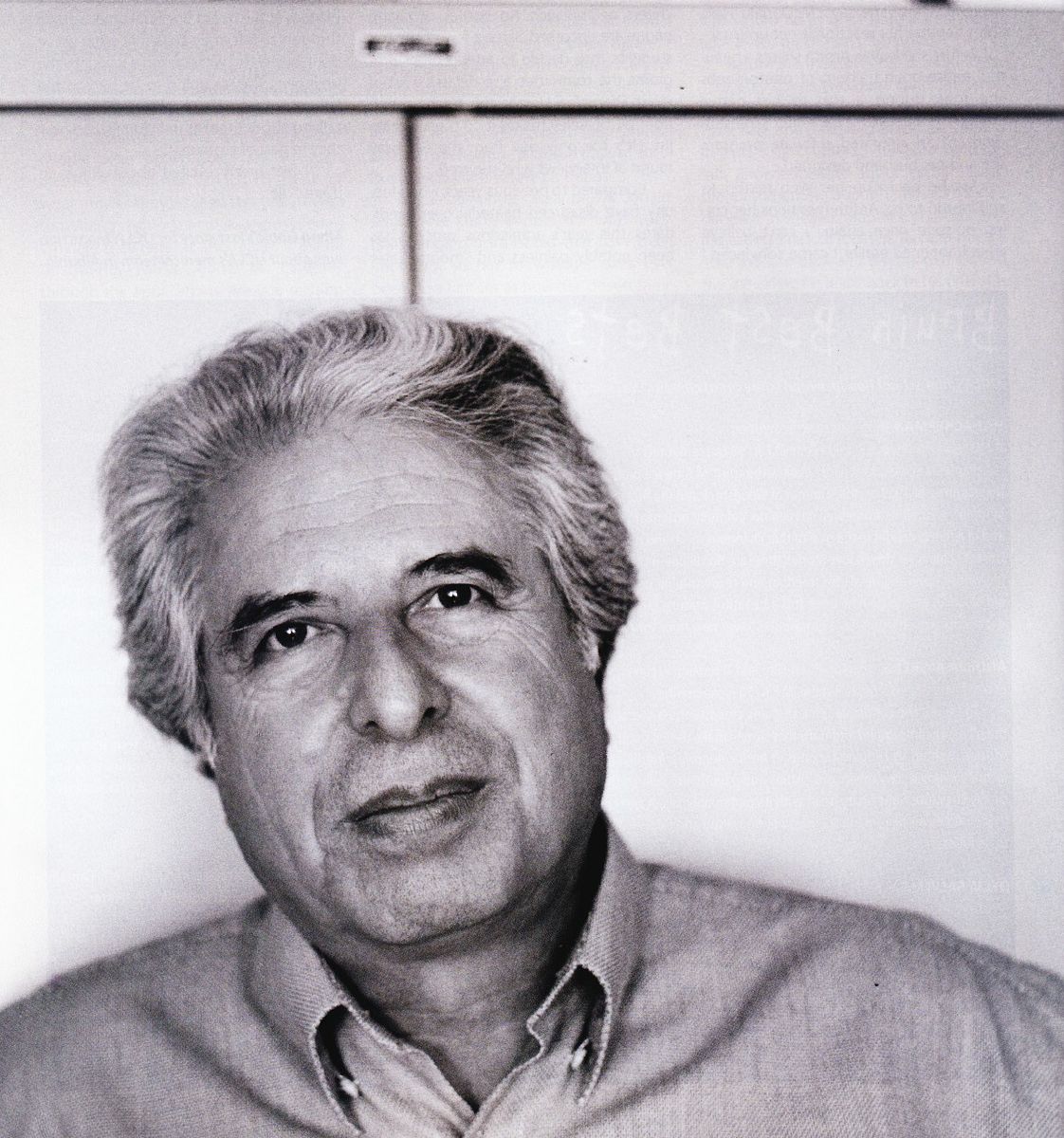
There is so much that is fascinating about Saul Friedlander’s life, it is hard to know where to begin or how, even, to define him. Historian. Teacher. Author. Policy maker. Survivor. It is the last, in fact, that defines all the rest.
Survivor. This aspect of his life is what makes his present-day work so compelling. One of the world’s leading scholars of the Holocaust, Friedlander studies, teaches and writes about an era with which he is intimate on more than merely academic terms. He survived the Nazi destruction of Europe’s Jews by being hidden among gentiles; his parents, though, were lost to the fires of Auschwitz.
He tells the story of his bitter passage as a child in war-torn Europe, his emigration to Palestine, his struggle as a young fighter for Israeli independence and his evolution into a world-class historian in a personal memoir, When Memory Comes. But it’s his most recent work, Nazi Germany and the Jews, Volume I: The Years of Persecution, 1933-1939, that has earned him the greatest recognition. The book — which was published in 1997 and makes extensive use of newly available documents, such as local German police reports — has been praised as the definitive history of Nazi policies prior to the Holocaust. It was instrumental in his receiving in June one of the nation’s most diverse and prestigious creative and intellectual awards, a MacArthur Foundation “genius” grant.
Friedlander’s scholarship, wrote the foundation, weaves “into a coherent whole the perspectives of the participants: ordinary Germans, party activists, military and political figures and, most importantly, victims and survivors. By enhancing our understanding of the nature and meaning of the Holocaust, [he] demonstrates the interplay of memory and representation in the interpretation of historic events.”
In his 448-page account, Friedlander describes a Germany that was, in the 1930s, “grotesque and chilling under the veneer of an even more chilling normality.” “For most ‘ordinary’ Germans, the early years of Hitler’s power were viewed as the beginning of a renaissance of prosperity,” he writes. And while there was acquiescence regarding the segregation and dismissal of Jews from civil service — and perhaps some glee in witnessing their degradation — “outside Party ranks there was no massive agitation to expel them from Germany or to unleash violence against them.”
“The chronology of persecution, segregation, emigration and expulsion, the sequence of humiliations and violence, of loss and bereavement that molded the memories of the Jews of Germany from 1933 to 1939, was not what impressed itself on the consciousness and memory of German society as a whole,” he writes.
Fielding congratulatory calls from friends and colleagues after the award was announced, Friedlander, who holds UCLA’s 1939 Club Chair in Holocaust Studies, seems a bit bemused by all the tumult. “I really didn’t expect this,” he says, leaning back in his chair in his book-lined office on the sixth floor of Bunche Hall. “The whole process is so secretive; it really was a wonderful surprise.”
Even more so, perhaps, since Friedlander plans to use the $375,000 prize over five years to help him complete the second volume of Nazi Germany and the Jews.
The good news came at a busy time for Friedlander, who was preparing for a three-month trip to Europe. Part pleasure — he and his Israeli-born wife, Hagith, would celebrate their 40th anniversary in Paris with their three children — and part work — as a member of the Independent Experts Commission, he would meet with a Swiss research team investigating that country’s questionable role in World War II and would lead an investigation by the German publisher Bertelsmann to examine that firm’s involvement with the Nazi regime — the trip is emblematic of Friedlander’s drive to pack as much life into every moment as possible.
And just days before he was to leave, Friedlander was invited to the Skirball Museum in Los Angeles to view the original copy of the Nuremberg laws, Hitler’s infamous edict codifying the exclusion of Jews from all aspects of German Society.
Although the contents of the document are familiar, “to see the actual paper with the most evil laws on it was strange and creepy,” he says. These, after all, were the very words that set in motion the chain of events that, ever since, have been the framework of Friedlander’s life. Friedlander was born in Prague, Czechoslovakia, in 1932, four months before Hitler’s ascent to power in Germany. Seven years later, his parents — Hans, a lawyer, and Elli — fled with him to France as Hitler systematically dismembered Eastern Europe. But France, under German occupation, did not prove to be a safe haven and, in 1942, when foreign Jews were being rounded up and deported to Germany, the family again had to flee. This time, in an effort to protect their son, Friedlander’s mother and father changed his name from Pavel to Paul-Henri Marie Ferrland and left him in the care of nuns at a French Catholic monastery. He was 10 years old.
His parents tried to make it to the safety of Switzerland, but they were stopped at the border and returned to France, and then sent to Germany. Friedlander’s mother and father were shipped to Auschwitz. He never saw them again.
Living in the care of the nuns until the end of the war, Friedlander existed on the fringe of the fires engulfing Europe, and in his 1979 memoir, he writes that in many ways he feels he was more a spectator than a victim. The child of modern, assimilated Jews, Friedlander was not raised in a religious home, but he embraced Catholicism and even thought of becoming a priest. But when he was 15, a Jesuit priest told him what had been happening to the Jews of Europe, “of Auschwitz, the trains, the gas chambers, the crematory ovens, the millions of dead,” Friedlander wrote.
“It was a jolt,” he says. His attention turned to rediscovering his roots, and he became passionately interested in the idea of resurrecting a Jewish homeland.
“I wanted to know everything about what was going on in the political situation of Palestine,” he says. “I read everything I could find.” The moment the United Nations partitioned Palestine into Jewish and Arab states, he wanted to go there “to fight [for a Jewish homeland],” he says. “I thought the idea of a Jewish state was a solution.”
As did many young Jewish survivors in post-Holocaust Europe, Friedlander tried to join a moderate Zionist youth movement, but it wouldn’t take him because, at 15, he was too young. He lied about his age and joined a more militant group that was linked to the hardcore Irgun, an underground organization that was fighting the British mandate in Palestine.
Not long after David Ben-Gurion announced the formation of the State of Israel, Friedlander sneaked away from his boarding school in Paris and boarded an Irgun-sponsored arms-smuggling ship, the Altalena, en route to Israel. However, as the Altalena approached Tel Aviv on June 20, 1948, with its cache of weapons, contrary to the orders of the newly formed Israel Defense Force, it was shelled. Twenty-two on board the ship were killed in the assault. (Among the survivors was Menachem Begin, who would become prime minister of Israel and sign a peace treaty with Egypt in 1979.) The destruction of the Altalena was among the bitterest episodes in Israel’s war of independence.
Friedlander again survived, and he made his way to two uncles living in a small village north of Tel Aviv. They packed him off to agricultural school “so I could learn something useful,” he says. “They told me, ‘Enough with this intellectualism. Learn a skill.’”
But his thirst for knowledge about his newly adopted country was great, and each day he would walk several miles to the nearest city to buy a newspaper, struggling to learn Hebrew so he could read it. “I was so enthusiastic about every little detail,” he says.
His excitement about living in Israel at that time, being at ground zero for the birth of a nation, remains palpable today. “It was an incredible experience,” he says, his face lighting up as his arms spread open. “I remember it with a glow. Israel had something heroic about it.”
He still calls Israel home, and in fact divides his time between Westwood and Tel Aviv, where he is a professor emeritus at Tel Aviv University.
Agricultural college soon wore thin, however, and Friedlander turned his attention to more intellectually rigorous pursuits. After a stint in the Israeli army, he returned to school full time, attending the School of Law and Economics in Tel Aviv. Thinking he would become a diplomat, he earned a master’s degree in political science from the Institut d’Etudes Politiques in Paris. From 1956-’61, he served as secretary to the president of the World Zionist Organization and as head of the scientific department of Israel’s Ministry of Defense under future prime minister Shimon Peres, who was then vice minister of defense in the government of David Ben-Gurion. In the 1980s, Friedlander was active in the Middle East peace moment, Peace Now.
But even while studying political science, Friedlander says he was drawn to the historical, rather than the political, dimension of that field. “From there, it was a natural progression to historical studies.”
After earning a Ph.D. in 1963 from the Graduate Institute of International Studies in Geneva, Switzerland, Friedlander decided he wanted to be a teacher. But always hovering just beyond the periphery was the specter of the Holocaust — a life-defining event that, he says, shaped not just the destinies of those who went through it, but also the destinies of their children.
“It is like a block of stone that you can’t remove from your life,” he says. How does one get beyond, if not over, such a horrific experience?
“That’s a very deep question with no clear answers,” he says with a sigh. Holocaust survivors, he says, tend to deal with the past in two ways: “Some try to block it out and never talk about it. Others, like myself, come to struggle with it by dealing with it.”
Friedlander says he did not set out originally to study the Holocaust, “but for me it was one way of coming to terms with it. It was my way of handling it.” In fact, it wasn’t until he was in his 30s and had gone back to Germany to conduct interviews and do research “that I realized how much the past molded my vision of things.” In Germany, he writes, he was caught between feeling “pleasant familiarity” and panic, a strong urge to pack his bags and flee.
What lies behind his historical digging is “a desire to preserve and set the record straight,” he says. Like Steven Spielberg who, through his Shoah Foundation, is recording the memories of Holocaust survivors, Friedlander feels an urgency to gather as much information as he can, quickly, because the survivors are rapidly aging and dying off. “I’m 66,” he notes, smiling.
And there seems to be more interest today in learning about that period than there was when he first began his research in the 1960s, Friedlander says. “Maybe it was still too close then. Survivors themselves weren’t keen on discussing it. They wanted to rebuild their lives. And to their children, it seemed very far away.”
Even Friedlander did not discuss his experiences with his three children: eldest son, Eli, a professor of philosophy at Tel Aviv University; David, who lives in Paris, where he imports exotic papers; and daughter Michal, a pianist who lives in New York.
“They were aware, but it was not a topic I liked to discuss. It would be difficult to avoid the topic in our house, but I didn’t like to discuss my experiences with them,” he says.
But slowly, people became interested in the Holocaust. In the late ’60s, as American youth were protesting the Vietnam War, German teens were beginning to ask their parents what they did in WWII. In the United States, a television miniseries, The Holocaust, presented the horror in a dramatic way, as did the more recent Schindler’s List and Life Is Beautiful.
Friedlander views these dramatic presentations with mixed feelings. As a historian, he can’t help but shudder at historic inaccuracies or the inability of dramas to put events into context.
“I don’t feel at ease with them because they simplify the Holocaust. But,” he adds with a self-deprecating smile, “I may not be the best judge.”
He understands the need for some dramatic license to tell a story. At least, he says, films like Schindler’s List add to the general public interest in the subject. “You have to make allowances for what filmmakers have to do to attract the interest of a wide audience,” he says. “The danger is in distortion.”
Today, he says, “enough distance has passed that people can examine the era. For example, the Vatican is just now struggling with the issue of Pope Pius XII [and the church’s relationship to the Third Reich]. Interest in the Holocaust is coming now from all sides.”
Friedlander, who also edits the journal History & Memory, which focuses on questions relating to the formation of historical consciousness, also is aware of the danger of being too close, too personally involved in his subject. He takes pains to separate himself emotionally from the work.
On the other hand, he believes that having lived through the Holocaust affords him a unique insight into the atmosphere of the times. Contemporary historians may not fully grasp the nuances of the reality, he says. For example, some can’t understand why the Jews seemed so passive and gave in so easily, or why others watched in silence as their Jewish neighbors were stripped of jobs, businesses, homes, positions and, finally, their lives.
But Friedlander “witnessed the paralysis of my own parents.”
Such insight is what earns him praise from other historians. Says David N. Myers, director of the UCLA Center for Jewish Studies, “Saul Friedlander is one of the most distinguished historians in the world today, not only of the Holocaust.” His personal connection brings to his research “a controlled passion and an underlying sense of moral urgency to explain that terrible darkness that has blotted out so much of this century. He fuses the skills of a great archival historian, a grand synthesizer and a master theoretician.”
Myers says there is an “intellectual agitation, even restlessness” in Friedlander’s labors, and the way he combines “vast learning, lyrical writing and … ethical responsibility” makes the historian “a humanist in the highest sense of the word.”
Professor Vincent P. Pecora of the Department of English says Friedlander’s passion for truth in his work may seem natural for a historian, but has actually been an issue of debate recently as some question whether historical research can ever really uncover the “way things were.”
But Friedlander, Pecora says, “insists that with time, patience and rigorous research methods, we can indeed know enough … to say what is true and what is false about the past. He has spent most of his scholarly career showing not only that it can be done, but that it matters in the extreme.”
It is his sensitivity toward his subject, combined with his clear authority in the field — his integration of personal experiences “into subtle historical and cultural scholarship” — that’s set Friedlander’s work apart, says Steven E. Aschheim, of the Dinur Center for the Study of Jewish History at Hebrew University in Jerusalem.
“Few people have written more suggestively, provided such rich insights into the structure of Nazism as Friedlander,” Aschheim wrote of the Holocaust scholar in an essay published in History & Memory (an issue dedicated to Friedlander in honor of his 65th birthday). “Saul Friedlander constitutes a distinctive, always stylish and sophisticated presence, a peculiarly authoritative custodial voice.”
It was Friedlander’s scholarship, as well as his ability to impart his knowledge to students, that led to his appointment to the 1939 Club Chair. Friedlander came to UCLA on a one-year appointment as a visiting professor in 1983; four years later he was offered the permanent position.
“He had an outstanding record as a historian and had already published several books about the Holocaust,” says Samuel Goetz, a UCLA alumnus and past president of the 1939 Club who proposed the chair — the first of its kind in for a public university in the U.S. “He impressed the search committee as an outstanding scholar.”
Historical research continues to excite Friedlander, who speaks five languages. Digging through musty old records often yields startling surprises. For example, while working on his Ph.D., he was researching relations between Hitler and the United States when he discovered a misplaced document from the German ambassador to the Vatican. The document discussed how the Pope, during his 1941 visit to Berlin, wanted to hear a Wagner opera played for him by the Berlin Orchestra.
“It was unsettling finding that letter because this was in 1941, when everyone knew what was going on,” Friedlander says.
This led Friedlander to examine the Vatican documents, which resulted in Friedlander’s 1965 book, Pius XII and the Third Reich, in which he examined the role of the Catholic Church during this time.
When asked if an event like the Holocaust could happen again, Friedlander shrugs.
“Something can always happen again, maybe in different ways.” There are echoes of the Holocaust in the ethnic cleansing in Kosovo, and in the atrocities of the Khmer Rouge in Cambodia before that, he says. “That is why it is so important to study the Holocaust, so it doesn’t happen again. Human evil is something permanent. Sometimes the social frameworks that control it are weak.”
The more he studies that era — the formative era of his life — the more he is astonished by “the width and breadth of how many people were involved in the Holocaust, how widespread it was, how little was done to stop it.”
Friedlander pauses to look at the purple jacaranda trees in full blossom beyond his window.
“It was so ruthless and systematic,” he says quietly. “There are still questions to answer.”