This place glistens with memories. Memories of holiday parties and a Christmas tree so tall that the painted figures cavorting on the ceiling of its reading room seemed to be reaching out to touch its top. Of the day a drunk driver crashed through its garden wall, sending bricks flying — and furtive scholars tiptoed away with them, weighty souvenirs from their favorite literary haunt. Of a sweltering summer afternoon when, on its lawn, sweating singers costumed as stars and planets sang a 17th-century oratorio, the name of which no one now recalls, though they still remember the 12-foot cardboard sun, painted a lurid gold, smack in the center of the pageant.
To generations of scholars, students and lucky others, that is just what this place has been: a brilliant sun irresistibly drawing them into its orbit.
Far too many people have labeled the William Andrews Clark Memorial Library a “hidden treasure” for the phrase to not be considered cliché within its gates. But clichés become clichés for a reason and, indeed, the Clark is a hidden treasure. It is a world-class library ensconced behind high walls, a magnificent Old World building smack in the heart of the once-grand West Adams district, run under the auspices of UCLA and open to the public, filled with works as important and rare as a First Folio of Shakespeare, inscribed first editions of Rousseau and Keats and an unrivaled collection of letters and manuscripts of Oscar Wilde.
For those who are intimate with its book-filled rooms and expansive grounds, it is something more: a home away from home, a retreat, a secret garden.
It goes without saying that the Clark is a haven for scholars and academics, those who build their reputations on the tireless study of the obscure and the more obscure. But there are others who have discovered the Clark and made it their own. Call them civilians — doctors, housewives, cops and Hollywood types with nothing more in common than a love of learning.
Adam Wechsler, an emeritus professor of neurology at UCLA, is one. He cannot contain his enthusiasm when he speaks of the Clark, which he calls his “ivory tower.”
“I believe in heroes,” he says. “I have lots of heroes. One of them is Jean-Jacques Rousseau. At the Clark, I was able to read from a first edition of The Contract Social inscribed by him!” Wechsler, slim and tan behind dark glasses, first heard of the Clark while teaching a course in the history of medicine. Since then, he’s come to the library once a month, each time requesting to see a first edition of an important work, and spending a few quiet hours poring over it. “I’ve read Hamlet and Macbeth from the First Folio of Shakespeare,” he says, his voice quivering with the profoundly emotional memory of that experience. “Imagine, there’s nowhere else you can do that. The Huntington has one, but you can’t read it.”
The fact that the Clark Library makes rare volumes of such classics as The Origin of Species, Edgar Allan Poe’s Tamerlane and works by Thomas Hobbes, John Keats and the Marquis de Sade available to the general public is hard to comprehend; we’re used to such rarities being treated as museum pieces rather than as literature, best viewed behind glass.
For Wechsler, who counts himself as “a bit of a romantic,” actually touching and spending time with original printings enables him, he says, to “really connect with the past.” The experience, the solitude of it, is something he jealously guards, and he’s concerned about word of the Clark getting out. “It’s a little selfish, I know, but I don’t want to see a lot of people here. I’ve never brought anyone with me; it’s something that I just don’t want to share.”
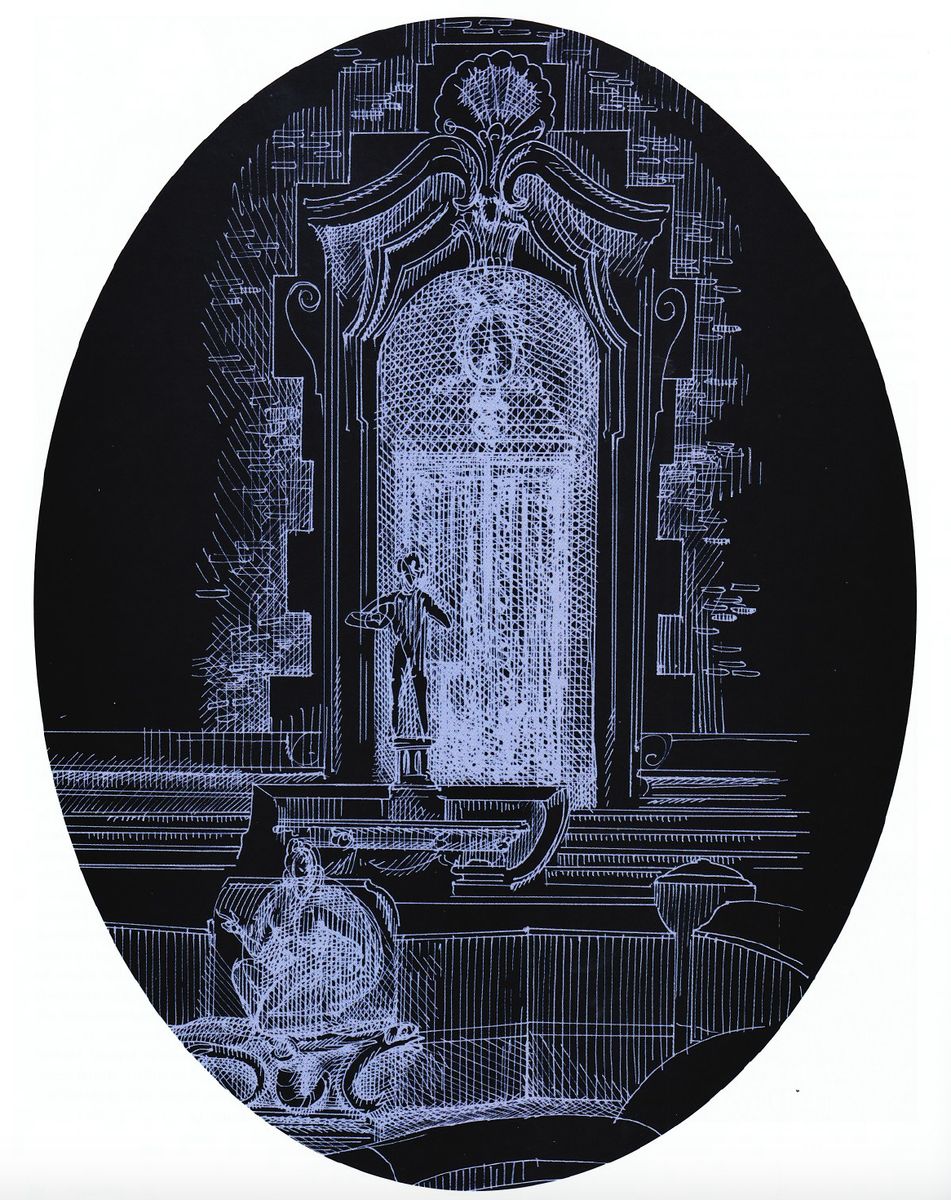
Drive through the gates of the Clark and the visitor is transported to a gentler time, encountering a world that could not possibly be more different from 21st-century Los Angeles, its lofty downtown towers looming just a few miles away. In the words of one aficionado, the library is “a bastion of civility … far from the world of newspapers where there is only the ugly, the exaggerated, the vulgar.” A formal garden leads to the front of a lovely, two-story brick edifice, every bit the vision of a grand European library. Inside the tall French doors, mythical figures dance on the vestibule ceiling. Enter one of the reading rooms and it’s easy for one’s breath to catch at the sight of the prettiest books in the Clark’s collection — volumes of all shapes and sizes that beckon with their richly colored bindings.
William Andrews Clark Jr. was a bibliophile of the first order who built the library to house his private collection. In 1926 — eight years before his death — he wrote a letter to the UC Board of Regents bequeathing the compound to UCLA, on the condition that none of its 13,000 volumes would ever be sold. The library is administered by the UCLA Center for 17th- and 18th-Century Studies, and books from that era make up most of the collection, which now totals about 100,000 volumes. The major exceptions are the Clark’s vast collection of “Wildeiana,” unrivaled anywhere in the world, and a formidable batch of 20th-century literature and printing from the western U.S.
Clark envisioned his gift as more than just a library; he wanted it to be a cultural center for Los Angeles. To fulfill his wish, the library has offered seminars and concerts that attract an eclectic mix of devotees, including Gail Samore. She attended her first Clark event in 1994, and has been to almost every one since. Discovering the Clark was like “stumbling into Eden for me,” she says. “I don’t know what I would have done without it.”
Now in her mid-50s, the former elementary schoolteacher and hypnotherapist says the Clark’s marathon weekend-long events have introduced her to “a certain group of people just like me who needed to be fed this stuff.” The group of 12 event regulars goes by the sobriquet The Clarkies.
Although she says she’s shy and “not a joiner,” Samore sits on the Clark’s Director’s Advisory Council. She lists her all-time favorite library event as the tribute to Oscar Wilde in 1999, on the occasion of the 100-year anniversary of his death. It included readings by actors John Lithgow and Juliana Margulies, along with papers delivered by Wilde scholars.
Events go beyond the more predictable academic subjects. In addition to the occasional tree-trimming and sun-drenched pageant, the Clark has hosted conferences on such off-the-beaten-track subjects as “Furniture, Society and Self in the 18th Century,” “The Masonic Legacy as Myth and Reality” and “Deformity, Monstrosity and Gender, 1600–1800.” Samore loves each and every one of them. “Some of the most unassuming, erudite people I’ve ever met in my life ‘participate in the conferences,’” she says.
Much of the pleasure of spending time at the Clark can be attributed to the main building and to the grounds that surround it. Head Librarian Bruce Whiteman says the library, designed by architect Robert Farquhar, was built in “an eclectic style.” The reading rooms were modeled after European museums and palaces that Clark fancied. The arched ceiling of the vestibule bears allegorical paintings by noted American painter Allyn Cox, who is best known for murals lining the halls of the U.S. Capitol. He also painted the murals in the Clark’s drawing room, scenes from Dryden’s All for Love and its inspiration, Antony and Cleopatra.
“It’s a gorgeous atmosphere,” says computer consultant Richard Dolan of the drawing room, where he attends Sunday afternoon chamber-music concerts. He goes to every Clark concert he can — they’re so popular, tickets are distributed by lottery — and sits as close as he can, enjoying the opportunity to follow the score with the musicians. “When you’re that close, you see what they see, and you are part of the music much more fully,” says Dolan, who as a young man wavered between art and science, eventually choosing physics over his clarinet.
Dolan also attends as many conferences as he can get to, and he jokes that only Peter Reill, the director of the Center for 17th- and 18th-Century Studies, has eaten more reception food than he has. The library is for him “a place of mental paradise.”
One of the appealing things for civilians is the idea that they can pretend, for a while, to be the scholar, the academic, the expert that they might have been if they’d taken a slightly different path. Dolan calls his experiences there “the best of academic life.” Wechsler points out that Keats was trained as a physician. “Thank God he decided to become a poet! Imagine if Keats had been forced by his family to continue in medicine. What a tragedy that would have been!” Recalling the adage that one always returns to one’s first love, Wechsler says that, if he had it to do all over again, he may have become a language professor.
And then there’s Robert Holloway.
A film and television production designer, Holloway sits in the south reading room of the Clark, leans over the imposing dark wood table and runs a hand through his silvery hair as he confides: “One of the greatest sorrows of my life is that I don’t have a degree.”
Since he discovered the Clark while scouting locations for a television movie, he says it’s been his own “personal university.” After a life-changing run-in with Oscar Wilde in the Beverly Hills Library — “The book literally fell off the shelf in front of me,” he says — Holloway began his studies in earnest, journeying to the Clark every day for a month to read Wilde’s letters and manuscripts. “Until you’ve put on those white gloves and touched the letters from ‘[The Ballad of] Reading Gaol,’ you haven’t experienced the library,” he says with a conspiratorial tone.
Holloway continued his research on and off between jobs for five years, and eventually published a novel, The Unauthorized Letters of Oscar Wilde (ex libris, 1998), and completed a play, Oscar and Speranza, based on correspondence he found in the Clark between Wilde and his notoriously overbearing mother — “the all-time literary stage mother,” Holloway calls her.
During his time doing research, Holloway became increasingly familiar with the Clark — so much so that he was, at times, able to “point out small errors in the card catalog.” It’s an honor, he explains modestly. Through Clark conferences, he met Merlin Holland, Wilde’s grandson, with whom he later lunched in London, “in the very hotel room where Wilde was arrested in 1885!” he says with obvious glee.
At the Wilde anniversary celebration, he met scholar and symposium organizer Giovanna Franci, who invited him to read at the University of Bologna’s international Oscar Wilde Conference. Since then, Holloway has been asked to participate in seminars in Adelaide and Berlin, and he recently accepted a position to teach production design at North Carolina School of the Arts.
“Part of the reason they liked me is because I’m a writer as well as a designer,” he says with pride. No longer an outsider, Holloway is the scholar he years ago could only have dreamed of becoming.
“I guess I’m going to be a professor now, thanks to the Clark,” he says. “I’m thrilled.”
His private university educated him well.



