When California’s Proposition 8 case on gay marriage came before the Supreme Court in March, Justice Anthony Kennedy noted that “there are some 40,000 children in California … that live with same-sex parents, and they want their parents to have full recognition and full status. The voice of those children is important in this case, don’t you think?”
Even more pivotal in the national debate over gay rights is the source of that statistic: The Williams Institute on Sexual Orientation and Gender Identity Law and Policy at the UCLA School of Law. Directly or indirectly, the institute’s trailblazing work influences the national dialogue on this hot-button topic at all levels of government and public policy, including the Court’s ongoing deliberations on the subject.
Founded 12 years ago, the Williams Institute has become the country’s premier think tank on sexual orientation and gender-identity law and public policy, a dispassionate dispenser of informed knowledge and precise research on sexual orientation and the law. It produces data and constitutional arguments used by governors, state legislators, budget chiefs, agency directors, congressmen and senators, pundits, judges at the state and federal levels, and other analysts and policymakers across the nation.
That is exactly what the institute’s eponymous benefactor had in mind from the beginning. “I founded the institute because I realized that research — objective research done by brilliant people — will make a difference by explaining what’s going on in real terms,” says retired businessman, philanthropist and professor Charles R. Williams ’57, M.B.A. ’58. “We’re not going to accomplish what we are trying to do by marching in the streets. I’m not knocking that approach but it’s not the thing, in the long term, that’s going to win the battle.”
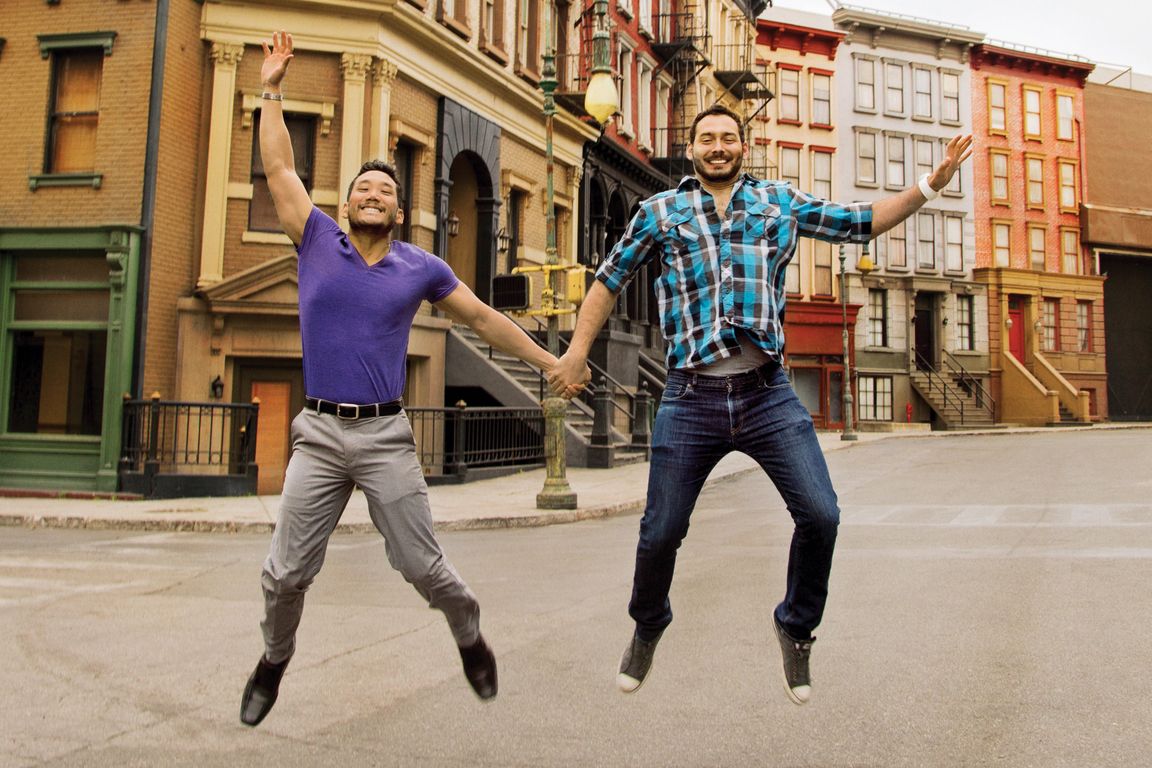
Satoshi Suga M.S. ’13 and Ronnie Rivera ’09
Satoshi, 27, and Ronnie, 30, met at a West Hollywood bar and became study buddies. Together for more than two years, Ronnie has just finished his first year at the Geffen School of Medicine, and Satoshi, who has a master’s in electrical engineering from UCLA, works at Fox Studios in research and development.
“Ever since I was a 16-year-old boy who was denied the ability to donate blood at a high school blood drive, I have dedicated myself to working wherever I see injustice.” — Ronnie
Demographics Don’t Lie
The institute’s demographic research is so respected that the U.S. Census Bureau relies on it. “The Census gave us funding to do a survey asking same-sex couples why they chose either the term ‘unmarried partner’ or ‘spouse’ on census forms, and to find out whether or not they were in a legally recognized relationship,” says Brad Sears, executive director of the institute and assistant dean of academic programs and centers at UCLA School of Law. “The LGBT community had been confused about how it should answer; the questions just weren’t phrased correctly. The results of our survey informed the Bureau how to correctly interpret data from the 2010 census.”
There’s been little research available regarding LGBT numbers because questions of sexuality and gender identity haven’t been on government surveys or large, national, private surveys. That’s changing, Sears says, because of the institute’s work. “The recent addition of an LGBT question on the daily Gallup Tracking Poll and a growing number of government surveys on health, youth and employee benefits regarding LGBT people are reflective of this. Additionally, the Pew Research Center is going to do a national survey of LGBT people and the Centers for Disease Control is adding a sexual-orientation question to the national health interview survey.”
“One of the issues in our political debates and discourses is that, oftentimes, you don’t count very much unless you’re counted,” says demographic expert Gary Gates, who holds the title of Williams Distinguished Scholar. “So being able to put it in numbers — how many LGBT people (an estimated 4 percent of the adult population, or around 9 million); how many same-sex couples (about 650,000); how many kids and adults have an LGBT parent (approximately 6 million) — is important to the debate.”
According to the institute’s research, there are 114,000 legally sanctioned, same-sex marriages; one in five same-sex couples have children under 18 years of age living at home (equating to 220,000 kids nationwide). “The geographic and economic spread, the differences in education, lots of other factors make LGBTs look like everybody else,” says Gates. “But they’re treated differently under the law.”
These children “are often being raised in places that have some of the least friendly legal environments for them,” Gates adds. “Same-sex parents are more likely to have these kids in states that are not coastal — they’re much more likely to be in the South, the Midwest and the mountain states.”
In addition, many of these couples are racial and ethnic minorities; a majority are female and they tend to be younger than different-sex parents. “They often evidence economic disadvantage,” he says. “One of the ways America offers to enhance economic stability is through marriage and the advantages couples are granted on account of marriage.”
Tasha Hill and Leslie Schafer

Tasha, 41, and Leslie, 45, have been a couple for nearly seven years. Tasha (in blue sweater) will be entering her third year at UCLA Law. Leslie, who has a Ph.D. in applied economics from the Wharton School, is a senior economist who testifies as an expert in complex commercial litigation.
“Tasha and I were legally married in Connecticut in 2009. We were living in Washington, D.C., at the time, which recognized our marriage as well. Because of Prop. 8, California does not recognize our marriage.” — Leslie
Courting Change
The Williams Institute does not take individual cases dealing with employment discrimination, the right to marry or other specific LGBT issues. It is, however, extremely involved in macro court cases that seek constitutional remedies for the restrictions proscribed by law on that community. “A decade of our research was used in the Prop. 8 arguments,” Sears says. “Our research director and one of our senior scholars, as well as two of our faculty advisory members, testified before the Senate. And we filed three amicus (‘friend of the court’) briefs for the Supreme Court regarding the Prop. 8 case.”
“The Williams Institute has called on me to teach nationally and statewide regarding LGBT domestic violence, juvenile law issues, and California’s first Supreme Court ruling around same-sex marriages,” adds Los Angeles Superior Court Judge D. Zeke Zeidler, president of the International Association of LGBT Judges. “I have also worked with colleagues to use the Williams Institute template to create the Los Angeles County Superior Court’s first judicial training on transgender issues. The use of statistics compiled by the Williams Institute to show the relevance of LGBT issues to judicial officers, to differentiate between sexual orientation and gender identity, and to dispel myths has been a crucial component of all of these judicial education programs.”
A New Work Order
There is no congressional legislation that protects LGBTs. “It is inconceivable to me that one can be fired in 29 states because of sexual orientation,” Chuck Williams says. “Employers don’t have to prove what they think your orientation is; they just have to think it.”
Williams cites another institute-generated statistic: There are more than 400 proven instances of legal discrimination in these states. “We did a survey over the course of a year and a half that examined what’s going on in each of these states,” he explains. “We’ve had 10 law firms working pro bono with us in order to present Congress with the facts about this. And we’ve proven that these state governments — be it in their Highway Patrol or other agencies — officially sanction the very discrimination that’s otherwise outlawed for other citizens. This has to be addressed.”
Mikaela Saelua
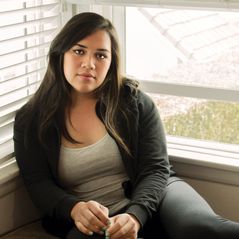
Mikaela, 23, is a fifth-year student at UCLA who hails from American Samoa and is majoring in political science. She’s a member of the Student Initiated Access Committee that funds student-run/initiated organizations and goes into underserved/underrepresented communities to help students gain entrance to institutions of higher education.
“Despite the fact that I am transitioning between genders, I participate in many spaces here at UCLA and have been able to take on leadership positions in those spaces.” — Mikaela
Follow the Money
Williams Research Director Lee Badgett is an economist and professor at the University of Massachusetts, Amherst, who examines the economic aspect of the issue. She’s been generally credited with debunking the myth that gays and lesbians are richer than their straight counterparts. In 2007, her research documented that same-sex couples paid on average more than $1,000 more in taxes annually than similarly situated opposite-sex, legally married couples.
In a February 2012 column for the online version of The New York Times, Badgett wrote: “Perhaps the most convincing evidence that nondiscrimination policies are good business policy comes from businesses themselves. A recent Williams Institute study of the 50 largest federal contractors and the 50 biggest Fortune 500 companies found that nearly all had policies against sexual orientation discrimination, and almost all said that diversity was good for business.”
These businesses have described their policies against sexual-orientation and gender-identity discrimination as “a sound business decision that results in more productive and loyal employees, more good ideas and a stronger customer base. That means the federal government and American taxpayers get more efficient contractors, whether for designing software applications or supporting troops in Afghanistan.”
Teach and Train
The Williams Institute conducts seminars for lawmakers and judges across the country who have never had a chance to take a course in gender law because such courses didn’t, and for the most part still don’t, exist. The institute’s Law Teaching Fellowship Program, for example, was initiated after a study discovered that there were only about 20 professors teaching gender and the law in America’s law schools. The paucity of such professors struck the Williams think-tankers as something that demands redress, particularly since the challenge to secure LGBT rights goes far beyond legalizing gay marriage.
“We look for someone who has graduated from law school, has been in practice or clerkship, and bring them to UCLA where they get to work with a full professor,” Williams explains. “They get to practice teaching, to do research. We’ve turned out nine such professors now who have gone on to train others.”
Erik Walsberg and Sam (Samantha) Xu

Sam, 27, was born in Guilin, China, but raised in Tucson, Ariz. She met Erik, 25, at UCLA, where both are Ph.D. students in mathematics. Sam (a transgender person) and Erik have been a couple since March of 2012. They work as teaching and research assistants.
“My transition (from male to female) in the math department has been relatively smooth, and most of the people have been supportive of me throughout this process.” — Sam
Going Global
The institute is increasing its efforts to achieve LGBT equality on an international scale. A member of Nepal’s Supreme Court was its guest at an international conference on LGBT rights. The three-day conference also was attended by the Chief Justice of Argentina (where employment nondiscrimination legislation subsequently passed and gay marriage was recently sanctioned). The institute has had a visiting scholar from the Balkans, and one Balkan nation sent representatives from its police departments to the institute for sensitivity training. “Gay marriage has become legal in Uruguay and even Colombia is looking at it, which is amazing,” says Williams.
Still, even after a dozen years of history, much more remains to be done, Sears says. “We still need resources. There are battles to fight no matter what the Supreme Court decides this summer. There’s so much left to do about persecution and decriminalization here and overseas.”



