Editor’s note: This is an article from the Fall 1997 issue of UCLA Magazine.
Steve Crocker ’68, Ph.D. ’77 was still a teenager at Van Nuys High School in the late 1950s when he received permission to use the computer lab at the University of California, Los Angeles. Crocker had a natural affinity for math and science — by age 13 he had taught himself the elements of calculus, and before he completed 10th grade, he had mastered the rudiments of computer programming.
“I remember being thrilled when I finally understood the concept of a loop,” Crocker says. “Loops enabled the computer to proceed with a very lengthy sequence of operations with relatively few instructions. I was a bit callow, but I remember thinking this was the kind of revelation that must have led Archimedes to run down the street naked, yelling, ‘Eureka!’”
By his senior year at Van Nuys High, Crocker was taking courses at UCLA. On weekends, he would trek to campus to use the university computer. Often he brought along his best friend, Vint Cerf M.S. ’70, Ph.D. ’72, another precocious kid from the Van Nuys High math club. Crocker and Cerf soon became fixtures in the lab; their presence there at any hour, day or night, wouldn’t have raised a single eyebrow.
But when they arrived one Saturday in 1960, the computer building was locked, and no one was around to let them in. “I couldn’t see any choice but to give up and go home,” Crocker recalls. Then the pair spotted an open second-story window. They looked at each other. And before either of them could give it a second thought, Cerf had climbed onto Crocker’s shoulders and into the building. Once inside, the boys put tape over a door latch so they could come and go all day. “When the Watergate burglars did the same thing a dozen years later and got caught,” says Crocker, “I shuddered.”
Crocker and Cerf harbored an intense love for computers. Crocker had trained himself on an IBM 360, and he spent the summer after high school furthering his programming skills on UCLA’s IBM 7090 and IBM 1401 mainframes. The next fall, he finally enrolled at the university, proceeding in fits and starts toward a degree, and by 1967 he was headed to MIT for graduate studies.
Cerf, meanwhile, attended Stanford on a full scholarship. He started out there as a math major, but soon was hooked on serious computing. “There was something amazingly enticing about programming,” he says. “You created your own universe and were the master of it. The computer would do anything you programmed it to do. It was this unbelievable sandbox in which every grain of sand was under your control.”
Upon completing their Ph.D.s, Crocker and Cerf, like their overachieving peers, could have taken up any number of challenging jobs in the defense or computer industries. Odds are high, in fact, that the two young scientists would have done just that — were it not for something very compelling that happened, deep in the corridors of Boelter Hall, in the summer of 1969.
It was a fortuitous time for computer science and the proto-digerati. The 1960s were the apex of the Cold War R&D boom, and computer science was finally coming of age. Research in digital computing particularly was blossoming. Federal largesse flowed copiously into the nation’s university-based research labs. UCLA’s computer science department received a large chunk of that money.
The main sponsor was the Pentagon’s Advanced Research Projects Agency (ARPA), which spent millions advancing computer science (and, not incidentally, creating a legacy unmatched to this day in the history of government-funded science). ARPA money came to UCLA, MIT and other major research institutions, where the best and brightest young scientists and engineers dedicated themselves to the esoteric business of developing “automatic computation.” Together with the emerging computer industry, they were turning computers into ever faster, smaller and more powerful calculating machines.
But university researchers were also pushing their machines in entirely new directions. Real-time computing, time-sharing systems and computer networking were considered dramatic new tools for expanding human intellectual reach. These were areas, researchers like Professor Leonard Kleinrock discovered, where you could have some fun and make a difference, too.
Kleinrock had joined the UCLA computer science faculty in 1963, having developed the underlying principles for data networking while a Ph.D. student at MIT. His tight bond and intellectual alliance with Lawrence Roberts, a classmate from MIT, would lead directly to the government’s selection of UCLA as the Kitty Hawk of computer networking.
In 1967 Roberts had moved to Washington, D.C., to take charge of creating the ARPANET, a project dedicated to finding a way to transmit huge chunks of digital data between computers in a number of smaller digital bundles. Funding for the project — a million dollars — had been approved by the Pentagon in 1966. This “packet-switching” network, as it came to be called, had been pioneered by Kleinrock and was to revolutionize communications by the decade’s end. “It was clear to me that high-speed packet-switched networks were exactly the right way for computers to talk to one another,” recalls Kleinrock. “But in those days the hot technology was time sharing. I had to wait for conditions to ripen before my ideas would catch on.”
When it came time to choose node one for the ARPANET-to-be, Roberts had no trouble finding the one spot on the map where he knew it could work: UCLA. On the Westwood campus was Kleinrock, the man who had influenced his thinking on network technology. Kleinrock promptly received a sizeable grant and, in 1968, established both a research group and the Network Measurement Center at UCLA.
Roberts and Kleinrock conceived of the Measurement Center as an outfit that would be responsible for performance analysis — a sort of digital test track like those on which fearless drivers push the outer limits of high-performance cars. Kleinrock and his group were in charge of gathering data — total network response time, traffic density, delays and capacity — the measures needed to evaluate how the network would perform. Kleinrock was a theoretician; his specialty was simulation and modeling. Through his analysis and simulations, he had come as close as one could to predicting the ways in which computer networks might perform without actually having a network to run. He welcomed the chance to put his theories into practice.
By 1968, both Vint Cerf and Steve Crocker were back at UCLA, ensconced in the labs at Boelter Hall. As an undergraduate, Crocker had worked, as he puts it, “at the bottom of the totem pole” on one of the first networking projects ever. The goal of that project, overseen by Professor Gerald Estrin, a longtime faculty member who had an interest in digital computing, had been to connect three existing computer centers on campus: UCLA’s main computing facility, the medical center and the business school. All operated IBM 7090/7094 machines of the period but, as it turned out, machine compatibilities weren’t the main obstacle to success. Human clashes were. To their chagrin, Estrin’s group discovered that each of the UCLA computing centers had developed its own culture, programming style, policies, quirks and egos. As a result, their project fizzled: The people involved simply couldn’t agree on a common approach to linking the centers.
But now, with Crocker and Cerf as members of his 40-member UCLA team, Kleinrock mounted a second, epochal venture into computer networking. He put Crocker in charge of software and added a new player, a young man named Jon Postel ’66, M.S. ’68, Ph.D. ’74. Postel was the resident eccentric. He sported a long, bushy beard, wore sandals year-round and never put on a necktie in his life. Unlike the others on the project, who were mainstream academics, Postel had developed his interest in computers at a local community college. Like the others, Postel was passionate about computers.
Now Kleinrock focused on the issue of hardware. He knew that UCLA would soon be receiving an Interface Message Processor (IMP), which was critical to making the ARPANET functional. The IMP would handle the “packet-switching” of data, allowing UCLA to link with other sites. But the IMP was not a stand-alone device. It was simply a high-speed interface that required a host computer to back it up on an array of tasks.
And therein lay Kleinrock and Company’s biggest problem. The UCLA computer science department owned a computer made by Scientific Data Systems called the Sigma-7. It was unreliable and difficult to program and no one much liked it. In fact, everyone agreed: The Sigma-7 was a dog. But, Kleinrock says, “It was our dog.” The Sigma-7 would have to play host to the IMP. It was Kleinrock’s hope that with a little bit of luck, the network would open doors to more wieldy machines elsewhere.
In the summer of 1968, news of the ARPANET project rippled through academia. Kleinrock contacted fellow principal investigators at ARPA-supported research universities to discuss critical details of the first phase of the experimental network and to lobby them on the importance of taking part in the project. “I met with reluctance,” he admits. “No one was eager to share their computer resources with others on the Net. I did some serious arm-twisting.” About the same time, a small group of graduate students met in Santa Barbara. The meeting was attended by representatives from UCLA, Stanford Research Institute and UC Santa Barbara.
The meeting was seminal, if only because of the enthusiasm it generated. “We had lots of questions — how IMPs and hosts would be connected, what hosts would ‘say’ to each other and what applications would be supported,” Crocker recalls. “No one had any answers, but the prospects seemed exciting. We found ourselves imagining all kinds of possibilities — interactive graphics, cooperating processes, automatic database query, electronic mail — but no one knew where to begin.” Still, from this summit emerged a corps of young researchers devoted to figuring out how each node on the network would “talk” to the other.
A month or so after the new group began meeting regularly (they called themselves the Network Working Group), it became clear to Crocker and others that they had better start accumulating notes on the discussions. If the meetings themselves were less than conclusive, perhaps the act of writing something down would help bring order to their collective thoughts. Crocker volunteered to write the first minutes. “I remember having great fear,” he says, “that we would offend whoever the ‘official’ protocol designers were.”
Of course, there were no other protocol designers, official or otherwise. But Crocker didn’t know that. He was living with friends at the time and worked all night on the first notes, writing in the bathroom so as not to wake anyone in the house. He was concerned less about what he wanted to say than with striking just the right provisional tone. He modestly labeled the document “Request for Comments” and sent it out by mail.
RFC No. 1 described in technical terms the basic “handshake” between two computers — how the most elemental connections would be made. “Request for Comments,” it turned out, was a perfect choice of titles. It sounded at once solicitous and serious. And it stuck.
The way Crocker crafted RFC No. 1 proved important in establishing the tenor for future dialogue. For decades to come, RFCs would remain a principal means of open expression in the computer networking community, the accepted unofficial method of recommending, reviewing and adopting new technical standards. (Today, the number of “published” RFCs reaches into the thousands, and continues to grow.)
UCLA’s Interface Message Processor, designed and built by a Cambridge, Massachusetts, firm named Bolt Beranek and Newman, was set to arrive for installation in Boelter Hall on the first of September. Now Kleinrock’s most pressing task was to build the interface between the Sigma-7 and the IMP that would allow the two computers to interact with one another. Unfortunately, the designer of the IMP wasn’t very helpful in this regard. The only promise anyone in Cambridge was willing to make was that two or more IMPs would be able to communicate with each other to move packets of data back and forth in a kind of “subnetwork.” It was entirely up to the host computers — or more likely the graduate students responsible for running them — to figure out what to do with the data once their IMP received it.
Then, with only a few months left before Kleinrock and the UCLA team were to accept delivery of IMP No. 1, a thick envelope arrived in the mail from Cambridge. Inside the package was a newly written set of specifications for connecting host computers to the soon-to-be-delivered IMP. The ARPANET at last seemed to be falling into place.
Kleinrock and Crocker asked technicians at Scientific Data Systems, makers of the Sigma-7, to build the interface hardware for the host-to-IMP connection. The company’s response was discouraging: It would take months and probably not be finished in time for the IMP’s arrival. Moreover, Scientific Data wanted tens of thousands of dollars to do the job.
So when Mike Wingfield ’67, M.S. ’69, Ph.D. ’72, a UCLA grad student techno-whiz kid, said he’d like to take a crack at solving the problem, Kleinrock figured, “Why not?” Wingfield plunged into the task and one week before the Interface Message Processor was scheduled to arrive, he had the hardware built, debugged and ready to go. “It was,” Crocker recalls, “a gorgeous piece of work.”
Now Crocker looked at the calendar. He counted on having at least one extra day to complete preparatory work on the network, since September 1 was Labor Day. He’d heard that the folks in Cambridge were having internal timing problems with the IMP. Timing bugs could be nasty and, Crocker hoped, might buy him the extra week he needed. But an excited call from Kleinrock advised Crocker that UCLA’s Interface Message Processor was about to be put on a plane and would arrive in Los Angeles on August 30 — two days early.
Suddenly, the deadline for launching the ARPANET lurched toward the UCLA team like a madman with a bomb.
On the Saturday before Labor Day, 1969, about a dozen people — Kleinrock, Crocker, Postel, Wingfield, Cerf and a handful of curiosity seekers — gathered on the loading dock of Boelter Hall. Champagne bottles were popped open: The IMP was arriving.
As a crate was removed from a moving van, someone raised a question: Would, umm, ugh, er … the IMP fit into the elevator? The computer was unpacked. It was roughly the size of a refrigerator. Into the elevator car it went — barely. On the third floor, the freight movers wheeled the machine down the hall to its new home in Room 3400. There the Sigma-7 hummed, oblivious to the massive disturbance that was about to invade its privacy. “It was a little like seeing your parents invite to dinner someone you’ve never met,” Crocker recalls. “You don’t pay much attention until you discover they intend to marry you off to this stranger.”
The IMP was powered up and began running its internal diagnostics. Next, Mike Wingfield attached his “gorgeous” interface. “Everyone was ready to point the finger at the other fellow if things went wrong,” Kleinrock remembers. To the group’s great delight and relief, the Sigma-7 was communicating with the Interface Message Processor.
A month after the first IMP was installed at UCLA, IMP No. 2 arrived at Stanford Research Institute. Of all the milestones that had been passed so far, the installation of IMP No. 2 was the one that would lead to attaining the goal Kleinrock and so many others had set out to accomplish in the first place: Connect two disparate computers and get them talking to each other.
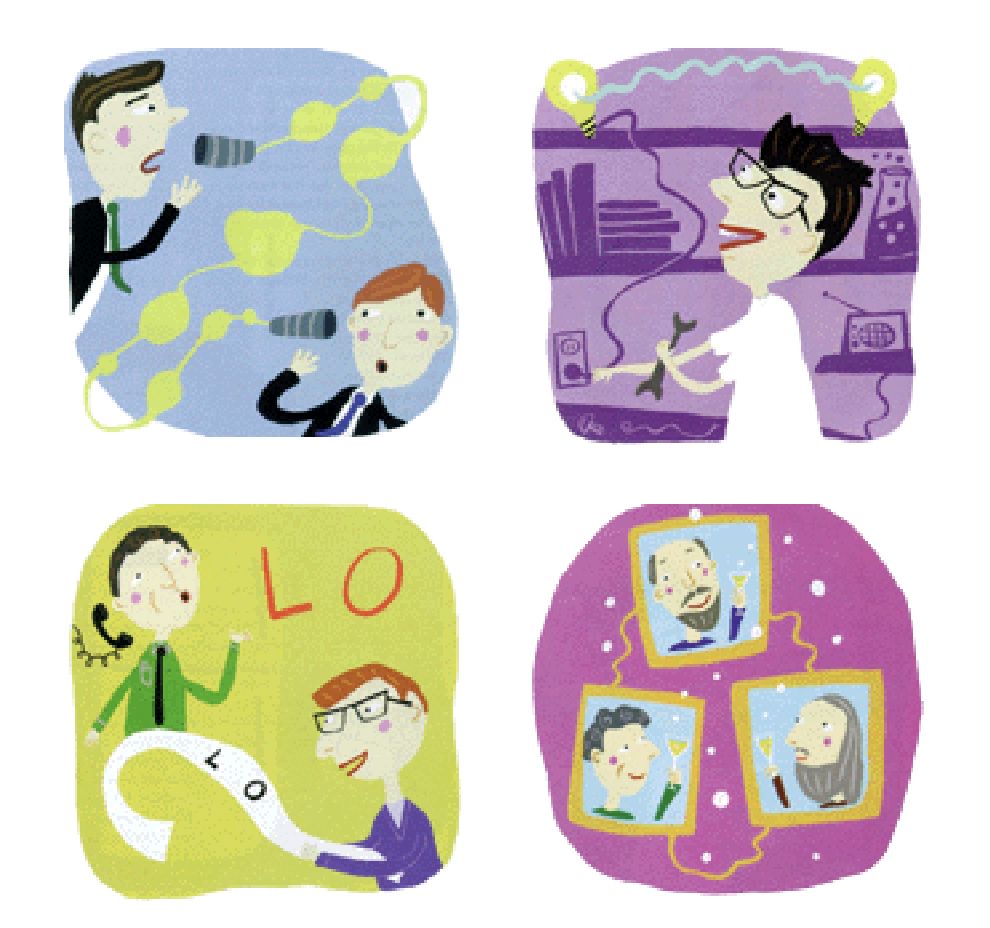
The moment to test the ARPANET had arrived. The first order of business was to make the connection, which meant sitting down at a teletypewriter at UCLA and typing L-O-G. This honor fell to Charlie Kline ’70, M.S. ’71, Ph.D. ’80, a UCLA undergraduate. Kline picked up the telephone in L.A. and pressed a button that rang a bell on the IMP in Palo Alto. A researcher at the Stanford Research Institute answered the call. The quality of the connection was not very good, and both men were sitting in noisy computer rooms, which didn’t help matters any.
Kline shouted into the phone: “I’m going to type an ‘L.’” He did so. “Did you get the ‘L’?” he asked.
“I got ‘one-one-four,’” the Stanford Research Institute operator replied, reading data encoded in octal, a computer language that used numbers expressed in base eight.
Kline did the conversion and saw that it was indeed an “L” that had been transmitted. Then he typed an “O.” “Did you get the ‘O’?” he asked.
“I got ‘one-one-seven,’” came the reply.
It was an “O.” Kline typed a “G.”
“The computer just crashed,” said the person on the other end of the line.
Later in the day, Kline tried again. L-O-G. This time the network worked flawlessly. Kline used the UCLA computer to communicate with the machine in Palo Alto. The Stanford Research Institute computer responded as if the Sigma-7 in Los Angeles were a true blue-and-gold friend.
And so in UCLA’s Boelter Hall, on that historic day, was born the ARPANET, which would in just two decades’ time begat the marvelous digital matrix known as the Internet.



