Thirty-four years ago in a small office in Boelter Hall, a refrigerator-sized Honeywell Interface Message Processor was set up 20 feet away from an equally clunky Scientific Data Systems Sigma-7. There, a team of UCLA computer scientists connected the very first node of what would later be called the Internet.
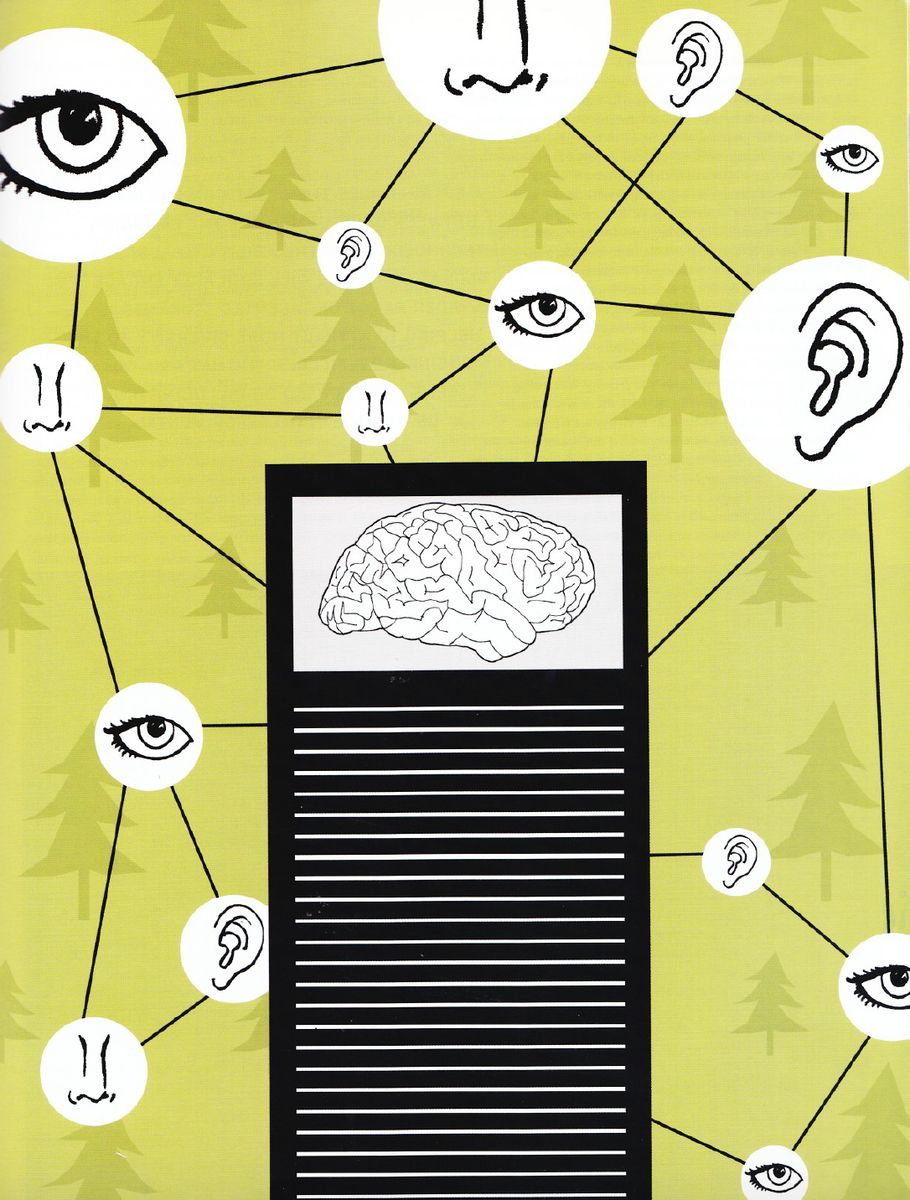
Today, the catalysts for a new kind of Internet — one that promises to connect the physical world just as its predecessor has linked the virtual world — are considerably smaller than those earlier Goliaths. They are barely visible microprocessors connected to cameras, microphones, motion detectors and other sensors, densely distributed within a natural or man-made environment to monitor and collect information with unprecedented resolution, and in some cases activate a response.
The architects behind the wireless-sensor networks of the not-so-distant future envision “smart” buildings that sense and adjust their bearings to ride out earthquakes, microscopic devices that monitor the health of medical patients outside the hospital and systems that alert farmers to soil contaminants or government authorities to possible bioterrorist acts, to name a few.
Once again, UCLA is the focal point of a national effort to develop and conduct initial experiments with a revolutionary new information technology. The university is the lead institution for the Center for Embedded Networked Sensing (CENS) — one of 11 Science and Technology Centers established nationwide by the National Science Foundation (NSF). The ambitious effort is being undertaken by a multidisciplinary research team at UCLA — headquartered at the Henry Samueli School of Engineering and Applied Science but fanning out across the campus — together with colleagues at partner institutions USC, UC Riverside, Caltech, UC Merced, Cal State Los Angeles and Jet Propulsion Laboratory. NSF provided $40 million over 10 years for the center, and an additional $12 million has come directly from UCLA and its partner institutions.
“This area is red hot — it could change the way we do a lot of science,” says John Cozzens, an NSF program manager who serves as technical coordinator for CENS.
The combination of small, low-power, autonomous sensors with wireless communication and computation capabilities — pioneered a decade ago by UCLA researchers William Kaiser and Greg Pottie — paved the way for embedded networked systems. “What’s so powerful is that you can take these sensors, distribute them in the environment and sense phenomena up close, even in the presence of obstacles, in ways that would be impossible with remote sensing,” explains Deborah Estrin, professor of computer science and founding director of CENS.
CENS researchers also are beginning to work on the next-generation technology — aerial robotic sensors, suspended along steel cables attached to buildings, trees or other natural or man-made structures and capable of monitoring vast, three-dimensional spaces. Networked infomechanical systems (NIMS), being developed by a CENS research team headed by Kaiser, a professor of electrical engineering, under a $7.5-million NSF grant, bring new advantages that include the ability to relocate, when triggered to do so, to where interesting phenomena are occurring; to collect environmental samples; and to dock when necessary to recharge their energy source — a feature that directly tackles a major constraint in wireless-sensor networks, where efficient energy use is critical.
Last summer, Kaiser’s team completed a test installation at the Wind River Canopy Crane Research Facility in Washington. With the new grant, the NIMS researchers will deploy a test bed at the James San Jacinto Mountains Reserve, part of the UC Natural Reserve System, to collect dense environmental and ecological data about populations of rare species and their habitats within a mountain-stream ecosystem and the surrounding conifer forests and meadows.
Kaiser and Pottie were developing some of the first sensor-node networks in the mid-1990s when they met Estrin, who infused their work with a new information-technology vision: that of larger-scale distributed systems, self-configuring and capable of adaptive in-network processing. Estrin, the daughter of two UCLA computer science professors, was at the time a member of the computer science faculty at USC, working on Internet routing protocols. With the growing commercialization of the Internet, she was becoming concerned about the decreasing likelihood that the problems she was tackling would actually be applied to Internet technology. “I have great respect for theoreticians, but I need to know that what I’m doing will eventually be usable,” she says.
Seeing the wide-ranging and far-reaching applicability of wireless-sensing network technology, Estrin not only began to tackle the research challenges, but also became a leader in promoting the field. Last September, Popular Science magazine named her to its annual “Brilliant 10” list of young scientists doing extraordinary work. Estrin hopes the clear connection between development of the emerging technology and the ability to address global concerns will similarly engage a wider range of talented students, helping to attract more diversity to the engineering field. With that as a goal, CENS has focused on including undergraduates in its experimental research; 23 of them accompanied Kaiser to Washington for the NIMS test installation last summer.
Estrin believes key strategies that contributed to Internet architecture are relevant to the new endeavor, including the focus on building relatively simple systems that can be expanded and can readily proliferate over a variety of settings with time. While CENS researchers such as Pottie address fundamental theoretical questions designed to test the limits of wireless-sensor networks, most of the focus is on experimental work, with the technologists and scientists working in close collaboration to hone the systems. “By concentrating on scientific applications at this early stage, we can explore the base technology and make much better progress more quickly,” Estrin says.
Initially, CENS is focusing on four applications. At the James Reserve near Palm Springs, researchers created a sensor network of cameras and motion detectors across 30 acres of wilderness to continuously monitor and characterize everything from microclimate dynamics to bird-nesting behaviors. A second group is using embedded systems to track the flow of contaminants in soil. A third CENS team employs the technology in an effort to understand and ultimately predict the conditions under which specific populations of marine microorganisms develop. And at the 17-story Factor Building on the UCLA campus, still another research group is installing a spatially dense network of seismic sensors to afford an unparalleled opportunity to learn about how buildings respond during an earthquake.
The Internet, Estrin points out, was able to emerge only through government investment in university research to create the enabling technology, overcome fundamental problems and ensure sufficient commonality to facilitate a worldwide phenomenon. The case for the university being the only feasible site to plant the seeds for a digital hook-up of the physical world is equally strong. “We’re not burdened with needing to have a commercially viable business model the way that industry is,” says Estrin. “By having science drive the technology, we’re able to make leaps that aren’t commercially viable to invest in.”
Cozzens of the NSF agrees. “It probably involves the highest risk of all the Science and Technology Centers ... but universities are where this type of high-risk basic research can be done,” he says.
Moreover, in UCLA and its partner institutions, CENS can draw on the breadth of expertise needed to meet the challenge of embedded networked sensing, which requires a diverse set of researchers within engineering to collaborate with scientists in a variety of fields on problems that are themselves multidisciplinary.
“We speak different languages,” says Philip Rundel, a UCLA biology professor and CENS member working on the James Reserve study. “Despite the tremendous advances in engineering and IT, there’s been little cross-linkage between those fields and environmental science. But I’m learning more about what they can do, and they’re learning more about the scientific questions we have. I’m realizing this isn’t just about using this technology to do the same things better; it’s using it to conduct studies that were never before possible.”
While the university is currently the focal point for embedded networked systems research, industry isn’t completely sitting on the sidelines. Intel Corp., in particular, has played a key role, both as a funder and as a developer of enabling technologies. “This line of research can tremendously increase the spatial and temporal fidelity with which we obtain data about the world around us,” says David Tennenhouse, Intel vice president of corporate technology and director of research. Tennenhouse notes, as an example, that farmers will obtain much more reliable spatial information with micro-weather stations placed on individual sensor nodes than from a precipitation report originating from the local airport. And with constant sampling and data readings, the temporal resolution is more precise, potentially enabling new phenomena to be detected. Along the same lines, Tennenhouse predicts that improvements in data collection will lead to major productivity gains in many manufacturing and agricultural sectors.
Formidable challenges loom. On the technical side, energy management has been a major issue since day one, necessitating systems that can automatically switch on and off as needed. Estrin notes that CENS researchers such as Professor of Electrical Engineering Mani Srivastava are developing techniques to exploit redundancy in measurements so as to overcome massive issues associated with distributed-sensor calibration; they also need to provide a programming environment for these systems so that applications can be implemented and updated quickly without violating the severe resource constraints of the wireless nodes. Social and legal concerns will need to be addressed. “In information technology, there’s always an issue of who will have access to it, and for what purposes,” says Pottie, an associate dean in the engineering school and deputy director of CENS. “The question is how the technology and public-policy processes should be shaped to ensure maximum social benefit.”
While CENS is focusing on scientific applications, there is little doubt that non-scientific uses will one day move front and center. The surveillance aspect of embedded networked systems has the potential to facilitate large-scale monitoring of borders, ports and civil infrastructure for homeland-security purposes. More everyday activities also could be transformed. The Internet shopping experience could be layered on top of the physical experience, so that window shoppers could hyperlink to more information about products.
Says Pottie: “Once you begin to think of this in terms of cyberspace and real space being intimately connected, the possibilities become limitless.”
Building Centers of Innovation
In addition to the Center for Embedded Networked Sensing, UCLA’s Henry Samueli School of Engineering and Applied Science has been the locus in the last two years for four other competitive research centers that have received funding from the federal government and private industry. Each center reflects a campuswide effort that involves a diverse group of scholars pursuing groundbreaking research that spans multiple disciplines to develop emerging technologies. All told the centers, including CENS, have attracted more than $94 million in funding. “The awarding of these centers represents a remarkable concentration of new technology and enterprise on the UCLA campus,” says Vijay Dhir, the school’s dean. “Collectively, they will have a profound impact on technology and business in Southern California.”
| The Center for Nanoscience Innovation for Defense (CNID) | |
 |
Funded by the Defense Advanced Research Projects Agency and Defense MicroElectronics Activity |
| CNID is a joint effort with UC Santa Barbara and UC Riverside to facilitate the rapid transition of research in the nanosciences into applications for the defense sector. Students gain industrial research experience and CNID faculty researchers keep companies informed of the latest developments in science and technology. |
|
| The Institute for Cell Mimetic Space Exploration (CMISE) | |
|
Funded by NASA |
| CMISE researchers combine bio-, nano- and information technologies to aid humans and machines in space. By mimicking the cell’s information-processing abilities, CMISE will establish a model for space-system design that will redefine space-exploration technology. |
|
| The Functional Engineered Nano Architectonics Focus Center (FENA) | |
|
Funded by the Semiconductor Industry Association and the Department of Defense |
| FENA researchers hope to extend semiconductor technology further into the realm of the nanoscale by seeking new technology solutions based on advances in nanotechnology, molecular electronics and quantum computing. |
|
| The Center for Scalable and Integrated Nano-Manufacturing (SINAM) | |
|
Funded by the National Science Foundation |
| SINAM combines fundamental science and technology that will transform laboratory science into industrial applications in nanoelectronics and biomedicine. Researchers want to create the next generation of nanotools and build them into systems that will enable cost-effective nanomanufacturing. | |