In 2013, Zoë Ryan was tapped to curate Istanbul’s second Design Biennial. The city was going through an intense period of change. Violent police response to an environmental sit-in at Gezi Park had led to thousands taking to the streets across the city; protests then quickly flared up in more than 60 other cities across Turkey. There was doubt as to whether it was the right time to hold a biennial at all. “We did hundreds of listening sessions with different groups of artists and creatives in the city,” Ryan says, “and it became quite clear that yes, they were really eager for this platform to be able to talk about all kinds of issues that were happening in the world.”
That experience, connecting with artists across a city in a moment of crisis, feels especially relevant now. In January 2025, Ryan took the reins as director of the Hammer Museum at UCLA, in yet another period of challenge and change — this time around both a volatile national political climate and the wildfires that erupted during her first week on the job.
Ryan has built a career of arriving in new places, navigating shifting circumstances and connecting quickly with communities. She comes to the Hammer from the Institute of Contemporary Art at the University of Pennsylvania, where she led critically acclaimed exhibitions, launched an annual art commission and expanded public engagement efforts, with new partnerships with museums and arts organizations both nationally and globally.
Ryan has stepped into an institutional legacy shaped over 25 years by her predecessor, Ann Philbin, who oversaw the Hammer’s transformation. During Philbin’s tenure, the museum expanded its collections to include the 4,500 artworks in the Hammer Contemporary Collection; 40,000 additional square feet of gallery space, offices and public spaces; and a strong international reputation. Ryan is approaching that legacy with curiosity, humility and open ears. “Getting on the ground and building those networks within and outside of the museum is what I really love to do,” she says. “I’m a good listener.” Here, she talks about the museum’s future, watching others watch art, and the possibility of becoming a “front room for art” in Los Angeles.
There’s a thing I’ve heard people talk about with science museums: that when they’re free, people use them more like parks. I know the Hammer’s been free since 2014, and you’ve worked at both free-entry and paid-entry museums. I’m curious how an art museum’s being free affects the way it interacts with the community.
Oh, I think being free is everything. I grew up in the U.K., and as a kid I would go to the National Gallery in London. I remember going in with my mom, and we’d choose one painting to look at really carefully. And then we might go back again and choose another. The gallery was much more like our front room. It felt connected to us as citizens — a place where we were free to come and go as we pleased. I didn't know anything about [what was] behind the scenes, but the galleries just vibrated. They resonated with me.
I love the idea of a museum being someone’s front room, that comfort.
But another exciting thing about being in museums is there’s this possibility of watching other people looking at things and having an experience or reacting to them. Or hearing what people think. You’re with other people, and you’re watching.
Yes, and right now there’s this thing across so many fields where folks are dealing with isolation, this loneliness epidemic. I’m curious whether you find it harder to get people out of the house than it used to be.
Well, we had 4,000 people at the opening of Alice Coltrane.
Wow, okay. So … no. [laughs]
So, it’s also timing, right? It’s very exciting to be here, and I feel very fortunate. But obviously it's been a very devastating moment to arrive. Early on, we had to close the Hammer. My second day was when the [Palisades and Eaton] fires started. We had to keep our public and our staff safe.
It’s been devastating for everyone here, including many artists and arts workers. So many stories — people working at the Hammer who lost their homes or were evacuated. Artists who’ve lost their studios or archives. We all went back to Zoom for a period. It felt like it brought back COVID times, in a way.
But very quickly, I found myself in conversations with fellow museum directors, and then joining with the Center for Cultural Innovation and donors and foundations, and the LA Arts Community Fire Relief Fund was created. I saw the community come together. I think the funders raised more than $14 million and gave the first grants to 1,700 artists and arts workers. And a couple of weeks later, we had the reveal event for the artists in Made in L.A., which is a flagship biennial — one of the projects I was most excited about coming onto at the Hammer.
That event is about revealing the 27 artists. I was fortunate I got to be in conversation with the two curators, Essence Harden and Paulina Pobocha, hearing how Made in L.A. brings such a focus of L.A. as a place of imagination. We decided to go forward. The artists were keen to continue with this program. And it was an incredible event.
And yeah, the opening of Alice Coltrane was 4,000 people dancing. Flying Lotus deejayed — he’s the grandnephew of Alice Coltrane.
I had no idea they were related.
Yes — it made it very, very, poignant. He did the most beautiful set, where he interwove recordings of Alice with his DJ set. One of the things I absolutely loved about the evening was how multigenerational it was. There were babies all the way up to senior visitors carving up the dance floor.
So I think people want to be together. Especially when so much is being thrown at us politically, socially — we're grappling with so much.
I was excited about the Alice Coltrane exhibit. I’m a huge fan of the music, and it was such an interesting way to present the art. I guess I’m curious about what it’s like to come into a museum that was started from a donated European art collection and is now in such a different place.
I always say that exhibitions are merely the start of a conversation. They’re not the end point, they’re the beginning. And in many ways, I’ve come to see collections the same way. I don’t see them as a closed loop. I think it’s what makes the Hammer so special — it’s the mix.
The Hammer is known for the extraordinary work in its collection, covering different centuries, and we are also known for contemporary art and really working with practitioners who are perhaps less well known now.
We have a lot of conversations about the visitor experience and wanting the Hammer to be a place where everyone feels welcome. I try to spend as much time as I can in the galleries, seeing how people are responding to what’s on view, to the experience of being at the Hammer.
It’s interesting hearing you talk about these moments of intimacy. I think, from the outside, when people think about UCLA, they’re sometimes thinking about the huge public entity, but you keep bringing up tight community.
When I was at the Art Institute of Chicago, I taught for 10 years — really, as a way to get a beat on the city, to hear what the students were excited about, and to help me start to think about how to build the collections and do exhibitions. Then at ICA [Philadelphia], again, working within a large academic environment.
What I saw there and see at UCLA is that art shows up across the entire campus. It could be how you use art as a way to take risks. Or maybe how you can think differently about visualizing mathematical modeling through artistic practice. And art can be this incredible lens to have critical conversations across difference. Being part of this broader academic environment makes the museum experience more expansive.
And one of the things I'm really excited about is that UCLA and the Hammer will have a metro stop in a couple of years. The metro will connect us to downtown, and we’re already starting to map those neighborhoods, and we are already doing partnerships and programs and looking into “Where are the possibilities for new partnerships and new collaborations?”
If I am someone who’s never been to the Hammer, what’s the selling point? Tell me why I should come.
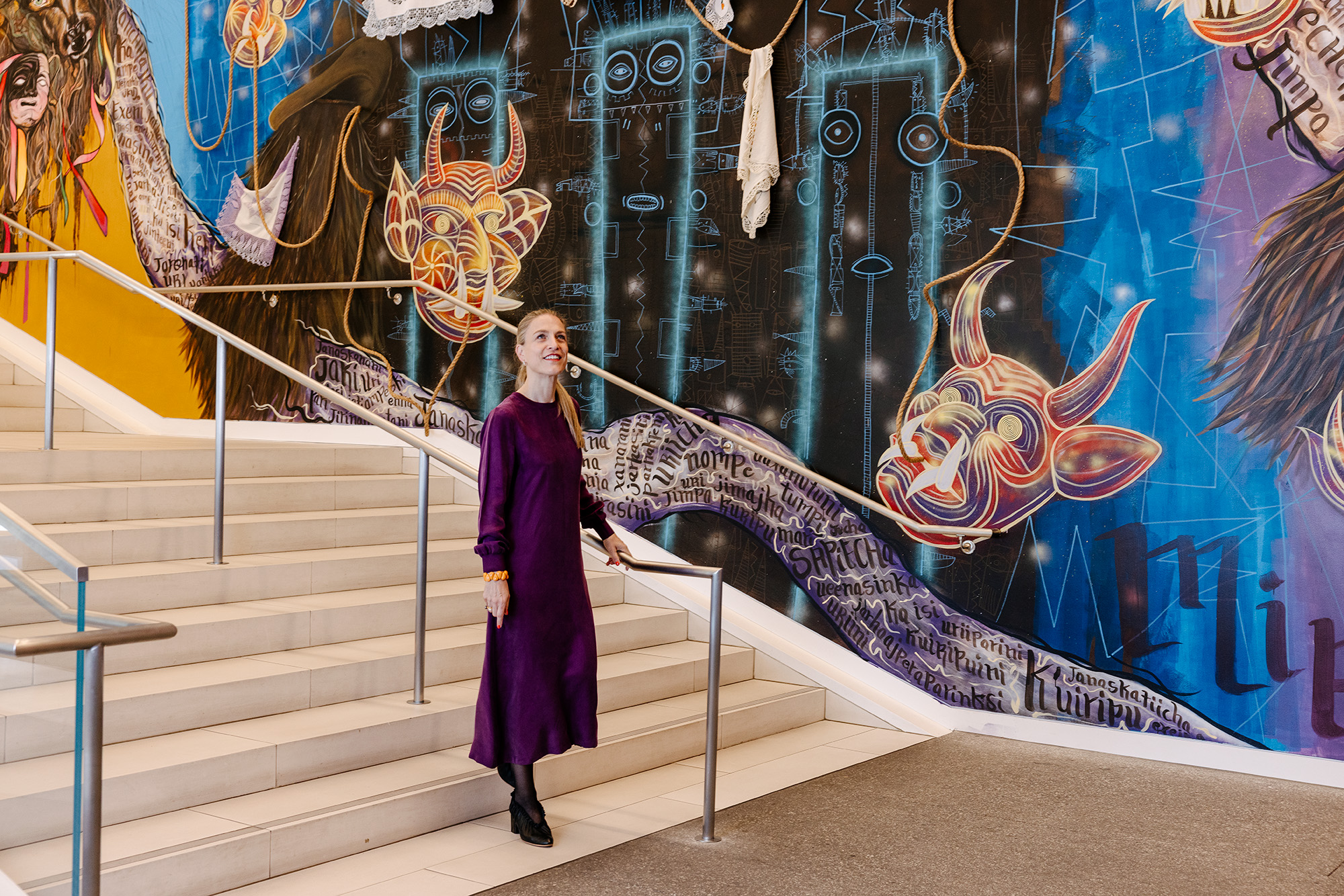
There is a beautiful installation in the lobby by Colectivo Cherani, a self-governing Indigenous community in Mexico. It’s one of the most moving installations I’ve ever seen. There couldn’t be a more beautiful welcome to the Hammer at this moment than that project.
I think the Noah Davis show is where we get to be really hometown proud. Noah Davis was an incredible artist who started The Underground Museum here in L.A. This will be a survey of his work, a marker of his impact on art history and on L.A.
And then with Made in L.A., you get to see a cross section of experimental, thoughtful, emerging talent, people who are taking the art world forward.
I feel like it is a gift of a program, for my own learning and for the city. At this moment where we can, amongst all this devastation and loss, still feel like we can celebrate each other and the artist community.
What a beautiful note to end on.
It’s a joyful moment for L.A.
Read more from UCLA Magazine’s Winter 2026 issue.