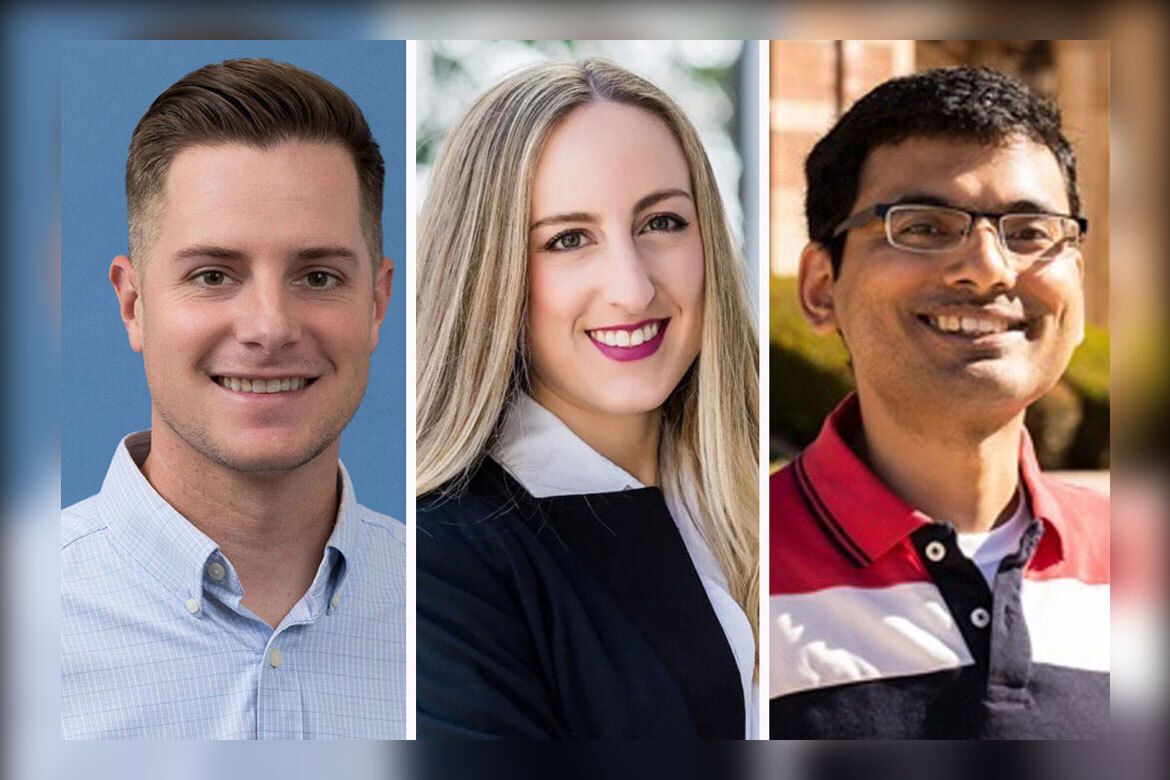
Three UCLA faculty members — David Clewett, Pradip Gatkine and Juliana Londoño-Vélez — are among 126 scientists and scholars from 44 colleges and universities across the United States and Canada selected today to receive 2026 Sloan Research Fellowships.
The Sloan Fellowships are among the most competitive and prestigious awards available to early-career researchers and are seen as evidence of the quality of an institution’s faculty in the fields of chemistry, computer science, Earth system science, economics, mathematics, neuroscience and physics. Fellows receive a two-year, $75,000 award to support their research.
“The Sloan Research Fellows are among the most promising early-career researchers in the U.S. and Canada, already driving meaningful progress in their respective disciplines,” said Stacie Bloom, president and CEO of the Alfred P. Sloan Foundation. “We look forward to seeing how these exceptional scholars continue to unlock new scientific advancements, redefine their fields and foster the well-being and knowledge of all.”
Since the fellowships were first awarded in 1955, a total of 187 UCLA faculty members have been selected. Fifty-nine Sloan Research Fellows have gone on to win Nobel Prizes, including UCLA astrophysicist Andrea Ghez, former UCLA engineering professor Omar Yaghi and UCLA alumnus and neuroscientist Ardem Patapoutian. Seventeen, including UCLA’s Terence Tao, have won the Fields Medal in mathematics, 72 have received the National Medal of Science and 25 have won the John Bates Clark Medal in economics.
This year’s UCLA Sloan Research Fellows are:
David Clewett
Assistant professor of psychology
UCLA College

Time flows in a continuous stream, yet our memories are divided into separate episodes that become part of our personal narrative. Cognitive neuroscientist David Clewett is unraveling the mystery of how — and where — this process occurs in the brain. Using advanced imaging, behavioral experiments and physiological measurements, he studies how feelings such as excitement, stress or joy shape what we remember, helping identify the neural systems that play a role in memory formation and explain why experiences like music or major life events can make memories especially vivid and enduring.
At UCLA, Clewett has built a dynamic research lab focused on this intersection of cognition, memory and emotion. His work on understanding the brain’s memory systems, honored with a 2022–23 UCLA Hellman Fellowship, may one day help improve learning and resilience, with implications for education, mental health and healthy cognitive aging.
♦ ♦ ♦
Pradip Gatkine
Assistant professor of physics and astronomy
UCLA College
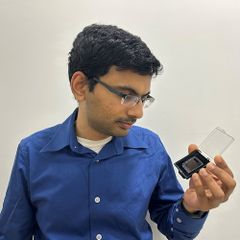
Blending precision engineering with big-picture cosmology, Pradip Gatkine is turning hardware innovations into new windows on the universe. Working at the vanguard of the burgeoning field of astrophotonics, which draws on cutting-edge, light-manipulating technologies to construct next-generation instruments that significantly improve astronomical observation, Gatkine is helping scientists reveal new information about exoplanets, evolving planetary systems and distant galaxies.
His work on novel optical technologies, including building ultra-sensitive, chip-based spectrographs for telescopes — once as big as a car, now miniaturized by Gatkine to the size of a shoebox — recently earned him the inaugural Kavli Exploration Award. The prize is supporting his innovative work at the Lick Observatory in San Jose, California, where he and his colleagues are creating a suite of state-of-the-art astrophotonic instruments to ensure that astronomers can better pursue answers to our most challenging questions about how planets form and how the universe evolved.
♦ ♦ ♦
Juliana Londoño-Vélez
Assistant professor of economics
UCLA College

Using administrative data and innovative experimental design, Juliana Londoño-Vélez investigates how tax and social policies can reduce poverty and inequality and promote upward mobility in Latin America. Her research applies state-of-the-art empirical methods to identify constraints on governments’ redistributive capacity and to evaluate how targeted interventions can shape the life trajectories of individuals from disadvantaged backgrounds.
In her recent research, Londoño-Vélez found that Ser Pilo Paga, a financial aid program in Colombia, significantly increased enrollment in higher education, leading to lasting gains in earnings and upward mobility and narrowing socioeconomic disparities. With support from the Sloan Fellowship, she plans to advance her research in two areas: examining how higher education positively benefits the lives of people in non-monetary ways, and exploring the effects of reproductive health care policy on women's physical and mental health.